Maedate Is the Crest That Turned a Samurai Helmet Into a Banner
· 11 min read
A maedate is the crest fixed to the front of a samurai kabuto, and it turned a piece of armour into a name, a family, and a signal that could be read across a battlefield.
A samurai could be recognised before his face was ever seen, and often before his sword was ever drawn. The sign that gave him away sat at the front of his helmet, bright against lacquered iron, shaped like a crescent moon, a pair of horns, a crane, or a family crest. That sign was a maedate, and it was the part of the helmet that spoke first.
A maedate is the crest mounted on the front of a samurai kabuto. The word names a single piece of armour, yet the piece carried a whole identity, because on a crowded battlefield a helmet that looked like every other helmet was a danger to its owner. Friends needed to know whom to follow, enemies needed to know whom they faced, and a commander needed to be found in seconds. The maedate solved all three problems at once, and it did so without adding a single weapon to the fight.
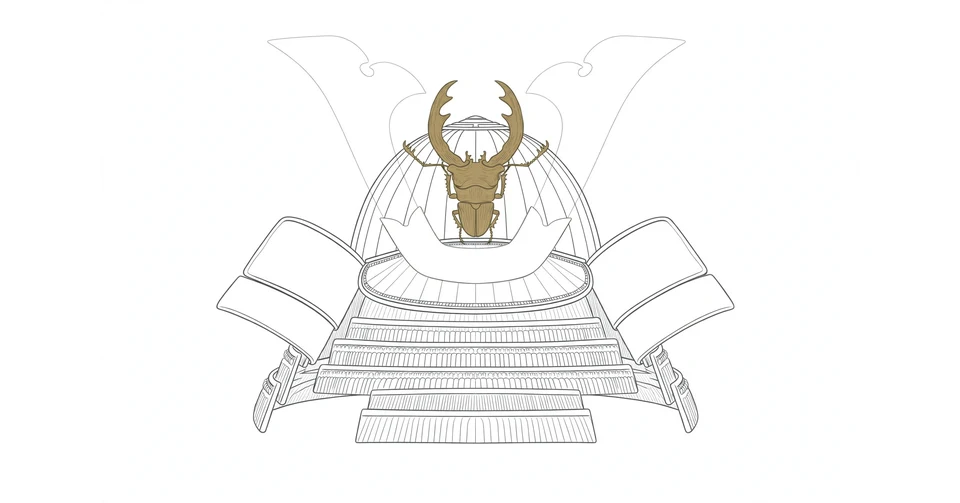
It is worth pausing on how small the thing was compared with the work it did. A maedate added no protection, stopped no blade, and turned no cut, and still it may have been the most valuable part of the helmet. Armour keeps a man alive, but a crest tells the living who he is, and on a battlefield where hundreds of men wore similar steel, being known was almost as important as being safe. That is the paradox at the heart of this story, that the least practical part of the helmet was the part nobody would fight without.
What a maedate is and where it sits
The maedate sits at the front of the kabuto, fixed to the bowl above the brim, where it faces whoever approaches the wearer. It is one of four crest positions on a samurai helmet, and the four together are called datemono, or tatemono. The others are the wakidate at the sides, the kashiradate at the top, and the ushirodate at the rear. The maedate was the most visible of the four, because it was the one that faced the enemy, and that is why it became the signature of the helmet.
The crest could take many forms. It could be a family crest, known as a mon, or a flat or sculptural object representing an animal, a mythical creature, a prayer, or some other symbol. Horns were particularly common, and many kabuto carry kuwagata, stylised antlers that sweep out from the bowl like the horns of a stag beetle. A maedate could also be a sun, a moon, a fan, a flower, or a shape with no meaning beyond the family that chose it, and the variety was the point. No two great houses wanted the same mark, because a mark that could be confused was a mark that had failed.
The crest was fixed to the helmet by a mounting point called the tsunamoto, and that detail matters more than it sounds. A maedate was not carved into the bowl or riveted on for good. It was attached at a point built for the purpose, so it could be changed, repaired, or replaced without rebuilding the helmet. A samurai could wear one crest for a campaign and another for a ceremony, and a helmet could be handed down through a family with a new crest for a new owner. The helmet stayed the same, and the identity on its front changed with the man inside it.
From a privilege of commanders to a mark for every samurai
The maedate did not begin as a common sight. In the early centuries of the samurai helmet, only daimyo and samurai of commander rank wore the crest ornaments called datemono, and the shapes were often simple, like a pair of hoes. The crest was a privilege, a sign that the wearer gave orders rather than took them, and its rarity was part of its meaning. To see a maedate on the field was to see a man who mattered.
That changed in the middle of the Muromachi period, when large group battles became more common. Ordinary samurai began to wear datemono in the shape of a hoe, the sun, the moon, or their flag on their kabuto, to show their courage and to distinguish friend from foe in the crush of battle. The reason was practical rather than proud. When armies grew larger and the fighting grew closer, a man needed to know at a glance who stood beside him, and the maedate gave him that glance. What had been a badge of rank became a tool of survival, and the helmet fronts of Japan filled with colour.
How a maedate was made
A maedate could be made of iron, and many were, worked by armourers into sweeping horns, crescents, and crests that had to be light enough to wear and strong enough to survive a day of fighting. But iron was not the only material, and often it was not the best one. A heavy crest could injure its wearer if it caught a blow, and a large iron shape added weight exactly where a helmet least wanted it, high on the front of the bowl.
The answer was a technique called harikake, a form of papier-mache mixed with lacquer over a wooden frame. A crest made this way was light, cheap, and safe, and it could be as large and as strange as the wearer wished. It only had to survive a day of battle and be seen from a distance, and paper and lacquer were enough for that. Some crests were made entirely of iron, but many of the boldest shapes on the battlefield were paper, and the men who wore them knew it. The maedate was theatre, and theatre does not need to be heavy to be convincing.
A surviving maedate dated to about 1800 to 1894, now held in the Oxford College Archives of Emory University, shows how late the tradition ran. The crest was still being made and kept long after the great battles had ended, because the object had outlived its first job and taken on a second one, as a keepsake, a family treasure, and a work of craft. The fullest overview of the kabuto gathers the crest positions, the parts, and the history in one place, and it is a good companion for anyone who wants to see how the maedate fits into the whole helmet.
The four crests of a helmet
A helmet could carry all four crest positions at once, and each one had its own job. The front crest faced the enemy, the side crests caught the eye from an angle, the top crest rose above the crowd, and the rear crest marked the wearer from behind. Together they turned a helmet into a signal that could be read from any direction, and that mattered when a battle turned and a man was suddenly facing the wrong way.
| Crest | Position | What it faced |
|---|---|---|
| Maedate | Front of the bowl | The enemy ahead |
| Wakidate | Sides of the bowl | Allies and enemies at an angle |
| Kashiradate | Top of the bowl | Anyone looking down from above |
| Ushirodate | Rear of the bowl | The men behind the wearer |
The table makes the system look neat, and in practice it was anything but. Few helmets carried all four crests at once, because each one added weight, cost, and something for an enemy blade to catch. Most helmets carried a maedate alone, or a maedate with a pair of side crests, and the choice was a balance between being seen and being safe. A commander who needed to be found wore more, and a foot soldier who needed to move fast wore less. The front crest was the one that almost nobody gave up, because it was the one that did the most work.
The crescent moon of Sendai
The most famous maedate in Japan belongs to Date Masamune, the daimyo of Sendai, who lived from 1567 to 1636. His black lacquer armour, designated an Important Cultural Property of Japan, is held by the Sendai City Museum, and its helmet carries a sweeping gold crescent moon as its maedate. The crescent is still the emblem of Sendai, and it appears on statues, souvenirs, and festival dress across the city. A single crest outlived its owner by nearly four hundred years and became the mark of a whole place.
Masamune was known as the One-Eyed Dragon of Oshu, and the crescent suited him. It was bold, simple, and impossible to mistake, and it could be recognised at a distance that no face and no flag could match. The armour is shown to the public only for limited periods each year, to protect the fragile lacquer and silk from light and wear, so the famous maedate is a rare sight in person. That restraint is part of its power. A crest that is always on display becomes decoration, while a crest that appears only sometimes keeps the feeling of an occasion.
The story of Masamune is worth reading in full, because the man behind the crest was as striking as the mark itself. The life of Date Masamune records a daimyo who rose young, fought across the wars of unification, and ruled Sendai until his death in 1636, and the crescent moon he wore became the symbol of the domain he built. The crest was not a decoration added to his story. It was the shorthand for it, the one image that could stand for the man, his house, and his city at once.
The helmet, the face, and the crest together
The maedate did not work alone. It was part of a system, and the system only makes sense when the pieces are seen together. The kabuto gave the samurai a helmet worthy of his sword, and the crest gave that helmet a name. The bowl protected the head, the neck guard protected the throat, and the crest told the field who the head belonged to, and each piece was made by a different hand and fitted to the wearer.
The face had its own piece too. The kabuto leaves the face open, and that opening was covered by a separate piece of armour called the menpo, a mask that guarded the cheeks, chin, and jaw. The menpo gave the samurai a face worth fearing, and it worked with the crest to complete the picture. The maedate said who the man was, and the menpo said what he was willing to face, and together they turned a man into a figure that could be recognised and remembered from across a field.
When the maedate became a keepsake
The maedate changed its job in the Edo period, when Japan grew peaceful under the Tokugawa shogunate. Armour was still made, and crests were still mounted on helmets, but no one expected to wear them into battle. The crest became a sign of lineage, a way for a family to say that it had fought, that it remembered how to fight, and that it still held the rank its ancestors had earned. The more elaborate the maedate, the clearer the message, and the helmets of this period are often the most beautiful that survive.
Why the front crest still matters
The maedate matters because it is honest about what a mark is for. It identifies, it remembers, and it gathers a whole story into a single shape that can be read at a distance, and it does all three without pretending that any one of those jobs is separate from the others. A commander needs to be recognised, a family needs its past to be visible, and a city needs a symbol it can carry, and a small crest on the front of a helmet answered all three needs at once.
That is also why it outlived the age that made it. The sword is the symbol of the samurai, but the sword is hidden in its sheath for most of its life, while the helmet is always on display. The maedate was the public face of a private code, and it still speaks clearly today, in a museum case, on a festival shelf, or in the crest of a city that remembers its founder. A crest that could do all of that was worth far more than the paper or iron it was made from, and the samurai knew it, which is why they never stopped making it beautiful.
More in Culture & Society
- Menuki Are the Small Ornaments Hidden Under a Katana Grip
- Habaki Is the Copper Collar That Locks a Katana in Its Sheath
- Samegawa Is the Ray Skin Hiding Under Every Katana Grip
- Tatara Is the Clay Furnace Where Tamahagane Begins
- Tsuka Is the Wrapped Grip That Lets a Katana Speak
- The Tanto Was the Small Blade a Samurai Trusted With His Life
Latest posts
- Tamahagane Is the Jewel Steel Behind Every Katana
- Seppuku Was the Ritual a Samurai Chose Over Disgrace
- Saya Is the Lacquered Sheath That Guards the Katana
- Daisho Was the Pair of Swords That Marked a Samurai
- Hamon Is the Wavy Line That Proves a Katana Is Real
- Ikebana and the Quiet Discipline Behind Japan's Flower Art
- The Wakizashi Was the Short Sword a Samurai Never Left Behind
- The Tsuba Turned a Sword Guard Into a Small Work of Art
- Omiyage and the Japanese Art of Bringing Something Back
- How the Katana Became the Soul of the Samurai
- The Menpo Gave the Samurai a Face Worth Fearing
- Japan Goes Maple Hunting Every Autumn and Calls It Momijigari
- Kabuto Gave the Samurai a Helmet Worthy of His Sword
- Christmas in Japan and the Fried Chicken Dinner That Started It All
- Kiso Yoshinaka Rode Out of the Mountains and Nearly Took Japan