Samegawa Is the Ray Skin Hiding Under Every Katana Grip
· 13 min read
Samegawa is the ray skin fitted under the cord wrap of a katana handle, and its rough nodes are what keep the grip from slipping. This is the story of a humble skin that does the hardest work on the sword.
Look closely at the handle of a katana and the first thing you notice is the cord, wound in neat diamonds. It is beautiful, and it is easy to assume the cord does all the work. It does not. Beneath the cord, pressed tight against the wooden core, lies a pale skin covered in small hard bumps. That skin is samegawa, and without it the cord would slip, the grip would loosen, and the sword would slowly come apart in the hand.
Samegawa is the skin of a ray, most often called shark skin in Japanese even though it comes from a ray rather than a shark. The Japanese name is written with the characters for shark and skin, and the name has stuck for centuries. What matters is not the name but the texture. The surface is studded with small rounded nodes, the calcified scales of the animal, and those nodes are the whole reason the skin ended up on a sword handle at all.
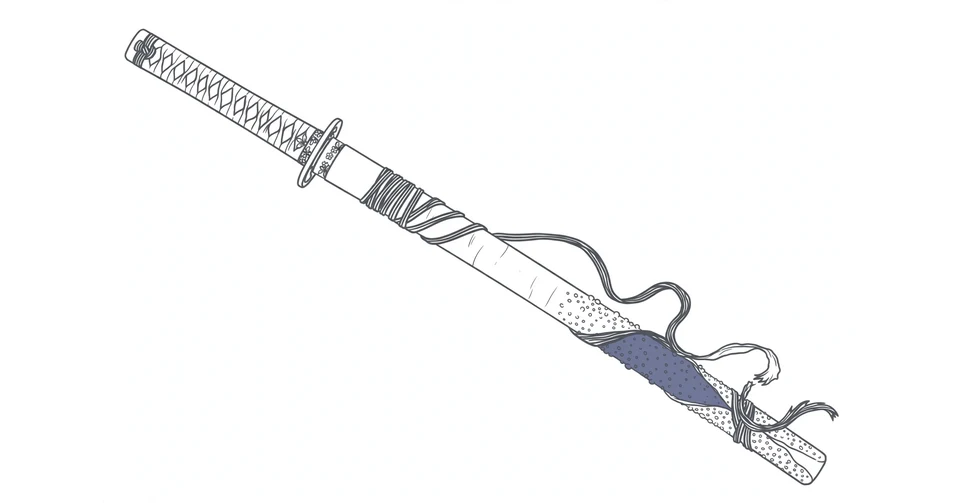
Those nodes do two jobs at once. They bite into the cord wound over them, so the wrapping cannot slide along the handle, and they bite gently into the palm, so the hand cannot slide either. A katana is a two handed weapon swung with force, and a handle that slips is not a minor annoyance. It is a danger to the person holding the sword and to everyone standing near. The samegawa is the quiet insurance against that danger, a rough skin doing rough work where nobody can see it. Every katana grip hides a piece of samegawa, and every swordsman owes it more than they know.
What samegawa actually is
Samegawa is rawhide, untanned skin, and in the Japanese tradition it is almost always left undyed. The hilts of the tachi, the katana, and the wakizashi were almost always covered in this pale undyed skin, and the whiteness of the material was itself a measure of quality. In Japan, the value of the skin was judged by how white it was, while in Europe, where the same material became fashionable under the name shagreen, buyers prized the way it took green dye. The same skin, two different ideas of beauty, and the Japanese one is the plainer of the two. White, rough, and honest. In English the material is usually called shagreen, a word that covers ray and shark skin rawhide used for sword hilts, scabbards, and cases.
This article began as a closer look at one layer of the tsuka, the wrapped handle described in Tsuka Is the Wrapped Grip That Lets a Katana Speak, and the skin deserves its own story because it does the hardest work in the whole assembly. The ray used is commonly the cowtail stingray, a broad flat fish whose skin is large enough to cover a handle and thick enough to survive years of use. Each skin is different. The nodes vary in size and spacing, larger near the centre of the skin and smaller toward the edges, and a craftsman choosing a piece for a handle will look for the section where the nodes are even and prominent. The best pieces have large, well formed nodes that stand proud of the surface, the kind sometimes called emperor nodes, and they are chosen for the most visible part of the handle. A handle covered in fine samegawa was a point of pride, and a buyer would run a thumb over the diamonds to feel the nodes before looking at anything else. A skin with weak or uneven nodes is not thrown away. It is used where it will be hidden, or on a less formal mounting.
It is worth pausing on the fact that this material comes from the sea. A katana is often described as a product of fire and iron, and the steel at its heart is indeed born in a furnace. But the handle is a product of the sea and the forest: wood from a magnolia tree, skin from a ray, cord from a silkworm or a cotton plant, and a bamboo pin to hold the whole thing together. The sword is a meeting point of four materials from four different worlds, and samegawa is the one that came the farthest to be there. The steel itself, the tamahagane smelted from iron sand, is the subject of Tamahagane Is the Jewel Steel Behind Every Katana, and it deserves its own story, but no blade, however fine, can be used without the skin that lets a hand hold it.
From the sea to the handle
Turning a raw ray skin into samegawa is slow work, and most of it is waiting. The skin is cleaned and tanned lightly, then soaked in water until it turns soft and pliable. While it is soft, the craftsman cuts it to the shape of the wooden core and fits it around the handle, easing it over the curves and pressing it into place. Rice glue, the same gentle adhesive used to join the two halves of the wooden core, holds it while it dries. Then the waiting begins.
As the skin dries it shrinks, and as it shrinks it hardens, pulling itself tight around the wood like a second shell. This is the step that gives samegawa its strength. A skin fitted loosely would wrinkle and lift, but a skin that shrinks onto the core becomes rigid, and that rigidity is what stops the wooden core from splitting around the hole for the bamboo pin. The handle becomes a single solid object rather than a stack of loose parts, and that solidity is felt the moment the sword is picked up.
The craftsman then trims the edges and checks the fit by hand, feeling for any loose spot or raised edge. If the samegawa has been fitted well, the surface feels dry, hard, and evenly rough, with the nodes standing up in a regular field. If it has been fitted badly, the skin will sound hollow when tapped, or the edges will lift when the cord is wound over them. There is no shortcut past this stage. A handle wrapped over poorly fitted samegawa will feel wrong for the entire life of the sword, and the only cure is to strip the handle down and start again, because a skin of samegawa fitted badly cannot be patched, only replaced.
Why the nodes matter
The nodes are not decoration, and that is the first thing to understand about samegawa. Each node is a small calcified scale, hard as a grain of sand, and together they form a surface that grips in every direction. When the cord is wound over the skin under high tension, it sinks slightly between the nodes and locks in place. Without the nodes, the cord would creep along the smooth wood with every swing. With them, the wrap stays exactly where the wrapper put it, year after year, and the samegawa beneath it never needs to be seen to do its work.
The nodes also grip the hand. Through the diamond openings in the cord, the palm touches the samegawa directly, and the rough surface gives the fingers something to hold even when the hands are wet with sweat or rain. This matters more than it sounds. A swordsman in training will practise the same cut hundreds of times in a single session, and tired hands sweat. A smooth handle would punish that effort with slips. A handle lined with samegawa forgives it, and the forgiveness is built into the material rather than added on top.
There is a third job, quieter than the first two. The skin absorbs a little moisture and a little shock, softening the jolt that travels down the blade into the hands with every cut. It is not padding in the modern sense. It is a thin, hard skin that happens to take the edge off a blow, and over a long practice session that small mercy adds up. I think this is the part of the craft that moves me most: the makers of these swords understood that a weapon used by a human being has to be kind to the hands that hold it, and they built that kindness into the handle from the inside out.
Full wrap or panels
Samegawa is fitted in two ways, and the choice says something about the sword. In a full wrap, the skin covers the entire wooden core, edge to edge, so that every part of the handle has the same rough grip beneath the cord. In panels, smaller pieces of skin are placed only where the diamond openings of the wrap will reveal them, with plain wood left beneath the cord crossings. The panel method saves material, and good ray skin has never been cheap, so many fine handles use panels without any loss of function. The full wrap is the more generous choice, and on a formal mounting it is a quiet statement that nothing was spared.
The difference is visible if you know where to look. Lift the cord gently at the edge of a diamond opening and you can see whether the pale skin continues underneath or stops at the edge of the panel. A collector checking a sword will look for this, and for the quality of the nodes, because the skin is one of the hardest parts of a handle to fake well. Moulded plastic can copy the look of nodes from a distance, but up close the copies are too regular, too smooth, and too even. Real samegawa is irregular by nature, and the irregularity is the proof.
The skin also appears beyond the handle. The same material was used on scabbards, where it gave the hand a grip while drawing the sword, and on small cases and boxes, where its hard rough surface survived years of handling. In Europe it became a fashionable covering for luggage and cases, but in Japan it stayed close to the sword. Old samegawa that has survived a century of handling is prized precisely because the material was never meant to be looked at, only used. That loyalty is fitting. The skin was never meant to be a luxury finish. It was meant to be the working layer of a working tool, and the sword is where it does its best work.
How to read samegawa on a real sword
If you ever hold a katana, the skin will tell you a great deal about the handle in less than a minute. Look through a diamond opening in the cord. Genuine samegawa is white or cream coloured, with rounded nodes of uneven size, slightly rough to the touch. If the surface under the cord is black, grey, or painted, or if it shines like plastic, the handle is not what it claims to be. The test costs nothing and needs no tools, and it is the same test a specialist uses first, because the skin cannot lie about itself the way a fresh wrapping can. A dealer who shows you the samegawa first is a dealer who knows what matters.
Then press the cord with your thumb. On a handle built over good samegawa, the cord does not move, because the nodes lock it in place and the skin has shrunk hard against the wood. If the cord shifts or lifts, something beneath it has failed, and the skin is the first suspect. This is why the story of the handle really begins with the skin rather than the cord. The cord is the part everyone sees, but the skin is the part that decides whether the cord can do its job, and a handle is only as honest as the layer nobody bothers to look at. The full guide to reading a handle this way, including the wrapping that sits over the skin, is given in this essential guide to tsukamaki, which explains how the cord, the skin, and the wooden core work as one assembly.
The quiet cost of a scarce skin
Good samegawa has always been expensive, and scarcity is part of its story. A single ray gives only a limited area of usable skin, and only part of that skin has nodes large and even enough for a fine handle. The rest is used for panels, for smaller swords, or for other work. This is why the full wrap on a formal sword means something, and why the skin on an old handle is treated with respect when a handle is taken apart for repair. The wooden core and the samegawa often survive several re-wrappings, outliving many lengths of cord, and each time the handle is opened the skin is checked, cleaned, and kept if it is still sound.
There is a lesson in that durability. We live in a time when most things are made to be replaced, and a handle that is designed to be opened, repaired, and put back together feels like it comes from another world. The samegawa sits at the centre of that design. It is not glued shut or nailed fast. It is fitted, shrunk, and held by tension, and it can be removed and replaced when its working life is done. A craft that plans for repair is a craft that respects both the material and the person who will use it, and I find that respect more impressive than any amount of decoration.
What the skin teaches
The next time you see a katana, look past the blade. Look at the handle, and then look past the cord, through one of the small diamond openings, at the pale rough skin beneath. It will not impress you the way the steel does. It has no shine, no pattern, and no colour to catch the eye. It is white, rough, and easy to ignore, and that is exactly the point. The best parts of a well made thing are often the parts you never see, doing work you never notice, and samegawa is the finest example of that truth on the whole sword.
A katana is remembered for its edge, and rightly so. But a sword that cannot be held cannot be used, and a handle that slips is a promise broken. Samegawa keeps that promise, quietly, for decades, asking for nothing except to be left in place and allowed to do its work. That is why the skin matters, and why it deserves to be named rather than hidden: it is the grip beneath the grip, and the sword would not be a sword without it.
More in Culture & Society
- Menuki Are the Small Ornaments Hidden Under a Katana Grip
- Habaki Is the Copper Collar That Locks a Katana in Its Sheath
- Maedate Is the Crest That Turned a Samurai Helmet Into a Banner
- Tatara Is the Clay Furnace Where Tamahagane Begins
- Tsuka Is the Wrapped Grip That Lets a Katana Speak
- The Tanto Was the Small Blade a Samurai Trusted With His Life
Latest posts
- Tamahagane Is the Jewel Steel Behind Every Katana
- Seppuku Was the Ritual a Samurai Chose Over Disgrace
- Saya Is the Lacquered Sheath That Guards the Katana
- Daisho Was the Pair of Swords That Marked a Samurai
- Hamon Is the Wavy Line That Proves a Katana Is Real
- Ikebana and the Quiet Discipline Behind Japan's Flower Art
- The Wakizashi Was the Short Sword a Samurai Never Left Behind
- The Tsuba Turned a Sword Guard Into a Small Work of Art
- Omiyage and the Japanese Art of Bringing Something Back
- How the Katana Became the Soul of the Samurai
- The Menpo Gave the Samurai a Face Worth Fearing
- Japan Goes Maple Hunting Every Autumn and Calls It Momijigari
- Kabuto Gave the Samurai a Helmet Worthy of His Sword
- Christmas in Japan and the Fried Chicken Dinner That Started It All
- Kiso Yoshinaka Rode Out of the Mountains and Nearly Took Japan