Tsuka-Ito Is the Cord That Binds a Katana Grip
· 20 min read
Tsuka-ito is the cord wrapped around a katana handle, and it does far more than decorate the grip. This guide explains what it is made of, how it is wrapped, and why its pattern, colour, and tension matter.
Look at a katana and your eye goes first to the blade. That is natural. The blade is the part that cuts, and it carries the smith's name and the polish that collectors argue about. But the part your hand actually touches is the handle, and the part that makes the handle work is a cord. Tsuka-ito is that cord, a braid of silk, cotton, or leather wound tightly around the grip in a pattern of diamonds, and it is doing far more than looking neat.
A handle without its cord would still be a handle, in the same way that a house without a roof would still be a house. It would function for a while, and then it would fail. The tsuka-ito holds the parts of the handle together, it gives the hand something to grip when the palm is wet with sweat, and it protects the wood and ray skin beneath it from wear. Take the cord away and the whole assembly loosens, rattles, and eventually comes apart. That is why the tsuka-ito deserves an article of its own.
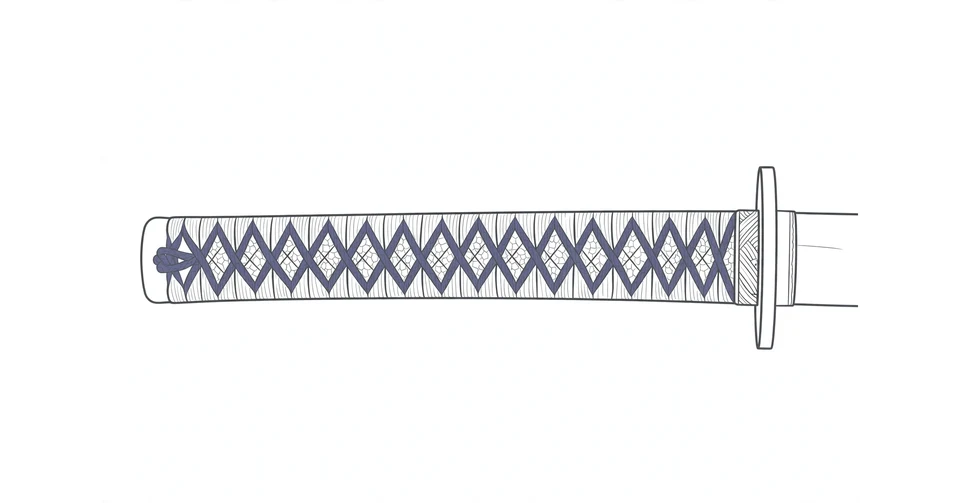
The word itself is simple. Tsuka means handle, and ito means thread or cord. The wrapping as a whole is called tsuka-maki, the wrapping of the handle, and the cord that does the wrapping is the tsuka-ito. The distinction matters, because one is the material and the other is the craft. A good cord in careless hands still makes a poor handle, and a skilled wrapper can only do so much with a cord that stretches, frays, or refuses to hold its tension. When people praise a katana grip, they are usually praising both at once without realising it.
What tsuka-ito is and why it matters
Tsuka-ito is the cord that binds a katana grip, and its first job is grip. The tsuka-ito is wound over a layer of ray skin, called samegawa, which is rough and granular to the touch. Together the two surfaces give the hand a hold that does not slip easily, even when the palm is wet from sweat or rain. The raised diamonds of the wrap give the fingers places to settle, and the slight give of the tsuka-ito cushions the hand and absorbs some of the shock of a cut. A handle wrapped loosely feels vague in the hand, as if the sword might shift at the worst moment, while a handle wrapped tightly feels like an extension of the arm.
Its second job is structural, and it is the more important of the two. The handle of a katana is not a single solid piece. It is two halves of wood, usually magnolia or another light, stable wood, carved to fit closely around the tang of the blade and held together by one or two bamboo pegs called mekugi. Over the wood goes the samegawa, and beneath the tsuka-ito sit small metal ornaments called menuki, which fill the palm and help the hand find its place. At the blade end sits a metal collar called the fuchi, and at the far end a cap called the kashira. The tsuka-ito is what binds all of this into one firm object. It pulls the wooden halves together, it pins the menuki in place, and it locks the fittings at both ends. Without that tension, the parts would shift and rattle, and the sword would become unsafe to use.
Its third job is protection. The tsuka-ito shields the wooden core from moisture, sweat, and abrasion, and it spreads the force of a cut evenly across the handle instead of letting it concentrate in one spot. Ray skin is tough, but it can crack and peel with age and impact, and wood can split along its grain if it is left exposed. A tight wrap is a layer of armour for the parts beneath it, and it is a layer that can be replaced when it wears out, which is more than can be said for the wood itself.
There is a fourth job, and it is the one most people notice first. The tsuka-ito is the most visible part of the handle, and its material, colour, and pattern say something about the sword and its owner. A black silk wrap on a formal mounting reads as restrained and serious. A coloured wrap can echo the lacquer of the scabbard, the metal of the guard, or the theme of the fittings. The tsuka-ito is not decoration added after the real work is done. It is part of the design, and a maker who chooses it carelessly has made a visible mistake.
What lies beneath the cord
To understand the tsuka-ito, it helps to know what it covers. The wooden core comes first, shaped to the tang and to the hand. If the wood is too loose, the handle rattles and the blade can shift. If it is too tight, the wood may crack as it expands and contracts with changes in humidity. The fit has to be exact, and it is tested by hand and by eye before any wrapping begins.
Over the wood goes the samegawa. The skin is usually applied in panels, with the most textured portion placed where the hand grips, though on finer handles it may cover the whole core. It is soaked to make it pliable, fitted closely, and fixed with rice glue. As it dries it shrinks and hardens, forming a rigid layer that reinforces the wood, especially around the holes for the mekugi pegs. The diamond shaped openings in the tsuka-ito exist so that this skin shows through, and the contrast between the dark cord and the pale, beaded skin is one of the most recognisable sights in Japanese craft.
The menuki sit beneath the tsuka-ito, positioned where the fingers rest. They began as practical pieces, filling the gap between the skin and the tsuka-ito and giving the hand a shape to hold, and they became an art form of their own. They are carved in metal, often in gold, silver, copper, or a copper gold alloy called shakudo, with motifs that range from flowers and animals to family crests and mythical creatures. A well placed menuki shows its face through one of the diamond openings, and its position helps the hand find the same grip every time.
At the two ends of the handle, the fuchi and the kashira frame the wrap. The fuchi reinforces the wood where it meets the guard, and the kashira closes the far end and protects the spot where the cord is pulled tightest. The cord that wraps the handle, the tsuka-ito, passes through small openings on either side of the kashira so the wrap can be tied off securely, and on finer examples those openings are fitted with small metal eyelets called shitodome. The whole assembly is held together by tension, and the tsuka-ito is the source of that tension. The tsuka itself is worth studying as a complete object, because the cord only makes sense as part of that assembly.
Silk, cotton, leather, and the modern synthetics
The traditional material for tsuka-ito is silk, and it is still the first choice for high quality work. Silk is strong, it resists stretching, and it holds its tension well over time, which matters more than it sounds. A cord that stretches slowly loosens the whole handle, and a handle that loosens is a handle that needs rewrapping. Silk also has a subtle sheen and takes dye beautifully, so it can be had in a wide range of colours, from deep black to rich blue and warm brown. Its feel is smooth yet grippy, and it conforms well to the hand.
Cotton is the practical alternative, and it has been used for a long time. It is cheaper than silk and easier to replace, and it absorbs moisture well, which can be a help in humid conditions or during long practice. Its grip is slightly coarser than silk, which some hands prefer. The trade off is durability. Good cotton cord is robust enough for regular handling and training, but it is generally less durable than silk, and it absorbs oils and dirt more readily, so it needs cleaning or replacement sooner.
Leather, usually deerskin, is the third traditional choice, and it has a character all its own. It is exceptionally durable and resistant to moisture, and it improves with age as it moulds to the hand and develops a patina. A leather wrap feels firmer and more tactile than silk or cotton, and it suits a working sword rather than a formal one. It is less common than the other two, but for a sword that will be handled hard, it is a serious choice.
Modern practice swords and budget reproductions often use synthetic cord, usually nylon or polyester. These materials are cheap and consistent, and they will hold a pattern well enough for display. What they lack is the feel of the traditional materials, and they can stretch in ways that make a neat wrap hard to achieve. A synthetic wrap on a practice sword is a reasonable compromise. On a sword that claims to be traditional, it is a sign that corners were cut. I think the material choice is where a buyer can learn the most about a sword with the least effort, because it is hard to fake the feel of real silk and easy to spot a cord that was chosen for price alone.
The main wrapping styles
The most common style is hinerimaki, the twist wrap. In this method the tsuka-ito is twisted on itself at each crossing point, forming raised diamonds on both sides of the handle. The twists keep the tsuka-ito flat and taut, and the pattern is symmetrical, clean, and instantly recognisable. It is the style most people picture when they think of a katana handle, and it has been a standard for centuries because it balances grip, durability, and appearance so well. A well executed hinerimaki feels even under the hand, with no loose spots and no diamonds that sit higher than their neighbours.
Katatatemaki, often called the battle wrap, is a more utilitarian style. Its pattern is asymmetrical. On one side of the handle, usually the side that faces outward when the sword is worn, the tsuka-ito is wrapped tightly and almost continuously, with little or no ray skin showing. On the other side, larger and more open diamonds reveal the samegawa beneath. The style gives a firm, unyielding grip on the dominant side, and its simpler side could be rewrapped more quickly if it was damaged in the field. It was common during the long wars of the Sengoku period, when durability and repair mattered more than ornament, and it is still favoured for swords meant for hard use.
Tsumami maki, the pinch wrap, is a more complex and refined style. The tsuka-ito is pinched or folded at the crossing points to create raised, textured sections, and the work takes longer and demands more skill. It is often reserved for ceremonial swords, where the extra labour is part of the point. The result is a handle with a strong tactile character, and a grip that tells the hand exactly where it is.
Jabaraki, the snake belly wrap, takes the opposite approach. Its crossings are spaced further apart, creating wide, open segments that show a great deal of the samegawa beneath, like the scales on a snake's belly. It is primarily an aesthetic choice, a way to display fine ray skin with prominent nodes, and it suits a display sword or an older tachi mounting more than a sword meant for daily practice. The wider spacing gives slightly less purchase than a tight hinerimaki, and that trade off is accepted for the sake of the look.
There are other styles too, including morotsunemaki, a double cross wrap that crosses the tsuka-ito twice in each diamond for an even firmer grip, and hiramaki, a simpler wrap in which the tsuka-ito crosses without the twisted or pinched treatment, associated with certain tachi mountings. The full list runs long, and regional schools and individual makers have their own variations. What matters for a reader is not memorising every name, but recognising that the pattern is a choice, and that each choice carries a reason. A handle wrapped in katatemaki tells a different story from one wrapped in tsumami maki, and a careful observer can read that story at a glance.
How a handle is wrapped
Wrapping a handle is the work of a specialist called a tsuka-maki-shi, and it is a craft that takes years to learn. The process begins with the wooden core, shaped and smoothed until it fits the tang without movement or rattle. The samegawa is then cut to size, soaked, fitted, and glued, with its most textured portion placed where the hand will grip and its seams hidden beneath the tsuka-ito.
Once the skin is set and the menuki are positioned, the wrapping begins. The tsuka-ito is usually started at the fuchi end and worked toward the kashira, with each pass tensioned and spaced by hand. Small paper wedges called hishi-gami are folded into the crossings to shape the diamonds and keep them even, and a bone folder is used to press the tsuka-ito into crisp lines. The wrapper must keep the tension consistent from one end of the handle to the other. Too loose, and the tsuka-ito will shift and the handle will feel insecure. Too tight, and the tsuka-ito may cut into the skin or the wood. The menuki must end up correctly placed beneath the tsuka-ito, with their faces showing through the diamond openings, and the tsuka-ito must pass through the openings at the kashira and be knotted off securely at the end. The final knots are not decoration. They lock the whole wrap in place and stop it from unravelling, and a knot tied badly can undo hours of careful work.
The skill is in the consistency. Anyone can wrap a handle once and produce something that looks passable in a photograph. Producing a wrap that feels even, holds its tension for years, and survives daily handling is another matter entirely. The difference shows in the details: diamonds of equal size, cord that lies flat at every crossing, menuki that sit exactly where the fingers expect them, and a knot at the kashira that looks as if it grew there. When I read accounts of this work, I am struck by how much of it is invisible. The finished handle hides the paper wedges, the glue, and the hours of adjustment, and what remains is a surface that looks simple and feels inevitable. That is usually the sign of work done well.
Colour, identity, and the story about 1645
Colour is where the tsuka-ito stops being purely practical and becomes personal. The colour of the tsuka-ito is usually chosen to match or complement the sageo, the braid that ties the scabbard to the belt, so the sword reads as one object rather than a collection of parts. A black cord with a black sageo is the standard formal look, and it is the one most students start with. A coloured cord can echo the lacquer of the scabbard, the theme of the fittings, or a favourite colour of the owner. Writers on the subject note that certain colours and styles were associated with particular samurai clans, martial arts schools, or periods, serving as a form of visual identity, and that the choice of cord could reflect the owner's status, taste, or the intended purpose of the sword.
That history has attracted a good deal of storytelling, and some of it should be treated with care. Our earlier article on the sageo states that the Tokugawa shogunate ruled by 1645 that the tsuka-ito should be black, and that some samurai got around the ruling with very dark blue or very dark brown. I tried to verify that claim before repeating it here, and I could not. The 1645 order I was able to check, an order from the seventh month of Shoho 2 that regulated the swords of the daimyo and the commoners, set limits on blade length. It did not, as far as the account I read shows, say anything about the colour of the handle cord. That does not prove the colour ruling never existed, since a ruling about formal dress for high ranking samurai on duty in Edo Castle could have covered fittings as well as blades, and the records of such rules are scattered. But a claim that specific deserves a source that states it plainly, and I did not find one. So I will not repeat the black cord ruling here as fact. The safer statement is the one the sources support: black became the standard and formal choice, and coloured cords were a matter of taste, school, and occasion. The sageo article remains worth reading for the cord it describes, but its 1645 claim about the handle wrap should be read as unverified until a proper source turns up.
What is better documented is the broader pattern. In the Edo period, as the samurai became more ceremonial and less martial, the sword became a symbol of status as much as a weapon, and the handle became more elaborate and decorative. A samurai might own several handles for a single blade and change them to suit the occasion, a practice called tsuka-gae. A formal occasion might call for a restrained black wrap with gold fittings, while a more casual setting might allow a coloured cord and simpler metalwork. The blade stayed the same. The handle changed, and with it the message the sword sent. That modular habit is one of the most interesting things about the Japanese sword. It treats the weapon as a set of parts that can be recombined, and it gives the owner a way to speak through craft without altering the steel.
Wear, care, and knowing when to rewrap
A well wrapped handle can last for decades, but the tsuka-ito is a working part, and it wears. The most common problem is loosening. With repeated use and changes in humidity, the tsuka-ito can stretch, and a loose wrap compromises the grip, lets the parts beneath it shift, and makes the sword feel unstable in the hand. Fraying follows, usually where the hands grip hardest or near the fuchi and kashira, where the tsuka-ito bends most sharply. The fibres thin, then break, and each broken strand weakens the whole pattern.
The skin beneath can also fail. Samegawa can crack, peel, or become discoloured with age, impact, or poor storage, and once it is damaged it no longer gives the tsuka-ito a stable base. The wooden core can shrink in dry air or swell in damp air, putting stress on everything around it. The bamboo mekugi pegs can wear, become brittle, or break, and a compromised peg is a safety problem, since it is the peg that keeps the blade from separating from the handle. Loose or rattling fittings are another warning sign, because they suggest the wrap has lost its tension or the core beneath it has changed shape.
Care is mostly a matter of gentle habits. The wrap should be wiped with a soft, dry, lint free cloth, and dust between the cords can be lifted with a soft bristled brush. Water, solvents, and abrasive cleaners should be avoided, since water can cause the tsuka-ito and the skin to shrink, swell, or grow mould. The sword should be stored where humidity and temperature are stable, ideally at moderate humidity, away from attics, basements, and direct sunlight. Hands should be clean and dry when the sword is handled, and the wrap should be inspected regularly for loosening, fraying, and damage to the fittings and pegs. These are small habits, and they are the difference between a handle that lasts a generation and one that needs attention within a few years.
Rewrapping becomes necessary when the tsuka-ito is significantly loose, broken, or extensively frayed, when the samegawa is badly cracked or peeling, when the fittings will not stay firm, or when a mekugi is worn or damaged. A rewrap is also an opportunity, since it allows the owner to change the colour or material of the tsuka-ito, or to reposition the menuki. It is a common maintenance task for collectors and practitioners, and it is best done by a skilled wrapper rather than attempted as a first project. A handle that has been rewrapped well feels new without looking new, and the sword keeps its character.
Why a cord deserves this much attention
It is easy to treat the tsuka-ito as a minor detail, a finishing touch applied after the serious work of forging and polishing is done. That view misses what the tsuka-ito actually does. It is the part that connects the hand to the blade, and it is the part that holds the handle together. It carries the shock of every cut, it protects the wood and skin beneath it, and it tells anyone who looks at the sword something about the person who chose it. A sword with a loose, frayed, or careless wrap is a sword that has been neglected, whatever the quality of its blade.
The deeper lesson is about craft itself. The tsuka-ito is a simple thing, a length of braided fibre, and the work of wrapping it is repetitive, physical, and largely invisible once it is finished. Yet the difference between a good wrap and a poor one is the difference between a tool that can be trusted and one that cannot. That is true of many crafts, and it is why the handle wrap has its own specialists, its own vocabulary, and its own history. The Japanese sword is often described as a complete work of art, and the tsuka-ito is part of that completeness, not an afterthought to it.
The next time you see a katana, look past the blade for a moment and study the handle. Notice the diamonds, and whether they are even. Notice the colour, and what it echoes on the rest of the mounting. Notice whether the tsuka-ito sits tight against the skin, and whether the menuki show through the openings where the fingers would rest. A small cord, wrapped well, is a quiet kind of mastery, and it deserves the same attention as the steel it serves. For a fuller picture of the craft that shapes the whole handle, the essential guide to tsukamaki covers the tools, the process, and the history in detail, and the guide to the tsuka explains how the cord fits among the wood, the skin, the ornaments, and the fittings.
More in Culture & Society
- Fuchi Is the Collar That Frames a Katana Grip
- Kashira Is the Small Cap That Finishes a Katana Grip
- Sageo Is the Cord That Ties a Katana to Its Samurai
- Menuki Are the Small Ornaments Hidden Under a Katana Grip
- Habaki Is the Copper Collar That Locks a Katana in Its Sheath
- Maedate Is the Crest That Turned a Samurai Helmet Into a Banner
Latest posts
- Samegawa Is the Ray Skin Hiding Under Every Katana Grip
- Tatara Is the Clay Furnace Where Tamahagane Begins
- Tsuka Is the Wrapped Grip That Lets a Katana Speak
- The Tanto Was the Small Blade a Samurai Trusted With His Life
- Tamahagane Is the Jewel Steel Behind Every Katana
- Seppuku Was the Ritual a Samurai Chose Over Disgrace
- Saya Is the Lacquered Sheath That Guards the Katana
- Daisho Was the Pair of Swords That Marked a Samurai
- Hamon Is the Wavy Line That Proves a Katana Is Real
- Ikebana and the Quiet Discipline Behind Japan's Flower Art
- The Wakizashi Was the Short Sword a Samurai Never Left Behind
- The Tsuba Turned a Sword Guard Into a Small Work of Art
- Omiyage and the Japanese Art of Bringing Something Back
- How the Katana Became the Soul of the Samurai
- The Menpo Gave the Samurai a Face Worth Fearing