Garuda Carried a Mountain to the Middle of the Ocean
· 17 min read
Garuda, the eagle mount of Vishnu, carried Mount Mandara to the middle of the ocean during the churning of the milk ocean, and the same bird still watches over Indonesia as its national emblem.
The gods and demons had a problem no army could solve, and the answer arrived on the wings of Garuda. They had agreed to churn the ocean of milk to find the nectar of immortality, and they had a rod and a rope for the work. The rod was Mount Mandara, a whole mountain. The rope was Vasuki, the great serpent. But the mountain was so heavy that the carriers collapsed under it on the way to the sea, and some of them died of exhaustion before the churning had even begun.
Then Vishnu arrived on his mount Garuda, and the story changed shape. Vishnu revived the fallen carriers, and then Garuda lifted the mountain itself and flew it to the middle of the ocean. A bird carried a mountain. That single image tells you almost everything about Garuda: he is the one who does what looks impossible, and he does it in service of someone else.
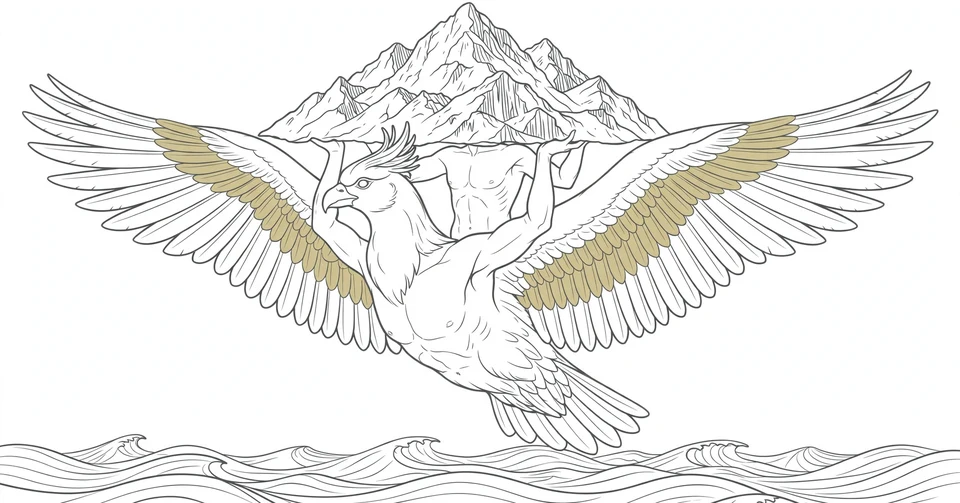
Garuda is the king of birds in Hindu myth, the mount of Vishnu, and the sworn enemy of serpents. His story is told in the Mahabharata, retold across the Puranas, carved on temples from India to Cambodia, and still alive today in Indonesia, where his image stands on the national emblem. This is the story of how a bird became a vehicle, a devotee, and a national symbol, and why the mountain flight is the moment that defines him.
The mountain too heavy for gods and demons
The churning of the ocean, the Samudra Manthana, is one of the great shared stories of Hindu myth. The devas and the asuras, gods and demons, set aside their war for one task: to churn the ocean of milk and draw out the amrita, the nectar of immortality. They needed a churning rod strong enough to stir an ocean, so they uprooted Mount Mandara. They needed a rope long enough to wrap around it, so they took Vasuki, the great naga who lives on the neck of Shiva, and promised him a share of the reward.
The plan was sound. The weight was not. As the two sides carried the mountain toward the ocean, the devas and asuras began to fall. The mountain was too heavy for the strongest beings in the cosmos, and several of them died of sheer exhaustion on the road. The churning had not started, and the workforce was already dying.
Vishnu flew in upon his mount Garuda. He revived the fallen carriers, and then Garuda did what no one else could do: he carried Mandara himself to the middle of the ocean. The telling of this moment in our earlier article on the churning puts it plainly, that Vishnu flew upon his mount, revived them all, and carried Mandara himself to the middle of the ocean.
I like the modesty of that sentence. It does not pause to explain how a bird lifts a mountain. In the myth, the question never arises, because Garuda is not an ordinary bird. He is the king of birds, a being whose strength is measured against gods, not against animals. The mountain is heavy, and he is stronger. That is the whole logic, and it is enough.
The scene also sets the pattern for everything Garuda does afterward. He does not churn the ocean himself. He does not claim the nectar. He makes the work possible and then steps aside, or rather flies aside, so the work can happen. He is the helper who can carry the heaviest thing in the story and still not become the hero of it. That restraint is part of his character, and it shows up again in the story of his birth.
A son who stole heaven's nectar
Garuda was born into a family quarrel that would shape his whole life. His father was the sage Kashyapa, one of the great progenitors of creation, from whom gods, demons, birds, and serpents all descend. Kashyapa had two wives. Kadru was the mother of the nagas, the serpents. Vinata was the mother of Aruna, the charioteer of the dawn, and of Garuda.
The two sisters made a wager over the colour of the celestial horse Uchchaihshravas. Kadru cheated. Her serpent children coiled themselves around the horse's tail to make it look dark, and Vinata lost the bet. The price was slavery: Vinata became the servant of Kadru and her serpent children, and her son grew up watching his mother in bondage.
When Garuda learned of it, he asked the nagas what price would buy her freedom. They named a price they believed no being could pay: the amrita, the nectar of immortality, held in heaven under the guard of Indra and the devas. He accepted without hesitation. He flew to heaven, broke through the defences Indra had arranged, scattered the armies sent to stop him, and seized the pot of nectar.
He did not drink a drop. That detail matters more than the theft itself. A being strong enough to take immortality, holding it in his hands, chose to carry it home untouched. He set the pot down on kusha grass and told the serpents to bathe ritually before drinking. While they bathed, Vishnu arrived and reclaimed the amrita for the devas. The nagas came back to find the pot gone, and in their greed they licked the sharp kusha grass where it had rested. The edges split their tongues, and that, the story says, is why serpents have forked tongues to this day.
Vinata walked free. Vishnu, struck by a being who could hold immortality and not drink it, offered Garuda boons. He asked for two things: to be immortal without the nectar, and to fly above Vishnu himself. Vishnu granted both, placing Garuda on his banner, so that he rides higher than even the one who carries him. And Garuda offered himself in return as Vishnu's vahana, his mount and vehicle. From that day the two are inseparable.
The story is told at length in the Adi Parva, the opening book of the Mahabharata, and it is the foundation of everything else about Garuda. He is a son first, a thief second, and a devotee third. The order matters. His strength exists to free his mother, not to enrich himself.
The enemy of every serpent
The amrita story also fixed Garuda's oldest enmity. The nagas enslaved his mother through deception, and from that day he became the naga-antaka, the destroyer of serpents, and the bhujaga-bhuj, the eater of snakes. In the tradition, serpents flee from him by instinct. His mere presence is enough to drive them away.
That idea is not a footnote. It runs through Hindu, Buddhist, and Jain texts, and it gives the bird a practical role that other deities do not have. The mantra drawn from the Garuda Purana has long been invoked for protection against snake venom. Villages in rural India where cobras were a real threat kept small images of the eagle at thresholds, and the symbolism still appears in protection amulets today. The theology behind it is simple: the bird represents the aerial principle that defeats the earth-bound principle of the serpent. He is clarity over coiled confusion, height over depth, swiftness over stealth.
The Ramayana uses Garuda at exactly one moment, and it is a telling one. During the battle with Indrajit, Rama and Lakshmana fall unconscious under the nagapasha, a serpent weapon. He arrives and frees them by his mere presence, because the nagas flee from him. The brothers do not need a counter-weapon. They need only the presence of the right principle. It is the same lesson as the mountain: the bird does not fight the battle for you. He changes the conditions so the battle can be won.
The Garuda Purana, one of the eighteen major Puranas of Hinduism, takes its name from him. In its current form it contains about 19,000 verses in two sections, and it is distinctive because its narrator is Garuda himself, questioning Vishnu on dharma, the afterlife, and cosmology. He is the only Hindu deity whose name is used for an entire Purana, and the only one who serves as both a mount, ridden by Vishnu, and a devotee, receiving worship in his own right.
How the bird looks in stone and paint
Garuda's appearance has stayed remarkably consistent for more than two thousand years. He is shown as a half-human, half-bird figure: the upper body of a powerfully built man, with arms that may carry a discus, a club, or a water pot, and a lower body with eagle-like talons. From his shoulders extend enormous golden or white wings. His head bears a crown, and his beak is sometimes shown instead of a human mouth, with a sharp curved profile. His skin is golden, sometimes red or green, depending on the regional tradition.
He is usually shown in flight, carrying Vishnu and Lakshmi on his back, or standing in the namaste posture before the deity. A tall pillar called a Garuda-stambha, surmounted by his image with hands folded in greeting, stands before every major Vaishnava temple in India. The devotee entering the temple first offers salutations to the bird at the pillar, and only then proceeds to darshan of Vishnu. The logic is that the vahana is a senior devotee whose mediation is required before the main deity's grace can be received.
In Southeast Asia the image adapted to local taste. The Balinese version is muscular and golden, shown in intricate carving with vivid colours, often locked in battle with a naga. The Javanese version is more humanoid. The Khmer one is taller and more elaborately crowned. The sculpture at Angkor Wat, carved in the twelfth century, shows the bird carrying Vishnu in nearly identical posture to Indian sculptures of the same period, which suggests the iconographic template travelled fully formed from India across the Indian Ocean.
The transmission is one of the best documented chapters in the spread of Hindu iconography. Sculptures and temple reliefs from Angkor Wat and Angkor Thom in Cambodia, from Prambanan on the island of Java, and from Borobudur, where Garuda appears on a Buddhist level with Hindu-derived iconography, show a process in which the eagle-deity became regionally central. Scholars date the transmission to roughly the fourth to eighth centuries, with iconographic forms stabilising by the time of the great Khmer monuments of the ninth to twelfth centuries.
The bird in wayang and Balinese art
Garuda reached Indonesia long before Indonesia existed as a state, and he never left. His image appears in many ancient Hindu-Buddhist temples across the archipelago. Mendut, Borobudur, Prambanan, Kidal, Penataran, Belahan, and Sukuh all depict him in bas-relief or statue. In the Prambanan temple complex there is a single temple located in front of the Vishnu temple, dedicated to the bird, although no statue of him stands inside its chamber today. In the Shiva temple at Prambanan there is a relief telling the Ramayana episode in which Jatayu, his nephew, also of the bird-god race, tried to rescue Sita from Ravana.
The most famous statue from ancient Java is the deified image of King Airlangga depicted as Vishnu mounting Garuda, from Belahan. It is now one of the important pieces in the Trowulan Museum. The king chose to be remembered not on a throne, but on the back of a bird.
In Java and Bali, the eagle appears in wayang performance, in the shadow puppet theatre where the Mahabharata and the Ramayana are still told night after night. The puppet masters who keep those epics alive know him as a character who arrives when the story needs lifting, literally and otherwise. Balinese tradition venerates Garuda as the lord of all flying creatures and the majestic king of birds. In Bali he is traditionally portrayed as a divine creature with the head, beak, wings, and claws of an eagle and the body of a human, usually in intricate carving with golden and vivid colours, as the vehicle of Vishnu or locked in battle against naga serpents.
What strikes me about this long afterlife is how little he changed in the crossing. He arrived from India as a bird who carries a god, and in Java and Bali he stayed a bird who carries a god. The names of the kings changed, the languages changed, the religions layered over one another, and he kept his wings.
The bird that became a nation's emblem
The strangest chapter of Garuda's life began in 1950, when a newly independent Indonesia needed a national emblem and chose a Hindu bird. The national emblem of Indonesia is called Garuda Pancasila. Its main part is the Garuda with a heraldic shield on its chest and a scroll gripped by its legs. The shield's five emblems represent Pancasila, the five principles of Indonesia's national ideology. The bird clutches a white ribbon scroll inscribed with the national motto Bhinneka Tunggal Ika, Old Javanese for Unity in Diversity.
Garuda Pancasila was designed by Sultan Hamid II from Pontianak, supervised by Sukarno, and adopted as the national emblem on 11 February 1950. The design was the winner of a competition held after the Dutch acknowledged Indonesian independence in 1949. Sultan Hamid II's design was accepted by the People's Consultative Assembly and the government, while the other finalist, by Muhammad Yamin, was rejected because its shining sun emblem seemed too close to the Japanese imperial flag. Sukarno presented the design to the public at the Hotel Des Indes in Jakarta on 15 February 1950. The first version was still bald, without a crest, and in March 1950 Sukarno ordered the palace artist Dullah to add the crest, reportedly because the bald bird looked too much like the bald eagle of the United States.
The emblem is full of deliberate numbers. The feathers on each wing total 17. The tail feathers total 8. The feathers below the shield total 19. The neck feathers total 45. Together they read 17-8-1945, the date of the proclamation of Indonesian independence. The design of Garuda Pancasila was inspired by the elang Jawa, the Javan hawk-eagle, an endangered raptor endemic to the mountain forests of Java, which was later registered by presidential decree as the national bird of Indonesia.
The motto comes from older ground still. Bhinneka Tunggal Ika is an Old Javanese stanza from Sutasoma, an epic poem attributed to the fourteenth-century Majapahit poet Empu Tantular. The poem expounded a doctrine of reconciliation between Hinduism and Buddhism, and its line about diversity and unity became the motto of a republic founded five centuries later.
Indonesia is the world's most populous Muslim-majority country, and yet it kept a Hindu deity as its national symbol. The founders chose the bird specifically to honour the pre-Islamic Hindu-Buddhist heritage of Java, Sumatra, and Bali. Thailand also uses Garuda as its royal emblem. The national airline is called Garuda Indonesia, and the football team is nicknamed the Garuda Team. A Jakarta businessman flying Garuda Indonesia home is travelling under the name of the divine eagle of Vishnu, and most passengers never stop to think about it.
I find that continuity quietly moving. A bird from a story about churning an ocean ended up on the wall of every Indonesian classroom, slightly above the photographs of the president and vice president. He was not put there as a religious statement. He was put there as a memory of where the country came from, and what it chose to keep.
Garuda Wisnu Kencana in Bali
If you want to see Garuda at his largest, go to Ungasan on the Bukit Peninsula in southern Bali. The Garuda Wisnu Kencana statue, usually shortened to GWK, shows Vishnu riding Garuda, and it rises about 121 metres from the base of its pedestal to the tip of the wings. The statue itself is about 75 metres tall and 65 metres wide, and it sits on a 46 metre pedestal. It is made of copper and brass sheeting over a steel frame, and it weighs about 4,000 tonnes.
The statue was designed by the Balinese sculptor Nyoman Nuarta, who first conceived the project in the early 1990s. Construction began in 1997 and stalled for years, when only Vishnu's head and torso, Garuda's head, and Vishnu's hands stood as separate pieces around the park. The completed statue was finished on 31 July 2018 and inaugurated by President Joko Widodo on 22 September 2018. It is the tallest statue of a Hindu deity and the tallest statue in Indonesia.
Standing under it, the scale does something the myth alone cannot do. The story says a bird carried a mountain. The statue shows a bird carrying a god, and the bird is the larger of the two. His wings spread wider than the figure he carries, and his body forms the base of the whole structure. The vehicle is the monument. That is not how most religious art works. Usually the god is the largest thing in the frame. At GWK, the bird who carries the god is the frame itself.
Why a bird that carries mountains still matters
Garuda has survived for nearly three thousand years of documented religious history, from the Rig Veda's Suparna, the fair-winged bird who flew to heaven to bring back the soma plant, to the Garuda on an Indonesian passport. He survived the crossing from India to Southeast Asia, the arrival of Islam, the colonial period, and the founding of a modern republic. Very few mythical figures manage that. Most fade when the religion that carried them fades. He did not fade, because he was never only a religious figure. He was always a picture of a quality: the strength to lift what others cannot lift, used in service of someone else.
That is why the mountain flight is the right image to remember him by. The amrita theft is more dramatic, and the emblem is more famous, but the mountain is the purest moment in his story. Nobody asked him to carry it. The gods and demons had a plan, the plan failed under its own weight, and he simply picked up the heaviest thing in the story and flew. He did not ask for a reward, and he did not stay to be thanked. He put the mountain where it needed to be, and the churning could begin.
I think that is a useful thing to keep in mind when the work in front of you looks too heavy. The story does not promise that the weight will disappear. It promises something smaller and more practical: that strength exists, that it can be borrowed, and that the heaviest part of a job is often just getting it to the right place. He carried a mountain to the middle of the ocean. The rest of the story, the churning, the nectar, the arguments over who would drink first, all of it only happened because the mountain arrived.
The bird is still flying. You can see him on a temple wall in Prambanan, on the wall of a classroom in Magelang, on the tail of an aeroplane, and on a hill in Bali where his wings are wider than a god. He has carried mountains, nectar, and gods. He has carried a nation's name. And he has never once put himself first. That is a long life for a bird, and a good one.
More in Culture & Society
- Desa Pakraman Is the Name the Law Gave the Old Village
- A Primbon Reads Your Life From the Day You Were Born
- Pasaran Is the Five-Day Week Java Never Gave Up
- A Ceper Folds a Coconut Leaf Into a Crescent Moon
- Your Neptu Is the Number Hidden Inside Your Birthday
- Tilem Is the Dark Moon Bali Counts Its Year By
Latest posts
- The Saka Calendar Sets Nyepi on a Different Date Every Year
- On Tumpek Kuningan Bali Feeds Its Ancestors
- Vasuki Was the Rope That Churned the Ocean of Milk
- En No Gyoja, the Mystic Shugendo Calls Its Patriarch
- A Saito Goma Burns Its Prayers Outdoors
- Kongobuji Still Governs the Mountain Kukai Left Behind
- A Shukubo Lets You Sleep Inside a Working Temple
- Okunoin Is Japan's Largest Cemetery and Its Quietest Forest
- Suka Duka Means the Banjar Shows Up for Joy and Grief Alike
- Tabuh Rah Spills Blood So the Ground Stays Calm
- The Bendesa Adat Speaks for a Village That Has Two Governments
- Catur Brata Is Four Silences Kept at the Same Time
- On Koyasan the Founder Is Said to Be Still Meditating
- Your Weton Is the Day You Were Born, Counted Two Ways
- Rahu and Ketu Still Chase the Sun and Moon Across the Sky