Dezomeshiki Opens the Year on Top of a Ladder
· 9 min read
Every January, dezomeshiki opens the firefighting year in Japan, a parade and ceremony where Edo period ladder acrobatics share the same morning with helicopters, rescue drills and more than a hundred fire engines.
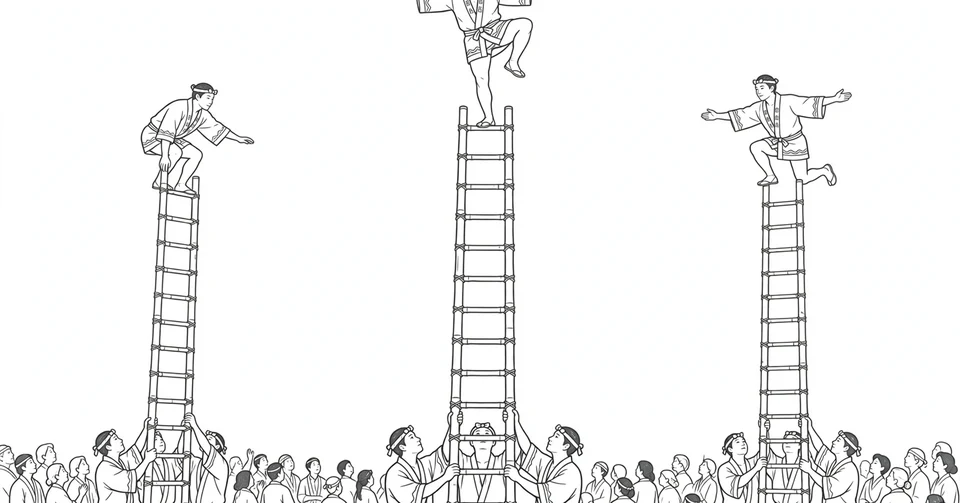
On a cold morning in early January, a man dressed as an Edo period firefighter climbs a bamboo ladder that is not leaning against anything. The ladder stands free in the open air, held upright by the hands, ropes and forked poles of the colleagues below him, and at the top, around six metres up, he lets go with both hands and leans out into a pose. This is dezomeshiki, the New Year ceremony of Japan's fire brigades, and it is how the Tokyo Fire Department opens its year.
Nothing in the scene is a stunt for its own sake. Dezomeshiki is at once a parade, a prayer for a fire free year, a public safety lecture and a demonstration of professional skill, and it has managed to be all of those things for a very long time. Crowds turn out in the January cold to watch, and the ladder climbers turn out to be only the oldest layer of a dezomeshiki programme that also includes helicopters.
Most fire services begin their year quietly, with inspections and paperwork behind closed doors. Dezomeshiki does the opposite. It takes the service out into the open, in front of the people it protects, and lets those people judge for themselves whether the firefighters look ready. That public promise, renewed every January, is the real subject of the ceremony.
What dezomeshiki is
The name dezomeshiki is usually translated as the first event, or first ceremony, of the year. Fire departments and volunteer fire corps all over Japan hold their own dezomeshiki in early January, and for the personnel involved it counts as the first official duty of the year, a collective first step back into uniform after the New Year break. A typical dezomeshiki programme mixes a formal parade of brigades and engines with water discharge drills, demonstrations of firefighting, rescue and first aid, and awards for members who have served with distinction.
Tokyo's dezomeshiki, hosted by the Tokyo Fire Department and traditionally held on January 6, is the largest and best known of them all, and watching it costs the public nothing. Well over two thousand firefighters take part, and similar ceremonies unfold in the same season in cities and small towns across the country, many of them run by the volunteer fire corps that still form the backbone of firefighting outside the big cities. The stated purposes of dezomeshiki have barely changed across the centuries: to pray for a safe year ahead, and to remind everyone watching that fire is patient, ordinary and always waiting for one careless moment.
A pep talk at Ueno Toshogu in 1659
The tradition behind dezomeshiki is usually traced to a single morning. On January 4, 1659, the standing fire brigade of Edo was gathered at Ueno Toshogu Shrine, where the feudal lord Inaba Masanori set out to raise its spirits. Reference summaries of the ceremony, such as the Japanese Wiki Corpus entry on dezomeshiki, describe that gathering as the first dezomeshiki in the tradition's history.
To understand why a pep talk needed a shrine and a lord, remember what Edo had just survived. In 1657, the Great Fire of Meireki had torn through the wooden city, destroying most of it and killing tens of thousands of people. The shogunate responded by creating the jobikeshi, a standing brigade of firefighters kept on duty full time at four stations around Edo. But new organisation could not undo what the fire had demonstrated to everyone: the city was built of wood and paper, and sooner or later it would burn again.
So the gathering at Ueno Toshogu was part encouragement and part prayer. The men who would stand between Edo and the next fire were told, in public, that their work mattered, and the gods were asked, also in public, for a quieter year. Every dezomeshiki since then has kept that double character. It is a show of strength and an admission of vulnerability at the same time, which is a more honest way to start a firefighting year than pretending the strength alone is enough.
The men who fought fire from the rooftops
To see why a ladder stands at the centre of dezomeshiki, you have to understand how fires were fought in Edo. There were no hydrants, no pumps worth the name and no water supply that could stand up to a serious blaze, so the main technique was demolition. Firefighters tore down the buildings around a fire before the flames could reach them, starving the fire of fuel and cutting a break it could not cross.
The men who did this work at height were the tobi, scaffolding workers and roof men chosen for their agility, balance and nerve, because nobody else in the city spent the working day that far above the ground. When the magistrate Ooka Tadasuke organised the town brigades in 1718, the famous 48 companies of the Iroha, their leaders and ladder climbers were drawn from the tobi, and the tobi became the folk heroes of Edo firefighting. I have written elsewhere about the hikeshi, the firefighters of Edo who wore their dragons into the fire, and dezomeshiki is the one morning of the year when their world is still performed in public, in the city they protected.
From the top of a ladder, a firefighter could do real work. He could read the wind, see which way the fire was travelling, judge the roofs around him and shout directions down to the demolition crews. The ladder was a watchtower, a command post and a tool of the trade all at once. The acrobatics came later, but they grew directly out of genuine skill, practised by men who were proud of it and happy to be watched.
Hashigo-nori is the part everyone waits for
The moment the crowds at dezomeshiki are waiting for is hashigo-nori, which simply means riding the ladder. A bamboo ladder of about six metres is raised and held vertical by a team on the ground, steadied with ropes and forked poles, and the climbers go up it one by one or in small formations. At the top they work through a repertoire of poses: standing tall with arms spread, leaning far out over empty air, hanging on in positions that look impossible from below. The poses are not improvisation. Each one has a name and a history, and the set has been handed down as a repertoire.
The performers are not circus artists hired for the day. They are members of the Edo Firemanship Preservation Association, founded in 1939 by volunteers from Tokyo's former municipal fire companies to keep the arts of the old brigades alive. A Mitsukoshi feature on the association and its traditional arts lists what that custody involves: the kiyari work songs of the log carriers, the preserved hanten livery coats and firefighting tools, the spinning dance of the brigade standards, and the ladder acrobatics themselves. Those standards are the matoi, the heavy crested poles that once marked each brigade's position above the smoke, whose story I have told in the matoi that went up first, with the firemen following.
Watch the holders rather than the climber, and hashigo-nori becomes the most honest display at dezomeshiki. The man at the top has no harness and no hidden support; he is, in the plainest sense, in the hands of the people below him. Firefighting has always been exactly that arrangement, one person's nerve resting on other people's reliability, and the ladder simply turns it into something a crowd can see.
Helicopters in the same programme
Then, without changing venue, dezomeshiki changes century. The same morning that opens with Edo dress and bamboo ladders continues with a parade of more than a hundred fire engines and helicopters, large scale firefighting and rescue drills, first aid demonstrations, and performances by the Tokyo Fire Department's band and colour guard team. Recent editions of the Tokyo dezomeshiki have included water discharge drills performed by unmanned vehicles, machinery that would have looked like sorcery to the men who gathered at Ueno Toshogu.
That the two halves belong to one event is not an accident of scheduling. Dezomeshiki exists, in part, to show the public what its fire service can currently do, and the newest equipment is as much a part of the promise as the oldest skills. A resident of Tokyo watching the parade is being told two things at once: this service remembers exactly where it comes from, and it is not relying on memory to save your house.
A museum that still answers emergency calls
There is a tension inside dezomeshiki that nobody involved tries to hide. Part of the event is a museum, with a preservation association performing skills that have had no practical use since the age of wooden cities ended. The rest of it is a working emergency service on duty, whose crews will answer real calls before the day is out. Most institutions keep those two identities in separate buildings, on separate budgets, with separate staff. Dezomeshiki puts them in the same parade and asks the public to hold both ideas at once.
I find that I trust the arrangement. A fire service willing to perform its own history in front of its citizens is making an argument about itself: that the values of the tobi, nerve, balance, teamwork and open pride in the work, are still the values it hires and trains for, even though the ladders are now aluminium and the watchtower is a helicopter. Heritage at dezomeshiki is not decoration pasted onto a modern service. It is the service explaining, once a year and out loud, why it believes it deserves the trust it will ask for on the other 364 days.
Every January, then, Tokyo's firefighters begin again the way their predecessors did in 1659, by standing in front of their city and making a promise in public. The city around them has been rebuilt in concrete and steel, and the engines are redder than anything Edo could have imagined, but in the middle of the programme a man still climbs a bamboo ladder held up by his colleagues' hands. Dezomeshiki opens the year on top of that ladder because the ladder says the oldest and most useful thing a fire brigade can say: we are ready, we are together, and you can watch us prove it.
More in Culture & Society
Latest posts
- Shimekasu Was Herring You Never Ate
- A Hana Donko Wears Its Cracks Like Flowers
- A Lembaga Perkreditan Desa Is a Bank the Village Owns
- Kaburiyu Is How You Talk Your Body Into the Bath
- Kuki Is the Spring the Sea Turned White
- Tatsuko Wished for Beauty and Became a Statue
- Warangan Is the Wash That Reveals the Pattern
- Ganbanyoku Is Bathing Without Water
- The Obuki Throws Out Nine Thousand Litres a Minute
- Every Village Writes Its Own Awig-Awig
- Sainokawara Is a Bath You Share With a Hundred Strangers
- Umaji Refused to Disappear
- Rwa Bhineda Keeps Opposites From Going to War
- Kasepekang Is Exile Without Leaving Home
- Jamasan Washes a Blade Thinner Every Year