The Matoi Went Up First and the Firemen Followed
· 10 min read
The matoi was the tall standard an Edo fire brigade raised on a rooftop before the real work began, part signal flag, part claim on the fire, and part promise that the man holding it would stay.
When fire broke out in Edo, the first thing to go up was not water. It was the matoi, the tall standard of whichever brigade reached the burning street first, carried up a ladder by one man and raised on a rooftop at the edge of the flames. Only once the matoi was flying did the rest of the brigade settle into its real work below, and in a sense the whole night was organised around keeping that one pole upright.
That can sound like ceremony getting in the way of an emergency. It was nearly the opposite. The matoi was the brigade's name, its claim on the fire and its order to advance, all in a single object, and in a wooden city with no radios, no engines and no street lighting worth the name, it did work that nothing else on the scene could do.
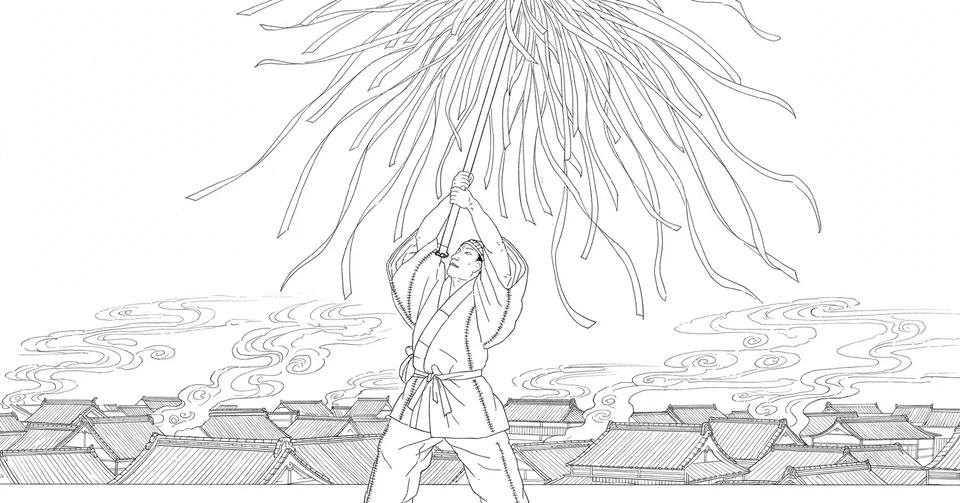
The men working under the standard were the hikeshi, the firefighters of Edo, and their method was demolition rather than water. They pulled down the houses standing in the fire's path and starved the flames of fuel, working from the rooftops with hooks and chains. A hook tells you what the hikeshi did. The matoi tells you who they were, and it explains, better than any of their tools, why they stayed on those roofs as long as they did.
What a matoi was made of
Strip away the romance and a matoi was a piece of signalling equipment, built to be read at a distance through smoke. Its base was a long wooden pole, tall enough to clear the rooftops around it. At the top of the pole sat the head, a shaped emblem that carried the brigade's own design, and below the head hung the baren, a burst of tassels, strips of paper or cloth that streamed and shivered as the bearer moved, so that the standard stayed visible even when the air was thick enough to hide the man holding it.
Reference works describe the matoi as a flag used to notify people of a fire near or within a building, which is accurate and somehow undersells it. Ordinary flags are flat. A matoi was closer to a piece of sculpture, a three dimensional crest on a staff, and it was nearer in spirit to a battle standard than to a signal flag. That may be more than a resemblance. It is said that the matoi began as an adaptation of the umajirushi, the great personal standards that commanders carried into battle in the samurai centuries, reused in peacetime by the shogunate's own firemen after the Great Fire of Meireki in 1657 frightened Edo into organising them. Whether or not the line of descent is exact, the logic carried over perfectly. On a battlefield, the standard says where the commander stands and whether his force is still fighting. At a fire, the matoi said the same two things.
Every brigade designed its own. The head might carry the brigade's crest, a character from the syllabary, a tool of the trade, or a symbol of the district it served, and the designs grew elaborate as brigades competed to be recognised. Recognition was the point. In smoke, at night, with several brigades converging on the same burning block, a firefighter who could read the standards above the roofs knew exactly who was already working, where their line was, and where his own crew was needed.
Forty eight brigades, forty eight matoi
The system behind the standards was fixed in 1720, when Edo's town fire companies were set in order as 48 brigades. Each brigade was assigned a character from the iroha, the traditional ordering of the Japanese syllabary, and each carried that identity on its matoi. The arrangement turned the map of Edo into something a resident could read from the rooftops during a fire. If you knew the characters, the standards told you which neighbourhood's men were fighting above your street.
A firefighter's jacket preserved in the Victoria and Albert Museum shows how thoroughly the matoi soaked into a brigade's identity. The jacket, made in the last decades of the nineteenth century, is dyed on its decorated side with the matoi of the Mo brigade, one of the companies identified by a syllabary character, responsible for the Ginza district. Because Ginza was the site of the city's silver mint, the Mo brigade worked a weight, a fundō of the kind used for weighing coin metal, into the design on its standard. The museum notes the practical purpose underneath all this heraldry: each brigade had a different and distinctive matoi, and the difference enabled identification and communication in the midst of a blaze.
I find that combination, a weighing tool as a badge of honour, very Edo. The brigades were working men, roofers, carpenters and labourers for the most part, and their proudest emblems were not crests granted by lords. They were the furniture of their own streets, the mint weight, the shop sign, the syllable painted on the fire tower, raised on a pole and defended like a flag at war.
The man who held the matoi
Carrying the standard was a job in itself, and the hardest one at the fire. The bearer, the matoi mochi, climbed with the pole to the roof on the lee side of the flames and planted himself at the point closest to the fire that the roof allowed. The townspeople called that spot the hana, the flower, and it is one of the reasons the hikeshi were nicknamed the flowers of Edo. From the hana the bearer worked his standard, waving the matoi so that other brigades arriving through the smoke could see who was engaged and hurry to help, and passing the signals his own officers needed, the calls for water to be thrown and for a building to come down.
His position was also a claim, and claims in Edo were money. A brigade whose matoi was seen flying over a street that survived could expect gifts of sake and money from the owners it had saved, so the race through the burning city was partly a race to raise the standard first and be remembered as the crew that held that ground. The matoi, in other words, turned firefighting into something like advertising: the higher and longer your sign stayed up, the better your name in the district afterwards.
Holding it was genuinely dangerous, and everyone knew it. The American naturalist Edward Morse, watching Tokyo fires in the late 1870s, a decade after the Edo period had formally ended, described standard bearers standing on ridge poles while water was thrown over them instead of at the flames, a detail that tells you the men were expected to burn before the fire did. Morse also recorded that bearers often lost their lives by remaining at their posts too long. The pole gave a man nowhere to hide. His hands were full, his position was the most exposed on the roof, and the whole street could see whether he was still there.
Why the matoi was not allowed to fall
A standard creates a simple public fact: while it stands, its owners are still in the fight. Let it fall, or carry it away early, and the same public draws the opposite conclusion just as fast. That visibility is why the matoi became a point of honour out of all proportion to its usefulness. Dropping the standard did not just lose a piece of equipment. It announced, in front of the entire district, that a brigade had quit a fire, and a town brigade lived on its name between fires as much as during them.
I think there is a hard, practical wisdom in making courage visible on purpose. A firefighter on a roof, alone in the sparks, might reasonably decide that he has done enough, and no one below could prove otherwise. Put his brigade's emblem in his hands and raise his name above the roofline, and the decision changes character. He is no longer an anonymous man retreating from a bad spot. He is the Mo brigade leaving its post, with the whole of Ginza watching. The matoi was a device for making it socially expensive to run, built by men who understood exactly how much willpower heat can take out of a person, and who chose to spend honour where water would not work.
The identity marked on the standard did not stay on the pole. Brigades painted the same crests and characters onto their reversible jackets, plain side out in the fire, pictured side out after a victory and on festival days, so that a winning crew walked home wearing its flag. And many hikeshi carried the same visual language further in, in the dragons, waves and water gods of full back irezumi, inked on the theory that what guarded the brigade in symbol might guard the man in fact. Standard, coat and skin were three versions of one statement: this is who I am, this is who I stand with, and I am staying.
The matoi after the age of fires
The world that needed the matoi ended with the Edo period. Organised municipal fire services replaced the town brigades, pumps and engines replaced demolition as the core technique, and the standard lost its job. What it did not lose was its place in the city's memory of itself. The matoi survived as ceremony, carried at festivals by the preservation societies that keep Edo firemanship alive, its tassels still streaming over crowds instead of rooftops.
In modern Japan the matoi is used only for ceremonial purposes, most visibly at Dezomeshiki, the New Year firemen's parade, where Tokyo's firefighters open the year with displays of the old skills, including the ladder acrobatics of the tobi, the roof men who once worked beside the standard bearer. The objects themselves have passed into keeping rather than use. The Fire Museum of the Tokyo Fire Department holds a large collection of replica matoi, and an artwork dated 1833 in the Edo-Tokyo Museum shows firefighters with matoi and ladders already striking the pose that prints would make famous: the pole up, the streamers out, the man silhouetted over a burning street. Even in its own century, the matoi was already becoming the picture Edo wanted to keep of its fires.
There is something quietly fitting in that afterlife. The matoi began as the most practical object at a fire, a name and a signal in a city that burned too often to afford confusion, and it lasted because the practical thing and the proud thing turned out to be the same pole. Radios, lights and reflective stripes do its work now, faster and better, and no modern firefighter is asked to stand on a ridge pole holding still in the sparks. But every January, when the standards go up over the Dezomeshiki ground and the tassels catch the winter light, Tokyo still reads them the way Edo did: not as decoration, but as a promise being made in public, by people who intend to be seen keeping it.
More in Culture & Society
Latest posts
- Shimekasu Was Herring You Never Ate
- A Hana Donko Wears Its Cracks Like Flowers
- A Lembaga Perkreditan Desa Is a Bank the Village Owns
- Kaburiyu Is How You Talk Your Body Into the Bath
- Kuki Is the Spring the Sea Turned White
- Tatsuko Wished for Beauty and Became a Statue
- Warangan Is the Wash That Reveals the Pattern
- Ganbanyoku Is Bathing Without Water
- The Obuki Throws Out Nine Thousand Litres a Minute
- Every Village Writes Its Own Awig-Awig
- Sainokawara Is a Bath You Share With a Hundred Strangers
- Umaji Refused to Disappear
- Rwa Bhineda Keeps Opposites From Going to War
- Kasepekang Is Exile Without Leaving Home
- Jamasan Washes a Blade Thinner Every Year