The Cave Where Amaterasu Hid the Sun
· 16 min read
Amaterasu, the sun goddess of Japanese myth, once hid in a cave and left the world in darkness until music, dance and a mirror lured her back into the light.
Imagine waking one morning to a sky that never brightens. The birds do not sing because they cannot tell morning from night. The rice in the fields stops growing. The gods themselves gather in the dark and whisper, because the sun has gone away and no one knows how to bring it back. That is how the oldest story in Japan begins, and it begins with Amaterasu.
The story is not a riddle for scholars only. It is told at shrines, painted on scrolls, danced in village festivals and carved into the way Japan still thinks about light. Amaterasu is the sun goddess, the highest kami in Shinto, and the cave she hid in is one of the most famous places in Japanese myth, even though no one can point to it on an ordinary map.
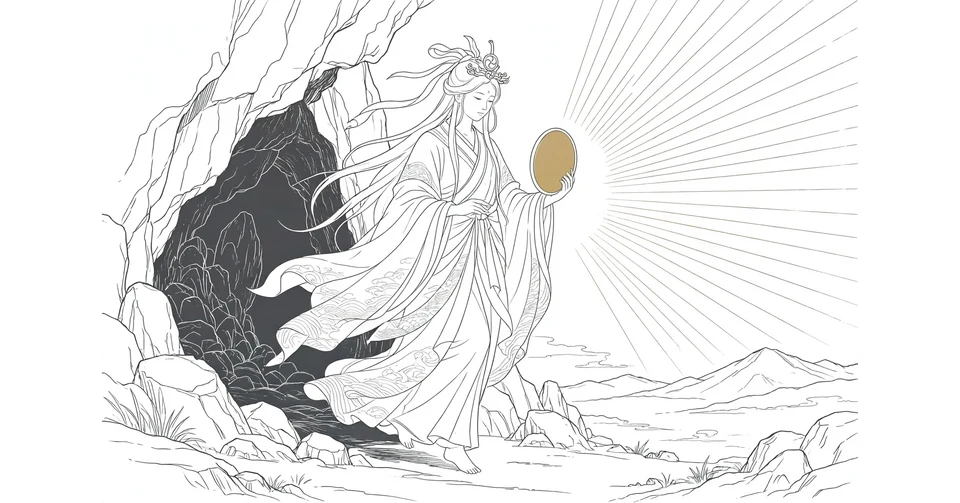
The tale is short enough to tell in a minute and deep enough to spend a lifetime unpacking. A goddess is hurt by her own brother, she withdraws from the world, and the world goes dark. The other gods do not drag her out by force. They make music, they dance, they laugh, and they hold up a mirror, and curiosity does what force could not. That choice, to answer darkness with a festival rather than a fight, is the heart of the story, and it still shapes how Japan understands Amaterasu today.
Why Amaterasu hid in the cave
Amaterasu ruled Takamagahara, the Plain of High Heaven, where the gods lived. Her younger brother Susanoo, the storm god, came up to heaven to say farewell before leaving for his own realm, and Amaterasu met him in armor, suspicious of his intentions. The two performed a trial by pledge to test his sincerity, and children were born from the trial. Amaterasu claimed the five male children as her own, and Susanoo, convinced he had proven himself, celebrated in the worst possible way.
He went on a rampage through heaven. He broke down the ridges between Amaterasu's rice fields and ruined her crops. He defiled her palace. Then he tore a hole in the roof of her weaving hall and threw a flayed horse through it. In the Kojiki version of the story, one of Amaterasu's weaving women was so startled that she struck herself against a shuttle and died. In the Nihon Shoki version, Amaterasu herself was wounded by the shuttle. The two old chronicles disagree on who was hurt, and that disagreement is worth remembering, because it shows how these stories were told and retold, with details shifting between tellings.
What both chronicles agree on is the ending of that day. Amaterasu, furious and grieving, shut herself inside the Ama-no-Iwato, the Heavenly Rock Cave, and rolled a great boulder across its mouth. With the sun goddess hidden, heaven and earth fell into total darkness. The gods could not see, the crops could not grow, and the world filled with the noise of restless spirits. Amaterasu had not destroyed the world. She had simply withdrawn her light from it, and that was enough.
Music, dance and a mirror
The gods gathered in the dark to decide what to do. The wise god Omoikane thought of a plan that is still worth studying today. Instead of begging or threatening, the gods would throw a festival so joyful that Amaterasu would want to see it for herself. They gathered roosters, the long crying birds, and made them cry as if dawn were coming. They uprooted a sacred sakaki tree from a mountain and hung it with jewels, cloth and a great mirror. The mirror was made by the smith god Ishikoridome, and the jewels by Tamanoya.
Then Ame-no-Uzume, the goddess of dance and mirth, stepped forward. She overturned a wooden bucket in front of the cave, climbed on top of it and danced, stamping loudly, until she was so caught up in the dance that she bared her breasts and let her clothes slip. The eight hundred myriad gods roared with laughter, and the whole Plain of High Heaven shook with the sound. It is a strange scene to picture, a sacred dance that is also a joke, but that is exactly the point. The gods were not performing a solemn rite. They were having fun, loudly, on purpose.
Inside the cave, Amaterasu heard the laughter and could not understand it. How could the gods be celebrating when she, the sun, was gone? She slid the boulder aside a little and asked what the noise was about. Ame-no-Uzume answered that they were celebrating because a goddess even greater than Amaterasu had appeared. Curious, Amaterasu leaned out further. The gods Ame-no-Koyane and Futodama held up the mirror, and Amaterasu saw her own shining face looking back at her. She stepped closer, thinking this must be the new goddess, and the strong god Ame-no-Tajikarao took her hand and pulled her out into the light. At once the other gods stretched a straw rope across the mouth of the cave so she could not go back inside. Light returned to the world.
I find something quietly wise in this plan. The gods did not solve the problem by arguing about who was right. They made the world outside the cave more interesting than the darkness inside it. Anyone who has ever tried to coax a hurt friend out of a closed room knows the same truth. A lecture rarely works, but laughter and music sometimes do. The story of Amaterasu suggests that even the sun can be lured back by joy.
Who Amaterasu is
The name Amaterasu means the great august deity who shines in heaven, from ama, meaning sky or heaven, and teru, meaning to shine. She is usually called Amaterasu Omikami, with Omikami meaning great august deity, and the Encyclopedia of Shinto describes her as the kami of the sun and the highest of all kami entrusted with rule over the Plain of High Heaven. She is the chief deity of the Shinto pantheon and the ruler of the heavenly realm, and she is also the most human of the great gods, because she feels anger, grief and curiosity, and she acts on all three.
Her birth is told in two ways, and both are worth knowing. In the Kojiki, compiled around 712, Amaterasu was born when the creator god Izanagi washed his left eye while purifying himself in a river after a journey to the underworld. Her brother Tsukuyomi, the moon, was born from his right eye, and Susanoo from his nose. In the Nihon Shoki, compiled in 720, the main text says Izanagi and his wife Izanami decided together to produce a child who would be lord of all, and the child they produced shone so brightly that her parents sent her up to heaven to rule. The details differ, but the meaning is the same in both books. Amaterasu was set above all the other gods from the beginning.
She was one of the three precious children, the most important offspring of Izanagi, with Tsukuyomi ruling the night and Susanoo the seas. That family arrangement explains a lot about the cave story. It was not a stranger who hurt Amaterasu. It was her own younger brother, and the hurt was worse because it came from inside the family. Myths from many countries tell of family quarrels among gods, but few of them make the quarrel cost the whole world its light.
The mirror, the jewel and the sword
The mirror that lured Amaterasu from the cave did not disappear from the story once its work was done. It became the Yata no Kagami, the eight span mirror, one of the three sacred treasures of the imperial house. The other two were the Yasakani no Magatama, a curved jewel, and the sword Kusanagi, which Susanoo found inside the serpent Yamata no Orochi and presented to Amaterasu as a gift of reconciliation after he was driven out of heaven. Together the three objects came to stand for the legitimacy of the imperial line, and they are still treated as sacred today.
Amaterasu gave the mirror and the jewel to her grandson Ninigi when she sent him down from heaven to rule the land below. Ninigi descended to Mount Takachiho with a retinue of gods, and his great grandson Jimmu later became the first emperor in the traditional account. The mirror was not just a pretty object. According to the Encyclopedia of Shinto, Amaterasu entrusted it to Ninigi as her own spirit vessel, a physical home for her presence, so that she would be with him as he pacified the land. That is why the mirror matters so much. It is the object that once showed the sun goddess her own face, and it became the sign that she was present with her descendants.
It is important to be clear about what is myth and what is history here. The Kojiki and the Nihon Shoki are real books, written in the early eighth century, but the events they describe belong to myth, not to recorded history. No historian treats Jimmu as a datable historical figure, and the descent of Ninigi cannot be verified the way a battle or a treaty can. What can be verified is that these stories were believed, retold and built into the rituals of the imperial court, and that belief itself shaped Japanese history for more than a thousand years. The cave, the mirror and the descent are true in the way that founding stories are true, which is not the same as being true in the way a census is true.
From a goddess to an imperial line
Because Amaterasu is the ancestress of the imperial family through Ninigi, her story is also the story of how Japan explained its emperors. The Nihon Shoki says that the emperors are her direct descendants, and for centuries the court treated that descent as the foundation of imperial authority. The sacred mirror kept at Ise is the visible link in that chain, passed down through the generations as proof that the emperor rules with the sun goddess behind him.
That claim had real consequences. In the centuries when the imperial court held power, the story of Amaterasu gave the emperor a divine standing that no rival could easily challenge. In the modern era, the claim became controversial, and after the Second World War the emperor issued the Humanity Declaration of 1946, renouncing the idea that the emperor was a living god. The declaration did not erase Amaterasu from Japanese life. It separated the religious idea of the emperor as a descendant of the sun goddess from the political claim of divinity, and the goddess herself remained at the center of Shinto.
I think there is a lesson in that separation. A story can lose its political power and keep its cultural power. Amaterasu is no longer the legal basis for anything, but she is still the sun goddess, still the reason for the most important shrine in Japan, and still the figure children meet first when they hear Japanese mythology. A myth that survives the loss of its political use is a myth that was never only about politics.
Ise, the shrine that rebuilds itself
The chief place of worship for Amaterasu is Ise Jingu, the Grand Shrine of Ise in Mie Prefecture, and it is unlike any other famous shrine in the world. The complex holds 125 shrines, centered on two main ones. Naiku, the Inner Shrine, is dedicated to Amaterasu, and Geku, the Outer Shrine, is dedicated to Toyouke, the goddess of food who provides her meals. The shrine's own account says the sacred mirror was carried to Ise by the princess Yamatohime, who searched many regions for a home for the goddess before receiving a revelation that she should be enshrined beside the Isuzu River. The shrine dates that enshrinement to about 2,000 years ago.
What makes Ise extraordinary is that it is rebuilt. Every 20 years, in a rite called Shikinen Sengu, the main sanctuaries are taken down and rebuilt in identical form on an adjacent plot, and the sacred treasures are remade as well. The tradition goes back to the seventh century, with the first rebuilding commonly dated to 690, and it was interrupted for more than a century in the medieval period before being restored. The most recent rebuilding, the 62nd, was completed in 2013, and the 63rd is scheduled for 2033. The Japan National Tourism Organization notes that each cycle of reconstruction takes eight years to complete, which means the work for 2033 is already underway.
The idea behind the rebuilding is called tokowaka, everlasting youth, the belief that a sacred thing stays alive by being made new. Most of the world preserves holy places by keeping the old stones standing as long as possible. Ise does the opposite. It keeps the buildings young so that the tradition stays old, and it passes the craft of building from one generation of carpenters to the next by making them do the work again. A visitor to Ise therefore sees buildings that are both ancient and new, and that contradiction is the point. Amaterasu has been worshipped there for some two thousand years, and the shrine refuses to let her home grow old.
Crossing the Uji Bridge over the Isuzu River to reach Naiku feels like a small version of the cave story in reverse. The bridge marks the boundary between the everyday world and the sacred one, and passing over it is a deliberate act, a step from noise into quiet. A torii gate marks where the ordinary world ends in the same way, standing at the threshold between the human world and the world of the kami. The cave was a door that closed, and the shrine is a door that opens, and both of them are about the same thing, the line between darkness and light.
The flag and the land of the rising sun
The red disc on the Japanese flag is called the hinomaru, the circle of the sun, and it is one of the simplest flags in the world. A red sun on a white field, with nothing else. It was used as a national symbol for centuries before it was formally established by law in 1999, and its simplicity is part of its power. It does not show a goddess, a mountain or a wave. It shows the sun itself, and anyone who knows the story of Amaterasu will see her in it, even though the flag was never officially designed as a portrait of the goddess.
The connection runs deeper than the flag. Japan calls itself Nihon or Nippon, written with characters meaning origin of the sun, which is why the English phrase land of the rising sun has clung to the country for so long. The sun is the highest god in Shinto, the sun goddess Amaterasu, and Japan calls itself the land of the rising sun, and that is no coincidence of language. A country that places a sun goddess at the top of its pantheon and then names itself after the sunrise is telling the world who it thinks it is. Hatsu-hinode, the first sunrise Japan wakes up for, carries the same feeling into the New Year, when crowds gather on beaches and mountaintops to watch the first light of the year rise, and to make a wish while it does.
I should be careful here, because it is tempting to claim more than the evidence supports. No document proves that the flag was designed to depict Amaterasu, and the name Nihon came into use through diplomacy with China, not through a shrine ritual. The honest version is more interesting than the neat one. The sun was already sacred in Japan before the flag and the name existed, and the flag and the name gave that sacredness a shape that the whole world could recognize. Amaterasu did not design the flag, but the flag makes sense in a country that worships her.
Why the story still matters
The cave story endures because it is about something everyone has felt. There are days when the light goes out, when a quarrel or a loss makes the world feel dark, and the temptation is to stay inside the cave and let the boulder stay where it is. The myth does not pretend that the darkness is unreal or that it can be argued away. It says the darkness is real, the hurt is real, and the way back is not a command but an invitation. Music, dance, laughter and a mirror, these are the tools the gods chose, and they are gentle tools.
Amaterasu also endures because she is more than the heroine of one story. She is the ancestor of emperors, the goddess of the most sacred shrine in Japan, the face in the mirror that became a treasure, and the light behind the flag. A single goddess carries all of that without contradiction, because a myth can hold more than one meaning at once. She is the sun in the sky, the light in a dark cave, and the reason a shrine is rebuilt every twenty years so that it never grows old.
If there is a quiet takeaway, it is this. The sun does not return because someone orders it to return. It returns because the world outside becomes worth stepping into again. That is a hopeful way to think about dark times, and it has lasted for thirteen centuries because it is true in a way that has nothing to do with whether the cave can be found on a map. The story of Amaterasu is still being told because people still need it, and as long as the sun rises, they probably always will.
More in Culture & Society
- Miyadashi Is the Moment the God Leaves Home
- Otabisho Is Where the God Rests on the Way Through Town
- Mikoshi Are the Portable Shrines Japan Carries on Its Shoulders
- Sanja Matsuri Turns Asakusa Into Tokyo's Loudest Weekend
- Waraji Straw Sandals Walked Japan for a Thousand Years
- Fujin Carries the Wind That Arrives Before the Thunder
Latest posts
- An Engawa Is Neither Inside nor Outside, and That Is the Point
- Nikko and the Shrines Hidden in the Cedar Forest
- Minka Are the Folk Houses Japan Built Around the Hearth
- The Orangutan and the Vanishing Forests of Borneo
- Hozomon Guards the Treasure House Behind Senso-ji's Main Hall
- Nakamise Is the Shopping Street That Has Fed Pilgrims for Centuries
- Kaminarimon Is the Thunder Gate That Opens Asakusa to the World
- Sony, the Tokyo Workshop That Taught the World to Listen
- Raijin Is the Thunder God Behind Japan's Summer Storms
- Tengu Is the Mountain Goblin Japan Still Meets on the Trail
- Kappa Is the River Imp Japan Still Warns Its Children About
- Calonarang Is the Night Rangda and Barong Finally Meet
- Yamata no Orochi Was Never Just a Monster to Slay
- Kit Kat Japan, the Flavours You Will Not Find Anywhere Else
- How Susanoo Slew the Eight-Headed Serpent and Won a Bride