Nukazuke Is the Living Pickle Bed Japan Feeds Every Day
· 28 min read
Nukazuke is Japan's rice bran pickle, made in a living bed of bran, salt and water that must be stirred by hand every day, and this guide explains how it works and how to keep one alive at home.
There is a container in many Japanese kitchens that never gets washed out, never gets emptied, and never really gets a day off. Inside it sits a brown, damp mash that smells faintly sour and yeasty, like bread dough that has been left to think. That mash is a nukadoko, a rice bran bed, and the pickles that come out of it are nukazuke, the branch of Japanese pickling that asks for a relationship.
Nukazuke is not a recipe you follow once and forget. It is a small living system you feed, stir and watch, and in return it turns ordinary cucumbers, carrots and daikon into something salty, sour and crisp that no quick pickle can match. A bed kept well can last for years, and some are passed down from one generation to the next, each one tasting slightly different depending on the hands that stir it.
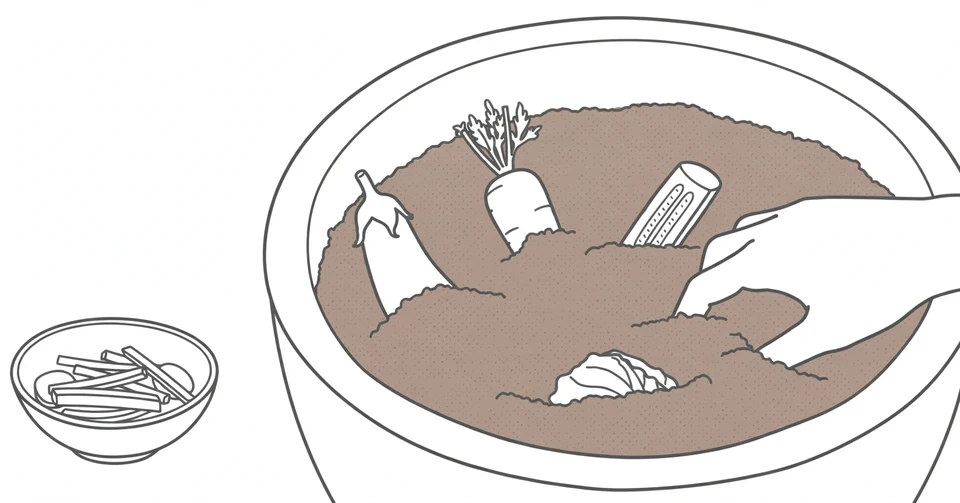
This guide explains what nukazuke is, how the bed works, what lives inside it, and how to start one at home without ruining it in the first week. It also covers which vegetables do best, how nukazuke compares with its cousins in the tsukemono family, and what to do when the bed starts smelling wrong. You do not need rare equipment to begin, but you do need one thing no shop can sell you, which is the habit of showing up every day.
What nukazuke actually is
Nukazuke is a type of traditional Japanese preserved food, made by fermenting vegetables in rice bran, and it developed in the 17th century. The word breaks apart neatly. Nuka means rice bran, the fine golden layer that comes off when rice is polished, and zuke means pickled. The vegetables are buried whole or in large pieces in a mash of bran, salt and water, and left there until the salt and the microbes have done their work. When they come out, they are rinsed, sliced thin, and served beside rice and miso soup.
The mash itself has its own name, nukadoko, which means bran bed, and it is also called nukamiso. It has the consistency of wet sand or cooked grits, and it holds the whole secret of nukazuke. The bed is alive with lactic acid bacteria and yeasts, and those tiny organisms are what turn a raw cucumber into a pickle. Salt draws water out of the vegetables, the bacteria turn sugars into lactic acid, and the acid gives nukazuke its gentle tang while keeping unwanted microbes from taking over. The process is slow, quiet and mostly invisible, which is why nukazuke rewards a cook who pays attention to small changes in smell and texture rather than one who watches the clock.
Almost any vegetable can be preserved this way, although the classics are cucumber, eggplant, daikon, cabbage, carrot and turnip. The taste of nukazuke can vary from pleasantly tangy to very sour, salty and pungent, depending on the recipe, the region and the age of the bed, and the texture is usually crisp and crunchy. Less common versions use fish, and in the north of Japan there are nukazuke made with sardine, mackerel and horse mackerel, but the vegetable kind is the one most people mean when they say the word. For the full family tree of Japanese pickles, the guide to tsukemono on this site sets out how the bran branch fits beside salt, vinegar, miso and sake lees.
What makes nukazuke different from most pickles is that the medium is not used once and thrown away. A vinegar brine is spent after one batch. A nukadoko is kept, fed and stirred, and it gets better with age. Old nukazuke beds are valued for their nuanced flavor, and cooks talk about them the way bakers talk about a sourdough starter, which is a fair comparison, since both are colonies of microbes kept alive by regular feeding and both pick up subtle flavors from the kitchen around them. A nukazuke bed should not be stored in a musty place, because it absorbs the character of its surroundings, for better and for worse.
The bed itself, bran salt and water
A nukadoko starts with three things: dry rice bran, salt and water. The bran is first mixed in a crock with salt, kombu seaweed and water, and the mixture is kneaded by hand until it feels like wet sand. Extra ingredients can be added for flavor and to help fermentation along, including ginger, beer, sake, dried red chillies, garlic, persimmon or apple peels, and powdered mustard seed. Each household has its own combination, and the bed becomes a record of those choices, which is one reason no two beds ever taste exactly alike.
The proportions matter, and the careful guides agree on the shape of them even when the exact numbers differ. The salt content of the bed should stay at about five to six percent of the total weight, counting the bran, salt and water together. One detailed modern guide starts with 500 grams of bran, about 70 grams of salt and 600 grams of water, which works out to six percent salt by total weight. The salt is not only there for flavor. It draws water from the vegetables, it slows down the microbes that would spoil the food, and it gives the lactic acid bacteria room to establish themselves. Too little salt and the bed can turn, too much and the pickles come out harsh. Getting the salt right is the first skill of nukazuke, and it is worth measuring with a scale rather than guessing by eye.
The container matters less than the care. Traditionally, Japanese cedar tubs called oke were used for fermenting pickles, and today ceramic or plastic containers are more common. What matters is that the container is food safe, has a lid, and is wide enough to let your hands reach the bottom, because you will be stirring it every day. A three liter container is a sensible size for a first bed, large enough to hold a few vegetables at once and small enough to manage on a kitchen counter. Wash it with hot soapy water, rinse it well, and dry it before the bran goes in.
Roasted bran and raw bran both work. If the bran you buy is raw, you can toast it first in a dry pan, stirring all the time, until it smells like fresh bread, then let it cool completely before mixing. The toasting is optional, but it gives the bed a warmer, nuttier character from the start. Some cooks buy ready made nukadoko in a bag from a Japanese supermarket, which already contains salt and seasonings, and that is a perfectly good way to begin. Follow the packet instructions, and you still get the daily stirring and the slow education that comes with it. Starting from a bag does not make the nukazuke any less yours, since the bed changes the moment your hands and your kitchen start shaping it.
A short history, from the Edo period to the modern kitchen
Nukazuke developed in the 17th century, which places its birth in the Edo period, a time when Japan was at peace, its cities were growing, and rice was the center of both the diet and the economy. Rice bran was the obvious medium for a pickle, because milling rice produced it in large quantities and it cost almost nothing. Farmhouse kitchens had bran to spare, and a household could keep a living bran bed going for years, feeding it fresh bran and salt the way a baker feeds a starter. Salt pickling stayed the everyday method, but the bran bed offered something salt alone could not, which was a deep, sour, yeasty flavor that improved with time.
There is a serious side to that history. The lactic acid bacteria in nukazuke are probiotics that support the intestinal flora, and they also produce folate and vitamin B12. Because nukazuke absorbs nutrients from the rice bran, it is high in vitamin B1, and that vitamin helped prevent beri-beri in 17th century Edo, the city we now call Tokyo. Beri-beri was a real and feared disease in a society that ate large amounts of polished white rice, which had lost the thiamine in the bran. The pickle that used the discarded bran put some of that nourishment back on the table. It is a neat piece of kitchen wisdom, turning a milling byproduct into both flavor and medicine, and it is worth remembering the next time someone calls pickles a mere side dish. You can read the full background on Wikipedia's guide to nukazuke, which sets out the history, the method and the science in one place.
The nukazuke bed also fitted the rhythms of a household without refrigeration. A family that kept a nukadoko could preserve the summer glut of cucumbers and eggplants through the months when fresh vegetables were scarce, and the pickle stopped being emergency food and became part of the meal itself. Pickles are an important part of the Japanese diet, often eaten at the end of a meal, and they are said to aid digestion, which is another reason a small dish of nukazuke earned its permanent place beside the rice. In a food culture that values restraint, a pickle that does one small job well earns more respect than a large dish that tries to do everything.
I find the history quietly moving, because it is a story of people making the most of what they already had. Nobody set out to invent a health food. They had bran, they had salt, they had vegetables that would rot, and they had hands. Out of that came a living food that is still made the same way four centuries later. That kind of continuity is rare, and it is one reason nukazuke feels less like a recipe and more like an inheritance.
What lives in the bed
The engine of nukazuke is fermentation, and the workers are lactic acid bacteria and yeasts. When vegetables are buried in a nukazuke bed, the salt draws out their water, and the bacteria feed on the sugars in that water and produce lactic acid. The acid lowers the pH of the bed, which gives the pickles their sourness and makes the bed a hostile place for the microbes that cause spoilage. It is the same basic process behind sauerkraut, kimchi and yogurt, and nukazuke belongs in that family of foods even though its flavor is entirely its own.
A new nukazuke bed is not alive yet. Unless a cook seeds a fresh batch with a spoonful of well seasoned bran from an older bed, the lactic acid producing colonies must come from somewhere, and they arrive on the skin of the starter vegetables or from human hands. That is why the traditional method starts with sacrificial vegetables, usually cabbage leaves or vegetable scraps, buried in the bed for the first days and then thrown away. The scraps are not food, they are bait. They carry the bacteria in, they feed them, and they are replaced with fresh ones every two or three days until the bed turns acidic and develops its own culture. At that point the bed is live, meaning it contains an active culture of single celled organisms, mostly lactobacilli and yeast, and real pickling can begin.
The smell tells you where the bed stands. At first it smells of raw bran, plain and dusty. Little by little it starts to smell sour and fruity, which is the sign that it is alive. Once the fermenting cultures have been established, the bed develops a complex aroma that may be described as anything from yeasty to earthy, and every bed smells slightly different. An unpleasant sour or stinky smell may indicate a problem, and a smell like solvent or nail polish remover means yeasts have taken over, usually because the bed has gone too long without stirring. The nose is the most honest tool in this craft, and learning to trust it is part of keeping nukazuke well.
Temperature shapes everything. The bacteria work fastest in warmth, roughly 20 to 25 degrees Celsius, and slow down in the cold. In summer a cucumber can be ready in as little as five or six hours, while in winter the same vegetable can take two or three days. That variation is normal, and it is why a good cook tastes the pickles rather than timing them. The bed itself also changes with the seasons, fermenting faster in August and going quiet in January, and the daily stirring keeps it balanced through both. Because the process depends on colonies of live organisms, flavors and smells can vary considerably from day to day, and that variation is not a flaw. It is the nature of a living food.
How to start a bed at home
Starting nukazuke takes patience more than skill, and the first two or three weeks are the hardest part, because the bed is not yet ready to eat from. Here is the shape of the process, drawn from a careful modern guide that measures everything and explains where every number comes from. Mix 500 grams of rice bran with about 70 grams of salt, then add about 600 grams of water a little at a time, kneading with clean hands until the mixture feels like wet sand or miso paste. Add a piece of dried kombu, a few dried red chillies with their stems and seeds removed, and any other seasonings you like, then press the bed into the container so no air pockets are left, smooth the top, wipe the sides clean, and put the lid on.
Then comes the waiting. Bury washed cabbage leaves or vegetable scraps in the bed, swap them for fresh ones every two or three days, and throw the old ones away. Stir the bed every day, and keep it at room temperature. Before you eat the first real vegetables, check the acidity. Mix a spoonful of the bed with a little distilled water, wait a few minutes, and dip a pH strip in it. It needs to read 4.6 or lower. If it reads higher, keep going with scraps and check again in a few days. It takes at least two to three weeks to get a nukazuke bed going, and it can take more than a month. In one study the pH of a new bed fell from 6.0 to 4.0 over 38 days, and no vegetables were pickled until day 40. That sounds slow, and it is, but the wait is the whole point. A bed that is rushed will not protect the vegetables, and the pickles will taste of raw bran instead of fermentation. The step by step guide to the rice bran bed walks through the same process with photos of each stage, and it is worth reading in full before you mix your first batch.
Once the bed is acidic, the real nukazuke pickling begins. Wash the vegetables under running water, bury them whole or in large pieces, well covered with bran on all sides, and pat the bed down evenly. Taste a cucumber after a few hours, and give a carrot or a turnip a day or more. The timing depends on the vegetable, its size and the warmth of the room, so tasting is the only reliable test. When the pickles are ready, take them out, brush the bran back into the bed, rinse the vegetables in cool clean water, slice them thin, and serve them at once. Whatever you do not eat goes straight into the refrigerator and should be eaten within two days, because nukazuke from a fresh bed is a fresh pickle with only one to three percent salt, not a long keeping preserve.
There is a shortcut, and it is worth knowing about. If a friend keeps a nukadoko, ask for a spoonful of their old bran to seed your new bed. A bit of well seasoned bran from an older batch gives the fresh bed its culture on day one instead of week three, and the bed establishes itself far faster. This is also how beds were traditionally shared between households, and it is a small reminder that fermentation has always been a communal craft as much as a solitary one. If no one you know keeps a bed, the scraps method works fine, it only asks for more patience.
The daily turning, by hand
The single most important rule of nukazuke is also the simplest: stir the bed every day. The bed must be stirred well daily to keep it from becoming putrescent, moldy or infested, and it is universally recommended that this daily stirring be done with clean bare hands. Reach to the bottom, bring what is underneath up to the top, fold the bed over on itself, press it down, smooth the surface, wipe the sides and put the lid back on. The whole job takes a minute, and skipping it is the fastest way to lose a bed.
Stirring does three things at once. It brings oxygen into the bed, which the yeasts on the surface need, and it mixes that oxygenated top layer down with the lactic acid bacteria living deeper inside, keeping the two populations in balance. It also keeps the salt and acidity even throughout the bed, so no pocket goes stale. Left unstirred, a few yeasts take over the surface and make the bed smell off, like solvent or nail polish remover, and mold can follow. The acidity, salt content and oxygenation provided by daily stirring is what keeps toxic microbes from growing, so the chore is not cosmetic. It is the safety system of nukazuke.
There is something honest about nukazuke, a food that demands to be touched. The traditional method is done with bare hands, and the bacteria from the hands become part of the bed, which is why each bed tastes different depending on who stirs it. Some cooks find this idea unappealing, and clean hands are genuinely essential, but the contact is the point. A spoon cannot feel whether the bed is too wet or too dry, whether the texture has gone slack, or whether a pocket of bran has gone untouched at the corner. Your hands can, and they learn fast. After a week of daily stirring, you will know the state of your nukazuke bed the way you know the state of your own kitchen, without thinking about it.
When daily stirring is not possible, the bed can be stored temporarily in the refrigerator for up to two weeks. The cold slows the microbes down, so the bed needs less looking after, and the pickles will also take longer. This is the practical answer for a holiday or a busy stretch, and it is far better than leaving a bed warm and unstirred on the counter. When you return, bring it back to room temperature, stir it well, and give it a day or two before burying fresh vegetables. A well kept bed forgives a short absence, but it does not forgive being forgotten.
Feeding the nukazuke bed is the other half of daily care. Each batch of vegetables takes salt from the bed and leaves water behind, so over time the bed shrinks and gets wet. Soak up any water on the surface with a clean cloth, and add fresh bran with its salt when the bed needs it. A useful proportion is about 11 to 12.5 grams of salt for every 100 grams of fresh bran, and some guides recommend discarding a portion of the old bran to make way for the new. In one study, salt had to be added four times in just over a month, which shows how quickly a busy bed consumes its salt. With this kind of care, a nukadoko can be kept indefinitely, and beds are often passed down from generation to generation.
What vegetables work best, and how long they take
Almost any vegetable can become nukazuke, but some are better suited than others, and the difference is mostly about water content, density and skin. Cucumbers are the classic first pickle, because they are quick, forgiving and unmistakable when they are ready, crisp and sour with the bran aroma sitting gently behind the cucumber flavor. Daikon is the other great classic, and daikon pickled in rice bran becomes takuan, bright yellow and firm, with a clean crunch that makes it a natural partner for rice. The traditional yellow color comes from dried gardenia fruit in the pickling mixture, though much commercial takuan today is colored artificially.
Eggplant, carrot, turnip and cabbage all do well, and each one takes its turn at a different speed. A cucumber can be ready in a few hours in warm weather, while a dense carrot or a thick piece of daikon may need a day or more. Small vegetables and thin pieces pickle faster, so cutting a vegetable lengthwise into sticks speeds things up, while a whole small eggplant or a thick turnip asks for patience. The rule is simple: taste early, taste often, and pull the vegetable out when it tastes right to you, not when a clock says so. A nukazuke pickle left too long in the bed gets too strong and too salty, and the pleasure of nukazuke is in the balance, not the extreme.
There are a few practical habits worth keeping. Salt the vegetables lightly before burying them if they are very wet, since that helps draw out water before the bed has to deal with it. Bury each piece so it is covered on all sides, with no part poking above the surface, because exposed vegetable dries out and picks up off flavors. Keep the bed at a steady temperature, and remember that fermentation slows in colder weather, so winter pickles need more time. And when you pull a pickle out, brush the bran back into the bed rather than washing it down the sink, because that bran is part of the living culture you are trying to keep.
Some vegetables are better avoided. Very soft or leafy ones can turn mushy and fall apart in the bed, and vegetables with strong flavors of their own, like onion or garlic in large amounts, can dominate the bed and change its character for every pickle after. That is not a strict ban, only a warning, and an experienced keeper can experiment freely. But for a first bed, stay with the classics. Cucumber, carrot, daikon, turnip, eggplant and cabbage will teach you everything you need to know about how nukazuke behaves, and they will do it without any unpleasant surprises.
Nukazuke beside its cousins
Nukazuke is one branch of a large family, and comparing it with its cousins is the fastest way to understand what makes it special. Shiozuke, salt pickling, is the simplest branch and the best place for a beginner. Vegetables are salted, pressed under a weight, and left until the salt has drawn out water and firmed the flesh. The result is clean and direct, the flavor of the vegetable itself with the edges sharpened. A cucumber can be salted in the morning and eaten as a pickle by dinner. Nukazuke is slower and deeper, trading that immediacy for a sour, yeasty complexity that salt alone cannot give.
Misozuke, miso pickling, is the closest cousin in spirit, because it also uses a living bed. The vegetable rests in a miso bed called a misodoko, usually mixed with a little mirin and sugar, and the pickling time runs from a few hours to a few days. Carrots and radishes come out savory, slightly sweet and still crisp, and the miso bed can be reused for batch after batch, with the flavor deepening as it ages. The difference is the commitment. A miso bed lives in the refrigerator and asks little of you, while a nukadoko sits on the counter and asks for your hands every day. Miso gives you richness without a relationship. Nukazuke gives you both.
Kasuzuke, sake lees pickling, is the branch where the medium does the most work. The lees are kneaded into a seasoned bed, usually with white miso, sugar and salt, loosened with sake, and enzymes left over from fermentation loosen proteins into amino acids and nudge starches toward sugar, so the flavor changes through the ingredient rather than sitting on its surface. A salmon fillet can spend a single night in the bed and go to the grill tasting faintly of the brewery, while a melon can sleep there for years. If you want the full story of that branch, the kasuzuke pickles on this site walk through the bed, the method and the history in detail. Kasuzuke is the patient, brewery flavored cousin. Nukazuke is the farmhouse cousin, made from what the rice mill threw away.
The comparison that matters most for a home cook thinking about nukazuke is time against attention. Quick salt pickles ask for an afternoon. Miso asks for a few days and a refrigerator shelf. Nukazuke asks for weeks to start and a minute a day forever after. In return it gives the most personal result of any pickle in the family, because no two beds ever taste alike. That trade is the whole question. If you want a pickle, make a salt pickle. If you want a companion in the kitchen, start a nukadoko.
Flavor, texture, and eating it well
A good nukazuke is easy to recognize, and it announces itself before you taste it. The aroma is yeasty and earthy, with the smell of bran sitting behind a clean sourness. The flavor is salty first, then sour, then something deeper that is hard to name, a savory roundness that comes from the fermentation itself. The texture is the part people remember most, because the pickles stay crisp and crunchy even after days in the bed. That crunch is the reward for the salt and the pressure and the daily care, and it is what separates a well made nukazuke from a pickle that has gone soft and tired.
The flavor of nukazuke changes with time in the bed, and learning that curve is part of the pleasure. A cucumber pulled after a few hours is lightly sour and still very much a cucumber, with the bran as a gentle background note. The same cucumber left for a day is sharper, saltier and more assertive, and after several days it becomes deeply sour and pungent, the kind of pickle that seasons a whole bowl of rice by itself. There is no single correct time, only the time that suits your taste and the meal in front of you. A mild pickle suits a delicate soup. A strong one suits plain rice and a cup of tea. Tasting as you go is not optional, it is the technique.
At the table, nukazuke plays the same role as the rest of the tsukemono family, which is to wake up the palate and balance the meal. A Japanese meal is often built as ichiju sansai, one soup and three dishes, and pickles are commonly counted as one of those three. Rice is mild, soup is warm and savory, the main dish is rich, and the pickle cuts through all of it with salt, sourness and crunch. A few thin slices are enough. Nukazuke is also served with drinks as otsumami, a small snack to accompany sake or beer, and it goes into bento boxes, where a few bright slices keep packed rice interesting hours after it was cooked. In every case the portion is small, and that is deliberate. The pickle is a seasoning and a refreshment, not a main dish.
One honest warning belongs here, and it applies to nukazuke as much as to any pickle. It is salty by design, and the salt is part of what makes it work. Enjoy it in small portions, as the small dish it is meant to be, rather than as a main dish. The pleasure is in the contrast, a little salt against mild rice, and eating a large pile of it misses the point. A few slices, eaten slowly, do more than a bowlful eaten quickly.
When the bed goes wrong
Every keeper of nukazuke meets trouble sooner or later, and most of it is fixable if it is caught early. A white, gray or pink film on the surface is usually kahm yeast, which is common on ferments and not dangerous in itself. Skim it off with a clean spoon, stir the bed more often, and keep going. A sour or stinky smell, or a smell like solvent or nail polish remover, means yeasts have taken over, usually because the bed went too long without stirring. Stir it daily, remove any discolored top layer, and give it a few days to recover. If the bed smells rotten, or if you see fuzzy mold that is green, blue, brown, black, pink or red, throw the whole bed out and start again. Mold on a ferment means the batch is finished, and no amount of skimming makes it safe.
Water is the other common problem for a nukazuke bed. Vegetables give off water as they pickle, and a bed that is too wet goes slack and loses its character. Soak up surface water with a clean cloth, add fresh bran and salt, and discard a portion of the old bran if the bed has grown too large or too wet. Salt is the quiet variable behind many failures. If the salt level drops, the bed loses its protection, so top it up whenever you add bran, using the proportion of about 11 to 12.5 grams of salt for every 100 grams of fresh bran. A bed that is kept salty enough, stirred daily and stored away from musty air is a resilient thing, and most problems trace back to one of those three conditions slipping.
There is also the question of who should eat nukazuke, and it deserves a straight answer. Because these are fresh, lightly salted pickles rather than long keeping preserves, food safety guides advise care for older adults, pregnant women, young children and anyone with a weakened immune system. For those eaters, keep the bed in the refrigerator, where fermentation slows, and eat the vegetables freshly pulled. It is a small precaution, and it costs nothing, but it is worth taking seriously. Fermentation is a partnership with living organisms, and part of keeping a bed well is knowing who it is safe to serve.
I think the trouble is part of the charm, in a strange way. A jar of vinegar pickles never asks anything of you, and it never teaches you anything either. A nukadoko asks for a minute a day, and in return it teaches you to notice small changes, to trust your nose, and to act early when something is off. Those are useful habits far beyond the kitchen. The bed is a small daily practice in attention, and the pickles are the reward, not the other way around.
The living pickle bed, and why it is worth the trouble
Nukazuke is the branch of Japanese pickling that asks for a relationship, and that is exactly why people love it. It is not the quickest pickle, it is not the simplest, and it is not the one you make once and forget. It is a bed of bran, salt and water that you feed, stir and watch, and that repays daily attention with pickles no shop can quite reproduce, because no shop has your hands, your kitchen or your patience.
The craft of nukazuke itself is old, practical and generous. It began in the 17th century as a way to use the bran left over from milling rice, and it turned a byproduct into a food that kept families fed through the winter, added vitamins to a diet of polished rice, and gave a small sour crunch to nearly every meal. That history is still alive in every kitchen where a bed sits on the counter, stirred by hand each morning, and it is a history you join the moment you mix your first batch.
If you start a nukazuke bed, start it knowing what you are signing up for. Give it two or three weeks before you expect a pickle, stir it every day even when nothing seems to be happening, and taste before you trust the clock. Keep the salt measured, the hands clean and the nose open. The bed will teach you the rest, slowly, one day at a time, and the first cucumber that comes out of it crisp, sour and smelling faintly of bran will tell you that the trouble was worth it. In a cuisine that values restraint, a small dish that asks for a little care every day earns its place at the table, and nukazuke has been earning it for four hundred years.
More in Food & Travel
Latest posts
- Shiso Is the Leaf That Paints Umeboshi Red
- Hello Kitty and the Cat Who Conquered the World
- Umeboshi Is the Sour Plum Japan Puts in Every Bento
- Baikasai Serves Tea Under the Plum Blossom at Kitano Tenmangu
- Plum Blossom Opens Japan's Year Before the Cherry Trees Wake
- Tenjin Engi Emaki Paints a Storm God Into a Saint of Learning
- The Flying Plum Tree That Followed a Scholar Into Exile
- Kitano Tenmangu Turns Plum Blossom Into a Prayer for Exams
- Japanese Geisha and the World Behind the Painted Face
- Tenjin Is the Storm God Who Became Japan's Patron of Learning
- Queen Is the Crown Japan Gives Its Best Woman Karuta Player
- Japanese Pottery and the Six Kilns That Turned Clay into Culture
- Meijin Is the Title Every Karuta Player Dreams of Wearing
- Dazaifu Tenmangu Is Where Japan Still Prays to a Scholar God
- Sugawara No Michizane Became the God Students Still Pray To