Tsukemono Is the Crunch Japan Puts Beside Every Meal
· 18 min read
Tsukemono are the pickles Japan serves beside rice, soup and tea, and this guide explains the main kinds, why they matter, and how to make a safe first batch at home.
Look at almost any Japanese meal and you will find a small dish sitting slightly apart from the rest. It holds a few slices of something salty, sour and crisp, and it is easy to mistake it for decoration. That small dish is tsukemono, the pickles Japan puts beside nearly every meal, and it earns its place at the table.
Tsukemono, which translates simply as pickled things, covers a whole family of preserved vegetables. Some are salted in the morning and eaten by dinner. Others sleep in rice bran or sake lees for months, or even years. What they share is a job: to wake up the palate, to balance rich food, and to make plain rice taste like a complete meal.
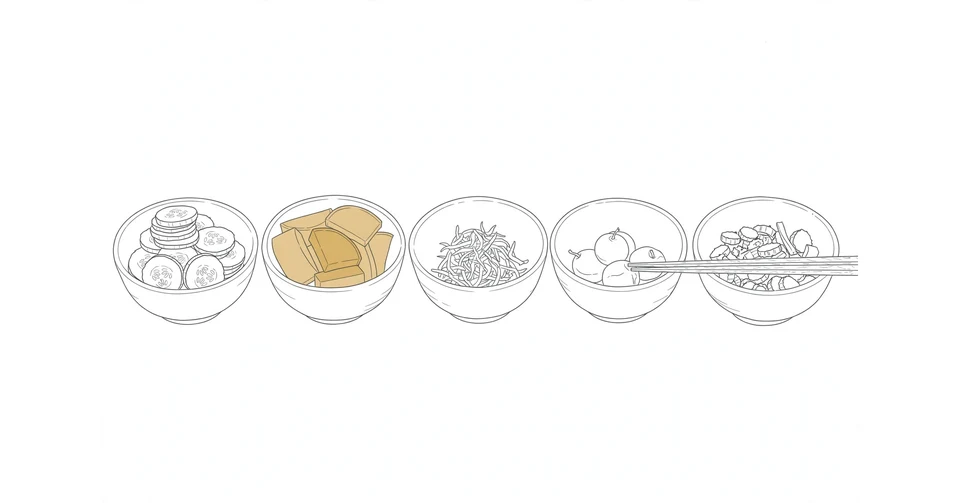
This guide walks through the tsukemono family from the quickest salt pickle to the slowest sleeper in the lees. It covers the main kinds, the history behind them, the role they play at the table, and a safe way to make your first batch at home. You do not need special equipment to begin, and you do not need to love strong flavors to enjoy the result. The point of tsukemono is not to shout. It is to add a small, bright note that makes everything else on the tray taste more like itself.
What tsukemono actually is
Tsukemono belongs to the broad church of Japanese pickles, whose branches are usually named after their pickling medium. Salt gives shiozuke, vinegar gives suzuke, miso gives misozuke, rice bran gives nukazuke, and sake lees give kasuzuke. Learn the medium and you can guess the flavor before you taste it. The naming is practical rather than poetic, which suits a food that began as a way to keep vegetables edible through the seasons when there was no refrigeration. The full family tree, from salt to sugar pickles, is set out on Wikipedia's guide to tsukemono.
The word itself is plain, but the pickles carry prettier names too. They are also called konomono, meaning fragrant things, and oshinko, meaning fresh fragrance. The older word konomono began as a polite term for miso, used for its smell, and over time it spread to pickles for the same reason. A good tsukemono announces itself by aroma before it reaches the mouth, and the names remember that. In everyday speech, though, tsukemono is the word everyone uses, from the cook at home to the shopkeeper in a Kyoto market street.
The vegetables inside change with the season and the region. Cucumbers, daikon, turnips, carrots, ginger, lotus root, eggplant and Chinese cabbage are among the favorites, and the same vegetable can turn out very differently depending on its medium. A cucumber in salt stays green and snappy. The same cucumber in miso turns mellow and savory. A daikon in rice bran becomes takuan, yellow and firm. The vegetable is only half the story. The bed it rests in writes the other half.
Making tsukemono needs only three things: a container, salt, and something to press down on top. The traditional press is called a tsukemonoki, and the weights are heavy stones known as tsukemono ishi, usually weighing one to two kilograms each. Before stones came into use, cooks pressed pickles by wedging a stick between the handle of the container and its lid. Modern presses use a screw or a spring instead of a stone, but the idea has not changed. Pressure squeezes water out of the vegetables, and salt or brine moves in to take its place. That exchange is the whole craft, and everything else is a variation on it.
Why a small dish of pickles sits beside almost every meal
A Japanese meal is often built as ichiju sansai, one soup and three dishes, and tsukemono is commonly counted as one of those three. The soup is usually miso soup, the main dish is often fish or meat, and the pickles sit alongside as the small, sharp voice in the group. Their role is balance, and the role of tsukemono is one it plays in every meal it joins. Rice is mild, soup is warm and savory, the main dish is rich, and the pickle cuts through all of it with salt, sourness and crunch. Without tsukemono, the meal can feel flat. With it, each bite of rice tastes fresh again.
The same logic explains why tsukemono travels so well. It goes into bento boxes, where a few bright slices keep packed rice interesting hours after it was cooked. It sits beside sushi, where thin ginger clears the palate between pieces. It turns up as a garnish on noodles and savory pancakes, where red pickled ginger adds color and bite. It is served with drinks as otsumami, a small snack to accompany sake or beer. And it appears as a course in the kaiseki portion of a Japanese tea ceremony, where its quiet flavors suit a meal built around attention and restraint.
There is also a practical reason the pickle is always there. Japan has four distinct seasons and a long history of growing far more vegetables in summer than a household could eat fresh. Pickling turned a glut into a pantry. A household that salted its cucumbers in August could still be eating them in winter. That habit shaped the cuisine so deeply that the pickle stopped being emergency food and became part of the meal itself, the way bread became part of a European table. Necessity taught the technique, and taste kept it.
I have come to think of tsukemono as the most honest dish on the tray. It does not hide behind sauce or garnish, and it cannot be fixed at the last minute if the salting went wrong. A good pickle tastes of patience and proportion, and a bad one tastes of haste. That honesty is part of its charm. In a food culture that values restraint, a small dish that does one thing well earns more respect than a large dish that tries to do everything.
A short history of pickling in Japan
Pickling in Japan is old, and its roots reach back more than a thousand years. Salt was the first medium, because salt was the first preservative people could rely on, and vegetables packed in salt would keep through the months when fresh produce was scarce. Over time, cooks learned that other fermented foods could do the same work with more flavor, and the family grew. Miso, sake lees and rice bran each became a bed in turn, and each one gave the pickles a different character.
The sake lees branch has one of the clearest paper trails. Kasuzuke, the pickles made in a bed of sake lees, was already being made in the Kansai region in the Nara period, roughly twelve hundred years ago, and a document from the year 905 already describes the method. It is also said to have served samurai as food that would not spoil on campaign, which makes sense when you consider that a bed of salty, alcoholic lees is a hostile place for the microbes that ruin fresh food. By the Edo period, sake dealers were promoting kasuzuke across Japan, and as brewing improved, the supply of good lees grew with it.
Other branches grew up alongside it, more quietly and closer to home. Rice bran pickling spread through farmhouse kitchens, where the bran left over from milling rice was free and plentiful, and a household could keep a living bran bed going for years, feeding it fresh bran and salt the way a baker feeds a starter. Salt pickling stayed the everyday method, the one any cook could do in an afternoon with no special supplies. The history of tsukemono is really the history of Japanese households making the most of what they already had, and turning leftovers into flavor.
That history is still visible in the way tsukemono is sold today. Department store basements and market streets keep whole counters of pickles, arranged by color and kind, and specialist shops sell nothing else. The range is enormous, from pale quick pickles that look almost fresh to dark, amber pickles that have slept in lees for years. The counter is a small museum of preservation, and every jar on it carries a different answer to the same old question of how to keep a vegetable good enough to become tsukemono.
The main families, named after their medium
The easiest way to learn tsukemono is to learn the mediums, because the medium decides the flavor, the texture and the time. Start with salt and work outward, and the whole family falls into place.
Shiozuke, salt pickling, is the simplest branch and the best place for a beginner. Vegetables are salted, pressed under a weight, and left until the salt has drawn out water and firmed the flesh. The tsukemono that results is clean and direct, the flavor of the vegetable itself with the edges sharpened. Asazuke, or shallow pickling, is the quickest form of shiozuke: vegetables are lightly salted or brined and refrigerated, ready in hours, with their color and crunch nearly intact. A cucumber can be salted in the morning and eaten as a pickle by dinner, and much of Japan's everyday tsukemono works on that kind of schedule. If you have only ever eaten one kind of tsukemono, it was probably this one.
Suzuke, vinegar pickling, adds brightness to tsukemono. Rice vinegar gives the pickles a clean sourness, and a sweetened version called amasuzuke, made with sugar and vinegar, turns the same technique gentle and round. Thinly sliced young ginger pickled in sweet vinegar becomes gari, the pale pink palate cleanser served with sushi. The name gari is said to come from the sound of crunching, or from the sound of a knife slicing ginger thin, and either origin fits a pickle whose whole job is to reset the mouth between bites.
Misozuke, miso pickling, is one of the easiest methods to try at home. The vegetable rests in a miso bed, called a misodoko, usually mixed with a little mirin and sugar, and the pickling time runs from a few hours to a few days depending on the ingredient. Carrots and radishes are common choices, and they come out savory, slightly sweet and still crisp. The miso bed can be reused for batch after batch of tsukemono, and the flavor deepens with use, which rewards a cook who pickles often.
Nukazuke, rice bran pickling, is the branch that asks for a relationship. The vegetables rest in a brown mash of roasted rice bran, salt and kombu, and the bed must be turned by hand every day to stay healthy. The pickling can last from several hours to several months, and the tsukemono that comes out is crisp, salty and faintly yeasty, rich in the lactic acid bacteria that give it a gentle tang. A nukazuke bed is a living thing, and cooks who keep one talk about it the way gardeners talk about a favorite plant. It rewards daily attention and punishes neglect, and that is exactly why people love it.
Kasuzuke, sake lees pickling, is the branch of tsukemono where the medium does the most work. The lees are first kneaded into a seasoned bed, a kasudoko, usually with white miso, sugar and salt, loosened with sake until it reaches the soft consistency of miso paste. The food rests in that bed, and enzymes left over from fermentation loosen proteins into amino acids and nudge starches toward sugar, so the flavor changes through the ingredient rather than sitting on its surface. A salmon fillet can spend a single night in the bed and go to the grill tasting faintly of the brewery, while a melon can sleep there for years. If you want the full story of this branch, the kasuzuke pickles on this site walk through the bed, the method and the history in detail.
Narazuke is the slowest sleeper in the tsukemono family and the best proof that tsukemono can be a long project rather than a quick one. The vegetables are salted first, then buried in sake lees and left there not for days but for years, and the narazuke pickles that finally come out of the tub are dark amber, still crisp, and saturated with the flavor of the brew they rested in. One to three years is a normal stay, and some batches sleep far longer. Narazuke belongs to the same family as the quick morning pickle, and holding both ends of that range in mind is the best way to understand what tsukemono really is: one idea, salt and time, played at many speeds.
Three familiar faces
If the families feel abstract, three famous pickles make them concrete. Takuan, umeboshi and narazuke show up in so many meals that most visitors meet them before they learn the word tsukemono, and each one teaches a different lesson about the craft.
Takuan is daikon pickled in rice bran, bright yellow and firm, with a clean crunch that makes it a natural partner for rice. The daikon is dried first, then packed in the bran bed, and the traditional yellow color comes from dried gardenia fruit in the pickling mixture, though much commercial takuan today is colored artificially. A smoked version from Akita prefecture, called iburigakko, dries the daikon over smoke instead of sun and comes out greyish yellow with a distinctive smoky aftertaste. Takuan is the proof that a humble root and a bed of bran can make a tsukemono worth serving every day.
Umeboshi is the most intense of the three, and the one most likely to surprise a first timer. Pickled Japanese plums, or ume, are dried and then packed in salt under a weight, traditionally with purple shiso leaves that dye them a dark pinkish purple. They are round, wrinkled, sour and often very salty, and a single one can season a whole bowl of rice. Place one in the center of white rice and you have hinomaru bento, named for the way the red plum resembles the Japanese flag. Umeboshi is also tucked into onigiri rice balls, where its salt and sourness keep the rice safe and lively. It is the pickle as seasoning, used by the piece rather than by the pile.
Narazuke, as noted above, is the patient one. Its dark amber slices taste of the sake lees they slept in, sweet and deep, and a little goes a long way. It is often served in thin slices with tea or sake, where its richness suits slow sipping. Of the three, it is the least everyday and the most memorable, the pickle you remember years later because no other food tastes quite like it.
Tsukemono at the table
Knowing the kinds matters less than knowing when to serve them, and the answer is nearly always. In an ichiju sansai meal, tsukemono sits among the soup, the rice and the main dish, refreshing the palate so that rich food never becomes tiring. A bite of pickle between spoonfuls of rice resets the mouth the way a sip of tea does, and the meal stays interesting to the last grain.
Bento boxes rely on the same trick, and tsukemono is the tool they use. A lunch packed in the morning is eaten hours later, and rice that has cooled needs a bright companion to wake it up. A few slices of takuan or a single umeboshi in the center of the rice do that work, and they do it without needing reheating or a separate container. Shibazuke, the Kyoto pickle of summer vegetables in plum vinegar, is a favorite with ochazuke, the simple dish of steamed rice with tea poured over it, where the pickle adds salt and crunch to something deliberately plain.
Curry has its own tsukemono. Fukujinzuke, a lightly brined mix of seven vegetables whose name honors the Seven Lucky Gods, is served with Japanese curry, and rakkyo, the small pickled onion that tastes faintly of shallot, sits beside it for the same reason. Both are sweet and sharp enough to balance a rich, spiced sauce, and both show how tsukemono adapts to dishes that arrived from elsewhere. The pickle is not precious about tradition. It goes where it is useful.
With drinks, tsukemono shrinks to the size of a snack. A small plate of tsukemono beside a cup of sake or a glass of beer is called otsumami, and it gives the drinker something salty and crisp to return to between sips. The same slices that refresh rice also refresh the palate between drinks, which is why a pickle shop and a sake shop have always been natural neighbors. The flavors are small, but the role is large: the pickle keeps the meal, and the evening, moving.
Making tsukemono at home, safely
The best first batch of tsukemono is a shiozuke, because it needs no special bed and no daily care. Start with a firm vegetable such as cucumber, daikon or turnip, and weigh it before you begin. A brine of about five percent salt, which is fifty grams of sea salt in a liter of water, is a reliable starting point, and recipes for this method generally use between two and ten percent salt depending on how strong and how long the pickle should be. Dissolve the salt in warm water, let the brine cool, and pour it over the vegetables in a clean container. Place a plate on top, then a weight about one and a half to two times the weight of the vegetables, and leave the container at room temperature. With a five percent brine, eight hours is a good pickling time, and you can adjust it to your taste. Once the pickles are ready, slice them, move them to the refrigerator, and eat them within about four days. Home cooks who want tested recipes for each kind can follow Just One Cookbook's guide to tsukemono, which walks through the main kinds with recipes for each.
Safety is mostly a matter of cleanliness and honesty. Wash your hands and your container before you start, and always use a clean utensil to take pickles out of the jar, never fingers that have touched other food. Keep quick pickles refrigerated once they are ready, and throw away anything that smells wrong, feels slimy, or shows mold. Do not reuse a brine that has already been diluted by vegetable juices, and do not reuse a pickling bed that held fish or meat for vegetables you plan to eat raw. These are small habits, but they are the difference between a tsukemono that is pleasantly sour and one that has turned.
If the first batch goes well, the next step is a misozuke, which is nearly as simple. Mix miso with a little mirin and sugar, spread the mixture over sliced carrots or radishes, and wait a few hours to a few days. The result is savory and mild, and the bed can be scraped off, kept in the refrigerator, and used again. After that, you can decide whether you want the daily commitment of a nukazuke bed or the slow patience of kasuzuke. There is no hurry. The quick pickles are already good, and they teach the most important lesson, which is that salt, pressure and a little time are enough.
One honest warning belongs here. Tsukemono is salty by design, and the salt is part of what makes it work as a pickle. Enjoy it in small portions, as the small dish it is meant to be, rather than as a main dish. The pleasure of tsukemono is in the contrast, a little salt against mild rice, and eating a large pile of it misses the point. A few slices, eaten slowly, do more than a bowlful eaten quickly.
The crunch that stays with you
Tsukemono is a small food with a large lesson, which is that a meal is not only about the main dish. The soup, the rice and the pickles each do a job, and the pickles do the quietest one: they keep the palate awake, they stretch the harvest through the year, and they remind the cook that patience is an ingredient too. A cucumber salted in the morning and a melon that slept in lees for three years are the same idea at different speeds, and both belong on the same table.
The next time a small dish of pickles arrives beside your rice, take a moment before you eat it. Notice the color, the smell and the crunch, and think about the medium that made it: salt, vinegar, miso, bran or lees. That little dish carries a thousand years of Japanese kitchens in it, and it asks for nothing more than a bite. In a cuisine that values restraint, that is a lot to ask of so small a thing, and tsukemono has been answering that ask, quietly and reliably, for longer than anyone can remember.
More in Food & Travel
- Takuan Turns a Humble Daikon Into Japan's Yellow Crunch
- Nukazuke Is the Living Pickle Bed Japan Feeds Every Day
- Ochazuke Is Rice Tea and Comfort in One Bowl
- Aojiso Is the Green Leaf Japan Eats Fresh and Raw
- Akajiso Gives Umeboshi Its Deep Red Blush
- Umeshu Is the Liqueur Japan Makes From Unripe Plums
Latest posts
- Shiso Is the Leaf That Paints Umeboshi Red
- Hello Kitty and the Cat Who Conquered the World
- Umeboshi Is the Sour Plum Japan Puts in Every Bento
- Baikasai Serves Tea Under the Plum Blossom at Kitano Tenmangu
- Plum Blossom Opens Japan's Year Before the Cherry Trees Wake
- Tenjin Engi Emaki Paints a Storm God Into a Saint of Learning
- The Flying Plum Tree That Followed a Scholar Into Exile
- Kitano Tenmangu Turns Plum Blossom Into a Prayer for Exams
- Japanese Geisha and the World Behind the Painted Face
- Tenjin Is the Storm God Who Became Japan's Patron of Learning
- Queen Is the Crown Japan Gives Its Best Woman Karuta Player
- Japanese Pottery and the Six Kilns That Turned Clay into Culture
- Meijin Is the Title Every Karuta Player Dreams of Wearing
- Dazaifu Tenmangu Is Where Japan Still Prays to a Scholar God
- Sugawara No Michizane Became the God Students Still Pray To