Takuan Turns a Humble Daikon Into Japan's Yellow Crunch
· 29 min read
Takuan is daikon dried in the sun and pickled in rice bran until it turns yellow and firm, and this guide explains the process, the history, and how to enjoy it.
Open a Japanese bento and you will often find two or three bright yellow slices tucked beside the rice, small and neat and impossible to miss. They look simple, almost plain, and that is the point. That little yellow pickle is takuan, and it has been doing the same quiet job at Japanese tables for centuries.
Takuan is daikon radish that has been dried in the sun and then pickled in a bed of salted rice bran. The drying concentrates the flavor and firms the flesh, and the bran bed gives it salt, a gentle tang, and its famous yellow color. What comes out is firm, crunchy, sweet and salty at once, and it makes plain rice taste complete.
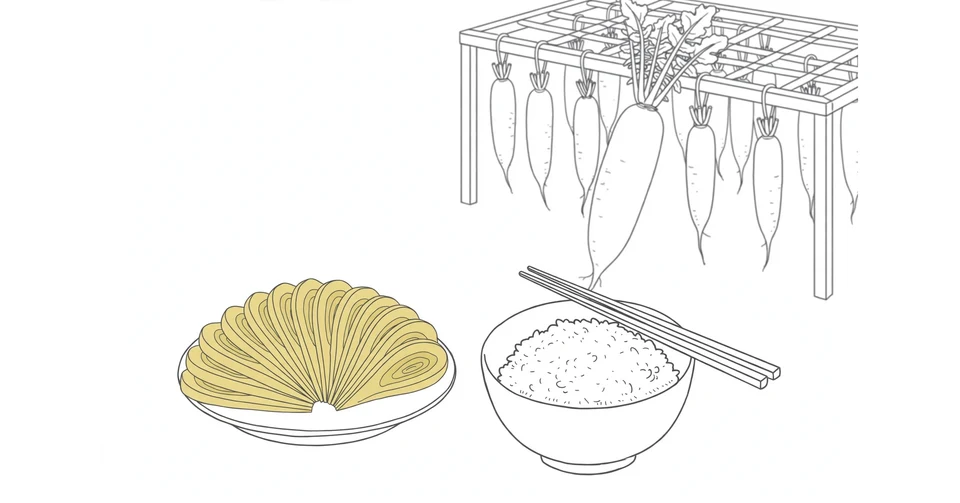
If you have ever wondered why such a humble root earns a permanent place beside rice, soup, and tea, the answer is in the process. Takuan is not a quick pickle. It is a slow transformation, and every step in it has a reason. This guide follows the daikon from the field to the bran bed, explains where the yellow comes from, tells the story of the monk whose name it carries, and shows how to buy it, serve it, and even make a quick version at home.
What takuan actually is
Takuan, also spelled takuwan and called takuan-zuke in full, is a pickled preparation of daikon radish. It belongs to the large family of Japanese pickles known as tsukemono, and it is one of the most familiar members of that family. Served cold, usually washed to remove excess brine and sliced thinly, takuan appears as a side dish during meals and as a snack at teatime. It is also enjoyed at the end of meals, where it is said to aid digestion. The standard reference for the pickle is the Wikipedia entry on takuan, which sets out the name, the method, and the history in compact form.
The first thing to notice about takuan is its color. A good piece is a warm, sunny yellow, and the slices are firm enough to snap cleanly when you bite them. The flavor is sweet, salty, and slightly tart, with a crunch that survives even after months in the pickling crock. That combination is what makes takuan so useful. It is not a loud food. It is a bright one, and it wakes up the palate between bites of mild rice.
Daikon itself is an unglamorous vegetable. It is a long white radish, mild in flavor, mostly water, and cheap enough to grow in large quantities. In most kitchens it disappears into soups and stews, where it softens and takes on the flavor of everything around it. Takuan does the opposite. It takes that plain root and, through drying and pickling, turns it into something with a character of its own. The daikon is still recognizably daikon, but it has become firmer, saltier, more fragrant, and far more interesting.
The second thing to notice is how little takuan you actually need. Two or three thin slices are enough for a bowl of rice. A small pile beside a cup of tea is enough for an afternoon snack. Takuan is a condiment as much as a side dish, and it works by contrast. A little salt against mild rice, a little crunch against soft grains, a little brightness against a plain tray. Eating a large pile of it would miss the point, and it would also be very salty. The pleasure is in the small portion, eaten slowly.
I think that restraint is part of why takuan has lasted so long. Japanese cooking often values foods that do one thing well rather than foods that try to do everything, and takuan does exactly one thing: it makes the rest of the meal taste better. It does not compete with the fish or the soup. It supports them, and then it gets out of the way. In a food culture that prizes balance, that is a high compliment.
How the sun dries the daikon
Every piece of takuan begins the same way, with a daikon hanging in the sun. In the traditional process, the radishes are hung by their leaves and left to dry for a few weeks until they become dehydrated and flexible. The sun and the wind pull water out of the root, and as the water leaves, the flavor concentrates. A fresh daikon is crisp and watery. A sun-dried daikon is bendable, denser, and far more flavorful, and that change is the foundation of everything that follows.
The drying usually happens in the cold and dry winter months, when the air is clear and the risk of rot is low. Farmers hang the daikon from lines or racks, sometimes in rows that stretch across a whole field, and the sight of hundreds of white roots swaying in the winter sun is one of the familiar seasonal scenes of rural Japan. It looks almost decorative, but it is practical work. The drying is not decoration. It is the first act of preservation, and it decides whether the pickle that follows will be firm or soggy.
Time matters here, and the sources do not agree on a single number. Wikipedia describes the drying as lasting a few weeks. The cooking guide Just One Cookbook puts it at one to two weeks. That difference is not a mistake. It reflects real variation in weather, in the size of the radishes, and in how dry the maker wants them. A thick daikon in damp weather needs longer. A thin one on a dry, windy hillside needs less. The honest way to describe it is that the daikon dries for one to a few weeks, until it is dehydrated and flexible, and the maker judges it by touch rather than by the calendar.
What the drying achieves is simple to understand and hard to replace. Water is what makes fresh vegetables spoil, and removing it makes the daikon harder for spoilage microbes to attack. Drying also changes the texture in a way that salting alone cannot. A daikon that goes straight into a brine stays wet inside and can turn soft. A daikon that has been dried first has already lost much of its water, so the salt and the bran can work on a firmer, denser root. The result is the famous crunch, a clean snap rather than a wet crunch, and that snap is the signature of good takuan.
Modern mass production often shortens this step. Factories may use salt or syrup to draw the water out faster, cutting the drying time from weeks to days. The shortcut works, in the sense that it produces a yellow pickle that looks right, but the texture and the depth of flavor are rarely the same. A quickly dehydrated daikon can be firm on the outside and soft inside, or salty without the gentle tang that a slow drying and a slow pickling produce. If you have ever eaten takuan that tasted flat and one dimensional, it was probably rushed at this stage.
There is a lesson in that for anyone who cooks. The slow steps in a recipe are usually slow for a reason, and the sun drying of takuan is one of them. You cannot hurry the sun, and you cannot fake what it does to a root vegetable. The best takuan still comes from makers who give the daikon its weeks in the winter air, and who accept that a good pickle cannot be made in a hurry.
The rice bran bed
Once the daikon is dry, it goes into the pickling crock, and the crock is where takuan becomes takuan. The dried radish is packed into a bed of salt, rice bran, and flavorings, weighted down, and left to pickle for several months. The bed is the heart of the method, and it is the same kind of bed that makes the whole family of rice bran pickles, known as nukazuke, which the guide to tsukemono on this site explains in detail.
Rice bran is the brown powder left over when rice is milled, and in a farming household it was free and plentiful. Mixed with salt and a little water, it becomes a thick, earthy mash that surrounds the daikon and slowly draws out the remaining water while letting salt and flavor move in. The bed also hosts lactic acid bacteria, the same family of microbes that ferment yogurt and sauerkraut, and those bacteria give takuan its gentle tang. The pickle is not simply salted. It is lightly fermented, and that fermentation is what separates it from a radish that has merely been soaked in salty water.
The traditional mixture is not bran and salt alone. Wikipedia lists salt, rice bran, optionally sugar, daikon greens, kombu, and perhaps chili pepper or dried persimmon peels. Just One Cookbook adds dried mikan, yuzu, apple, or persimmon peels, and sake lees, to enhance the flavor, color, and aroma. Each maker has a slightly different recipe, and the differences are part of the character of the pickle. Kombu adds a savory depth. Citrus peel adds fragrance. Chili adds a faint warmth. Persimmon peel adds a gentle sweetness. None of these is essential, but together they explain why takuan from one shop can taste noticeably different from takuan from another.
A weight goes on top of the crock, pressing the daikon down into the bed. The weight keeps the radish submerged, squeezes out water, and makes sure the salt reaches every part of the root. In the old days the weight was a stone. Today it is often a lid with a screw press, but the principle is the same. Without pressure, the pickle would dry out on top and spoil. With it, the daikon stays buried in the bran, and the slow exchange of water and salt can go on undisturbed.
The pickling time is long. Wikipedia says the daikon is allowed to pickle for several months. Just One Cookbook puts the time at about a month. Again, the difference reflects real variation rather than error. A shorter stay in the bed gives a paler, milder takuan. A longer stay gives a deeper yellow, a firmer bite, and a stronger flavor. Some makers leave the daikon in the bed for months, and the older and sourer a piece of takuan becomes, the more likely it is to be stir fried or braised rather than eaten raw. The bed does not stop working just because the pickle is ready. It keeps changing the flavor, and the cook decides when to stop it.
Keeping a bran bed alive is a small act of care. The bed must be turned by hand, fed with fresh bran and salt, and kept at the right moisture. A neglected bed can turn sour or moldy, while a well kept one can last for years, growing richer with use. Many households once kept a single bed going for a long time, feeding it the way a baker feeds a sourdough starter, and the flavor of the takuan it produced was the flavor of that household. That is a kind of cooking that has mostly disappeared from busy modern kitchens, but it is still alive in pickle shops and in farmhouses that make their own.
Where the yellow comes from
The yellow of takuan is its most recognizable feature, and it is also its most misunderstood one. Many people assume the color comes from the daikon itself, or from the bran, but a fresh daikon is white and rice bran is brown. The yellow has to be added, and the traditional way to add it is with dried gardenia fruit, known as kuchinashi in Japanese.
Gardenia fruit has been used as a natural yellow dye in Japan for centuries, in food and in textiles, and a small amount in the pickling mixture gives takuan its warm golden color. Just One Cookbook names turmeric, gardenia fruit, and safflower as the traditional sources of the bright yellow hue. The color is not only decorative. It signals to the eater that the pickle has been made in the traditional way, and it makes the small yellow slices easy to spot on a tray of white rice and pale soup.
Modern mass produced takuan often gets its color from artificial coloring instead. The dye is cheaper, more consistent, and easier to control than gardenia fruit, and it produces a yellow that is brighter and more uniform than the natural version. Wikipedia notes that most mass produced takuan uses artificial color to enhance the appearance, and the difference is visible once you know what to look for. A natural takuan tends toward a warm, slightly uneven gold, while an artificially colored one can look almost neon, with a yellow so bright it seems to glow against the plate.
That is a useful thing to know when you are shopping. Just One Cookbook advises buyers to avoid takuan with a neon yellow color and preservatives in the ingredient list, and to choose takuan made the traditional method when possible. The advice is practical rather than snobbish. A neon yellow pickle is not dangerous, but it is a sign that the maker has chosen speed and appearance over the slow process that gives takuan its depth. The color should be a hint about the method, not a substitute for it.
There is also a paler version of takuan, and it is worth knowing about so that you do not mistake it for a bad batch. A shorter fermentation period produces a more pale cream color, because the yellow has had less time to develop and the bran has had less time to work. Pale takuan is usually milder and less salty, and some people prefer it. It is not a failed pickle. It is a younger one, and it has its own place at the table.
I have a soft spot for the natural gold, uneven and a little muted, because it looks like something that was made rather than manufactured. The bright yellow of a factory pickle can be cheerful, but it tells you nothing about the daikon or the bed. The softer gold of a gardenia colored takuan tells you that someone dried the root in the sun, mixed the bran by hand, and waited. That is a small story, but it is written in the color, and I like food that carries its story where you can see it.
The monk behind the name
Takuan is one of the few foods in Japan named after a person, and the person was a Zen Buddhist monk named Takuan Soho, who lived from 1573 to 1645. He is popularly credited with creating this yellow pickle, which now bears his name. The story is told in guidebooks, in pickle shops, and in the standard references, and it is the kind of story that sounds too neat to be entirely true.
The honest version is that the story is popular rather than proven. Wikipedia says Takuan Soho is popularly credited with creating the pickle. Just One Cookbook says the name refers to Takuan Soho, a Japanese Zen Buddhist monk in the 16th century credited with its invention. Both sources use the careful word credited, and that caution matters. There is no surviving document in which the monk himself writes down a recipe for pickled daikon, and pickling daikon in rice bran almost certainly predates him. What he may have done, if the tradition has any truth in it, is to popularize a particular method, or to introduce a version of the pickle to a wider circle, and his name stuck to it.
Takuan Soho was a real and significant figure, a Zen master, a calligrapher, and a teacher whose influence reached the shogun's court. He is remembered for his writings on Zen and the martial arts, and for his friendship with the swordsman Miyamoto Musashi. That a man of his standing should be remembered for a pickle as well as for philosophy is a charming detail, and it may be exactly why the story has survived. A pickle named after a monk is memorable in a way that a pickle named after a village is not.
Whether he invented takuan or merely lent it his name, the story does useful work. It ties the pickle to a period, to a place, and to a way of thinking about food that values simplicity and patience. Zen cooking is spare and deliberate, and takuan fits that spirit. It is a plain vegetable, preserved with patience, served in small portions, and eaten with attention. You do not need to believe the monk invented it to appreciate the fit between the food and the philosophy.
There is also a practical lesson in the doubt itself. Food histories are full of stories that are popular rather than proven, and a careful eater learns to enjoy the story without treating it as fact. Takuan is delicious whether or not a 17th century monk invented it, and its history is interesting enough without the legend. The daikon, the sun, and the bran bed are the real story. The monk is the decoration, and a good decoration does not need to be true to be worth keeping.
The smoked cousin from Akita
Takuan has a famous relative, and it comes from the snowy north. Iburi-gakko, also called iburizuke, is a specialty of Akita prefecture, and it is made the same way as takuan except for one step. Instead of drying the daikon in the sun, the makers dry it over smoke, originally above the hearth of the house. The result is a pickle that is greyish yellow rather than bright yellow, with a distinctive smoky aftertaste that sets it apart from ordinary takuan.
The name tells the story. Iburi means smoked, and gakko is the local word for pickle. The smoking was born from necessity. In Akita, where winters are long and snowy, hanging daikon outside in the sun was not always practical, so families hung the roots inside, above the hearth, where the smoke from the fire dried them and flavored them at the same time. What began as a workaround became a specialty, and the smoke that was once a compromise is now the whole point.
Iburi-gakko was granted geographical indication status in Japan in 2019, which means that the name is protected and the pickle must be made in Akita according to the traditional method to carry it. That recognition matters, because it protects a small regional food from being copied badly elsewhere, and it tells buyers that the smoky pickle they are eating is the real thing. For a food that began above a farmhouse hearth, that is a long journey.
Tasting iburi-gakko beside ordinary takuan is the best way to understand both of them. The ordinary takuan is clean and bright, with the flavor of bran and salt. The smoked version is deeper and warmer, with the smoke sitting behind the salt like a low note in music. The texture is similar, firm and crunchy, but the aroma is completely different. One smells of the sun and the bran bed. The other smells of woodsmoke and winter. I find the smoked version more memorable, but I reach for the ordinary version more often, because its clean flavor goes with more foods. That is the difference between a specialty and a staple, and both have their place.
If you visit Akita, you will find iburi-gakko sold in markets and pickle shops, often sliced thin and served with rice or with sake. Outside Akita it is harder to find, but specialist shops and online sellers carry it, and it is worth seeking out once. It is the proof that a single change in a recipe, drying over smoke instead of sun, can create a food that feels entirely new while remaining unmistakably part of the same family.
Takuan at the table
Takuan earns its place at the table by being useful in many small ways. The most common is the simplest: a few thin slices beside a bowl of steamed rice. The rice is mild and soft, and the takuan is salty, firm, and bright. Each bite of rice tastes fresh again after a bite of pickle, and the meal stays interesting to the last grain. That is the same job that the whole family of tsukemono does, and takuan does it as well as any of them.
In a bento box, takuan works even harder. A lunch packed in the morning is eaten hours later, and rice that has cooled needs a bright companion to wake it up. Strip cut takuan is often used for Japanese bento, where the thin strips are easy to pack and easy to eat with chopsticks. A few strips beside the rice, or tucked into a corner of the box, keep the meal lively without needing reheating or a separate container. It is a small detail, but it is the kind of detail that makes a packed lunch feel cared for rather than merely packed.
Takuan also appears in sushi, where strip cut pieces are rolled into maki. Shinkomaki is a sushi roll made with takuan alone, and torotaku-maki pairs fatty tuna with takuan, the rich fish balanced by the salty crunch of the pickle. The pairing works because the pickle cuts through the fat, the way a squeeze of lemon cuts through fried food. A roll that was only tuna would be rich and heavy. With takuan inside, it stays bright.
At teatime, takuan shrinks to the size of a snack. A small plate of sliced takuan beside a cup of green tea is a quiet pleasure, the salt and crunch giving the drinker something to return to between sips. The same slices work as otsumami, a small snack to accompany sake or beer, where the salt makes the drink taste better and the crunch gives the hand something to do. The pickle is not precious about the occasion. It goes where it is useful, and it is useful almost everywhere.
Older takuan, the pieces that have stayed in the bran bed long enough to turn sour, get a different treatment. Traditional takuan that has become older and sour is sometimes stir fried or braised, and the cooking softens the sharpness while keeping the flavor. That is a good habit to borrow. A pickle that is too strong to eat raw is not a failed pickle. It is an ingredient waiting for a pan, and a quick stir fry with a little oil can turn it into a savory side dish.
There is one more use worth mentioning, and it is the one that surprises visitors most. Takuan is eaten at the end of meals to aid digestion, a small salty finish after the main dishes are done. Whether the pickle genuinely helps digestion is a claim best left to nutritionists, but the ritual makes sense. A small, sharp bite at the end of a meal clears the palate and signals that eating is over. It is a gentle full stop, and it is a better ending than a sweet dessert for a meal that was built on balance.
Takuan and its neighbors
Takuan does not stand alone on the pickle counter. It sits beside other famous tsukemono, and comparing them is the fastest way to learn what makes each one special. The most famous neighbor is umeboshi, the pickled plum, and the contrast between the two is instructive. Umeboshi is round, wrinkled, intensely sour and often very salty, and a single plum can season a whole bowl of rice. Takuan is mild by comparison, a pickle you eat by the slice rather than by the piece, and you can eat several slices without wincing. If umeboshi is the pickle as seasoning, used sparingly and with respect, then takuan is the pickle as companion, eaten steadily beside the rice. The story of umeboshi on this site tells how that small red plum earned its place in the center of the rice bowl, and it is worth reading beside this one.
The other neighbors teach different lessons. Narazuke, the pickle that sleeps in sake lees for years, is dark amber and rich, and a little goes a long way. Shibazuke, the Kyoto pickle of summer vegetables in plum vinegar, is bright purple and sharp, and it is a favorite with ochazuke, the simple dish of steamed rice with tea poured over it. Fukujinzuke, the lightly brined mix of seven vegetables, is served with Japanese curry, where its sweetness balances the spice. Each of these pickles has its own medium, its own color, and its own job, and together they show how wide the idea of tsukemono really is.
Takuan sits in the middle of that range. It is not the quickest pickle, and it is not the slowest. It is not the mildest, and it is not the strongest. It is the everyday one, the pickle that a household could make every winter and eat all year, and that ordinariness is its strength. A food that is too special becomes a treat. A food that is ordinary enough to eat every day becomes part of how a culture tastes, and takuan has been part of how Japan tastes for a very long time.
That everyday quality also explains why takuan traveled so well. In Korea, where it is called danmuji, it is a common side dish served with light meals and with Korean Chinese dishes, and it is usually sweeter and crunchier than the Japanese original. It fills kimbap, the Korean seaweed rice roll, and it sits beside jajangmyeon, the black bean noodles. The pickle crossed the sea and adapted to a new cuisine, which is what good everyday foods do. They do not stay where they were born. They go where they are useful, and they change just enough to fit in.
How to buy takuan
Buying takuan is easy, and buying good takuan is only slightly harder. You can find it at Japanese, Korean, or Asian grocery stores, in the refrigerator section, with other types of tsukemono and fermented foods. It is sold whole, in sections, in strips, or already sliced, and the form you choose depends on how you plan to use it. A whole takuan lasts longest and gives you the most control over the thickness of the slices. Pre sliced takuan is convenient for bento, and strip cut takuan is ready for sushi rolls.
When you are choosing, start with the color. Look for a warm, natural gold rather than a neon yellow. The neon color is a sign of artificial coloring, and while it is not harmful, it usually means the maker has taken shortcuts elsewhere too. A pale cream color is fine, and it usually means a shorter fermentation and a milder flavor. The color should look like food, not like a highlighter.
Next, read the ingredient list. A traditional takuan lists daikon, salt, rice bran, and perhaps gardenia fruit, kombu, and sugar. A long list of preservatives and artificial colors is a sign of a factory pickle made for shelf life rather than flavor. None of those additives makes the pickle unsafe, but they do make it less interesting, and the price difference between a simple takuan and a heavily processed one is usually small. Choose the simple one.
Texture is the third thing to check, and you can judge it before you buy. A good takuan feels firm and dense, not soft or spongy. If you are buying it sliced, the slices should look crisp at the edges, not limp or translucent. If you are buying it whole, it should feel heavy for its size, which means it still holds its structure after months in the bran bed. A takuan that bends easily has been over softened, and it will not give you the clean crunch that makes the pickle worth eating.
Price is the last consideration, and here the news is good. Takuan is one of the cheapest pickles you can buy, and even the better brands cost little. That low price is part of its charm. It is a food that was invented to preserve a cheap vegetable through the winter, and it has never pretended to be luxurious. Paying a little more for a traditionally made version is worth it, but you do not need to pay a lot. The best takuan is still an everyday food at an everyday price.
Once you bring it home, store it in the refrigerator and keep it in its brine or in a sealed container. It will keep for weeks, and the flavor will continue to develop slowly. Wash the slices briefly in water before serving to remove excess brine, then slice them thinly and serve them cold. That simple preparation is all takuan needs, and it is the way it has been served for generations.
A quick takuan at home
Making traditional takuan at home is a project for the patient, because the real method needs weeks of sun drying and months in a bran bed. Most home cooks do not have the space, the time, or the winter sun to do it properly, and that is fine. There is a quick version that captures the flavor and the color, and it is a good way to learn what takuan tastes like before you commit to the slow method. The Just One Cookbook guide to takuan sets out the process and the quick recipe side by side, and it is the clearest English language starting point I have found.
The quick version starts with fresh daikon, peeled and cut into sticks or thin rounds. The daikon is salted and left to draw out water, then rinsed and packed in a mixture of salt, sugar, water, and a pinch of turmeric powder or turmeric juice for the golden yellow hue. Turmeric is not the traditional coloring, gardenia fruit is, but it gives a similar warm gold and it is far easier to find outside Japan. The pickle is ready in a day or two, and it will keep in the refrigerator for a week or more.
The result is not the same as a traditionally made takuan, and it is honest to say so. A quick pickle has not been dried in the sun, and it has not slept in a bran bed, so it lacks the firmness and the gentle tang that those steps create. What it does have is the right color, the right crunch, and a sweet and salty flavor that is recognizably takuan. It is a sketch of the real thing rather than a copy, and a sketch is a good place to start.
If the quick version makes you want the real thing, the next step is to try the traditional method in miniature. Dry a few small daikon on a sunny windowsill or balcony for a week, turning them daily, until they are flexible. Then pack them in a small crock with salt, rice bran, and a little sugar, weight them down, and leave them for a month. The bran bed needs turning and attention, and you will need to keep it clean and at the right moisture, but a small batch is manageable, and the first time you slice open a takuan you made yourself, the yellow inside will feel like a small reward.
Safety matters at every stage, and the rules are the same as for any pickle. Wash your hands and your container before you start. Use clean utensils to take pickles out of the jar, never fingers that have touched other food. Keep the finished pickle refrigerated, and throw away anything that smells wrong, feels slimy, or shows mold. Takuan is salty by design, and that salt helps preserve it, but salt is not a guarantee. Cleanliness and honesty about what looks and smells right are the real safeguards.
One more practical note belongs here. Takuan is high in sodium, as any pickle made in salt and bran must be, and it should be eaten in small portions. Just One Cookbook notes that it is low in calories and carbohydrates compared with other tsukemono, but high in sodium, and advises eating a few slices a day. That is good advice, and it matches how takuan is served in Japan, as a small dish beside the rice rather than a main dish. Enjoy the crunch, enjoy the salt, and let a few slices do their work.
Why a yellow pickle matters
Takuan matters because it is a small food that carries a large story. It carries the story of a farming household that needed to keep its daikon through the winter, and found that sun and bran could do what refrigeration could not. It carries the story of a monk whose name stuck to a pickle, and of a northern prefecture that turned smoke into a specialty. It carries the story of a pickle that crossed the sea to Korea and became danmuji, and of a yellow slice that still sits beside rice in bento boxes made every morning across Japan.
It also matters because it is a reminder that good food does not need to be complicated or expensive. A daikon is one of the cheapest vegetables in the market. Rice bran is a byproduct that would otherwise be thrown away. Salt, sun, and time are free. Put them together with patience, and you get a food that is firm, bright, and satisfying, a food that has fed people for centuries and still earns its place on the tray. That is a kind of cooking worth remembering, in a world that often measures food by how new or how rare it is.
The next time you open a bento and find those yellow slices beside the rice, take a moment before you eat them. Notice the color, the smell, and the crunch, and think about the daikon hanging in the winter sun and the bran bed it slept in for months. That small pickle carries a season of work in it, and it asks for nothing more than a bite. In a cuisine that values restraint, that is a lot to ask of so small a thing, and takuan has been answering that ask, quietly and reliably, for longer than anyone can remember.
More in Food & Travel
Latest posts
- Shiso Is the Leaf That Paints Umeboshi Red
- Hello Kitty and the Cat Who Conquered the World
- Umeboshi Is the Sour Plum Japan Puts in Every Bento
- Baikasai Serves Tea Under the Plum Blossom at Kitano Tenmangu
- Plum Blossom Opens Japan's Year Before the Cherry Trees Wake
- Tenjin Engi Emaki Paints a Storm God Into a Saint of Learning
- The Flying Plum Tree That Followed a Scholar Into Exile
- Kitano Tenmangu Turns Plum Blossom Into a Prayer for Exams
- Japanese Geisha and the World Behind the Painted Face
- Tenjin Is the Storm God Who Became Japan's Patron of Learning
- Queen Is the Crown Japan Gives Its Best Woman Karuta Player
- Japanese Pottery and the Six Kilns That Turned Clay into Culture
- Meijin Is the Title Every Karuta Player Dreams of Wearing
- Dazaifu Tenmangu Is Where Japan Still Prays to a Scholar God
- Sugawara No Michizane Became the God Students Still Pray To