A Tokoyama Spends Ten Years Learning to Dress a Topknot
· 30 min read
A tokoyama is the specialist hairdresser who dresses a sumo wrestler's topknot, a craft that takes about ten years to master and a lifetime to keep.
A sumo wrestler never dresses his own hair. Every morning, before training begins, he sits still while another man combs, oils, and ties his topknot into place. That man is a tokoyama, a specialist hairdresser employed by the Japan Sumo Association, and his work is one of the quietest crafts in Japanese sport.
A tokoyama normally joins the association around the age of fifteen. He starts at the bottom, in the fifth class, and works his way up through the ranks as he gains skill and seniority. It takes about ten years before a tokoyama can sculpt the ginkgo leaf topknot worn by wrestlers in the top two divisions, and only the most senior men at the very top may style the hair of a yokozuna.
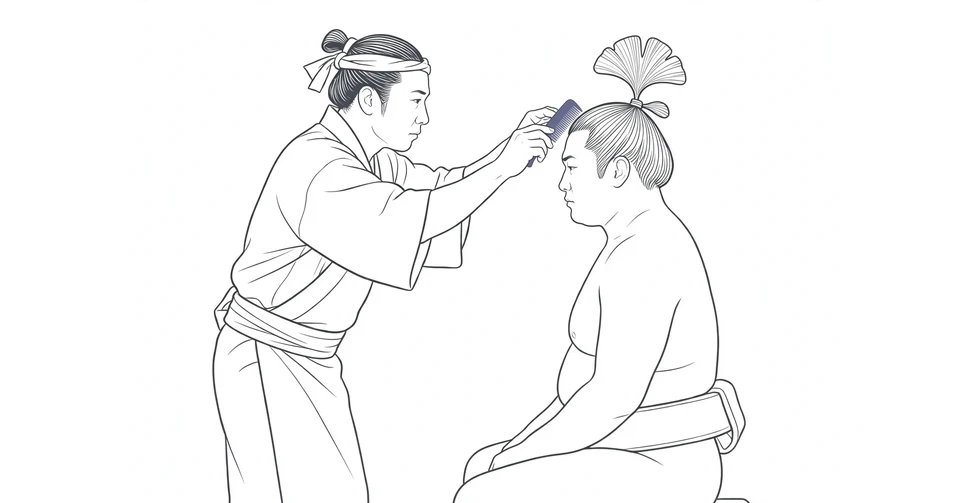
That ten year apprenticeship is the heart of this story. In a sport that measures a wrestler by wins and losses, the tokoyama is measured by patience, by hands that learn slowly, and by a knot that must look effortless even though nothing about making it is easy. This article follows the tokoyama from his first day in a stable to the special rank at the top, through his combs and oils, his working day, and the bond he forms with the wrestlers whose hair he dresses.
What a tokoyama is
A tokoyama is a traditional Japanese hairdresser who specialises in the hair of professional sumo wrestlers, and also in the hair and wigs of the kabuki and bunraku theatre. The word uses a character meaning floor, because in the Edo period barbers kept shops on simple raised floors, and the old word tokoya, which uses the same character, was a traditional name for a barber in Japan. The trade grew out of those Edo period barbers, some of whom gradually began to specialise in the hairstyles of actors, puppets, and wrestlers.
In professional sumo, the tokoyama are employed by the Japan Sumo Association to cut and prepare the wrestlers' hair, which is then styled in the chonmage topknot. Outside of wrestlers and stablemasters, there are three main jobs in the association: the gyoji, or referee, the yobidashi, or ring announcer and handyman, and the tokoyama. The first two appear on and around the ring during tournaments. The hairdresser does his work behind the scenes, early in the morning, in the stable, where the audience never sees him.
That invisibility is part of the job. A tokoyama does not take a bow, does not hear his name announced, and does not appear on the television coverage of a bout. His work appears instead on the head of every wrestler who walks to the ring, and it has to survive training, sweat, and the impact of a bout without coming undone. When the knot holds, nobody thinks about the man who tied it. When it fails, everyone notices. I think that is a fair description of most essential work. The people who keep a tradition standing are rarely the people standing in the light, and the tokoyama has stood in the shadow of the ring for generations without complaint.
The hairdresser is not a barber in the ordinary sense. An ordinary barber cuts hair to suit the customer, and the customer walks out and forgets about it. A tokoyama dresses the same heads every day, for years, and the hair he works with belongs to a system of rank. The plain knot of a junior wrestler and the fanned ginkgo leaf of a sekitori are different statements, and the tokoyama must know which one each man is entitled to wear, and when. His hands carry the rules of the sport as surely as a referee carries the rulebook.
From Edo barbers to the sumo stable
The hairdresser trade is the result of a slow evolution. In the Edo period, barbers served ordinary customers, and some of them gradually began to specialise in the hairstyles of actors and wrestlers, whose hair had to hold a shape through a performance or a bout. The craft passed down through those specialists, hand to hand, in the same way it still passes down today, from a senior hairdresser to a junior one.
Historically, wrestlers went to public barbershops to get their hair done. That arrangement worked while traditional barbers were common. During the Meiji era, however, traditional barbers gradually disappeared as Western hairstyles became fashionable, and the wrestlers who had kept the chonmage topknot needed someone to dress it. For a time, tokoyama were borrowed from kabuki theatres to serve wrestlers during tournaments. Eventually the hairdresser became an integral part of professional sumo and began training specifically to style the wrestlers' hair.
That borrowing tells us something about how close sumo and the theatre once were. Both worlds kept the topknot after the rest of Japan had cut its hair short, and both needed the same hands to keep it. A tokoyama who could dress a kabuki actor's wig could learn to dress a wrestler's topknot, because the tools were similar, the oils were similar, and the patience was the same. The theatre lent sumo its hairdressers, and sumo kept them.
There is a detail in that history that I find quietly moving. The tokoyama did not arrive in sumo with a grand plan. He arrived because someone was needed, because the barbers had gone, and because the knot still had to be tied every morning. Traditions often survive in that unplanned way, not through a committee decision but through a practical gap that one person steps in to fill. The hairdresser stepped into the gap, and he never left.
Today the Sumo Association employs the tokoyama and ranks them according to experience and ability. There are around fifty tokoyama employed by the association at all times, and new positions can be created if a stable with more than twelve wrestlers and no hairdresser requests one. A hairdresser is attached to a sumo stable like other personnel, and a stable that does not have its own tokoyama can rely on hairdressers from other stables belonging to the same ichimon, or clan, to do its wrestlers' hair. The craft is organised around the stable system, and the hairdresser belongs to the stable as surely as the wrestlers do.
Joining at fifteen
A tokoyama normally joins the Japan Sumo Association around the age of fifteen, the same age at which many wrestlers, referees, and ring announcers begin. Apprentices are all men aged fifteen to nineteen, and they are attached to a sumo stable, where they live and learn alongside the wrestlers. It is a young start by any modern measure, and it is a start that asks a teenager to commit to a craft he cannot yet perform.
Each hairdresser learns his trade from a senior member of staff. If a tokoyama's stable does not have a more experienced hairdresser, a hairdresser from the same ichimon will take over the apprenticeship. The teaching is direct and personal. The apprentice watches, then helps, then tries, and his mistakes are corrected by hands that have made the same mistakes years before. There is no classroom for this work, and no shortcut through it. The senior tokoyama is the school.
Unlike the gyoji and the yobidashi, the hairdresser does not follow the divisional system of the wrestlers. Referees and ring announcers are classified by division, but a tokoyama starts at fifth class, called goto, and is promoted to fourth class, third class, and upward as he gains years of service and skill. The ranks are his ladder, and every step up it means more wrestlers trust him with their hair, and more complicated styles he is allowed to attempt.
The ladder is long. Promotion to third class takes around ten years, while promotion to second and first class takes around twenty and thirty years respectively. A tokoyama is not considered a qualified craftsman, a shikakusha, until he is promoted to the rank of second class. When promoted to second class, a hairdresser receives a higher salary and a bonus during tournaments. The numbers make the point plainly. This is not a craft you pick up in a year. It is a craft you grow into over decades, and the association's ranks are honest about that.
I think there is something admirable about a system that refuses to hurry a young worker. A fifteen year old who joins a stable today will not be a qualified craftsman until he is in his thirties, and he will not reach the top until he is near retirement. Modern work promises fast promotion and quick mastery, and it often delivers neither. The tokoyama system promises the opposite, slow promotion and real mastery, and it delivers both to the men who stay.
The ten year road to the oichomage
It takes about ten years before a tokoyama reaches the level where he can sculpt the oicho, the ginkgo leaf style topknot worn by wrestlers in the top two divisions when competing in tournaments or attending formal events. The plain chonmage, the knot every wrestler wears, is the starting point. The oichomage, the fanned leaf, is the prize, and the hairdresser earns the right to make it only after a decade of daily work.
The ten year figure is worth pausing over, because two sources describe it in slightly different ways. The Japan Times reports that it takes about ten years before a hairdresser can sculpt the ginkgo leaf topknot, and the wider record agrees that the ornate oichomage usually only comes after ten years of experience. Another measure in the same record says a tokoyama must train for at least seven years before he is considered capable of working on his own. The two figures do not contradict each other. Seven years is the point at which a tokoyama can be trusted to work alone. Ten years is the point at which he can be trusted with the sport's most visible hairstyle. The conservative reading is the honest one. A hairdresser works alone after seven years, and earns the ginkgo leaf after ten.
The reason the oichomage takes so long is that it is not simply a knot tied tighter. The end of the knot is spread out into a semicircle and held in shape with oil and wax, and the shape has to be even, firm, and clean from every angle, under television lights, after a morning of training, and through the collisions of a bout. A plain chonmage can hide a small unevenness. A fan cannot. The leaf is a flat surface, and every flaw in it is visible. That is why the tokoyama who makes it must have ten years of mornings behind him.
The full story of the fan itself is told in How an Oichomage Turns a Wrestler Into a Sekitori, which traces the knot from its samurai roots to the rank it marks today. The plain knot says a man belongs. The fan says he has arrived. The tokoyama is the man who decides, with his hands, whether the fan is ready to be seen, and the wrestler trusts him with that decision every time he sits down in front of him.
That trust is not given lightly, and it is not given quickly. A wrestler's hair is personal in a way that a uniform is not. It grows with him, it carries the smell of his work, and it is the first thing people see when he walks into a room. To sit still every morning while another man combs and pulls at your hair is to accept that your appearance belongs partly to someone else. The hairdresser earns that acceptance slowly, one morning at a time, over ten years, until the wrestler no longer thinks about it at all. That is what mastery looks like from the chair. The customer stops watching the hands.
The special rank at the top
Above the first class sits the special rank, called tokuto, or special class tokoyama. A tokoyama can ascend to this rank only after reaching first class and demonstrating exceptional skill, and promotion to this rank has very strict prerequisites. The hairdresser must have served for around forty five years and have demonstrated excellent talents. It is a rank that takes a working lifetime to reach, and most tokoyama never reach it at all.
There are normally two special rank tokoyama at the very top. Only these men are allowed to style the hair of a yokozuna, the wrestler of the highest rank. The Japan Times states this plainly, and the wider record agrees, while noting that three special class hairdresser coexisted in 2019, when Tokohachi, Tokomatsu, and Tokoyodo all held the rank at once. The normal number is two, and the exception proves how strict the rule is. Even three was news.
The special class tokoyama have appeared on the banzuke, the official ranking sheet, since January 2008, and in January 2012 first class tokoyama were also added. That change matters because the banzuke is the document that records who matters in sumo, and for most of the sport's history the hairdressers were not on it. Putting them there was a public acknowledgement that the hairdressers are part of the sport, not servants standing outside it. A tokoyama must retire at the age of sixty five, so a man who joins at fifteen and reaches the special rank after forty five years has about five years at the top before he must step down. The summit is narrow, and it is brief.
There is a lesson in that narrowness that applies far beyond sumo. We often imagine that the top of a craft is a wide plateau where the master finally rests. For a tokoyama, the top is a small room with two chairs, occupied for a few years at the end of a long life, and the only reward is the right to dress the hair of the greatest wrestler alive. I find that strangely pure. The reward for forty five years of work is not money or fame. It is the hardest job in the craft, done for the most demanding customer, under the brightest lights. The hairdresser system does not bribe its masters with comfort. It honours them with difficulty.
The combs that last a decade
The toolkit of a tokoyama is extremely specialised, and it features an array of combs, each of which does a specific task. The combs are made of a particular wood, and each type of comb is made from a different type of wood, and they are crafted by a single company based in Nagoya. The Japan Times reports that they are only crafted by one Nagoya based company, and the wider record agrees that the last company to manufacture them is now based in Nagoya, although the tools were once generally made in Kyoto Prefecture.
These special combs are necessary because a wrestler's hair is generally very thick and filled with sand after training on the clay ring. The tokoyama also comb, wax, and style the hair every day in a rough and intense manner, because the knot has to survive training, sweat, and the impact of bouts. Regular combs would break constantly under that punishment, but the combs used by a hairdresser can last up to a decade. The Sumo Association buys the combs and distributes them to the tokoyama, and the only part of his kit that a hairdresser chooses himself is the traditional styling scissors.
The named combs each have a job. An araigushi comb is first used on the hair, followed by a sukigushi to spread out the ointment and shine the hair. A soroigushi is used to tidy up the hair when everything is done. For the oichomage, a special tool called a maekaki is used only for making that style, where the hair is then spread out using a metal pick called a magebo. The names matter because they show how divided the work is. No single comb does everything. Each comb does one thing, and the tokoyama must know which one to reach for without thinking.
In sumo it is also common for a hairdresser to grow a thumbnail to facilitate styling. The thumbnail is a tool as much as any comb, a small ledge of nail that helps part and shape the hair. It is a detail that tells you how physical this craft is. The tokoyama does not stand back and direct. He leans in, combs hard, pulls, oils, and shapes with his hands and his nails, and the work leaves its mark on his body as surely as training leaves its mark on a wrestler.
I keep thinking about the comb that lasts a decade. A tool that survives ten years of daily use on thick, sandy hair is a tool made by someone who understands the work as well as the man who uses it. The comb maker in Nagoya and the tokoyama in the stable are partners in a craft that neither could do alone, and both are becoming rare. When we talk about saving a tradition, we usually mean saving the visible part, the wrestler and the knot. We forget the maker of the comb, and the maker of the oil, and the maker of the string, and yet without them the knot cannot be tied at all.
Bintsuke and the smell of sumo
The dressing of a topknot relies on bintsuke, a thick, sweet smelling wax and oil that is worked into the hair to give it hold and shine. The hairdressers use a special ointment called binzuke, also spelled bintsuke, renowned for its sturdiness, making it ideal for elaborate hairstyles. In sumo, the tokoyama only use binzuke produced by a company in Edogawa, Tokyo, and the sukiyu ointment they use is made traditionally from rapeseed, Japan wax, and vanilla fragrance. The ointment has a distinctive scent that is associated with professional sumo.
In both sumo and kabuki, the tokoyama use two kinds of oil, called sukiyu and chuneri, produced specifically for the manufacture of wigs. The oils are not interchangeable, and they are not ordinary hair products. They are made for this work, in small quantities, by companies that serve almost no other market. The scent of bintsuke is one of the smells of the sumo world, as recognisable in the arena as the smell of the clay ring, and it clings to a wrestler's hair long after the dressing is done.
The hair is combed, oiled, and shaped with a firm hand, and the hairdresser comb, wax, and style the hair every day in a rough and intense manner. The word rough matters here. This is not a gentle salon treatment. The hair is thick, it is full of sand, and it must be forced into a shape that will hold through a bout. The tokoyama pulls hard, and the wrestler sits still, and the two of them have an understanding that the discomfort is part of the job. A knot that is tied gently will not survive the day.
The scent is the part of the craft that the audience never sees but the wrestlers never forget. Smell is the most direct of the senses, and the smell of bintsuke is the smell of the stable in the morning, of the dressing room before a tournament, of a career. Long after a wrestler retires, he will recognise that scent in an instant, and it will bring back the mornings when a tokoyama stood behind him with a comb in his hand. I think every craft has a smell like that, a scent that belongs to the work and to no other place, and the men who carry it on their clothes carry the craft with them wherever they go.
A working day in the stable
A hairdresser's working day begins early, before the wrestlers train, because the hair must be dressed before the day begins. The plain chonmage that every wrestler wears is the daily work, and the tokoyama dresses it for each man in the stable, one after another, combing out the sand and the sweat of the day before, oiling the hair, and folding it into its knot. It is repetitive work, and it is done without ceremony, in the same room, at the same hour, every day.
The rhythm changes with the calendar. On ordinary days inside the stable, a wrestler may wear the flatter everyday knot. On formal occasions and during a tournament, a sekitori must wear the more elaborate oichomage, and the tokoyama's work becomes longer, more careful, and more visible. The fan has to be perfect, because it will be seen by thousands of people in the arena and by millions on television. The hairdresser who dresses it carries that pressure in his hands, and he has ten years of mornings to steady them.
The plain chonmage every wrestler wears is the base from which all of this begins, and the tokoyama is the man who maintains that base day after day. A new recruit spends his first months growing his hair out, and the tokoyama watches that growth the way a gardener watches a plant, waiting for the day when there is enough hair to tie. That waiting is part of the job too. The hairdresser cannot hurry the hair, and the wrestler cannot hurry his rank, and both of them learn patience from the same slow process.
The work is daily and demanding, and it is done behind the scenes by men whose names the audience never learns. And yet without them, the most recognisable symbol of sumo would not exist. A chonmage is not only a knot. It is a knot made by someone else's hands, and those hands trained for a decade to make it look effortless. The wrestler takes the applause, and the knot takes the photographs, but the knot is made by hands that trained for ten years to tie it.
I find that division of attention unfair, but I also find it honest. The audience comes to see the wrestlers, not the hairdressers, and the hairdresser knows that. He does not dress hair in order to be seen. He dresses it so that the wrestler can be seen properly, with his rank visible and his tradition intact. There is a dignity in work done for someone else's appearance, and the tokoyama carries that dignity without asking for credit. The stable knows his name, the wrestlers know his hands, and that is enough for him.
The tokoyama of the theatre
Sumo is not the only world that employs a hairdresser. The trade also serves the kabuki and bunraku theatre, and the theatre tokoyama has his own specialisations and his own ranks. In kabuki, the hairstyle, and more specifically the wig, is an important element of the art, as no actor appears on stage without one. The craftsmen who comb the actors' hair are called tokoyama, but they are not responsible for creating the wigs, which is the work of wig makers called katsuraya. The hairdresser fits and finishes the wig before the actor goes on stage.
Kabuki tokoyama are the only ones to be divided into groups called sangai tokoyama, the third floor hairdresser, and nikai tokoyama, the second floor tokoyama. The names come from the floors of the Kabuki-za on which the hairdressers work on their wigs. The second floor tokoyama specialise in styling the hair of actors playing female roles, while the third floor tokoyama specialise in styling male characters. Kabuki hairdressers are assigned to specific actors on a full time basis, and the relationship between a tokoyama and his actor is close and lasting.
In bunraku, puppets are coiffed like real actors. The tokoyama in bunraku are responsible for both creating the wig and styling it, which is different from kabuki, where the wig maker and the hairdresser are separate. The hairdresser receives instructions from a steward called the kashirawari-iin, who selects puppet heads from about four hundred options to show subtle differences in what the characters are expressing. Once the wig has been chosen, the tokoyama is responsible for styling it to match the puppet. There are about one hundred and twenty different hairstyles, with about eighty for men and forty for women.
The theatre tokoyama and the sumo hairdresser share a trade, but they work in different worlds. The theatre tokoyama dresses a wig that will be seen under stage lights for a few hours. The sumo tokoyama dresses living hair that must survive a bout. Both need the same oils, the same combs, and the same patience, and both are finding it harder to obtain the traditional tools and balms they need, as the craftsmen who produce them retire without replacement. The trade is one craft with two stages, and both stages are feeling the same pressure.
The bond between wrestler and hairdresser
A hairdresser maintains a close relationship with those whose hair he arranges, often assigned to the particular service of a small group of people. In sumo, the tokoyama is seen as an essential element of the sport, helping to maintain its traditional appearance, and the bond between a wrestler and his hairdresser can last an entire career. The wrestler sits in the same chair, in front of the same hands, morning after morning, year after year, and the two men come to know each other in a way that has nothing to do with words.
The most famous example is that of former yokozuna Hakuho, whose hair was combed throughout his career by the same tokoyama, the former special class hairdresser Tokohachi. Hakuho was one of the greatest wrestlers in the history of the sport, and the man who dressed his hair was the same man, day after day, for the whole of that career. The wrestler trusted one pair of hands with the symbol of his rank, and the tokoyama carried that trust for years without a mistake that mattered.
Some wrestlers value the tokoyama so highly that they employ their own hairdressers on their own money, as the great yokozuna Taiho did. That detail tells you how the wrestlers themselves see the craft. The association provides a hairdresser, but a champion may want his own, a man he has chosen, whose hands he knows, and whose work he trusts completely. The hairdresser is not a luxury in that arrangement. He is a necessity, and the wrestler pays for him out of his own pocket because the knot matters that much.
The importance of the tokoyama also extends to the founding of new stables, as their opening may be called into question if they are unable to obtain a hairdresser. A stable without a tokoyama is a stable that cannot dress its wrestlers properly, and the association treats that as a real problem, not a minor inconvenience. The hairdresser is part of the foundation of a stable, as essential as the ring, the kitchen, and the master. A new stable needs a hairdresser before it can truly begin.
I think the bond between a wrestler and his tokoyama is one of the most human things in sumo. The sport is full of hierarchy and formality, of bowing and rank and silence, but the morning dressing is intimate. One man sits still, and another man stands behind him, touching his head, combing his hair, and shaping the symbol of his career. It is a moment of trust repeated every day, and it lasts longer than most friendships. The wrestler's career ends, and the knot is cut, but the memory of those mornings stays with both men.
A craft under pressure
As of the 2020s, it is becoming increasingly difficult to obtain the traditional tools and balms used to style the hair, as the craftsmen who produce them are all gradually retiring without replacement. This is notably the case for the paper strings called motoyui, used to tie up the hair of sumo wrestlers and kabuki actors' wigs, which were made by just one craftsman in Iida, Nagano, until he was forced to close down his business for good in 2020, when all activities requiring his strings ceased due to the pandemic. In recent years, a few craftsmen have taken over the traditional manufacturing activities, and two craftsmen now continue to produce motoyui.
The motoyui story is a warning, and it is also a small piece of good news. The warning is that a whole craft can depend on a single person, and when that person stops, the craft stops with him. The good news is that two craftsmen have taken up the work, and the string is being made again. But the margin is thin. Two craftsmen is not a secure supply. It is a reprieve, and the tokoyama knows it every time he ties a knot with a string that almost stopped existing.
Ointment for wrestlers' heads is also in short supply, with fewer and fewer companies able to manufacture it, due particularly to recruitment difficulties and the lack of a market with sufficient demand, and existing family businesses are unable to continue their activities after the current managers retire. The bintsuke that gives the topknot its hold and its scent is made by a small number of companies for a small number of customers, and when those companies close, there is no large market to replace them. The hairdresser's craft depends on suppliers who are themselves craftsmen, and those suppliers are disappearing one by one.
The pressure is not only about supply. It is about people. A tokoyama joins at fifteen and trains for ten years before he can make the ginkgo leaf, and the modern world does not make it easy to ask a teenager to commit to that. The work is early, physical, repetitive, and invisible, and the reward is slow. The young men who do choose it are choosing a life that most of their peers would not understand, and the association must keep finding them, year after year, or the craft will shrink with the supply of its tools.
I worry about this, and I think the worry is justified. A tradition that depends on fifty hairdressers, one comb maker in Nagoya, one oil maker in Edogawa, and two string makers is a tradition balanced on a small number of shoulders. It has survived because each of those shoulders has held so far. But survival is not guaranteed, and the day the tokoyama can no longer be found, or the combs can no longer be bought, is the day the topknot itself is in danger. The knot looks permanent. The hands that make it are not.
Why ten years is the right measure
Ten years is a long time to learn to dress hair. It is longer than a university degree, longer than most apprenticeships, and longer than many careers last in full. It is worth asking why sumo insists on it, and the answer is that the hairdresser is not only learning to dress hair. He is learning to be trusted with a man's identity, to work under pressure without showing it, and to repeat a difficult task perfectly, every morning, for years.
A tokoyama who has trained for ten years has dressed thousands of topknots. He has combed hair full of sand, hair that is too short, hair that is too thick, and hair that will not sit still. He has made the plain knot on a nervous recruit and the fan on a sekitori before a tournament, and he has learned the difference between the two in his hands, not in a book. The ten years are not a delay. They are the education itself, and there is no shorter version of it.
The craft also teaches something that is rare in modern work, which is that some things cannot be hurried without being damaged. A topknot tied in a hurry will not hold. A comb used carelessly will break. A young hairdresser promoted too soon will make a mistake in front of a crowd. The tokoyama system is built on the belief that time is not wasted when it is spent learning properly, and that a man who has waited ten years for the ginkgo leaf will value it more than a man who was given it in two.
That belief is worth keeping, even outside sumo. We live in a world that promises mastery in weeks, and the promise is usually false. The hairdresser reminds us that real mastery has a price, and the price is measured in years, not in courses or certificates. Ten years of mornings, ten years of combs and oil, ten years of sitting behind a wrestler and learning his hair. It is a slow price, and it is an honest one.
The hands behind the knot
A tokoyama spends ten years learning to dress a topknot, and then he spends the rest of his working life dressing one, morning after morning, until he retires at sixty five. He joins at fifteen, starts in the fifth class, works alone after about seven years, earns the ginkgo leaf after about ten, reaches the second class after about twenty, the first after about thirty, and the special rank, if he ever reaches it, after about forty five. At the top he may dress the hair of a yokozuna, and then he steps down, and a younger tokoyama takes his place.
The arc of that career is the arc of the craft itself. It begins with a teenager who cannot yet tie a knot, and it ends with an old man whose hands have tied thousands of them. In between, there are combs from Nagoya, oil from Edogawa, string from Iida, and the scent of bintsuke in the morning air of the stable. The wrestler grows, wins, loses, and retires, and the hairdresser is there for all of it, behind him, out of sight, keeping the symbol of his rank in place.
The next time you watch a sumo tournament, look at the hair before you look at the bout. Find the plain knot on a young wrestler, and the fan on a sekitori, and remember that neither of them tied it himself. A tokoyama tied it, after ten years of learning how, and he will be back tomorrow morning to tie it again. The knot is the most visible thing in sumo, and the man who makes it is the least visible. That is the way the sport has always worked, and it is worth noticing, because the hands behind the knot are the hands that keep the tradition alive.
More in Culture & Society
- An Oyakata Is the Father a Sumo Stable Cannot Replace
- Japanese Calligraphy and the Brush That Turns Writing Into Art
- A Tegata Is Sumo's Inked Handprint Autograph
- A Rikishi Is a Man of the Sumo World Before He Wins a Single Bout
- Mawashi Carries a Wrestler's Rank Around His Waist
- Yokai, the Strange Spirits That Haunt Japanese Folklore
Latest posts
- Namasu Turns Daikon and Carrot Into a Red and White Wish
- Ebi Bends Like an Old Back and Wishes You a Long Life
- Yokozuna Is the Rank Sumo Never Takes Back
- Kobumaki Rolls Joy Into a Strip of Kelp
- Kurikinton Is the Golden Mash That Wishes You Wealth
- Japanese Beer and the Dry Wars That Changed How Japan Drinks
- Kamaboko Paints the New Year Red and White
- Datemaki Rolls Sweet Eggs Into a Spiral of Good Luck
- Japanese Bento and the Lunch Box That Became an Art Form
- Tazukuri Turns Tiny Sardines Into a Wish for a Good Harvest
- Kazunoko Is the Herring Roe That Promises Children and Plenty
- Kuromame Turns Black Beans Into a Wish for Health
- Gyoji Are Sumo's Referees in Silk and Calligraphy
- Japanese Baseball and the Game Japan Made Its Own
- Jubako Layers a Family's Luck One Box at a Time