A Maegashira Climbs the Numbered Ladder One Bout at a Time
· 19 min read
A maegashira is a rank-and-file wrestler of sumo's top division, numbered from 1 down to about 17, and every tournament rewrites where he stands.
Somewhere below the titled ranks of sumo, below the yokozuna and ozeki whose names fill the posters, most of the top division quietly goes to work. A maegashira is one of those wrestlers, a rank-and-file member of makuuchi, the top division, numbered from 1 down to about 17. He wears no rope and holds no title, yet he fights the same fifteen bouts as everyone else, on the same clay, in front of the same crowd.
That number next to his name is not decoration. It decides who he faces, how hard his tournament will be, and how far he can climb. Win more than you lose and the number shrinks. Lose more than you win and it grows, until the division itself lets him go. Every maegashira lives inside that simple arithmetic, one bout at a time.
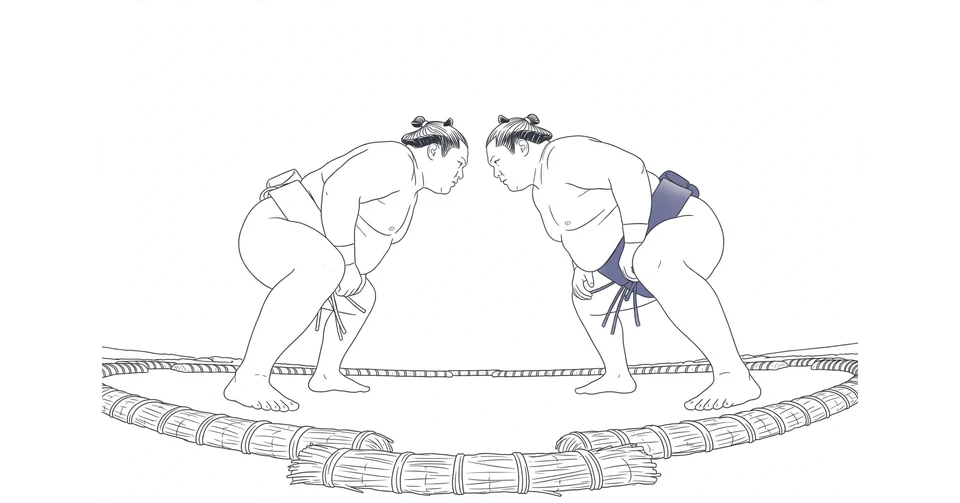
The name comes from characters that can be read as front row, and the picture fits. A maegashira stands at the front of the crowd below the titled ranks, first in line for whatever the tournament brings. He is not a trainee and not a champion. He is a professional at the top level whose exact place is written as a number, and that number is the whole story of his working life.
What a maegashira actually is
Makuuchi is the top division of professional sumo, and it holds five ranks. At the top sit the titled ranks, the san'yaku: yokozuna, ozeki, sekiwake, and komusubi. Everyone else in the division is a maegashira. The division has been fixed at 42 wrestlers since 2004, and the titled ranks usually take between 8 and 12 of those places. That leaves roughly 30 to 34 men as maegashira in any given tournament, which makes them the great majority of the top division.
The ranks run from maegashira 1 at the top down to around maegashira 17 at the bottom. The exact bottom number shifts from tournament to tournament, because the division is capped at 42 and every extra titled wrestler takes one slot away from the numbered ranks. In the September 2026 tournament, for example, there were 33 of them, with the lowest rank listed as number 17 on the east side only. The man at number 1 is one good tournament away from a title. The man at number 17 is one bad tournament away from falling out of the top division entirely.
That spread is what makes the rank interesting. The two ends of that ladder live in different worlds, even though they share a name. The man at number 1 fights the champions every day. The man at number 17 fights men much like himself, and his main job is to stay in the division at all. Both carry the same rank name, and both answer to the same arithmetic of wins and losses.
It is worth saying plainly that a maegashira is a sekitori, a salaried wrestler. The line that matters most in a sumo career is the one between juryo and makushita, and a maegashira sits safely above it. He earns a monthly salary from the Japan Sumo Association, lives in a private room at his stable, wears a silk belt in tournaments, and has junior wrestlers to attend him. The pay rises with rank, from about 1,100,000 yen a month in juryo to about 3,000,000 yen for a yokozuna, with a raise for every rank coming from the January 2027 tournament. A maegashira is therefore not a struggler in the sense of an unpaid trainee. He has arrived. What he has not done is climb high enough to be safe, and that is the tension of the rank.
For a fuller picture of how the five ranks of the top division fit together, the Makuuchi article on Wikipedia lays out the division rank by rank, including the privileges and duties that come with each step.
East and west, and why the small print matters
Every numbered rank comes in two versions, east and west. At each number there is an east man and a west man, and the east man is treated as the slightly higher of the two. East number 1 outranks west number 1, east number 5 outranks west number 5, and so on down the sheet. The difference is small, a single half step, but in a system built on half steps it matters. A wrestler who finishes a tournament at west maegashira 3 and climbs to east maegashira 2 has moved two half steps, and the next banzuke will show it.
The banzuke itself is the ranking sheet, a hand lettered document published about two weeks before each tournament, and it lists every professional wrestler in order. The calligraphy and the ceremony around its release are part of what makes sumo feel older than a sports league. Our earlier piece on the banzuke remembers every basho in calligraphy looks at that document as a record, and the maegashira ranks are where most of its names sit. When a new banzuke comes out, the first thing a maegashira does is look for his own name, and the second thing he does is look at the names printed just above and just below it, because those are the men he will probably meet.
There is no weight class in sumo, and no seeding by size. Rank decides the matchups, not body weight, so a small maegashira and a huge one meet whenever the banzuke puts them close together. The sheet is the draw, the schedule, and the verdict on the last tournament all at once. A maegashira does not choose his opponents. He reads his number, and the number chooses for him.
I find something honest in that arrangement. In most sports, a ranking is a number on a website that fans argue about. In sumo, the ranking is a sheet of paper that decides your working conditions for the next fifteen days. It is public, it is calligraphed, and it is final until the next tournament rewrites it.
The joi, or the hard end of the ladder
Not all of them fight the same tournament. The upper ranks, roughly maegashira 1 through 4, form a group called the joi, the upper reaches, and they receive the toughest scheduling in the division. A man ranked 4 or above can expect several bouts against san'yaku wrestlers, including ozeki and yokozuna. The men at 1 or 2 will usually face everybody in the san'yaku, except for men from their own stable, and those are considered very difficult ranks to hold.
Below that, from about number 5 down, a wrestler mostly fights others at his own level. His tournament is a contest among equals, and his job is to win more than he loses against men at his own level. The schedule is lighter in name only, because a losing record at number 10 still drops him several places, and a losing record at number 16 can drop him out of makuuchi altogether. The bottom of the ladder is not a soft place. It is a narrow ledge.
The boundary between the two groups shifts a little from tournament to tournament, depending on how many titled wrestlers there are. That is part of the design. The joi is not a fixed club with a fixed membership. It is a zone that the banzuke creates fresh each time, and a maegashira climbs into it by winning, then has to survive it to stay there.
There is a second wrinkle that keeps the schedule honest. If a lower ranked maegashira is in contention for the championship in the second week of a tournament, the schedulers will start matching him against increasingly higher ranked opponents. He does not get to win a title by beating only men at his own level. The system tests him as soon as he looks dangerous, and that is why a low ranked title challenge is so dramatic to watch. The man at the bottom has to beat the men at the top before anyone will hand him the cup.
Fifteen bouts decide everything
Professional sumo runs six tournaments a year, and each one lasts fifteen days. A maegashira fights once a day, fifteen bouts in all, and his record across those fifteen days decides his next rank. Eight wins or more is kachi-koshi, a winning record, and it brings promotion. Seven wins or fewer is make-koshi, a losing record, and it brings demotion. There is no committee, no vote, and no appeal. The arithmetic is public, and everyone can do it.
The movement can be small or extreme. A maegashira 2 who goes 8 and 7 might climb a single step to maegashira 1. A maegashira 14 who wins the championship can jump all the way to komusubi, which is exactly what happened to Takatoriki in March 2000, when he won the title with a 13 and 2 record from maegashira 14. A maegashira who goes 5 and 10 can fall five or six places in a single tournament, and a man at the bottom who goes 3 and 12 can fall out of the division entirely, down to juryo. The banzuke is rebuilt after every tournament, so no rank is ever permanent.
The one thing a maegashira can count on is that his fate depends on other wrestlers too. A winning record does not guarantee a fixed number of places, because his promotion depends on how the men above him performed as well. If the titled ranks all win, there may be no room to move up. If several titled wrestlers lose badly, a gap opens. The former wrestler Shinzaburo, writing about the ranks, calls this banzuke luck, and it is real. A maegashira can do everything right and still find the ladder crowded, or do just enough and find a door open. His guide to the sumo ranks explains how the numbers move, and it is written by a man who lived inside them.
Wrestlers from the same stable never face each other, which is the one mercy in the schedule. Beyond that, the rule is simple. Fight the man in front of you, keep count, and let the next banzuke say what it says.
The gold star and the prizes within reach
He has two prizes that the titled ranks above him cannot win, and both of them shape how he fights. The first is the kinboshi, the gold star. When he defeats a yokozuna, the win is recorded as a gold star, and he is paid a monetary reward for that victory for the rest of his career. The sum is modest by the standards of professional sport, but the honor is not. A gold star is a permanent mark on a career, and a wrestler who earns one has beaten the best wrestler in the sport on a day when it counted. The crowd knows it, and the noise in the arena when it happens is unlike anything else in sumo.
The second is the sansho, the three special prizes awarded at the end of each tournament for exceptional performance. The prizes are for Fighting Spirit, Technique, and Outstanding Performance, and a maegashira is eligible for all three. Sekiwake and komusubi are eligible too, but yokozuna and ozeki are not, which means the prizes belong to the lower half of the division. A maegashira who posts a strong record against hard opposition will very often leave the tournament with a prize and a promotion, and the prize money and the prestige both matter.
These two systems change the incentives of the rank in a healthy way. A man at the bottom of the division has no title to defend and no reputation to protect, so he can fight freely. A man at the top has the hardest schedule in the sport, but he also has the richest opportunities, a gold star here, a special prize there, and a titled rank waiting if he survives the week. The rank rewards boldness, and I think that is why the most memorable tournaments so often turn on a rank-and-file wrestler rather than a champion. The champions are expected to win. The rank-and-file man is allowed to surprise everyone.
When the bottom of the ladder wins it all
The most famous fact about the maegashira ranks is that a man at the very bottom can win the whole tournament. It has happened several times in the modern era, and each time it has stopped the sumo world in its tracks. In January 2020, Tokushoryu, the lowest ranked wrestler in the tournament at maegashira 17, won the championship with a 14 and 1 record. He had spent the first two weeks beating men from the lower half of the banzuke, and on the final day, still in contention for the title, he was matched against ozeki Takakeisho, the highest ranked wrestler competing in that tournament. He won that bout too, and took the Emperor's Cup.
Six months later, in July 2020, Terunofuji did the same thing from the same rank, maegashira 17 east, finishing 13 and 2 and beating sekiwake Mitakeumi on the final day. Terunofuji was a former ozeki on a long climb back from injury and illness, a man who had fallen as far as jonidan, the second lowest division, and rebuilt his career bout by bout. His title from maegashira 17 was the middle chapter of one of the great comebacks in the sport, and he went on to become the 73rd yokozuna the following year.
It happened again in March 2024, when Takerufuji won from maegashira 17 east with a 13 and 2 record, and in January 2021, when Daieisho won from maegashira 1 west, also at 13 and 2. The pattern is worth noticing. Three of the four most recent low ranked champions came from the bottom rank, the very bottom of the division. The reason is structural. A man at the bottom spends the first week fighting men near his own level, and if he keeps winning, the schedule only gets hard in the second week, when he is already full of confidence. A man at number 1 faces the champions from day one. The bottom of the ladder is a longer road, but it is a gentler one at the start, and a wrestler in form can ride it all the way to the cup.
None of this makes a maegashira title common. Most tournaments are won by a yokozuna or an ozeki, as the sport expects. But the possibility is real, and it is real because the system is honest. Fifteen bouts, no seeding by reputation, and a schedule that tests a challenger only when he earns the test. A maegashira who wins a title has not been lucky in the way a lottery winner is lucky. He has beaten fifteen men in fifteen days, including some of the best in the world, and the cup is his by right.
The long stay, a career spent as a maegashira
Not every man at the rank is passing through on the way up. Some men spend most of their careers at the rank, and their stories are quieter but no less respectable. The record for the most appearances at the rank without ever reaching a titled rank belongs to Sadanoumi, who appeared in the numbered ranks 60 times between May 2014 and November 2025, reaching as high as number 1. Sixty tournaments in the top division, and never once a sekiwake or a komusubi. That is more than a decade of professional sumo at the highest level, lived almost entirely inside the numbered ranks.
There is a lesson in that record, and it is not a sad one. A career as a maegashira is a career as a top division professional, with a salary, a private room, and a place on the televised broadcast every day of every tournament. The men who hold those places are among the forty two best wrestlers in Japan, out of nearly six hundred professionals on the banzuke. The gap between maegashira 1 and komusubi is one rank, and it is also a wall that many fine wrestlers never climb. The wall does not make their careers failures. It makes them honest.
The risk, of course, is the other direction. A maegashira who posts a losing record at the bottom of the division falls to juryo, the second division, and the fall costs him more than a number. Juryo is still salaried and still professional, but it is not the top division, and the television cameras and the crowds are smaller. The climb back is the same climb he made the first time, one winning record at a time. Some men bounce back in a single tournament. Some never return. That is the bargain of the rank, and every maegashira signs it each time he steps onto the clay.
I have come to admire the men who accept that bargain for years without complaint. Sport loves a champion, and it loves a prodigy, but it is built on the professionals who show up, fight fifteen times, and accept whatever number the next sheet of paper gives them. The maegashira ranks are where most of that work is done.
A day in the life of a numbered wrestler
The daily life of a maegashira looks much like the life of any sekitori, and very different from the life of a trainee. He rises early for practice at the stable, trains with the men of his stable, eats the communal stew called chankonabe, rests in the afternoon, and returns to the arena for his bout. As a sekitori he has junior wrestlers to help with chores and to attend him, and he wears his hair in the ginkgo leaf topknot, the oicho-mage, that marks a top division man. These are real privileges, and they are part of why the climb matters.
On tournament days, the order of bouts follows the ranks. The lower divisions fight first, juryo in the middle, and makuuchi last, with the titled ranks closing the day. He fights somewhere in the middle of the top division program, and the crowd is already full and loud by then. The upper men, the men of the joi, fight late in the day against the champions, and their bouts are often the ones that decide the tournament. The lower men fight earlier, and their bouts are often the ones that decide who stays in the division and who falls.
The work between tournaments is quieter. There are regional tours, practice sessions, and the long wait for the next banzuke, which arrives about thirteen days before the next tournament begins. For a man at the rank, that day is the most important date on the calendar. It tells him his number, his opponents, and the size of the task ahead. A man who climbed to number 2 will spend the next two weeks preparing for the champions. A man who fell to number 15 will spend them preparing for a fight to stay in the division. Both will train the same way, and both will find out on day one whether the preparation was enough.
The way a maegashira carries himself matters too, because sumo is a sport that watches behavior as closely as results. A wrestler who wins with grace and loses with composure earns the respect of the crowd and of his fellow wrestlers, and respect is a kind of currency in the sumo world. The rank has no title to hide behind, so character shows. That is true of every maegashira, from the man at the top of the ladder to the man at the bottom, and it is one of the reasons the numbered ranks repay attention.
Why the numbered ranks deserve a closer look
It is easy to watch sumo for the champions, and the champions deserve the attention. But the division is forty two men, and most of them are maegashira, and the tournament is decided as much by their results as by the title race at the top. The man at maegashira 8 who goes 11 and 4 has changed the next banzuke as surely as the yokozuna who goes 14 and 1. The man at maegashira 16 who goes 8 and 7 has saved his career for another two months. These are small stories, and they are the ones that make the sport feel like a living thing rather than a ceremony.
The maegashira rank is also the clearest window into what sumo values. The system does not protect a wrestler because he was good last year, and it does not punish him forever for one bad tournament. It measures the last fifteen days and moves him accordingly, up or down, by a step or by a leap. That is a harsh way to run a career, and it is also a fair one. A maegashira knows exactly where he stands, because his rank is a number, and the number is printed on a sheet of paper for the whole country to read.
If you watch a tournament, spend one day following the numbered ranks rather than the champions. Watch the man at number 3 fight an ozeki he has never beaten, and the man at number 14 fight for the win that keeps him in the division. Watch the lower ranked wrestler who starts the second week at 7 and 0 and suddenly finds himself facing a yokozuna. That is where the sport is most alive, in the numbered ranks, where every bout is a step up or a step down, and every wrestler climbs the ladder one bout at a time. Our earlier look at fifteen days of basho decide who sumo remembers follows a tournament from the opening day to the last, and the numbered men are in every chapter of it, because they are most of the division, and because the ladder they climb is the sport itself.
More in Culture & Society
- Komusubi Is the Smallest Chair at Sumo's Top Table
- A Sekiwake Waits One Win From Sumo's Highest Door
- Tanabata Festival and the Star-Crossed Lovers Behind the Bamboo Wishes
- An Ozeki Stands One Step From the Top and Cannot Afford to Slip
- An Oyakata Is the Father a Sumo Stable Cannot Replace
- A Tokoyama Spends Ten Years Learning to Dress a Topknot
Latest posts
- Japanese Calligraphy and the Brush That Turns Writing Into Art
- A Tegata Is Sumo's Inked Handprint Autograph
- A Rikishi Is a Man of the Sumo World Before He Wins a Single Bout
- Mawashi Carries a Wrestler's Rank Around His Waist
- Namasu Turns Daikon and Carrot Into a Red and White Wish
- Yokai, the Strange Spirits That Haunt Japanese Folklore
- Ebi Bends Like an Old Back and Wishes You a Long Life
- Yokozuna Is the Rank Sumo Never Takes Back
- Kobumaki Rolls Joy Into a Strip of Kelp
- Kurikinton Is the Golden Mash That Wishes You Wealth
- Japanese Beer and the Dry Wars That Changed How Japan Drinks
- Kamaboko Paints the New Year Red and White
- Datemaki Rolls Sweet Eggs Into a Spiral of Good Luck
- Japanese Bento and the Lunch Box That Became an Art Form
- Tazukuri Turns Tiny Sardines Into a Wish for a Good Harvest