An Oyakata Is the Father a Sumo Stable Cannot Replace
· 19 min read
An oyakata is a retired wrestler who holds one of sumo's 105 elder shares and becomes the father of a stable, coaching its wrestlers, running its household, and answering for everything that happens under its roof.
Every morning before dawn, in a plain building in a Tokyo district like Ryogoku, a man in his fifties or sixties takes a seat at the side of a clay ring and watches teenage boys stamp the ground until their legs shake. He says little. When he does speak, the whole room listens. That man is the oyakata, the stablemaster, and he is the reason the building is a stable at all rather than a gym with dormitories attached.
An oyakata is a retired wrestler who has become an elder of the Japan Sumo Association, and the word itself gives away the job. Long before it belonged to sumo, oyakata meant a surrogate parent, a big brother, or the master of an apprentice, and that is still what the role is. The oyakata is coach, landlord, recruiter, disciplinarian, and father to every wrestler who lives under his roof, and there is no one else in the building who can do what he does. If an oyakata leaves, the stable closes or passes to a successor, because the authority he carries cannot be hired out or handed to a committee.
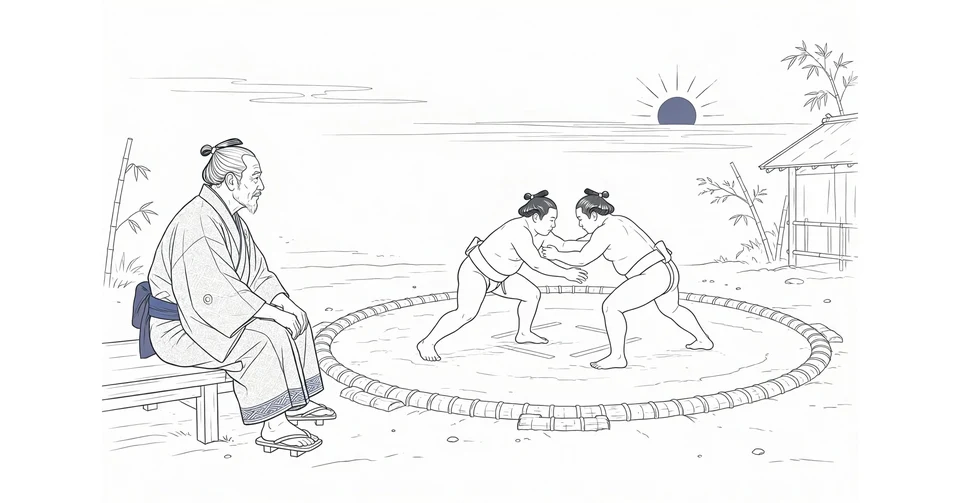
That authority is rare by design. There are only 105 elder shares in all of sumo, a number fixed in 1927, and only a wrestler who holds one of them can run a stable. Most wrestlers retire without ever getting near one, and the men who do hold them have usually spent their whole adult lives earning the right. So when you watch a tournament and see a wrestler bow toward the man sitting at the side of the ring, you are watching a relationship that began when the wrestler was fifteen years old and far from home, and that will shape every year of his career.
What the word oyakata actually means
The official title is toshiyori, which means elder, and it is the formal name used inside the Japan Sumo Association. But inside a stable, almost nobody calls the master a toshiyori. They call him oyakata, or sometimes shisho, which means teacher or master. The distinction matters, because the three words describe three different things. A toshiyori is any elder of the association, including men who work in offices, judge bouts, or coach without running a stable. An oyakata is a coach, and a shisho is specifically the elder who owns and runs a heya, a stable. The oyakata who runs a stable is the one at the top of its pyramid, and he alone is the owner, so he alone is the highest authority in the communal life of the house.
The history of the word reaches back further than professional sumo itself. Before the term entered the sumo world in the seventeenth century, toshiyori was used in the Edo period to describe government administrators and community leaders, with a meaning close to senior citizen. The word oyakata, meanwhile, was an honorific attached to proper nouns, and it first described a person with the status of a surrogate parent or a big brother, someone who took responsibility for an apprentice. That older meaning never left the job. When a boy joins a stable, he does not sign up for a sports club. He moves into the oyakata's house, eats at his table, and lives under his rules, and the man who takes him in is expected to raise him, not just train him.
I find this the most revealing thing about sumo, because it explains why the sport has never really modernised into something like other professional leagues. A football club can sack a manager and hire another one on Monday. A stable cannot do that with an oyakata, because the oyakata is not an employee of the stable. He is the stable, in the sense that his name, his share, his reputation, and his household are the institution. When the association talks about a stable, it is really talking about an oyakata and the men who live with him.
An oyakata begins as a wrestler, and most wrestlers never get there
Nobody is appointed as an oyakata from outside. Every elder is a former wrestler who reached a high enough rank to be eligible, and the bar is set deliberately high. A wrestler who reached the san'yaku ranks, the three ranks below yokozuna plus yokozuna itself, is entitled to apply after a single tournament at that level. A wrestler who topped out as a maegashira, in the top division but below san'yaku, needs twenty tournaments in the top division. A wrestler who reached juryo, the second division, needs thirty tournaments as a sekitori, meaning in the top two divisions. Those are the public rules, and they are strict enough that only a small minority of the hundreds of men who wrestle professionally ever qualify.
Even qualifying is not enough, because eligibility is only the first gate. To become an oyakata, a retired wrestler must also acquire a share, called a kabu, inside the Japan Sumo Association. Each share carries a generational family name, a myoseki, and the wrestler who inherits one receives a diploma bearing the name he has inherited. Without a share, there is no elder status, no coaching job, and no stable to run. A yokozuna may stay in the association under his ring name for five years after retiring, and an ozeki for three, while he looks for a share, but after that grace period the same rule applies to everyone. Find a share, or leave.
There is one more condition, and it is the one that has caused the most argument over the years. A wrestler must be a Japanese citizen to become an oyakata, so a wrestler born overseas must give up his original citizenship and become Japanese first. The association once declared that a foreigner could never be a trainer, then corrected itself under criticism, and the first foreign born wrestler to become an elder was Takamiyama, who retired in 1984 and founded Azumazeki stable two years later under the name Azumazeki. Kotooshu, from Bulgaria, became the first elder of European origin in 2014, and Kyokutenho, born in Mongolia, became the first Mongolian born elder in 2017. The door is open now, but it is a narrow door, and it stays narrow on purpose.
The result is a strange arithmetic that shapes the whole sport. Hundreds of young men enter sumo, most of them as teenagers, and only a fraction will ever be eligible for elder status, and only a fraction of those will find a share. The rest retire into ordinary life, often carrying injuries, with no job waiting for them in the world they gave their youth to. The shares are described in the association's own history as the last hope of remaining in the sporting world, with a salary and the support of their peers, and that is why wrestlers push themselves beyond reason to keep their careers alive while a share might come free. The oyakata at the side of the ring is not just a coach. He is a man who survived a selection process that defeated most of the men he ever trained with.
One of only 105 shares, and the price of holding one
The number 105 is the single most important fact about the oyakata system, and it has not changed for nearly a century. When the sumo associations of Osaka and Tokyo merged in 1927, it was decided that the quota of Tokyo, with eighty eight elders, and Osaka, with seventeen, would form the maximum number of names that could be inherited in the newly proclaimed All Japan Sumo Association. Eighty eight plus seventeen is 105, and that total has been fixed ever since. No new shares are created. A man who wants to become an oyakata must wait for an existing holder to leave, usually by reaching the mandatory retirement age, or by dying, and then he must persuade the holder, or the holder's family, to pass the share to him.
The transfer itself is famously opaque. Deals are generally no more than oral agreements between an applicant and his predecessor, and purchase prices are never disclosed. In the 1990s, when speculation over shares was at its fiercest, a share was said to trade at around 200 million yen, and the pressure became so intense that the chairman of the association at the time proposed banning the buying and selling of shares altogether and placing unused shares under the association's management. He faced such strong opposition from the board that he withdrew the proposal and resigned as chairman. The association later became a public interest incorporated foundation, and under its new statutes the sale of shares is theoretically prohibited, with the association itself managing the names and the elders retaining only the right to recommend successors. The press has reported, more than once, that the reform changed less than it appeared to, because consultation fees paid to a former shareholder look very much like the old purchase price under a new name. Whether the money still changes hands or not, the effect is the same: the shares stay scarce, and scarcity keeps them valuable.
Scarcity also creates a strange rental market. A retired wrestler who has secured a share can rent it to another retired wrestler in a process called kari kabu, borrowed share, which lets the tenant work as an elder while he looks for a share of his own. The arrangement has been compared to a game of musical chairs, because the tenant must keep finding a name to borrow or leave the association, and some elders have changed names several times during their coaching careers. One former wrestler, Wakajishi, was known for borrowing no fewer than eleven different names between 1983 and 1996. I think the musical chairs image is exactly right, and it tells you something important about the men who sit in the stablemaster's chair. They did not walk into the job. They waited, negotiated, borrowed, and sometimes gambled their savings on a name that might keep them in sumo for another decade.
For the full story of how the cap works and why it has never been raised, my piece on the 105 elder shares that limit all of sumo goes into the detail. The short version is that the number is not an accident. It was fixed to stop the uncontrolled spread of elder titles, and it has stayed fixed because every holder has a reason to keep it that way. A share that anyone could get would be worth nothing, and a share worth nothing would not guarantee a job for life.
The oyakata as father, and the okamisan as mother
A stable is a house before it is a team, and the oyakata runs it the way a father runs a household. The typical stable has a practice area on the ground floor and living quarters above, and the oyakata and his family often occupy the topmost floor. The setup is thoroughly paternalistic, as a visit to the Takadagawa stable described it, with the stablemaster acting as father to his charges and his wife, the okamisan, acting as mother. The wrestlers eat together, sleep under the same roof, and follow a schedule the oyakata sets. Only sekitori, wrestlers in the two highest divisions, who are married are allowed to live on their own. Everyone else lives in the stable, in shared quarters, until rank earns them a private room. The arrangement is described in detail in a Nippon.com visit to a Tokyo stable, which found the same pattern in every house it looked at: communal life, one roof, one father figure at the top.
The father role is literal in a way that surprises outsiders. New recruits usually arrive straight from junior high school, around fifteen years old, leaving their families behind to live with strangers. The oyakata takes them in, feeds them, houses them, and decides how they spend their days. The oyakata recruits them himself, often travelling to their hometowns and persuading their parents to trust him with their sons. In return, the boys owe him obedience, and the obedience is total. Juniors wake before dawn to sweep the ring and prepare the training room, cook for the seniors, do the laundry, and serve the men above them, because serving is part of the job at the bottom. The oyakata decides who trains, who rests, who is punished, and who is ready for a tournament. There is no appeal, and there is no human resources department.
His wife is the other half of the arrangement. The okamisan handles the day to day operations of the stable, looks after the wrestlers as she would her own sons, and manages the household that makes the training possible. I wrote about her separately, in my piece on how every stable runs on its okamisan, because she is easy to overlook and impossible to replace. But the division of labour is clear. She runs the house. He runs the wrestlers, and he answers for them.
Answering for them is the part of the job that weighs heaviest. When a wrestler misbehaves outside the stable, it is the oyakata who is called to explain, apologise, and accept the consequences. When a wrestler is injured, it is the oyakata who decides on treatment and who carries the worry. When a young recruit is homesick, or frightened, or thinking of quitting, it is the oyakata he talks to, or the okamisan, and the conversation happens behind closed doors, in the house where they all live. A coach in most sports goes home at night and stops being responsible. An oyakata never stops, because his wrestlers never leave his house.
A day in the life of an oyakata
The working day of an oyakata starts before the wrestlers do, and it is built around a single fixed point, the morning practice called asageiko. The juniors are up first, in some stables around five in the morning, to prepare the ring. The seniors arrive later, toward seven or eight. The oyakata watches from his seat at the side, and for long stretches his is the only voice in the room. When it rises, everyone in earshot understands that someone has stopped working hard enough. That seat at the side of the ring is where the authority of the house is most visible, and it is also where the coaching happens. The oyakata corrects a stance, stops a drill, orders a rematch, or simply watches in silence while a junior charges at a senior's chest until his legs give out. The training is the same every morning, and the oyakata is the reason it stays the same, because he is the memory of the stable. He trained the same way under his own master, and he teaches the way he was taught.
After practice comes the first meal of the day, the hot pot called chankonabe, cooked by the juniors and eaten in rank order, seniors first. The oyakata eats with his wrestlers, and the meal is part of the job, not a break from it. It is where he sees who is eating well and who is not, who is tired, who is injured, who is struggling, and who is ready. Then the afternoon brings the rest of the work: paperwork for the association, meetings, sponsors, fans, the media, and the endless small decisions of running a house full of young men. A stable is also a business, with bills, a building to maintain, and a reputation to protect, and the oyakata is the manager of all of it.
What strikes me about this routine is how little of it looks like coaching in the modern sense. There is no sports science department, no team of assistants with clipboards, no rotation of specialists. There is one oyakata, sitting at the side of a clay ring, who knows every wrestler in the room by name, by habit, and by weakness, because he recruited most of them as children and has watched them grow up in his house. That knowledge is the real qualification for the job, and it cannot be bought with a share or learned from a manual. It is earned by living with the wrestlers, year after year, and it is why a stable with a good oyakata can keep producing good wrestlers for decades, while a stable that loses its master often fades quickly.
When an oyakata retires, and who takes his place
Every oyakata knows the date his job will end, because the rule is absolute. All elders must relinquish their share when they reach the age of 65, which is the compulsory retirement age within the Japan Sumo Association. There is no extension, no honorary continuation, and no vote to keep a popular master in place. At 65, the share passes on, the stable passes to a successor, and the oyakata who ran the house for decades becomes a former master, sometimes staying attached to the stable informally to offer advice, but no longer in charge. The system is designed that way on purpose. A fixed retirement age is what keeps the 105 shares moving, because without it the holders would stay forever and no young retiree would ever get a chance.
Succession is usually a family affair, or as close to one as sumo allows. Shares are traditionally managed within the same ichimon, a group of stables that also functions as a political clan inside the association, and holders are reluctant to let a share pass to a member of another clan. It is also common for a share to stay within a wrestler's family, and agreements on transfers within the same family are traditionally not affected by money at all. When an elder dies, the management of his share may fall to his family, and most often to his widow, because although only a former wrestler can use the name, the diploma itself can technically be held by someone outside the association, and the association has no way to force it back. The story of the Izutsu share shows how tangled this can get. When the former Izutsu died in 2019, his family rented the share to the former Toyonoshima, and the arrangement only ended when Shimanoumi, who had married the late master's daughter, became the heir.
There is one exception to the whole system, and it is reserved for the greatest champions. A wrestler with an era defining career can be offered a single generation elder share, called ichidai toshiyori kabu, which lets him stay as an elder under his own ring name without taking one of the 105 shares, and which ceases to exist when he retires. Only three wrestlers have ever received it: Taiho, Kitanoumi, and Takanohana. A fourth, Chiyonofuji, was offered it and chose a normal share instead, becoming Kokonoe. In October 2021, when the great yokozuna Hakuho retired, it was widely expected that he would receive the same honour, but he was denied it, and a member of the Yokozuna Deliberation Council declared at a press conference that no such system exists under the association's new statutes. Critics called the decision an insult to the greatest champion in the history of professional sumo, and the argument has not really ended since. The full record of the elder system, including the rules for becoming a toshiyori, the share system, and the retirement age, is set out in the Wikipedia article on toshiyori, which traces the institution from its Edo period origins to the present day.
That controversy is worth remembering, because it shows what the oyakata system really is. It is not a job ladder. It is a closed world of 105 names, passed from hand to hand by oral agreement, family loyalty, and clan politics, and even a wrestler who won more championships than anyone in history could not force his way in when the association decided the door was shut. The men who hold the shares protect the system because the system protects them, and the system survives because every holder knows that his own place in it depends on the same rules.
Why the father cannot be replaced
I keep coming back to the seat at the side of the ring. In every account of morning practice, in every photograph of a stable, there is the same image: the juniors drilling, the seniors waiting their turn, and one older man sitting quietly at the edge, watching. He does not need to shout. His presence is the discipline, his silence is the standard, and his approval is the reward the young wrestlers are working for. A stable without an oyakata is a building with a ring in it. A stable with one is a family, with all the warmth and all the severity that word implies.
That is why the title of this article uses the word father, and why I think the word is exact rather than poetic. A father is not replaceable by a better qualified stranger, because the job is not a set of skills. It is a relationship, built over years of living together, eating together, and trusting one another with things that matter. The oyakata recruited his wrestlers as children, watched them grow, taught them how to fall without breaking, and will still be there when they retire and need help finding a life outside the ring. No committee can do that. No rotation of guest coaches can do that. Only an oyakata who lives in the house, and who will answer for everything that happens inside it, can do that.
Sumo will keep changing around him. Tournaments move to new arenas, foreign wrestlers arrive and become elders, the association rewrites its statutes, and the price of a share rises and falls. But the shape of the stable will stay the same as long as the oyakata system does, because the sport is built on a simple idea that has survived for centuries: a boy leaves home at fifteen, and another man becomes his father until he is ready to stand on his own. The share, the salary, and the title are the machinery. The father is the point.
More in Culture & Society
- A Tokoyama Spends Ten Years Learning to Dress a Topknot
- Japanese Calligraphy and the Brush That Turns Writing Into Art
- A Tegata Is Sumo's Inked Handprint Autograph
- A Rikishi Is a Man of the Sumo World Before He Wins a Single Bout
- Mawashi Carries a Wrestler's Rank Around His Waist
- Yokai, the Strange Spirits That Haunt Japanese Folklore
Latest posts
- Namasu Turns Daikon and Carrot Into a Red and White Wish
- Ebi Bends Like an Old Back and Wishes You a Long Life
- Yokozuna Is the Rank Sumo Never Takes Back
- Kobumaki Rolls Joy Into a Strip of Kelp
- Kurikinton Is the Golden Mash That Wishes You Wealth
- Japanese Beer and the Dry Wars That Changed How Japan Drinks
- Kamaboko Paints the New Year Red and White
- Datemaki Rolls Sweet Eggs Into a Spiral of Good Luck
- Japanese Bento and the Lunch Box That Became an Art Form
- Tazukuri Turns Tiny Sardines Into a Wish for a Good Harvest
- Kazunoko Is the Herring Roe That Promises Children and Plenty
- Kuromame Turns Black Beans Into a Wish for Health
- Gyoji Are Sumo's Referees in Silk and Calligraphy
- Japanese Baseball and the Game Japan Made Its Own
- Jubako Layers a Family's Luck One Box at a Time