Jubako Layers a Family's Luck One Box at a Time
· 21 min read
A jubako is a set of square lacquered boxes that stack into a tower, and each tier carries a wish, a dish, and a piece of family history.
Lift the lid off a jubako and you are not opening a lunch box. You are opening a small tower of intentions. A jubako is a set of square lacquered boxes, usually black outside and red inside, that stack into a tower of two, three, four, or even five tiers, and every layer has a job to do.
The word itself explains the object. Ju means layering or stacking, and hako means box, so a jubako is quite literally a stack of boxes. What the name does not explain is why a family would keep such a thing for decades, repair it when it chips, wrap it in cloth between uses, and hand it to the next generation like a piece of furniture that happens to hold dinner.
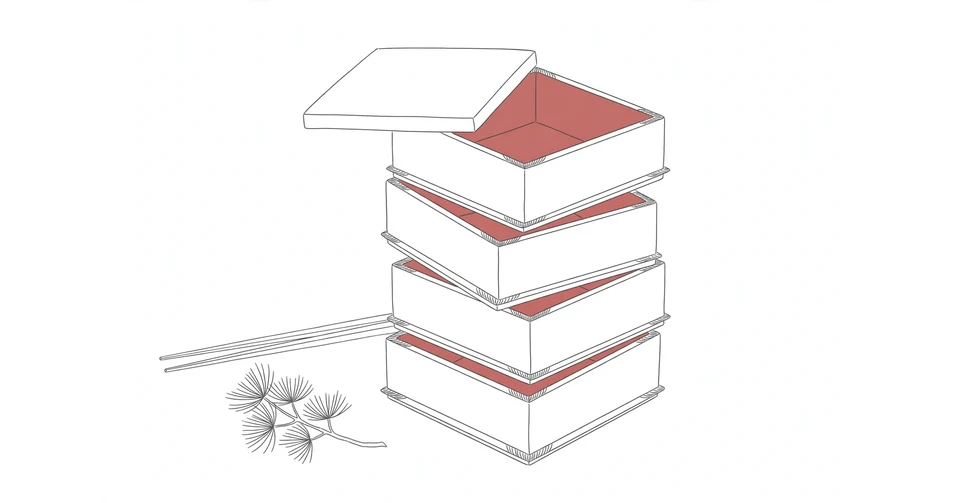
The short answer is that a jubako is the rare object that is useful, beautiful, and meaningful at the same time. It carries food, it decorates the table, and it says something about the people eating from it, all without saying a word. This is the story of that box, how it is made, what each tier means, and why it still matters in kitchens that own a microwave and a fridge.
What a jubako is
A jubako is a set of separate shallow boxes, all the same size, that stack one on top of another and close with a single lid. The classic form is square, because a square uses space well, stacks securely, and makes it easy to arrange small dishes in neat compartments. Round jubako also exist, and there are even hexagonal and flower petal shaped sets, but the square tower is the shape most people picture when they hear the word.
The classic colours are black on the outside and red on the inside. Black and vermilion are the classic lacquer colours for festive and formal ware, and the contrast does real work at the table. Dark food looks brighter against a red interior, and a black exterior makes the whole stack look calm and formal even before the lid comes off. Modern sets come in natural wood, brown, patterned designs, and bright contemporary colours too, but the black and red pairing is still the one that signals a celebration.
Inside, the tiers are shallow on purpose. A jubako is not a deep pot. Each tier holds a single layer of small dishes, arranged tightly enough to stay in place and leave every item visible. Removable dividers or small cups can separate sauces and strongly flavoured foods, but many traditional arrangements rely on careful placement alone. The food is meant to be seen from above, like a small garden, and the cook who packs a jubako is doing a little bit of flower arranging with food.
The strongest association of the jubako is with osechi, the New Year feast of Japan. Our guide to osechi and the luck packed into its stacked boxes follows the dishes and the wishes they carry, and the jubako is the quiet partner in that story. The boxes are the reason the feast can be cooked days in advance, carried to the table in one neat tower, and then unstacked and laid side by side so everyone can reach every dish. Without the jubako, osechi would be a pile of small plates. With it, osechi is a ceremony.
That is the first thing to understand about a jubako. It is not a container that happens to hold a celebration. It is part of the celebration itself. The stacking is the message, and the message is that good things pile up, layer upon layer, the way the boxes do.
A short history of the jubako
The jubako has been part of Japanese life for a long time. Its first written mention appears in a late Muromachi period document called the Manjuya-hon Setsuyoshu, which places the box in the written record centuries ago, in a period that ran from the fourteenth century into the late sixteenth. At first the jubako belonged to the aristocratic class, and fine lacquered sets were treated as artistic crafts as much as household objects.
By the early Edo period, which began in 1603, production of the jubako was well established and the boxes had become accessible to common people. They were used for serving food at banquets and became popular for outdoor gatherings, and the opulent lacquered and gilded sets used by daimyo, the provincial lords of the time, still survive in museums today. The gap between a lord's jubako and a commoner's jubako was wide, but the shape was the same, and that shared shape is part of the charm. A lord and a farmer both ate from stacked boxes, even if the lacquer on one of them cost more than the food inside.
The picnic box has its own name and its own story. A sage-jubako is a lacquer picnic box made for carrying a meal on a special outing, to a temple, a festival, or a cherry blossom viewing. One surviving example from around 1730, in the Edo period, is a four tiered lacquer set that travelled with small bottles of sake, filled with food arranged painstakingly and packed tightly to show abundance and care. The contents changed with the season and might include vegetables, eggs, rice, and raw fish. Even common people occasionally used a sage-jubako, though the most extravagant decorated examples belonged to daimyo, who would employ a special bearer to carry the box when attending hanami, the viewing of the cherry blossoms.
A four tier set is often described as the most formal, with one tier for each of the four seasons. That reading fits the way Japan thinks about the year, and it fits the way a jubako works at the table. Each tier is a season of its own, and the whole stack is a year in miniature. Whether or not every family believed that literally, the idea survived because it feels true when you lift the lid and see four small worlds stacked on top of one another.
How a jubako is made
A traditional lacquered jubako begins as wood. A woodworker shapes the base of each tier, and the pieces are joined so precisely that the boxes sit flat on one another without wobbling. Getting a square box to stack true is harder than it looks, and applying an even coat of lacquer to angular boxes takes real skill. The lacquerware craftsmanship is part of what makes a good jubako feel solid in the hand and look calm on the table.
Then comes the urushi, the natural lacquer made from the sap of the lacquer tree. Raw lacquer is painted onto the wooden base to seal it and keep moisture out, and then coat after coat is built up, each one dried and polished before the next. The base coats alone are built up slowly over months, layer by layer, and the top coats use the finest filtered lacquer to give the deep gloss that lacquerware is known for. It is slow work, and that slowness is the point. A jubako that is rushed will show it, and a jubako that is made patiently will last for decades.
The decoration is where a jubako becomes personal. Maki-e is the technique of painting a shape in wet lacquer and sprinkling it with gold or silver powder, so the design appears as the lacquer dries. Chinkin is a related technique in which the artisan carves shallow lines into the lacquer and fills them with metallic dust. Traditional designs favour auspicious patterns, pine, bamboo, and plum blossoms, cranes, and tortoises, the old symbols of long life and good fortune. A pine sprig beside a jubako is not a random decoration. It is the same wish, repeated in a different medium.
Two regions are famous for this work. Wajima, in Ishikawa Prefecture, is known for lacquerware strengthened with diatomaceous earth in its base coats, and Echizen, in Fukui Prefecture, lists bowls, trays, and stacked boxes among its core lacquer products. Buying a jubako from a known lacquer region is a little like buying a knife from a known smithing town. The name on the box is a promise about how it was made, and a well made jubako can be repaired and refinished rather than thrown away.
Not every jubako is lacquered wood. Natural wood sets are lighter and have a warmth of their own, with the added habit of absorbing a little moisture, which helps keep food flavours steady. Plastic and resin sets are lighter still, cheaper, and easy to wash, and many are safe in the dishwasher. A complete guide to the craft, the materials, and the care of these boxes is laid out in the Kogei Japonica guide to jubako, which walks through every type from lacquered heirloom to modern picnic set. The material you choose says something about how you plan to use the box, and there is no shame in choosing the practical one.
Size matters more than most first time buyers expect. A three tiered jubako of 6.5 sun, about 19.5 centimetres across, suits osechi for four to five people. Smaller households do well with a compact 5 sun set, about 15 centimetres, or a 4 sun set of about 12 centimetres, in two tiers or even a single tier. For outdoor use, a medium 6 sun or 7 sun set, about 18 to 21 centimetres, in a lightweight material is easier to carry when full. The rule is simple. Choose the number of tiers for the number of people you serve, and choose the size for the amount of food you actually cook, not the amount you dream of cooking.
What each tier of a jubako means
The tiers of a jubako have names, counted from the top. The first tier is ichi-no-juu, the second is ni-no-juu, the third is san-no-juu, and the fourth is yo-no-juu. You do not need to memorise these to use a jubako well, but knowing them changes how you look at the stack. Each tier is a named place, not just a layer, and the cook who packs the box is deciding what belongs in each named place.
In osechi, the traditional assignment gives each tier a category. The top tier holds the celebratory dishes and sweets, the black beans, the herring roe, the small dried sardines, the sweet rolled omelette, and the golden chestnut paste. The middle tier holds the grilled and vinegared foods, the prawns, the sea bream, the yellowtail, and the red and white vinegared vegetables. The bottom tier holds the simmered foods, the lotus root, the taro, the carrot, the shiitake, and the burdock. A fuller guide to the tiers and their dishes is part of the osechi story, and the arrangement varies by household, region, and seller.
| Tier | Name | What it traditionally holds |
|---|---|---|
| Top | Ichi-no-juu | Celebratory dishes and sweets |
| Second | Ni-no-juu | Grilled and vinegared foods |
| Third | San-no-juu | Simmered vegetables and roots |
| Fourth | Yo-no-juu | An extra tier for larger gatherings |
That table is a guide, not a law. The exact order is not universal across regions and households, and modern commercial boxes rearrange the contents according to style, the number of tiers, and the space available. A family in Kansai may pack its box differently from a family in Kanto, and both are correct. The tiers are a language, and like any language, the accent changes from place to place.
What does not change is the symbolism of the stacking itself. Layer upon layer, the boxes are said to represent happiness piling up on happiness, good fortune stacked the way the boxes are stacked. It is a simple idea, and that is why it has lasted. You do not need to believe in magic to enjoy it. You only need to notice that a tower of food feels more hopeful than a single plate, and that opening one tier after another feels like unwrapping a small series of gifts.
I think the tier system also teaches something about cooking. When each tier has a category, the cook cannot hide behind one big dish. Every tier has to earn its place, and the balance of the whole box matters more than any single item. That is a good way to think about a meal, and a good way to think about a year too. No single month carries the year. It is the stack that does it.
The jubako beyond New Year
New Year is the most famous job of the jubako, but it is far from the only one. The box was made for celebration in general, and Japan has never been short of occasions worth celebrating. Once you start looking, the jubako turns up everywhere, at festivals, at seasonal observances, and on ordinary days that someone decided to make a little special.
For Girls' Day on March 3, a jubako may present chirashi sushi, scattered sushi topped with colourful ingredients, and hina-arare, the sweet rice crackers of the festival. For Boys' Day on May 5, it may hold kashiwa-mochi, rice cakes wrapped in oak leaves, and chimaki, bamboo leaf wrapped rice dumplings. These are not the dishes of the New Year. They are the dishes of spring, and the same box carries them with the same care. The jubako does not belong to one holiday. It belongs to the calendar.
The picnic is where the jubako shows its practical side. A sage-jubako was built to travel, to be carried to a temple outing, a festival, or a hillside of cherry blossoms, and opened where the food would be eaten. The tiers keep different dishes separate on the journey, the lid keeps them covered, and the stack is easy for one person to carry. At the blossoms, the box is unstacked and the meal becomes a spread on a picnic cloth, with the same small dishes that would have been served at home. I like that image, a formal object behaving casually under a tree. It reminds me that tradition is not only for the dining room. It is also for the outdoors, where it has to prove itself.
Modern life has given the jubako new jobs. It appears at sports days and school events, where a family needs to feed several people from a single container. It appears at home parties, where it lets a host present many small dishes without a dozen plates. It holds wagashi, the traditional sweets, at festive gatherings. Smaller sets store pickles and preserved foods, ready to be served directly at the table, and a handsome jubako can sit on a shelf as a decorative object between uses. The box adapts because its logic is simple. Several small things, kept separate, carried together, presented as one.
How to use a jubako at the table
A jubako arrives at the table as a tower and leaves it as a spread. The lid comes off, the tiers are unstacked, and each tier is laid beside the others so everyone can reach every dish. Nobody is meant to eat from the tower itself. The tower is for carrying and for presenting. The meal begins when the stack comes apart, and there is something satisfying about that moment, like a small building being taken down so people can eat inside it.
The food in a jubako is usually shared. The box is placed where several diners can reach it, and each person takes a portion onto their own small plate or bowl rather than eating directly from the communal tier. If serving chopsticks are provided, use them rather than reaching in with your own chopsticks. It is a small courtesy, and it keeps the shared food clean for everyone. This is the same instinct that runs through Japanese dining in general. The food is communal, the plate is personal, and the line between them is respected without fuss.
Beside the cold tiers sits the one hot dish of the season. At New Year that is usually ozoni, the soup of pounded rice cakes, made fresh each morning while the boxes wait on the table. Our article on ozoni and the argument over what goes in it follows the broth from the clear soup of Kanto to the white miso soup of Kansai, and it shows how regional the New Year table really is. The jubako and the ozoni belong together, the cold boxes and the hot bowl, the food made days ago and the food made that morning, and a household that serves one without the other is missing half the season.
Packing a jubako is a skill of its own. The food should be grouped tightly enough to stay in place and look ordered, while leaving each item identifiable. Small dishes are packed close together, sauces are kept in small cups or behind dividers, and strong flavours are kept away from delicate ones. The aim is abundance without mess, a box that looks full but not crowded. The first time you pack one, you will probably leave gaps. The second time, you will pack tighter. By the third time, you will understand why the boxes are square. Every corner is usable, and nothing is wasted.
Looking after lacquer so a jubako outlives you
A lacquered jubako is not a fragile object, but it is not a plastic tub either. It asks for a little attention, and in return it lasts long enough to be handed down. The care is simple, and most of it comes down to gentleness and patience.
Wash a lacquered jubako by hand, soon after use, with a mild detergent and a soft sponge or a soft cloth. Use lukewarm water rather than hot or cold water, which can cause the lacquer to crack, and dry the tiers promptly with a soft cloth so no moisture sits on the surface. Avoid abrasive sponges and hard brushes entirely. They will scratch the lacquer, and scratches on lacquer are much harder to forgive than scratches on wood.
Do not put a traditional lacquered jubako in the dishwasher, the microwave, or a long soak in the sink. Extremely hot food, prolonged soaking, and harsh detergents can damage the finish and the wooden base underneath. If the maker gives care instructions, follow those first, because different lacquers and different bases have different limits. The safe default is the gentle one. Hand wash, dry promptly, and store clean and dry, with the tiers protected from rubbing against one another.
Storage matters as much as washing. Keep a lacquered jubako out of prolonged strong sunlight, and keep it away from extreme dryness, which can make lacquer crack. A room with moderate humidity, around 50 to 60 percent, is ideal, and in a dry winter a humidifier in the room can help. Avoid storing the box in a hot attic or a damp cupboard. The lacquer likes the same conditions you do, not too hot, not too dry, not too damp, and it will repay that kindness for years. The Suwada guide to jubako sets out the same care in detail, from hand washing to storage, and it is a good reference to keep beside the box itself.
Here is the part I like most. A well used jubako will still pick up small scratches over the years, and that is not a failure. The scratches are the record of the meals it has carried, the New Years, the picnics, the parties, and the quiet dinners when someone decided to make an ordinary evening a little special. A new jubako is beautiful. A scratched jubako is beautiful and honest. When a family passes one down, they are not passing down a perfect object. They are passing down the evidence of all the meals that came before, and the invitation to add a few more scratches of your own.
Choosing your first jubako
If you are buying your first jubako, start with how you will actually use it. Count the people you usually feed, and choose the number of tiers for them. A two tier set is enough for a small household. A three tier set suits a family of four or five. A four tier set is for a large gathering or a formal occasion, and it is also the most impressive to open, which counts for something.
Then choose the material with the same honesty. A true urushi lacquer set is the most beautiful and the most demanding. It needs hand washing, careful drying, and decent storage, and it will cost more than a plastic set. A modern lacquer or resin set gives you much of the look with far less worry. An uncoated wooden set is light and warm, but it needs thorough drying to prevent mould. A plastic set is the easiest of all, light, washable, and cheap enough to take to a park without anxiety. None of these is the wrong choice. The wrong choice is the jubako that stays in a cupboard because it is too precious or too fussy to use.
Look for a few practical details before you buy. Check that the tiers stack flat and sit securely without wobbling. Check whether they nest or stack compactly for storage when empty. Look for removable dividers if you serve foods with sauces. Make sure the box is easy to lift when full, because a loaded three tier jubako is heavier than it looks. And look at the lacquer itself, or the finish, in good light. An even coat with a good shine and carefully made decoration is the sign of a well made box, whether it comes from Wajima, Echizen, or a modern workshop.
My own advice is to buy the jubako you will use, not the jubako you will admire. A modest resin set that goes to the park every spring will give you more joy than a lacquered heirloom that never leaves its wrapping. And if you do buy a lacquered set, use it. Lacquer is made to be used, and a jubako that is used gently and cared for properly will outlast the person who bought it. That is the whole idea. The box is not a decoration. It is a tool for gathering people, and tools are meant to be held.
A quiet way to keep a family together
A jubako layers a family's luck one box at a time because it turns a meal into a small piece of architecture. The tiers stack, the lid lifts, the dishes appear in their named places, and for a little while the table is organised around something more than hunger. It is organised around care, the care of the cook who packed each tier, the care of the artisan who lacquered the wood, and the care of the family that kept the box long enough for the lacquer to earn its scratches.
I think that is why the jubako has survived the move from aristocratic banquets to common kitchens, from daimyo picnics under the cherry blossoms to school sports days, and from hand lacquered wood to dishwasher safe plastic. The object changed, but the idea did not. Food tastes better when it is presented with intention, and a family eats better when the meal itself says that this moment matters.
You do not need a special occasion to use a jubako. You need a few small dishes, a few people you like, and a table to unstack the tiers on. The luck in the box was never magic. It was always the effect of taking the time to pack something beautiful, opening it together, and eating slowly enough to notice what you have. The boxes will be washed, dried, and stacked again before the evening ends, and they will be ready the next time someone decides that an ordinary day deserves a small tower of its own.
More in Food & Travel
- Kuromame Turns Black Beans Into a Wish for Health
- Osechi Packs a Whole Year of Luck Into Stacked Boxes
- Japan Goes Maple Hunting Every Autumn and Calls It Momijigari
- Koyo Turns Japan Into a Country That Forecasts Leaves
- Momiji-Gari Is Japan's Autumn Answer to Hanami
- Momiji Turns Japan Red Every Autumn
Latest posts
- Gyoji Are Sumo's Referees in Silk and Calligraphy
- Japanese Baseball and the Game Japan Made Its Own
- The Banzuke Remembers Every Basho in Calligraphy
- Fifteen Days of Basho Decide Who Sumo Remembers
- Kojiri Is the End Cap That Takes Every Knock for a Katana
- Kurikata Is the Chestnut Knob That Holds a Katana at the Hip
- Koshirae Is the Formal Mounting That Turns a Blade Into a Katana
- Shirasaya Is the Plain White Scabbard Where a Katana Rests
- The Togishi Polishes a Katana for Weeks Before It Ever Cuts
- Kozuka Is the Small Knife Hiding in a Katana's Saya
- Wakizashi Was the Short Sword a Samurai Never Took Off
- Tsuba Is the Small Guard That Stops a Katana From Cutting Its Owner
- Yokote Is the Small Line That Tells a Katana's Age
- Seppa Are the Thin Washers That Keep a Katana From Rattling
- Kissaki Is the Small Tip That Finishes a Katana