Yokote Is the Small Line That Tells a Katana's Age
· 25 min read
The yokote is a short angled line across a katana blade near its tip, and its sharpness, angle, and placement help appraisers judge the age, school, and condition of a sword.
Hold a katana in good light and let your eye travel from the handle to the point. The blade is long, curved, and mostly smooth, so your eye moves quickly. Then, a few centimetres before the tip, it stops. A short line runs across the blade at a slight angle, dividing the main body from the point. That line is the yokote, and it is one of the smallest features on the whole sword. It is also one of the most informative.
The line does not cut anything. It does not hold the sword together, and it does not make the blade stronger. Its job is different. It marks a boundary, and in marking that boundary it records decisions made by the smith, the polisher, and the centuries that followed. A sharp line speaks of careful work. A soft one speaks of wear, of hurried polishing, or of a blade that was never well finished. Learning to read that one line is a short cut to understanding how experts look at a Japanese sword.
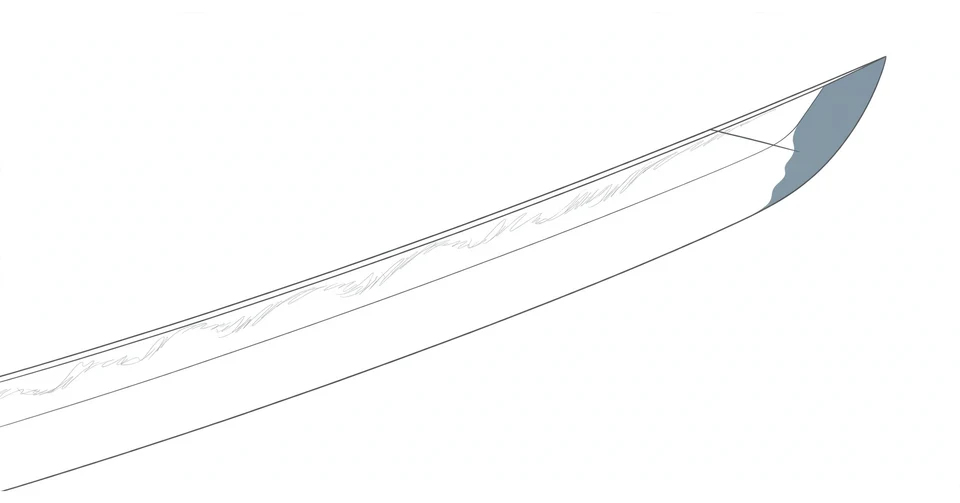
This article grew out of a single line in the published kissaki article, which says, "The tip is the kissaki, separated from the rest of the blade by a small angled line called the yokote." The katana overview article says the same thing in its own way. Those two sentences name the line, but they leave the interesting questions open. What exactly is the yokote, why does the polisher create it, how do its sharpness and angle help appraisers date and judge a blade, how does it differ between periods and schools, what does a soft or missing line mean, and how should you look for it when you handle a sword? This article takes those questions one at a time, and it starts with the simplest one of all: what the line actually is.
What the yokote is
The yokote is the straight line that separates the kissaki, the tip of the blade, from the rest of the sword. It runs from the cutting edge to the shinogi, the ridge line that runs along the side of the blade. On a blade held with the edge facing up, the line crosses the flat surface at a slight angle, and it is the line where the geometry of the blade changes. On one side of it sits the long, relatively flat surface of the blade body. On the other side sit the short, steeply angled surfaces of the tip.
The word itself is plain Japanese. Yoko means across or sideways, and te means hand, so the word names the line that runs across. The name describes what the eye sees, a line drawn across the blade, and it does not try to dress the thing up. That plainness suits the object. It is not decoration. It is the visible edge of a change in shape, and it appears because the tip of a Japanese sword is built differently from the rest of the blade.
It helps to picture the blade as two surfaces meeting. The main body of the blade, called the ji, is ground in long, even strokes that run from the handle toward the tip. The tip, the kissaki, is ground differently, with strokes that run at a different angle, because its surfaces face a different direction. Where those two sets of strokes meet, a line appears. That line is the intersection of two planes, one belonging to the body and one belonging to the tip, and that is why a good line looks so crisp. Two flat surfaces meeting at an angle always make a sharp edge, and the eye reads that edge at once.
This is also why the line is a polisher's line as much as a smith's line. The smith forges the shape, but the polisher finishes it. The polisher works the body of the blade with long strokes and then works the tip with shorter, angled strokes, and the meeting point of the two must be kept clean. If the polisher lets the strokes of the body drift past the line, or lets the strokes of the tip wander back into the body, the line blurs. A crisp line therefore shows that someone worked with patience and control, and a blurred one shows the opposite. The line is small, but it is honest in a way that larger features are not. A long surface can hide a mistake. A line cannot.
The line also gives the kissaki its shape. Without it, the tip would melt into the body of the blade with no clear beginning, and the sword would look unfinished, as if the maker had not decided where the point should start. With it, the tip becomes a defined area with its own character. The length of the tip is measured from the line to the point, the width of the blade at the tip is measured at the line, and the thickness there has its own name as well. In other words, it is not only a line on the steel. It is the reference point from which the whole tip is measured, and that is why it appears in every serious description of a blade.
Where the line sits among the shinogi and the mitsukado
To find the line, you need to know the lines around it, because no line on a katana exists alone. The most important of these is the shinogi, the ridge that runs along each side of the blade from near the handle to the tip. The shinogi divides the flat surface of the blade body from the surface above it, toward the back of the blade. When the shinogi reaches the tip area, it changes direction and runs diagonally toward the point. That diagonal section is called the ko-shinogi, the small ridge.
The line runs from the cutting edge up to the shinogi, and the ko-shinogi runs from the shinogi toward the point. All three lines meet at a single point, and that point has its own name: the mitsukado, which means three corners. It is the spot where the line, the shinogi, and the ko-shinogi come together, and it is one of the most delicate places on the entire blade. A polisher who works carelessly in the mitsukado area can ruin a sword, because too much metal removed there changes the shape of the tip beyond repair. The mitsukado is small, but it is the meeting point of the whole geometry of the tip, and it has to be right.
On either side of the line, the surfaces have their own names too. The surface above the line, inside the tip, is called the yokote-ue. The surface below the line, on the body of the blade, is called the yokote-shita. These names matter because the polisher treats the two surfaces differently. The tip surface is polished to a slightly different finish from the body surface, and the contrast between them is part of what makes a well polished sword look alive. The line is what keeps those two finishes apart, and a good polish makes the line visible without making it harsh.
The cutting edge inside the tip has its own name as well: the fukura. It is the curved part of the edge that sweeps from the yokote up to the point. A full, rounded fukura gives a broad, soft looking tip. A straighter, more withered fukura gives a narrow, pointed tip. The shape of the fukura is one of the first things an appraiser notices, because it changes with period and school, and it is measured against the line as its starting point. A tip with a generous fukura and a clean line looks calm and complete. A tip with a thin fukura and a faint line looks tired, as if the blade had been polished too many times and had lost its original shape.
Not every Japanese blade has a yokote. It belongs to a particular way of building a blade, the shinogi-zukuri construction, in which a ridge runs along the blade and the tip is shaped as a separate, well defined area. This construction appeared after the Heian period and became the most common form for Japanese long swords, which is why most katana have a clear one. Other constructions do without it. The flat sided hira-zukuri blade, common on tanto and small wakizashi, has no ridge and no line, because there is no change of plane for the line to mark. The shobu-zukuri blade, named for its resemblance to an iris leaf, also lacks a conventional one. This is a useful reminder that the yokote is not a universal feature of Japanese swords. It belongs to one tradition of building blades, and when the construction changes, the line goes away. Knowing that keeps you from looking for the line on a blade that was never meant to have one.
Why the polisher creates the yokote
The smith forges the blade, but the polisher gives it its face. Polishing a Japanese sword is not like polishing a knife. It is a long process, done in stages with natural stones of increasing fineness, and it takes weeks for a single blade. The polisher is called a togishi, and the work is divided into foundation polishing, called shitaji-togi, and finishing polishing, called shiage-togi. The line is created and refined across both stages, and it is one of the last things the polisher finishes.
In the foundation stage, the polisher shapes the blade and removes the marks of forging. The mune, the back of the blade, and the shinogi are polished first, then the ji, the main surface. Then comes the tip. This area is very delicate, and the mitsukado must be polished correctly. If too much metal is lost there, the sword is ruined. The placement of the line is also important at this stage, because the foundation work decides where the line will sit. A polisher who sets the line in the wrong place, too close to the point or too far back toward the handle, changes the proportions of the tip, and that mistake cannot be undone later without removing more steel and shortening the blade.
The finishing stage is where the line becomes visible in its final form. After the foundation work, the polisher works with very fine stones, hazuya and jizuya, to bring out the hamon, the temper line, and to give the steel its quiet brightness. The last part of the sword to be finished is the boshi, the continuation of the hamon inside the tip. The boshi is finished by first making the yokote line. Its placement has already been established in the foundation work, and now the line is refined further until it is clear and sharp. After the line is made, the rest of the boshi is polished to match the colour of the line, and the whole tip is made clear and even. No scratches should be left on the boshi when the work is done.
This order matters, and it tells you something about the craft. The line comes first, and the rest of the tip is made to match it. The line is the standard, and the surface follows. That is the opposite of how most people imagine polishing, where you smooth everything and the lines appear by themselves. On a katana, the lines are made deliberately, one by one, and the surfaces are finished around them. A good line is therefore not an accident of a good polish. It is a decision, made early and then defended through every later stage.
There is also a practical reason the polisher works this way. The tip is the hardest part of the blade to polish well, because its surfaces are short, angled, and close together. A stone that works beautifully on the long flat body of the blade is too large and too blunt for the tip, so the polisher uses small stones and soft buffers, and works with great care. The line gives that work a boundary to respect. It tells the polisher where the body ends and the tip begins, and it keeps the two areas from bleeding into each other. Without a clear line, the polish of the tip would drift into the polish of the body, and the sword would lose the crisp definition that makes it legible.
I think there is a lesson in this that goes beyond swords. In many crafts, the hardest work is not the large surface but the edge where two surfaces meet. Anyone can make a long, smooth plane look good. The test comes at the corner, the joint, or the line where one thing becomes another. The yokote is that test on a katana, and it is visible to anyone willing to look closely, not only to an expert with a magnifier. That is why I keep coming back to it. It is a small line, but it is where the craft shows itself most clearly.
How the yokote helps date a blade
A katana does not carry a date in the way a modern object does. The signature on the tang, the mei, sometimes includes a date, but signatures can be forged, tangs can be shortened, and many old blades have lost their signatures entirely. Appraisers therefore read the blade itself, and the tip is one of the richest sources of information on the whole sword. The yokote sits at the centre of that reading, because the size of the tip, the width of the blade at the line, and the thickness there are all measured from it.
The most common way to describe a tip is by its size. A small tip is called ko-kissaki, a medium tip chu-kissaki, and a large tip o-kissaki. These sizes changed with fashion and with the demands of war, so they carry a rough date with them. The small ko-kissaki was common in the late Heian and early Kamakura periods, when refinement was the dominant value and blades were elegant and restrained. The large o-kissaki became common in the Nanbokucho period, the era of civil war in the fourteenth century, when blades grew longer and wider and the tips grew with them. The medium chu-kissaki sits between the two and appears in almost every period, which makes it less useful on its own as a dating clue, but still valuable as part of the whole picture.
The width of the blade at the yokote has its own name, sakihaba, and the width at the notches near the handle is called motohaba. Comparing the two tells an appraiser about the taper of the blade, and the taper changes with period. A blade that is wide at the yokote and narrow at the handle has a strong taper, which suggests one kind of period. A blade that is nearly the same width at both ends has little taper, which suggests another. The thickness at the yokote, called sakikasane, is measured against the thickness at the handle, called moto-kasane, in the same way. These are simple measurements, but they are taken from the yokote, and without a clear line the measurements would have no fixed starting point.
Schools of sword making also left their marks around the yokote. The Ayanokoji school, for example, made slender tachi with small ko-kissaki, yet the tips could look wide and stubby, with a wide width observed both at the yokote area and at the bottom of the blade. The Awataguchi school of the mid-Kamakura period made blades with a short, wide tip called ikubi-kissaki, and a wide blade width in the yokote area. These are specific combinations, and an appraiser who knows them can narrow a blade down to a school, and sometimes to a single smith, from the shape of the tip alone. The yokote does not give the answer by itself. It gives the frame in which the answer is found.
It is important to be honest about the limits of this. No single feature dates a blade. A small tip on a blade claimed to be from the Kamakura period is consistent with that claim, but it does not prove it, because later smiths revived earlier styles on purpose. The large o-kissaki of the Nanbokucho period was revived in the early Edo period, and again in the Shinshinto period, so a large tip can mean an old blade or a later blade imitating an old one. The yokote helps an appraiser ask the right questions, and it helps rule out wrong answers, but it does not give a date by itself. Anyone who tells you that a single line can date a sword is selling something, not teaching something. The honest version is better: the line is one piece of evidence among many, and it is a useful one because it is hard to fake and easy to measure.
There is one more thing worth saying about dating. The yokote itself has no known date of origin, and I will not invent one. No source I read gives a year when the line first appeared, and it would be dishonest to guess. What the sources do say is that the shinogi-zukuri construction, the blade form that carries the yokote, became common after the Heian period, and that the line has been part of the tradition ever since. That is enough. A feature does not need a birthday to be useful. It needs to be consistent, measurable, and hard to fake, and the yokote is all three.
What a soft or missing yokote means
If the yokote is so important, what does it mean when it is soft, faint, or missing entirely? The answer depends on the blade, and it is worth going through the possibilities one by one, because they are very different from each other.
The most common cause is polishing. Every time a blade is polished, a small amount of steel is removed. Over centuries, a blade that has been polished many times loses width, loses thickness, and loses the sharpness of its lines. The yokote is one of the first lines to suffer, because it is a fine edge on a small surface, and each polish takes a little more of it away. A blade with a soft yokote may simply be an old blade that has been loved too much, polished too often, and worn down by care. That is not a fault in the blade. It is a sign of a long life, and it is part of what appraisers call a tired blade, one that has given much of itself to the centuries.
A second cause is careless polishing. A polisher who rushes the tip, or who uses stones that are too coarse, or who lets the strokes of the body drift across the line, can soften the yokote in a single session. The line can also be damaged by a polisher who tries to remove a chip or a scratch near the tip and takes too much steel in the process. Once the line is gone, it is hard to bring back without removing more steel and changing the shape of the tip, so a bad polish can do lasting harm. This is one reason a good polish is so valued, and why a bad polish is so hard to forgive. The steel is the same steel. The difference is in the hands that finished it.
A third possibility is that the blade was never well made. A poorly forged blade, or a modern reproduction made without understanding the geometry, may have a yokote that was never crisp in the first place. On such a blade, the line may look like a smudge rather than a line, or it may wander, changing angle as it crosses the blade. This is a useful warning sign. A genuine antique blade, even a tired one, usually shows that the line was once sharp, because the geometry underneath is correct. A blade whose yokote was never right is often wrong in other ways too, and the line is the easiest place to see it.
A fourth possibility is damage. A chip at the tip, or a bend near the point, can destroy the yokote and the mitsukado with it. Repairing such damage means reshaping the tip, and reshaping the tip means moving the line. An appraiser who sees a yokote that sits in an odd place, or a tip whose proportions look wrong, will suspect that the blade has been repaired, and will look for other signs to confirm it. A repaired blade is not worthless, but it is worth less than an unrepaired one, and the buyer should know.
Finally, there is the simple possibility that the blade was never meant to have a yokote at all. A hira-zukuri tanto or a shobu-zukuri blade has no conventional line, and looking for one on such a blade is a mistake. The absence of a yokote on those blades means nothing about their quality or their age. It means only that they belong to a different construction. This is why context matters. A missing line is a clue, not a verdict, and it has to be read together with everything else the blade shows.
The table below gathers these possibilities in one place, so you can see them side by side.
| Condition of the yokote | What it may mean | How serious it is |
|---|---|---|
| Sharp and clear | Good workmanship, healthy polish | None, this is what you hope for |
| Soft but still visible | Many polishes over a long life, or a tired blade | Mild, part of the blade's history |
| Blurred by careless polishing | Rushed or unskilled work on the tip | Serious, hard to reverse |
| Missing after damage or repair | Chip or bend at the tip, reshaped | Serious, affects value |
| Absent by construction | Hira-zukuri or shobu-zukuri blade | Not a problem at all |
That table is a guide, not a rule book. No table can replace looking at a real blade in good light, and no single feature should decide a purchase. But it shows why the yokote is worth checking first. It is a small line, and it can tell you whether a blade is healthy, tired, damaged, or simply built differently from the one you expected.
How to look for the yokote when handling a sword
If you ever get the chance to hold a real katana, the yokote is one of the first things to look for, and it is easy to find once you know how. The first rule is the most important one: never touch the blade with a bare hand. The oils on your skin will mark the steel and can cause rust, and a sharp blade can cut you before you feel it. Hold the sword by the handle, or by the tang if the handle has been removed, and let the blade rest in good light. If you are at a museum or a dealer's shop, ask before handling anything, and follow the owner's rules. A sword that has survived for centuries deserves that respect.
Hold the blade with the edge facing up and the tip pointing away from you, and tilt it slowly under the light. The yokote will appear as a short line crossing the blade near the tip, catching the light differently from the surfaces on either side. It is easiest to see when the light comes from the side, because the line is the meeting of two planes, and a side light makes the change of angle visible. If you look straight at the blade, the line may disappear, because both surfaces reflect the light in the same way. Tilt the blade a little, and it comes back. That is part of the pleasure of looking at a katana. It does not give up its details all at once. It asks you to move, to tilt, to look again.
Once you have found the yokote, follow it. Does it run straight from the edge to the ridge, or does it wander? Is it crisp, with a clear edge, or soft, as if someone had smudged it with a thumb? Look at the point where it meets the ridge, the mitsukado. Is that point clean and sharp, or rounded and worn? Then look at the tip beyond the line. Is the fukura, the curve of the edge, full and rounded, or thin and straight? Does the boshi, the temper line inside the tip, continue smoothly from the body, or does it break away at the yokote? Each of these questions is small, and each one adds a little more to the picture.
It helps to compare two blades side by side, if you can. A blade with a sharp yokote and a blade with a soft one look very different once you know what to look for, and the comparison teaches your eye faster than any description. The same is true of tips. A small ko-kissaki and a large o-kissaki are easy to tell apart when they sit next to each other, and once you have seen the difference, you will notice it everywhere. If you cannot handle real blades, photographs help, but they are a poor substitute. A photograph flattens the blade and hides the angles, and the yokote is all about angles. If a photograph is all you have, look for pictures taken in raking light, with the blade tilted, because those are the ones that show the line.
One more piece of advice, and it is the most practical of all. Do not buy a sword because the yokote looks good. Buy it, if you buy it at all, because the whole blade is good, and because you have had it checked by someone who knows more than you do. The yokote is a useful clue, and it is a good place to start looking, but it is not a substitute for expertise. There are people who have spent decades learning to read these blades, and their judgement is worth paying for. A sword is an expensive object, and a mistake is an expensive lesson. Look at the line, learn from it, enjoy it, and then ask an expert before you spend your money.
A small line with a large lesson
The yokote is a line of steel a few centimetres long, and it is easy to miss. Most people who see a katana for the first time never notice it. They see the curve, the shine, and the long edge, and those are the things that impress. The yokote does not impress. It divides, it measures, and it records, and it does all of that quietly, without asking for attention. That is precisely why it is worth writing about, and why it is worth learning to see.
What I find most striking about the yokote is that it is a boundary, and boundaries are where craft shows itself. A long surface can be smoothed by patience alone. A line where two surfaces meet asks for judgement. The smith has to decide where the tip begins. The polisher has to decide where the line sits, and then defend that decision through every stage of the work. The centuries have to decide whether to preserve the line or wear it away. Every yokote you see is the result of all those decisions, and that is why a single line can tell you so much about a blade. It is a record of choices, written in steel.
There is also something quietly hopeful in the fact that such a small thing can carry so much meaning. It suggests that attention is never wasted, even when it is spent on something that most people will never notice. The polisher who spends an extra hour on the yokote knows that most owners will never look closely enough to see the difference. The polisher does it anyway, because the work is the point, not the praise. That is a good way to work, and not only on swords. Do the small thing well, even when no one is watching, because the small thing is where the quality lives.
If you remember one thing from this article, let it be this. The next time you see a katana, look past the curve and the shine, and find the short line near the tip. It is the yokote, and it is telling you a story about who made the blade, who polished it, how old it is, and how it has been treated. The story is written in a line a few centimetres long, and it has been waiting there for centuries, for anyone willing to look closely enough to read it.
For a fuller picture of the tip that the yokote defines, the earlier article on the kissaki, the small tip that finishes a katana works through the sizes and shapes of the tip in detail, and the overview of how the katana became the soul of the samurai places that tip in the wider story of the sword. Two references I relied on while writing this are the Wikipedia article on the Japanese sword, which describes the yokote as the straight line that bounds the kissaki, and the detailed guide to the meaning of the yokote on a katana, which explains the measurements taken from the line and the schools whose tips can be recognised by it.
More in Culture & Society
- Wakizashi Was the Short Sword a Samurai Never Took Off
- Tsuba Is the Small Guard That Stops a Katana From Cutting Its Owner
- Seppa Are the Thin Washers That Keep a Katana From Rattling
- Kissaki Is the Small Tip That Finishes a Katana
- Nakago Is the Hidden Tang That Carries a Katana's Signature
- Mekugi Holds a Katana Together With a Single Bamboo Pin
Latest posts
- Why a Katana Stays Put, Thanks to the Koiguchi
- Tsuka-Ito Is the Cord That Binds a Katana Grip
- Fuchi Is the Collar That Frames a Katana Grip
- Kashira Is the Small Cap That Finishes a Katana Grip
- Sageo Is the Cord That Ties a Katana to Its Samurai
- Menuki Are the Small Ornaments Hidden Under a Katana Grip
- Habaki Is the Copper Collar That Locks a Katana in Its Sheath
- Maedate Is the Crest That Turned a Samurai Helmet Into a Banner
- Samegawa Is the Ray Skin Hiding Under Every Katana Grip
- Tatara Is the Clay Furnace Where Tamahagane Begins
- Tsuka Is the Wrapped Grip That Lets a Katana Speak
- The Tanto Was the Small Blade a Samurai Trusted With His Life
- Tamahagane Is the Jewel Steel Behind Every Katana
- Seppuku Was the Ritual a Samurai Chose Over Disgrace
- Saya Is the Lacquered Sheath That Guards the Katana