Kozuka Is the Small Knife Hiding in a Katana's Saya
· 14 min read
A kozuka is the small utility knife tucked into a slot on the outer face of a katana saya, and its tiny handle is one of the finest canvases in Japanese metalwork.
Look closely at a katana in its sheath and you may notice something odd. Tucked into a slim slot on the outer face of the saya, the lacquered scabbard, sits a second and much smaller knife. It is easy to miss, and that is the point. The kozuka is a small utility knife that rides along with the sword, hidden in plain sight, and its handle is often the most beautiful piece of metalwork on the whole mounting.
The word kozuka properly names the handle, the small decorated plate that you grip, while the little blade fitted into it is called the kogatana. In everyday speech the whole object goes by the name kozuka, and museums do the same, so this article follows that habit. What matters is the idea: a working knife, small enough to disappear into the side of a sheath, finished like a jewel.
A kozuka is about as long as a finger. The examples in museum collections usually measure around nine and a half centimetres long and a little over a centimetre wide. Yet within that sliver of metal, the great workshops of Edo Japan painted dragons, cranes, peonies, rivers, and whole landscapes in gold, silver, and blackened copper alloy. The smallest fitting on the sword became one of the freest places for an artist to work.
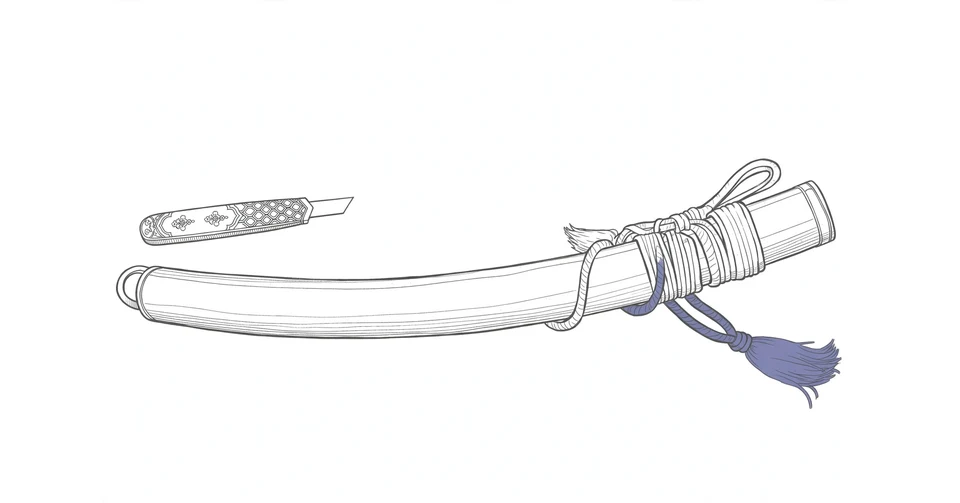
The slot it lives in belongs to the saya, the lacquered sheath that guards the katana, and the two objects only make sense together. The sheath keeps the blade safe, and the kozuka keeps a small working edge close at hand, so the wearer never had to reach for another tool. If you want the story of the sheath itself, read Saya Is the Lacquered Sheath That Guards the Katana.
What a kozuka actually is
A kozuka is a small knife carried in a pocket worked into the outer face of a sword scabbard. The blade slides into the slot and the decorated handle stays outside, sitting flush against the lacquer, ready to be pinched between thumb and finger and drawn out. Nothing about it is large or loud. It is a quiet companion to a weapon that was designed to be noticed, and the contrast is part of its charm.
The handle is the part that survives in museums and collections, and for good reason. The blade of a kozuka was a plain working edge, and over the centuries many blades were lost, replaced, or worn away. The handle, by contrast, was made to be looked at. It is a flat plate of metal, usually copper or a copper alloy, with its face worked in relief, inlay, and engraving. Turn it over and you often find a signature or an attribution engraved on the back, a small record of who made it and when.
Size is the first thing that surprises people who see one in person. The Metropolitan Museum of Art lists its Goto school examples at about nine and a half centimetres long and one and four tenths of a centimetre wide, which is roughly the length of a finger and the width of a thumbnail. Hold that scale in mind while reading about the decoration, because the skill involved only makes sense against it. A dragon coiled around a sword, a river with flowers, a boat full of revellers, all of it fitted onto a plate smaller than a bookmark.
There is also a simple reason the kozuka stayed small. The slot in the saya could only hold so much, and the knife had to ride comfortably at the hip all day without snagging on clothing or weighing the sword down. The makers accepted that limit and then made a virtue of it. When you cannot make something bigger, you make it better, and the kozuka is the proof that a tight limit can sharpen an artist rather than hold one back.
The handle is the artwork
The face of a kozuka is a miniature painting in metal. The makers worked in high relief, carving figures that stand proud of the surface, and they set those figures against a ground of nanako, a field of tiny punched circles so regular that it looks like fine grain from a distance. Gold and silver were inlaid for colour, and the dark ground beneath them made the bright metal glow. The effect is closer to a lacquer painting than to ordinary metalwork, and it rewards the same slow looking.
The subjects were the familiar cast of Japanese art. One Goto school kozuka in the Metropolitan Museum of Art carries a dragon coiled around a sword. Another shows a bird among leaves, a third a river with flowers, and a fourth a design of shells. A gold peony, chiselled by the fourth generation master Goto Kojo, sits on a handle finished two centuries later by the twelfth generation master Goto Mitsumasa, which tells you something about how these objects were valued. A fine kozuka was not used up and thrown away. It was kept, reworked, and handed down.
What I admire most about these tiny plates is the confidence behind them. The artist had almost no room, no second draft, and no way to hide a mistake under a larger gesture. Every cut had to be right the first time, at a scale where a slip of the chisel would ruin the piece. That kind of work asks for a patience that is hard to imagine from the outside, and it is worth remembering whenever we praise something only because it is big. Smallness is not a lesser ambition. It is a stricter one.
The Goto school and the black gold of shakudo
No name belongs to the kozuka more than Goto. The Goto school of sword fitting makers was founded in the fifteenth century by Goto Yujo, who is said to have been patronized by the shogun Ashikaga Yoshimasa, who ruled from 1435 to 1490. The school went on for fifteen generations of masters in the main line, and its work set the standard that other workshops measured themselves against for centuries.
The signature material of the Goto masters was shakudo, an alloy of copper and gold that is chemically treated to turn a rich blue black. The Metropolitan Museum of Art describes the classic Goto style as painterly designs carved in high relief on a ground of shakudo, finished in nanako, with colourful accents in gold and silver. The dark ground is the key to the whole effect. Against it, a gold crane or a silver flower seems lit from within, and the tiny punched circles of the nanako catch the light like frost. You can see the finest examples of this work in this Goto school set of sword fittings at the Metropolitan Museum of Art, where each of the first fifteen generations of masters is represented by a matching set.
The Goto masters concentrated on the smaller fittings, the kozuka, the kogai, and the menuki, and they left the stouter sword guards to other masters. That division of labour shaped the whole craft. The guard, the tsuba, belonged to the iron workers, and its story is told in Tsuba Is the Small Guard That Stops a Katana From Cutting Its Owner. The small fittings belonged to the soft metal workers, and the kozuka was the largest canvas they had. A handle about ten centimetres long gave an artist more room than a grip ornament or a hair tool, and the best Goto work treats that space like a page.
Around 1600 the Goto masters began to authenticate the work of their predecessors, and the attributions were usually engraved on the backs of the pieces themselves. Earlier generations had not signed their work, so these later notes were part scholarship and part salesmanship, a way of saying that a piece came from the hand of a named master. The museum notes that these attributions bear witness to the keen interest in early sword fittings as status symbols for high ranking samurai. A kozuka was never only a knife. It was also a signature, worn at the hip, that told everyone in the room what its owner could afford and what he knew.
A matching set called mitokoromono
A fine kozuka rarely travelled alone. It was usually one piece of a mitokoromono, a matching set of three kinds of fitting: one kozuka, one kogai, and two menuki. The kogai is a skewer like hairdressing tool carried in a slot on the front of the scabbard, and the menuki are a pair of grip ornaments held under the wrappings of the handle. Made as a set, the pieces shared one design, one ground, and one hand, so the whole sword mounting read as a single composition rather than a pile of parts.
The most complete record of this tradition sits in the Metropolitan Museum of Art. Its collection of Goto sword fittings was assembled by Count Mito Tokugawa in the nineteenth century, and each of the first fifteen generations of masters of the main Goto school is represented by a mitokoromono, with two additional sets of kozuka and one set of menuki for each generation. The museum calls it the most complete representation of the famous Goto school of sword fittings masters. Fifteen generations, each with its own matched set, is a portrait of a craft lineage that is hard to match anywhere else in the world.
The British Museum holds the same idea at a smaller scale. One of its pieces pairs a kozuka with a kogai, the two decorated with flying cranes in high relief on a nanako ground, made of shakudo and dated to the eighteenth or nineteenth century. Another, made by Hosono Sozaemon Masamori, is a shibuichi kozuka engraved and inlaid in gold, copper, and shakudo with a boatload of revellers, and it measures nine and a half centimetres long. You can study the crane piece in the British Museum collection record for this kozuka and kogai. Both pieces show the same habit: the knife and the hair tool were designed together, as one thought, not two.
There is a practical lesson tucked inside the matching set. A samurai who ordered a mitokoromono was not buying three decorations. He was buying coherence, the sense that every part of his sword belonged to the same hand and the same moment. The pieces were small, the budget was large, and the result was a sword that looked considered from every angle. It is the same instinct that makes a person match a belt to a pair of shoes, only carried to a level of craft that most of us will never touch.
What the little blade was for
The plain truth is that a kozuka was a utility knife. Museum records describe it as the handle of the small utility knife fitted into a slot on the scabbard, and that word, utility, is doing a lot of work. It was a working blade for the small jobs of daily life, kept close because a samurai in full dress could not easily carry a separate tool roll. The exact jobs are not spelled out in the museum records I read, so it is best not to invent a list. What is clear is the role: the katana was for combat and ceremony, and the kozuka was for everything else, the small cutting tasks that fill an ordinary day.
That division is worth pausing over. The sword itself was hedged about with rules, ritual, and reverence, and drawing it for a trivial reason would have been unthinkable. The little knife in its side had no such burden. It could be drawn, used, wiped, and put away without ceremony, and that freedom is what made it useful. Every culture keeps a small blade for small jobs, from a pocket knife to a kitchen paring knife, and the kozuka is the Japanese answer to the same need, dressed in the finest clothes the craft could provide.
There is also a quiet point about value here. The blade of a kozuka was the working part, and it is the handle that museums prize, catalogue, and display. Use wears out, but care endures. The part that was handled gently and admired survived, while the part that did the cutting was spent and replaced. I think that is a fair picture of how most good things last: not because they were never used, but because somebody cared for the part that could be cared for and accepted that the working edge would need renewing.
Collecting a kozuka today
For a collector, the kozuka has an obvious appeal. A katana is large, expensive, and bound by strict rules in Japan, where swords are registered and their ownership is controlled. A kozuka is small enough to hold in one hand, small enough to display in a case on a desk, and it carries the same Goto school artistry as the great mountings. Many of the finest examples are already in museums, which is where a beginner should start: look first, handle nothing, and learn what good nanako and honest gold inlay actually look like before spending anything.
Signatures and attributions are the first thing to study. Goto pieces often carry attributions engraved on the back, and later generations signed and appraised the work of their predecessors, so the back of a kozuka can be as informative as the front. But attributions were also a form of marketing in their own day, and not every old inscription is reliable. A careful collector learns to judge the work itself, the crispness of the carving, the regularity of the nanako ground, and the quality of the inlay, and treats a signature as a clue rather than a guarantee.
Condition matters in the same way. Nanako is a field of tiny punched dots, and worn or polished examples lose the crispness that makes the ground shimmer. Gold inlay can lift or wear thin, and a handle that has been harshly cleaned may have lost the dark patina of its shakudo ground. Provenance helps too: a piece that passed through a known collection, like the Tokugawa collection at the Metropolitan Museum of Art, carries a history that supports its attribution. None of this is a buying guide, and no price is quoted here because prices move and fakes exist, but the habit is the same as with any old craft. Study the best examples in museums, ask questions of people who have handled many pieces, and be slow to buy.
The smallest part of the sword
The kozuka began as an answer to a practical question: where do you keep a small knife when you already carry a sword? The answer was a slot in the side of the sheath, and the artists of Edo Japan took that practical answer and turned it into a miniature gallery. Dragons, cranes, peonies, rivers, shells, and boatloads of revellers all found their way onto plates the size of a finger, in gold and silver on blackened shakudo, and the smallest fitting on the sword became one of the most personal.
That is the part that stays with me. The katana was a public object, governed by law, rank, and ceremony, and the tsuba and the lacquered saya spoke for their owner in the language of status. The kozuka was smaller and quieter. It sat in its slot, out of sight, waiting for a small job, and its beauty was mostly for the person who carried it. A sword is judged by how it looks to others. A kozuka is judged by how it feels in the hand of its owner, and that is a more honest test of craft.
Look for it the next time you see a sheathed katana, in a museum or in a photograph. The blade gets the attention, the guard gets the admiration, and the sheath gets the praise for its lacquer. Then, on the outer face of the saya, there is a slim decorated plate, flush against the black lacquer, easy to overlook. Pull it out in your mind and you hold a small knife, a small painting, and a small piece of a five hundred year old school of metalwork, all in a single object that fits in the palm of your hand.
More in Culture & Society
- Koshirae Is the Formal Mounting That Turns a Blade Into a Katana
- Shirasaya Is the Plain White Scabbard Where a Katana Rests
- The Togishi Polishes a Katana for Weeks Before It Ever Cuts
- Wakizashi Was the Short Sword a Samurai Never Took Off
- Tsuba Is the Small Guard That Stops a Katana From Cutting Its Owner
- Yokote Is the Small Line That Tells a Katana's Age
Latest posts
- Seppa Are the Thin Washers That Keep a Katana From Rattling
- Kissaki Is the Small Tip That Finishes a Katana
- Nakago Is the Hidden Tang That Carries a Katana's Signature
- Mekugi Holds a Katana Together With a Single Bamboo Pin
- Why a Katana Stays Put, Thanks to the Koiguchi
- Tsuka-Ito Is the Cord That Binds a Katana Grip
- Fuchi Is the Collar That Frames a Katana Grip
- Kashira Is the Small Cap That Finishes a Katana Grip
- Sageo Is the Cord That Ties a Katana to Its Samurai
- Menuki Are the Small Ornaments Hidden Under a Katana Grip
- Habaki Is the Copper Collar That Locks a Katana in Its Sheath
- Maedate Is the Crest That Turned a Samurai Helmet Into a Banner
- Samegawa Is the Ray Skin Hiding Under Every Katana Grip
- Tatara Is the Clay Furnace Where Tamahagane Begins
- Tsuka Is the Wrapped Grip That Lets a Katana Speak