Wakizashi Was the Short Sword a Samurai Never Took Off
· 14 min read
The wakizashi was the short sword a samurai kept on his belt from morning to night, indoors and out, while the famous katana often stayed at the door.
Picture a samurai arriving at his lord's castle in the Edo period. At the entrance he unbuckles his long katana and leaves it in the sword rack, as custom demands. He steps into the reception hall unarmed, or so it seems. The truth is that a wakizashi is still tucked through his belt, its curved blade resting quietly against his side. The long sword stayed at the door. The short sword went everywhere.
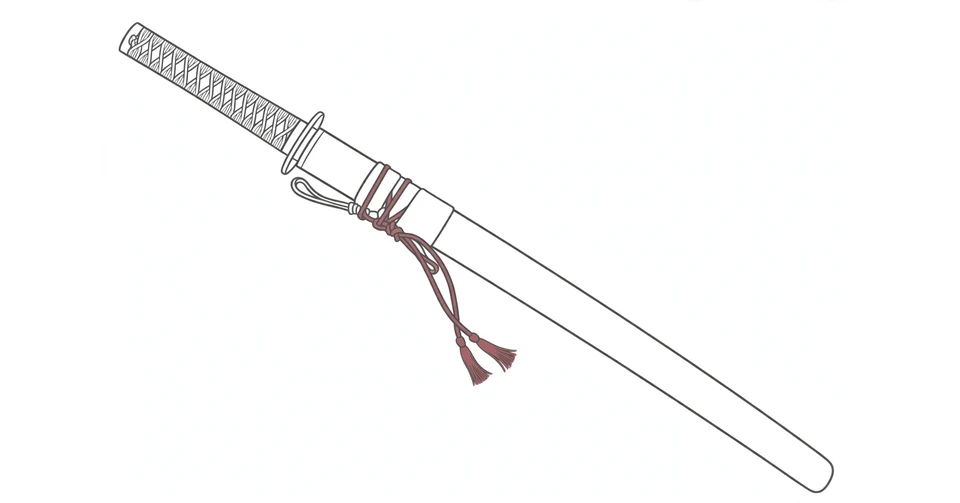
That small fact changes how we should picture the samurai. Popular films show the warrior with a katana in his hands, but in daily life the katana was often the sword left behind. It was the constant companion, worn from waking until sleeping and kept within reach through the night. It was a weapon, a badge of rank, and a piece of everyday dress, all at once.
What a wakizashi actually was
A wakizashi is a Japanese short sword with a blade between 30 and 60 centimetres long, or roughly 12 to 24 inches. It is curved and single edged, like a katana, and it was worn thrust through the obi, the sash at the waist, with the cutting edge facing upward so it could be drawn in one fast motion. The name itself describes how it was carried. It comes from waki, meaning side, and sashi, meaning to insert, so the name literally means the sword inserted at the side.
The blade is shorter than a katana but it is not simply a small katana. It could be forged differently, with its own cross section and balance, and it was often a little wider in proportion to its length, with a flatter curve so it could be handled in tight spaces. Blades near the upper end of the range were called o-wakizashi, while the shortest ones, close to dagger length, were called ko-wakizashi. The lines between these categories were conventions rather than strict laws, and surviving examples show plenty of variation.
The wakizashi came into its own during the Muromachi period, in the 15th and 16th centuries, when warfare in Japan was changing. The older tachi, a long sword hung edge down from a cord, had suited mounted warriors. The newer style of sword, worn thrust through the belt with the edge up, suited foot soldiers who needed to draw quickly. Once samurai began carrying a long sword in this new way, a shorter companion sword followed naturally. It was there if the long sword broke or was lost, and it was there for fighting at close quarters, where a long blade was useless.
What strikes me is how practical the whole idea was. Nobody sat down and designed a symbol. Warriors carried a second, shorter blade because it solved real problems, and only later did that practical habit harden into law and ceremony. It earned its meaning on the battlefield and in the corridor before it ever earned it in a statute book.
How the short sword earned its place
During the Sengoku period, the age of civil war that ran from 1467 to 1615, the short companion sword was still a flexible idea. A warrior might carry any second blade he owned, and the two swords often came from different smiths and were never meant to be a pair. The long sword and the short sword were simply the two best blades a man happened to have.
The turning point came with the unification of Japan. In 1588, Toyotomi Hideyoshi ordered the sword hunt known as the Katanagari, which forbade peasants from owning swords. From that moment, carrying a long blade became a privilege of the warrior class. The Tokugawa shogunate, which took power after the battle of Sekigahara in 1600, went further. By 1638, the lengths of the katana and the short sword were officially regulated, and the pairing of the two swords became the legal mark of a samurai.
The pair was called the daisho, meaning large and small, and only samurai were allowed to wear it. That rule is the origin of the line quoted in the earlier article about the daisho: "The long sword was the katana, the short sword the wakizashi, and together they marked the line between the warrior class and everyone else." The short sword was half of that line. Without it, a man was not fully a samurai in the eyes of the law.
Ordinary people were not entirely shut out. Commoners were allowed to carry a single short sword of legal length, the ko-wakizashi, and wealthy merchants often did so when travelling, because the roads carried a real risk of bandits. Doctors and certain other professional groups had similar privileges. But the second sword, the long one, was never permitted to them. The difference between a merchant with a wakizashi and a samurai with a wakizashi was what else he was allowed to carry, and that difference was everything.
The rule that made two swords a samurai
In the Edo period, the Tokugawa government regulated the daisho down to the smallest detail, and the short sword had its own official form. The scabbard of the katana had to end flat, while the scabbard of the wakizashi ended round, and that small difference is still one of the most reliable ways to identify an official Edo period wakizashi today. For formal visits to the capital, samurai wore the strict banzashi daisho: black lacquered scabbards, hilts wrapped over white ray skin, horn pommel caps, and simple sword guards bearing the family crest. At home in their own domains, the same men could wear far more elaborate pairs, with golden lions, dragons, and gilded fittings, but at the shogun's court, restraint was the rule.
The system of alternate attendance, sankin-kotai, made this visible across the country. Every lord had to travel to Edo at regular intervals and keep his family there permanently, and the samurai who accompanied him had to appear at court in the correct form. The uniform sword protocol was political as much as ceremonial. It stopped ambitious lords from displaying wealth or independence in the capital, and it turned the two swords into a kind of uniform.
This is where the short sword stops looking like a weapon and starts looking like an identity card. A samurai did not only own his swords, he wore his rank, and the short sword was the part of that rank that never left his body. You could take a man's katana at the door, but as long as the wakizashi stayed on his belt, everyone in the room knew exactly who he was.
The sword that stayed on the belt
The most revealing thing about the short sword is where the katana could not go. In reception rooms and at audiences with higher ranking people, carrying the long sword was forbidden, or at least unwelcome, because the host did not want an armed guest at close range. The wakizashi, by contrast, was allowed. It was short enough not to be an open threat, yet close enough to defend its owner's immediate space. So while the katana waited in the rack outside, the wakizashi sat in the room where the real conversations happened.
Japanese houses helped make this distinction. Narrow corridors, low door frames, and low ceilings made it almost impossible to draw and swing a katana indoors, while a wakizashi could be used effectively in a confined room. Fighting schools developed techniques for the short sword indoors, working with the limited range of movement rather than against it. It was, in the plainest sense, the weapon of the room rather than the battlefield.
It stayed with its owner through the most ordinary moments of the day. It went to meals, to the bath, and to sleep, often placed beside the pillow within its owner's reach. In houses where the long sword rested on a sword stand, the katana-kake, the wakizashi often remained on the body even when the katana had been set aside. The only common exception was the tea ceremony, where etiquette required all weapons to be placed on a special shelf before entering the tea house, and even then the wakizashi was put back on as soon as the ceremony ended.
There is something quietly moving about that constancy. The katana was the sword of the campaign and the ceremony, the one people remember. The wakizashi was the sword of the everyday, the one that shared its owner's life. I find the second kind of loyalty more interesting than the first, because it had nothing to prove. It was simply there, day after day, in a long period of peace when most samurai would never draw a blade in anger.
The wakizashi and seppuku
No discussion of the wakizashi is complete without seppuku, the ritual suicide of the samurai, but the common picture of it is wrong in an important way. The widespread notion is that seppuku was always performed with a wakizashi. In fact, the classic ritual of the Edo period most often used a tanto, a short dagger without a sword guard, sometimes wrapped in white paper and placed on a small wooden stand. The wakizashi served as an alternative when no tanto was available, or in spontaneous situations where honour demanded an immediate act.
The distinction matters because it tells us what the short sword really was. Most short swords were never used for seppuku at all. They were everyday swords. But because a samurai wore his wakizashi continuously, even in moments of capture or military failure, the blade was immediately at hand when honour demanded a ritual end. Its role in seppuku came from its constant presence, not from a special design for the purpose.
History gives us real cases. Sen no Rikyu, the great tea master, was ordered to commit seppuku by Hideyoshi in 1591 and used a short sword. Toyotomi Hidetsugu, Hideyoshi's nephew, was forced to the same end in 1595. In the famous case of the 47 ronin in 1703, the blade handed to the samurai of Ako was a tanto in most accounts, though some of the ronin are said to have used their own wakizashi, which they had carried through their revenge. In 1663 the shogunate banned junshi, the suicide of retainers on the death of their lord, and turned seppuku from a free decision into a controlled punishment, with the condemned man often assigned a wakizashi or a small prepared knife. The blade became part of state protocol.
There is also a much later and darker footnote. On 12 October 1960, Inejiro Asanuma, the chairman of the Japan Socialist Party, was assassinated during a speech at Hibiya Public Hall in Tokyo by the 17 year old Otoya Yamaguchi, who used a wakizashi. Nearly a century after the sword ban, the short sword could still appear in public life in the most shocking way. It is a reminder that the wakizashi was never only a museum piece, and that its history did not end with the samurai.
How a wakizashi was made
The short sword was not a lesser product of the forge. It was made to the same standard as a katana, by the same chain of specialists, and a fine one could take months or years to complete. The smith, the polisher, the scabbard maker, the metal fittings artisan, and the hilt wrapper each brought decades of training to the work, and each stage had its own master.
The blade began as tamahagane, steel smelted from iron sand in a traditional tatara furnace. The smith folded the steel repeatedly, sometimes twenty to thirty times, until the blade held thousands of thin layers, visible after polishing as a fine surface pattern called hada. The hardening line, the hamon, came from differential hardening. The cutting edge was coated with a thin layer of clay and the back with a thicker one, so that when the blade was quenched in water, the edge hardened into martensite while the back stayed softer and more flexible. That combination of a hard edge and a resilient body is the technical heart of the Japanese sword.
The mounting, the koshirae, was an ensemble of detachable parts. The scabbard, the saya, was usually carved from honoki, or magnolia wood, and coated with many layers of urushi lacquer, with sanding between each coat, a process that could take months. The hilt, the tsuka, was covered with ray skin, called same, and wrapped with cord. The guard, the tsuba, was often the most decorative element, worked in iron with engravings, inlays of gold, silver, or copper, and family crests. The small ornaments on the hilt, the menuki, might show dragons, lions, or plants, and the collar and pommel cap, the fuchi and kashira, often carried the family crest as well.
In a daisho pair, the fittings of the two swords were designed to harmonise, so that the katana and the wakizashi read as one coordinated set. The five classical smithing traditions, the Gokaden of Yamashiro, Yamato, Bizen, Soshu, and Mino, all produced blades of every length. Some schools became especially known for short swords, such as the Hizen school under Hizen Tadayoshi in the early 17th century, whose wakizashi were prized for their quality. A visitor to a museum today can still see this craft at close range. The Samurai Museum Berlin describes the wakizashi as a Japanese short sword with a blade length of between about 30 and 60 centimetres, worn together with the longer katana as a pair.
The end of the samurai and the afterlife of the wakizashi
The Meiji Restoration of 1868 began the end of the samurai class. The new government set out to rebuild Japan as a modern nation, and that meant dissolving the feudal order. In 1871 the lords lost their domains, and in 1872 the hereditary privileges of samurai families ended. Then, in 1876, came the Haitorei, the sword ban, which prohibited former samurai from carrying swords in public. Only the military and the police were allowed to carry state approved uniform swords.
The effect on the swordsmithing industry was immediate and severe. Within a few years the domestic market for Japanese swords collapsed. Many forges closed, and others switched to kitchen knives, farm tools, or cutlery. Lines of great smithing schools, some documented over centuries, were broken. Only a few masters kept the tradition alive in small circles, often in rural regions, and often without being able to show their work publicly.
At the same time, the wakizashi began a second life. Western diplomats, traders, and travellers who came to Japan after the country opened bought katana, wakizashi, and tanto as souvenirs, and museums in Europe and America began building systematic collections. Most of the Japanese swords in London, Paris, Vienna, New York, and Berlin arrived in the West between the 1870s and the 1920s. The export threatened Japan's cultural heritage, and it also gave the Japanese sword an international audience it had never had.
Appreciation returned slowly. From the 1930s, and more strongly after the Second World War, swordsmithing was recognised again as Japanese cultural heritage, and the Living National Treasure system, established in 1950, came to include masters of the craft. Today a wakizashi is usually encountered in a museum case or a collection, but it also lives on in kabuki theatre, in period films, and in manga and anime, where the image of the samurai is kept alive. Popular culture often exaggerates the katana and sidelines the wakizashi, but the surviving swords tell a different story about which blade a samurai actually lived with.
Why the short sword still matters
The wakizashi matters because it corrects a picture most of us carry in our heads. The samurai of popular imagination is a figure with a long sword drawn on a battlefield, but the historical samurai spent most of his life in a long period of peace, and the blade that shared that life was the short one on his belt. The katana declared his rank to the world. The wakizashi carried it through the ordinary hours, and that is where a culture really lives.
I keep coming back to the scene at the castle door. The long sword is handed over, the short sword stays, and the man walks into the room still himself. There is a lesson in that for anyone who has ever been judged by the biggest thing they own or the loudest thing they can do. The wakizashi was smaller, quieter, and closer, and it was the one that never left. The swords that define us are rarely the ones we display. They are the ones we carry when nobody is watching.
More in Culture & Society
- Tsuba Is the Small Guard That Stops a Katana From Cutting Its Owner
- Yokote Is the Small Line That Tells a Katana's Age
- Seppa Are the Thin Washers That Keep a Katana From Rattling
- Kissaki Is the Small Tip That Finishes a Katana
- Nakago Is the Hidden Tang That Carries a Katana's Signature
- Mekugi Holds a Katana Together With a Single Bamboo Pin
Latest posts
- Why a Katana Stays Put, Thanks to the Koiguchi
- Tsuka-Ito Is the Cord That Binds a Katana Grip
- Fuchi Is the Collar That Frames a Katana Grip
- Kashira Is the Small Cap That Finishes a Katana Grip
- Sageo Is the Cord That Ties a Katana to Its Samurai
- Menuki Are the Small Ornaments Hidden Under a Katana Grip
- Habaki Is the Copper Collar That Locks a Katana in Its Sheath
- Maedate Is the Crest That Turned a Samurai Helmet Into a Banner
- Samegawa Is the Ray Skin Hiding Under Every Katana Grip
- Tatara Is the Clay Furnace Where Tamahagane Begins
- Tsuka Is the Wrapped Grip That Lets a Katana Speak
- The Tanto Was the Small Blade a Samurai Trusted With His Life
- Tamahagane Is the Jewel Steel Behind Every Katana
- Seppuku Was the Ritual a Samurai Chose Over Disgrace
- Saya Is the Lacquered Sheath That Guards the Katana