Kurikata Is the Chestnut Knob That Holds a Katana at the Hip
· 16 min read
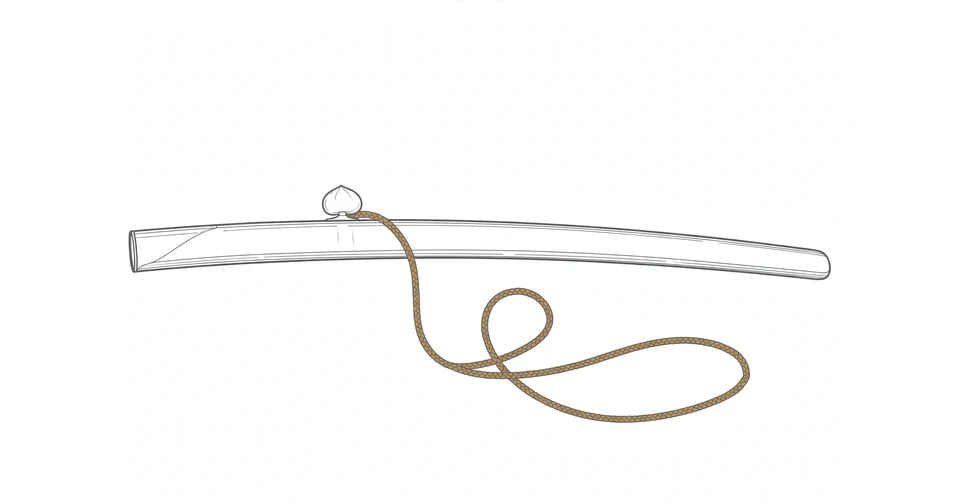
The kurikata is the small chestnut-shaped knob on a katana saya that anchors the sageo cord and holds the sword at the wearer's hip.
A katana is famous for its blade, but the small knob on its scabbard does the quiet work of keeping the whole sword where it belongs. That knob is the kurikata, and without it a samurai could not wear his sword at his hip at all.
The kurikata is a small fitting on the outer side of the saya, the lacquered wooden scabbard, shaped like a chestnut cut in half. A braided cord called the sageo passes through it, and the sageo ties the saya to the wearer's sash, the obi. The cord, the knob, and the sash form a simple system, and the knob is the anchor point that holds the system together.
Look at a katana in a museum and you will probably notice the blade first, then the handle, then the scabbard. The knob is easy to miss because it is small and sits close to the mouth of the scabbard. Yet it is one of the most practical fittings on the sword, and its story touches on craft, martial arts, and the way Japanese craftsmen named things after the natural world. This article follows that small knob from its chestnut name to its job on the hip.
What a kurikata is
The word kurikata comes from two Japanese words. Kuri means chestnut, and kata means shape or form, so the name describes exactly what the fitting looks like. It is a small knob, rounded like a chestnut that has been sliced in half, and it stands proud of the surface of the saya. Some sources spell the word kurigata, with a g instead of a k, which reflects how the sound softens in spoken Japanese. This article uses kurikata throughout, the spelling in the title, but both spellings point to the same small fitting.
The standard glossary of Japanese sword mountings defines it in one plain line, as the knob on the side of the saya for attaching the sageo. That short definition is accurate, and it is also the reason the fitting matters. It is not decoration, though it can be decorated. It is the one place where the cord that secures the sword is allowed to grip the scabbard.
To understand it, it helps to picture the whole mounting, which in Japanese is called the koshirae. A katana in koshirae is a sword dressed for wearing. It has a handle wrapped in cord, a guard, and a saya finished in lacquer. It belongs to the saya, and it belongs only to a saya made for carrying. That distinction turns out to be important, and it is worth keeping in mind as we go.
I think there is something quietly appealing about the name itself. Japanese sword fittings carry names that are often bluntly descriptive, like the koiguchi, the carp mouth, which is the opening of the saya, or the kojiri, the end cap of the scabbard. The chestnut knob follows the same habit. A craftsman looked at a small rounded knob and saw a chestnut, and the name stuck for centuries. It is a reminder that even in a craft as formal as sword making, people named things the way ordinary people name things, by what they resemble.
Where the kurikata sits on the saya
The kurikata sits near the mouth of the saya, on the outer face, the side that faces away from the body when the sword is worn. Its usual place is a short distance below the koiguchi, the mouth of the scabbard where the blade enters. One detailed guide to the fitting puts the traditional position at about four finger widths from the koiguchi when the saya also carries slots for the kozuka, a small utility knife, and the kogai, a hair spike. When a saya has only one of those slots, or none at all, the position can vary, and some martial arts schools place it as close as three finger widths from the mouth.
That placement is not an accident. It has to sit far enough from the mouth to leave room for the kozuka and kogai pockets, and close enough to the mouth that the sageo can hold the top of the saya firmly against the obi. The exact spot is a compromise between the fittings that share the scabbard and the job the cord has to do. One placed too far down the saya would let the scabbard swing. A kurikata placed too close to the mouth would crowd the other fittings and weaken the wood around it.
The side it sits on matters too. The kurikata is on the omote, the front or outer face of the saya, the side that shows when the sword hangs at the hip. The sageo passes through the knob and hangs on that outer face, where the wearer can reach it and where it can be tied without getting tangled against the body. Everything about the placement is practical, and that practicality is part of what makes the fitting interesting. Nobody put the kurikata where it is to make the sword prettier. They put it where the cord needed an anchor.
How the kurikata holds the sword at the hip
A katana is worn thrust through the obi with the cutting edge facing upward, and it stays there by friction and by the sageo. The sageo is a braided cord of silk or cotton, and one end of it passes through the kurikata. The rest of the cord is tied around the saya and to the obi, so the sword hangs from the sash instead of sliding through it. If you want the full story of the cord itself, our article on sageo explains how it is braided and tied. The knob is the partner in that story, the fixed point the cord depends on.
Without it, the sageo would have nothing to hold on to. A cord wrapped around a smooth, lacquered saya would slide, especially when the wearer walks, rides, or moves quickly. The knob gives the cord a place to pass through, and the knob shape stops the cord from slipping off sideways. It is a small piece of engineering, a hole and a bump, and it solves the whole problem of keeping a heavy sword attached to a cloth sash.
It also works as a stopper. As a person moves, a saya tends to slide downward through the obi, and the knob catches against the sash and slows that slide. It is not the main thing holding the sword up, since the friction of the saya against the obi does most of that work, but it is a useful second line of defence. On a long walk or a ride on horseback, when a sword would otherwise creep downward with every step, that small catch matters.
There is a third job, and it belongs to the moment of the draw. In iaido and other sword arts, the draw is a two handed movement. The right hand pulls the handle while the left hand pulls the saya back, a motion called sayabiki. The knob gives the left thumb a place to rest and a surface to push against, which helps the practitioner control the scabbard during the draw. Some guides go further and say the kurikata lets a practitioner free the blade with a squeeze of the saya, but that claim is harder to verify and depends on the school and the fit of the sword, so it is best treated as a technique that some practitioners describe rather than a universal fact.
Next to the kurikata sits another small fitting, the kaerizuno, a hook shaped piece that locks the saya to the obi while drawing. The two fittings work as neighbours. The kurikata anchors the cord, and the kaerizuno hooks the sash, and together they keep the scabbard steady while the blade comes out. It is a good example of how a katana mounting is a system, not a collection of separate decorations. Every fitting has a neighbour, and every neighbour has a job.
What a kurikata is made of
The most common material for a kurikata is wood, and often it is the same wood as the saya itself. The saya of a koshirae is usually made from honoki, a light magnolia wood that is easy to carve and kind to the blade. One carved from the same honoki blends with the scabbard, takes lacquer the same way, and moves with the wood as the seasons change. For many swords, that is enough, and the fitting is plain, functional, and almost invisible.
Buffalo horn is the next step up, and it is the material most often associated with a well made kurikata. Horn is hard, smooth, and slightly glossy, and it polishes beautifully. It also resists wear better than wood, which matters for a fitting that a cord rubs against every time the sword is tied and untied. The koiguchi and the kojiri, the mouth and the end cap of the saya, are also traditionally made of buffalo horn, so a horn kurikata matches the rest of the scabbard furniture.
Metal ones exist too, and they tend to appear on higher end swords. Steel, silver, and various alloys are all used, sometimes with carving, inlay, or painted decoration. A metal kurikata can be a small work of art in its own right, engraved with a pattern or shaped with more freedom than wood or horn allows. In modern times, resin is also widely used, especially on practice swords and reproductions, because it is cheap, consistent, and easy to mould into the chestnut shape.
Many carry two tiny metal caps or rings called shitodome, one on each side of the knob, where the sageo passes through. The shitodome are partly decorative, and in modern reproductions they are often made in a gold coloured metal, but they also protect the edges of the cord hole from wear. A cord rubbing against bare wood or horn will slowly wear a groove, and a metal cap takes that wear instead. It is a small detail, and it shows how much thought went into a fitting that most people never notice.
How a kurikata is made
Making one is a job for a specialist, the craftsman who builds the sword mountings. A detailed guide to the kurigata describes the process using a buffalo horn plate as the example, and the steps show how much care goes into a piece the size of a thumbnail.
First the craftsman measures the groove that will hold it in the saya, and sketches the shape roughly on the horn plate. The bottom edge of the sketch matches the length of the groove. Then a hole is drilled for the cord, at the spot where the sageo will pass through. After the hole is drilled, the shape is cut out with a saw, sometimes an electric jigsaw, and the outer edge is sanded smooth.
The sanding has a subtle detail. The bottom side of the kurikata is made thicker than the top side, with a difference of about 2 mm between the two. That taper is not decoration. The groove carved into the saya is shaped to match, wider toward the bottom, so the kurikata slides in from the side and cannot be pulled out upward. It is a mechanical lock, held in place by its own shape as well as by glue.
The final steps are shaping the outside and the cord hole with a file, then polishing with fine sandpaper until the horn shines. The whole process is slow, hand work, and it is easy to see why a well made one costs more than its size suggests. A craftsman is not just carving a knob. He is fitting a small piece of horn into a groove so precisely that it will hold a sword at a man's hip for decades.
Why a storage saya has no kurikata
There is one kind of saya that never has a kurikata, and it is the shirasaya, the plain wooden mounting used to store a blade when it is not being worn. A shirasaya is a simple saya and handle made of undecorated honoki wood, with no lacquer, no guard, and no cord. It exists to protect the blade from moisture and damage while it rests, and it is not meant to be carried at the hip.
The absence of the knob on a shirasaya is the clearest proof of what the fitting is for. A storage scabbard does not need a cord, so it does not need the knob the cord passes through. It belongs to the koshirae, the mounting made for wearing, and only to the koshirae. When a blade is taken out of storage and fitted with a new koshirae, the kurikata appears with it. When the blade goes back into storage, the kurikata disappears again.
This also explains why collectors pay attention to the kurikata when they look at a sword. A koshirae without a kurikata is either incomplete or it is not a koshirae at all. The presence of the knob, and its condition, tells a buyer whether the mounting was made for carrying and whether it has been looked after. It is a small detail, but in a field where small details carry a lot of information, it is a useful one.
The contrast also says something about Japanese craft in general. Nothing is added without a reason, and nothing is carried over from one context to another just because it looks right. The shirasaya is plain because plain is what storage needs. The koshirae is decorated because a worn sword is also a statement about its owner. The knob sits exactly on that line between function and display, a working part that also happens to be beautiful.
What can go wrong with a kurikata
A kurikata is a small piece of wood or horn glued into a groove, and the most common problem is that it comes loose. Wood moves with humidity, glue ages, and a cord tugging at the knob day after day slowly works it free. A loose one is not a disaster. Since the fitting was originally attached with glue, it can usually be fixed by cleaning the groove and applying fresh glue, then holding the knob in place until the glue sets.
The cord hole can also wear. A sageo rubbing through the same hole for years will slowly enlarge it, and a worn hole can let the cord sit crooked or chafe more quickly. This is one reason the shitodome caps matter. They take the wear that would otherwise eat into the wood or horn, and they can be replaced more easily than the kurikata itself.
Cracks are the more serious problem. Horn can crack if it dries out, and wood can split along the grain if the saya is dropped or knocked. A cracked kurikata should be replaced rather than patched, because a fitting that holds a sword at the hip is not a place to gamble on a repair. A good sword polisher or mounting craftsman can fit a new one, and the replacement should match the material and finish of the rest of the saya.
For a collector, the condition of the kurikata is worth a close look. Check that it sits tight in its groove, with no gap and no wobble. Check that the cord hole is clean and round, and that the shitodome caps are present and secure. Check that the shape is still a clean chestnut, not worn flat on one side. None of these checks needs special tools, just good light and a willingness to look closely at a small thing.
How to look at a kurikata
The next time you see a katana, whether in a museum, a shop, or a dojo, look for the knob before you look at the blade. Find the mouth of the saya, move a few finger widths down the outer face, and there it is, a small chestnut of wood or horn with a cord passing through it. It is the first fitting that tells you how the sword was actually carried, and it is often the most honest part of the mounting.
Notice the material. A wooden one that matches the saya tells you the mounting was made as a set. A horn kurikata tells you the owner, or the craftsman, wanted something harder wearing and a little more refined. A metal kurikata with carving or inlay tells you the mounting was made to be looked at as well as used. None of these is better than the others in any absolute sense. Each one is a choice, and the choice says something about the sword and the person who carried it.
Notice the sageo too, because the knob and the sageo are a pair. The colour and braid of the cord, and the knot it is tied in, often reflect the owner's school or taste, and the cord can only do its work because the knob gives it somewhere to hold. A frayed cord on a sound kurikata is a small job. A sound cord on a loose kurikata is a warning. The two parts fail in different ways, and knowing which one you are looking at is the beginning of knowing the sword.
I find myself admiring the kurikata more the longer I spend with Japanese swords, not because it is impressive but because it is not. The blade gets the poetry, the guard gets the artistry, and the handle gets the attention of every martial arts student. The knob gets none of that, and it still does its job every time the sword is worn. There is a lesson in that, about the parts of any craft that are small, unglamorous, and indispensable, and about how much of good design is really about solving a small problem well and then getting out of the way.
The kurikata is a chestnut shaped knob, a hole for a cord, and a small piece of wood, horn, or metal set into a lacquered scabbard. That is all it is, and it is enough. It holds the katana at the hip, it keeps the sageo from slipping, it steadies the draw, and it has done so for centuries without ever asking to be noticed. The next time a katana catches your eye, spare a glance for the small knob on its side. It is the part that lets the rest of the sword be carried at all.
More in Culture & Society
- Fifteen Days of Basho Decide Who Sumo Remembers
- Kojiri Is the End Cap That Takes Every Knock for a Katana
- Koshirae Is the Formal Mounting That Turns a Blade Into a Katana
- Shirasaya Is the Plain White Scabbard Where a Katana Rests
- The Togishi Polishes a Katana for Weeks Before It Ever Cuts
- Kozuka Is the Small Knife Hiding in a Katana's Saya
Latest posts
- Osechi Packs a Whole Year of Luck Into Stacked Boxes
- Wakizashi Was the Short Sword a Samurai Never Took Off
- Tsuba Is the Small Guard That Stops a Katana From Cutting Its Owner
- Yokote Is the Small Line That Tells a Katana's Age
- Seppa Are the Thin Washers That Keep a Katana From Rattling
- Kissaki Is the Small Tip That Finishes a Katana
- Nakago Is the Hidden Tang That Carries a Katana's Signature
- Mekugi Holds a Katana Together With a Single Bamboo Pin
- Why a Katana Stays Put, Thanks to the Koiguchi
- Tsuka-Ito Is the Cord That Binds a Katana Grip
- Fuchi Is the Collar That Frames a Katana Grip
- Kashira Is the Small Cap That Finishes a Katana Grip
- Sageo Is the Cord That Ties a Katana to Its Samurai
- Menuki Are the Small Ornaments Hidden Under a Katana Grip
- Habaki Is the Copper Collar That Locks a Katana in Its Sheath