Seppa Are the Thin Washers That Keep a Katana From Rattling
· 18 min read
Seppa are the thin metal washers that sit on either side of a katana guard, taking up slack and holding the whole mounting tight and silent.
Pick up a well mounted katana and shake it gently. Nothing moves. The guard sits firm, the handle feels like one piece with the blade, and the whole sword answers as a single object. That silence is not an accident. It is the work of parts most people never notice, and the smallest of them are the seppa.
Seppa are thin metal washers, usually oval, that sit on either side of the tsuba, the hand guard of the sword. One seppa rests between the habaki, the wedge shaped collar at the base of the blade, and the guard. The other rests between the guard and the fuchi, the collar at the mouth of the handle. Together they take up the slack in the stack of fittings, so nothing rocks, nothing clicks, and nothing rattles. They are, in every sense, the washers of the sword.
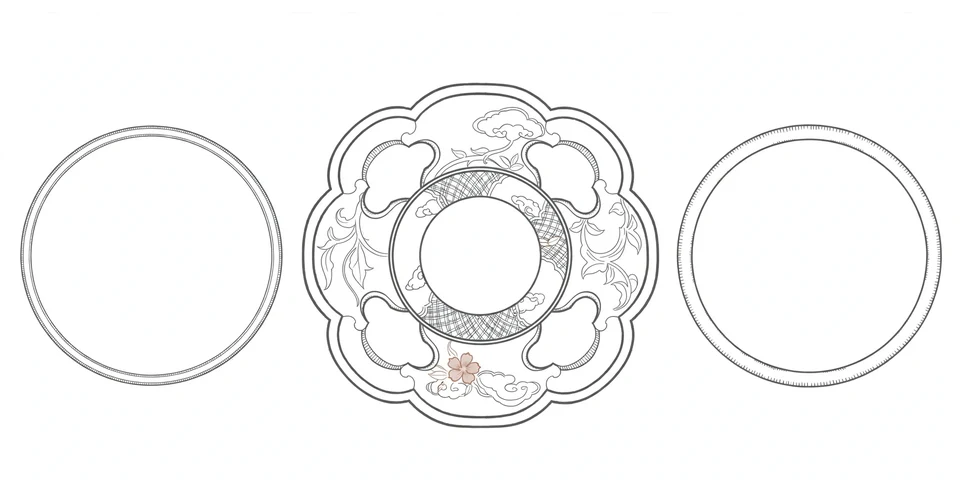
This article grew out of three sentences in earlier pieces on this site. The habaki article says the tsuba is "flanked on each side by thin washers called seppa", and the tsuba article says the guard is held "by two thin washers called seppa on either side". The fuchi article lists the mounting order as "the blade, the habaki, a seppa washer, the tsuba, another seppa, and then the fuchi". Those lines treat the washers as a passing detail. They deserve more than that, because a katana without working washers is a katana that announces itself with every step, and a katana with good washers feels like it was carved from one piece of steel.
What seppa actually are
A seppa is a flat washer with a hole in the middle, shaped to match the cross section of the blade tang where it passes through the guard. The word is usually written with the characters for cut and feather, and the usual explanation is that the name refers to the thin, feather like profile of the piece. Whether or not that translation captures the full history of the word, it captures the object well. The washer is thin, light, and easy to overlook, and it does a job nothing else in the mounting can do.
The standard arrangement uses a pair. The lower seppa, on the blade side, sits against the habaki. The upper seppa, on the handle side, sits against the fuchi. The tsuba is sandwiched between them. When the handle is fitted onto the tang and pinned in place with the mekugi peg, the whole stack is squeezed together, and the washers are the parts that absorb the pressure and spread it evenly. The reference work on Japanese sword mountings puts it plainly: the seppa are washers above and below the tsuba to tighten the fittings.
That definition sounds modest, and it is meant to. Seppa were never supposed to draw the eye. The craftsmen who made them, the shiroganeshi or white metal workers, specialised in the fittings that touch the blade directly, and their work was judged by how invisible it felt in use. A tsuba could be a masterpiece of openwork iron. A habaki could carry a fine engraved texture. The seppa just had to fit, and fitting is a harder test than it sounds, because a washer that is too thick leaves the handle proud of its seat, while a washer that is too thin leaves the guard free to rock on the tang.
Why a sword needs washers at all
A katana is not glued together. The blade, the guard, the collars, and the handle are separate pieces held in place by friction and by one small bamboo peg. That construction is deliberate. It lets a sword be taken apart for cleaning, lets a damaged handle be replaced without touching the blade, and lets an owner fit a new guard to an old blade. But a construction with no glue and no screws has a weakness. Every joint is a place where a tiny gap can open, and a tiny gap in a sword becomes a rattle, a wobble, and eventually wear.
Metal moves with temperature. Wood swells and shrinks with humidity. A handle that fit perfectly in a dry winter can loosen in a humid summer, and a guard that sat tight for years can develop a hair of play after the sword has been drawn and sheathed a thousand times. The seppa exist to absorb those changes. Because they are thin and slightly soft, they compress under pressure and fill gaps that would otherwise stay open. Because there are two of them, one on each side of the guard, they centre the tsuba on the tang and keep it from tilting.
The rattle they prevent is not only a matter of manners. A guard that rocks on the tang hammers at the metal around the hole with every movement, and over time that hammering enlarges the hole and loosens the fit further. A loose guard also changes how the sword feels in the hand, because the balance of a katana depends on every fitting sitting exactly where it belongs. A sword that rattles is a sword telling its owner that something in the stack has failed, and the seppa are usually the first place a careful owner looks.
There is a useful comparison close to home. A bicycle wheel is held true by spokes that are individually thin and unremarkable, and a door hangs straight because of hinges that nobody admires. The seppa belong to that class of object: small, plain, and load bearing in a quiet way. Remove them and the assembly still looks complete from a distance, but the moment you pick it up, the difference is obvious.
Where seppa sit in the mounting stack
To understand seppa, it helps to picture the whole stack of fittings in order, from the blade toward the handle. First comes the blade itself, and at its base the habaki, the wedge shaped collar that locks the sword into its scabbard. The habaki article on this site explains that collar in detail, and it is worth reading alongside this one, because the habaki is the copper collar that locks a katana in its sheath, and the seppa press directly against it. Then comes the first seppa. Then the tsuba. Then the second seppa. Then the fuchi, the collar that frames the mouth of the handle, and then the tsuka, the wrapped grip itself.
The order matters because each piece in the stack has a different job, and the seppa are the diplomats between neighbours that would otherwise damage each other. The habaki is usually copper, a soft metal. The tsuba is often iron, a hard one. If the two sat face to face, the iron would chew at the copper every time the sword moved, and the habaki would lose the precise fit that keeps the blade secure in its scabbard. A washer between them takes the friction instead. The same is true on the other side, where the washer shields the tsuba from the fuchi and spreads the pressure of the handle evenly across the back of the guard.
The stack is also the reason seppa come in pairs. A single washer on one side of the guard would leave the other side unsupported, and the guard would tilt toward the unsupported face. Two washers, one on each side, keep the guard centred and the pressure balanced. When a sword is taken apart, the pair usually stays with the guard, and an experienced handler will keep the two washers in their original order, because over years of use each washer wears to match the face it sits against, and swapping them can spoil a fit that took decades to settle.
Copper, brass, iron, and shakudo
Most seppa are made from copper. The metal is soft enough to compress slightly under pressure, which is exactly what a washer needs to do, and it resists corrosion well enough to survive inside a sword mounting for generations. Copper also takes a patina gracefully, darkening to a deep russet brown that sits quietly beside the iron of a tsuba and the lacquer of a scabbard. A copper washer does not shout. It ages in step with the rest of the sword.
Brass is the next most common choice. It is an alloy of copper and zinc, harder than pure copper and yellow in colour, and it is used where a slightly stiffer washer is wanted or where the maker prefers the warmer tone. Iron washers exist too, usually on plainer mountings or on swords where the whole set of fittings is iron and the maker wants the washers to match. Iron is less forgiving than copper, since it does not compress as readily, so an iron washer has to be fitted more precisely from the start.
The most prized washers are made from shakudo, the dark alloy of copper and gold that is one of the great materials of Japanese metalwork. A good shakudo surface is a deep purplish black, often compared to a raven wing, and it is achieved by patinating an alloy that is typically around 94 to 97 percent copper with a few percent gold. Shakudo washers are rare, because the material is costly and the part is small and mostly hidden, and that is rather the point. Choosing shakudo for a washer that almost nobody will see is a statement about the owner. It says that the quality of the sword does not stop where the eye stops.
The choice of metal is never only about looks. Different metals expand at different rates and grip the tang differently, so the maker has to think about how the seppa will behave beside its neighbours. A copper seppa beside an iron tsuba is a safe pairing, because the soft washer yields before the hard guard does. A shakudo washer is chosen for a high grade mounting where every fitting is expected to be of the best material available, regardless of whether it shows. The guide to the shiroganeshi, the craftsmen who make habaki and seppa, notes that seppa are typically made from copper, brass, or iron, chosen for durability and for compatibility with the other metal components. Compatibility is the right word. A seppa is a neighbour before it is an ornament.
How a pair of seppa is fitted by hand
Seppa are not bought off a shelf and dropped into place. Each pair is fitted to one sword, by hand, and the fitting is a process of patient removal rather than addition. The craftsman starts with a washer slightly thicker than needed, assembles the sword, and feels for play. If the guard rocks, the washer is too thin, and a thicker one is tried. If the handle will not seat fully, the washer is too thick, and the craftsman files a whisper of metal from its face, reassembles the sword, and tests again.
The tools are simple: hammers, anvils, files of many grades, and scraping tools for the finest adjustments. The skill lies in knowing how much to remove and where. Each washer must be flat across its whole face, because a washer that is thick on one side and thin on the other will tilt the guard. It must match the shape of the tang hole in the tsuba, because a washer that overhangs the hole can catch and bind. And it must be thin enough to disappear into the stack, adding almost no length to the assembly, while still being thick enough to do its job.
This is slow work, and it is easy to ruin a washer by rushing it. File too much from one spot and the washer is scrap. File evenly but too far and the pair is too thin, and the craftsman starts again with fresh metal. There is a lesson in that for anyone who has ever been tempted to fix a loose joint by tightening a screw harder. The Japanese approach is the opposite. When something rattles, the answer is not more force. It is a better fit, achieved by removing a little material in exactly the right place and then testing again.
Modern reproduction swords often ship with seppa that were stamped out by machine and never fitted to the individual sword at all. They look right in a photograph and they do the job after a fashion, but they are one of the first things an experienced handler checks, because a stamped washer is flat in theory and rarely flat in practice. On a traditionally mounted sword, the washers are as individual as a fingerprint. They belong to that sword and to no other, and moving them to a different mounting is a gamble.
The quiet decorative role of seppa
For most of their history, these washers were deliberately plain. A washer that draws the eye has failed at its job, which is to disappear between two more important fittings. But plain is not the same as careless, and on fine mountings the seppa carry a quiet decoration of their own. Some are given a fine textured surface, a stone like grain called ishime, or a pattern of tiny punched marks that catches the light when the sword is taken apart. Some are shaped with a slightly raised rim or a gentle oval that echoes the curve of the tsuba. A few carry a family crest, a mon, engraved small enough to be seen only when the sword is disassembled.
This restraint is characteristic of the best Japanese craft. The decoration is there for the owner, not for an audience, and it is found only by someone who takes the sword apart with care. There is something honest about that. A culture that decorates its washers is a culture that believes quality should run all the way through an object, not just across the surfaces that happen to face outward.
It is worth pausing on that idea, because it runs against how most things are made now. A modern product is designed to look good in a photograph and to survive until the warranty runs out, and the parts you never see are usually the cheapest parts in the box. A katana mounting was made on the opposite principle. The hidden parts were made with the same care as the visible ones, because the maker knew the owner would one day take the sword apart and look. The seppa are the test of that principle. If a maker cheats on the washers, nobody will know until the sword rattles, and by then the maker is long gone. If a maker does the washers properly, nobody will know either, except the owner, who will feel it every time he picks the sword up. That is a strange kind of accountability, enforced only by pride, and it is one of the reasons these old swords still feel so good in the hand.
How to tell a good pair from a bad one
If you ever handle a katana, and you should only do so with the owner's permission and with clean, dry hands, there are a few simple checks that reveal the quality of the washers without taking anything apart. Hold the sword by the handle and shake it gently from side to side. A good mounting is silent. Any click or tick from the guard area means something in the stack has play, and the washers are the usual suspects. Then press the guard lightly with your thumb, first on one edge and then on the other. It should not rock. A guard that tilts under thumb pressure is a guard whose washers are no longer filling the gap.
Look at the seam where the seppa meets the tsuba. On a well fitted sword the line is even all the way around, with no wedge of daylight opening on one side. Look at the colour of the two washers. They should match each other and sit comfortably with the neighbouring fittings, because a mismatched pair is often a sign that one washer was replaced in a hurry. And look at the surface. A good seppa is flat, clean, and free of deep scratches or hammer marks, even though almost nobody will ever see it. Those marks would tell you the washer was forced rather than fitted.
There are also signs that point the other way. A washer that is visibly bent or dished has been crushed by over tightening, and it will never sit flat again. A washer with a hole that is too large for the tang will shift sideways and let the guard wander. A pair of washers in different thicknesses will tilt the guard, and a pair in different metals will age at different rates and may one day react with each other. None of these faults is dramatic on its own, and that is what makes them easy to ignore. But a sword is a system, and a small fault in the washers becomes a larger fault in the guard, and a larger fault in the guard becomes wear on the blade. The wise owner fixes the small fault while it is still small.
One more check is worth mentioning, because it is the easiest to perform and the most often skipped. When a sword is taken apart for cleaning, the washers should be kept in order and returned to the same faces they came from. Mark them lightly, or simply remember which one sat against the habaki and which against the fuchi. Swapping them seems harmless, since they look identical, but years of use wear each washer to its own face, and a swapped pair can introduce exactly the rattle the owner was trying to avoid. Good practice with small parts is mostly a matter of paying attention, and these washers reward attention more than most.
What seppa teach about Japanese craft
There is a temptation to treat seppa as a footnote, a part too small to matter, and the history of writing about Japanese swords has mostly given in to that temptation. The tsuba gets the museum exhibitions. The blade gets the poetry. The habaki gets the technical articles. The seppa get a line, if that. But the more time you spend with a well mounted sword, the more that order of attention feels upside down. The blade is the soul of the sword, certainly, and the guard is its face, but the washers are the reason the soul and the face stay together without a sound.
That is a useful way to think about craft in general. Every well made thing has its own small washers, the unglamorous parts that hold the impressive parts together. In a house it is the shims behind the skirting board. In a piece of writing it is the transitions between paragraphs. In a friendship it is the small remembered detail, the message returned, the promise kept on time. None of these things photographs well, and none of them wins prizes, and a thing built without them still looks finished from a distance. It is only when you live with it that the difference shows, in the rattle that was never fixed and the wobble that slowly gets worse.
The katana mounting understood this centuries ago, and it built the understanding into the object itself. The whole koshirae, the complete mounting of the sword, is an assembly of named parts, each with a maker, a material, and a job. The tsuba article on this site describes how the tsuba turned a sword guard into a small work of art, and it is a wonderful story. But the guard only became a work of art because it sat in a stack that held it still, and the stack only held it still because two thin washers did their quiet job on either side. Art needs engineering, and engineering at its best looks like nothing at all.
So the next time you see a katana, in a museum or in a photograph, look past the guard for a moment and imagine the two thin washers behind it. They are copper or brass or iron or dark shakudo, a fraction of the sword by weight and almost none of it by fame, and they are the reason the sword is silent when it moves. A culture that lavishes that much care on a washer is a culture that believes no part of a thing is beneath attention. That belief, carried into ordinary life, is worth more than any single sword. Make the hidden parts well, fit them by hand, test them by feel, and the whole thing will hold together for a hundred years without a sound.
More in Culture & Society
- Wakizashi Was the Short Sword a Samurai Never Took Off
- Tsuba Is the Small Guard That Stops a Katana From Cutting Its Owner
- Yokote Is the Small Line That Tells a Katana's Age
- Kissaki Is the Small Tip That Finishes a Katana
- Nakago Is the Hidden Tang That Carries a Katana's Signature
- Mekugi Holds a Katana Together With a Single Bamboo Pin
Latest posts
- Why a Katana Stays Put, Thanks to the Koiguchi
- Tsuka-Ito Is the Cord That Binds a Katana Grip
- Fuchi Is the Collar That Frames a Katana Grip
- Kashira Is the Small Cap That Finishes a Katana Grip
- Sageo Is the Cord That Ties a Katana to Its Samurai
- Menuki Are the Small Ornaments Hidden Under a Katana Grip
- Habaki Is the Copper Collar That Locks a Katana in Its Sheath
- Maedate Is the Crest That Turned a Samurai Helmet Into a Banner
- Samegawa Is the Ray Skin Hiding Under Every Katana Grip
- Tatara Is the Clay Furnace Where Tamahagane Begins
- Tsuka Is the Wrapped Grip That Lets a Katana Speak
- The Tanto Was the Small Blade a Samurai Trusted With His Life
- Tamahagane Is the Jewel Steel Behind Every Katana
- Seppuku Was the Ritual a Samurai Chose Over Disgrace
- Saya Is the Lacquered Sheath That Guards the Katana