Koshirae Is the Formal Mounting That Turns a Blade Into a Katana
· 21 min read
A koshirae is the complete formal mounting of a Japanese sword, the lacquered scabbard, wrapped handle, guard, and fittings that turn a bare blade into a katana ready to be worn.
Stand in front of a katana in a museum and watch where the eyes go. They go to the steel, to the curve of the blade and the wavy temper line along its edge, and they stay there. The mounting that holds the blade barely gets a glance. It looks like a black sheath with a wrapped handle, a finished object, nothing more. That is the wrong way to look at it. A bare blade is not a katana. It becomes one only when it is dressed, and the dressing has a name, koshirae.
That name is koshirae. A koshirae is the complete formal mounting of a Japanese sword, the lacquered scabbard, the wrapped handle, the guard, and every small fitting that connects them, built for one specific blade and no other. It protects the steel, it makes the sword wearable at the hip, and it tells everyone in the room who the owner is. The blade is the soul of the sword. The koshirae is the body it wears in public, and it deserves the same attention as the steel inside it.
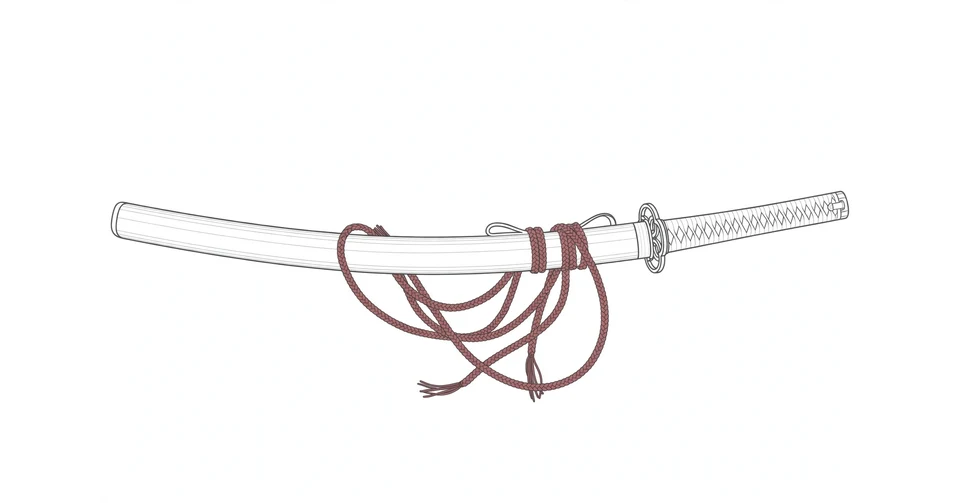
The idea for this story came from a sentence in the story of the saya, the lacquered sheath itself. When the sword is carried, it wears its koshirae, the complete formal mounting: lacquered scabbard, wrapped handle, guard, and all the fittings. That one sentence contains a whole world, because a koshirae is not a single object. It is a small society of crafts, materials, and rules, assembled by several specialists who never meet, and it is worth meeting each of them.
What a koshirae is
A koshirae is the set of housings and fittings that holds a Japanese sword blade when the sword is being worn by its owner. The word comes from the verb koshiraeru, an old word meaning to make or create, which has fallen out of everyday speech. A more precise word for the same thing is toso, meaning sword furniture, and the parts themselves are called tosogu. The metal fittings have their own name, kanagu, and the outer mountings as a whole are called gaiso, set against toshin, the body of the sword, meaning the blade itself. That vocabulary already tells you something important. In Japanese, the blade and its mounting are two different things, with two different names, and the mounting is a craft in its own right.
The distinction matters because a blade does not belong to one koshirae permanently. Over a life that can span centuries and dozens of owners, a significant blade may pass through many different mountings, each one reflecting the taste, the status, and the intentions of a specific owner at a specific moment in history. A koshirae is therefore a historical document as much as a piece of equipment. Its style, its materials, and its imagery reveal when and where a sword was used, who owned it, and what that person wished to communicate. Reading a koshirae is its own branch of Japanese sword scholarship, and it begins with knowing what each part is and who made it. A full list of the components, from the fuchi and habaki to the menuki and seppa, is given in the reference on Japanese sword mountings.
The most familiar koshirae is the katana style, the one most people picture when they hear the word samurai sword. Swords mounted this way are worn with the cutting edge up, tucked through the sash at the hip. The older tachi style is different. A tachi is worn with the cutting edge down, suspended from two hangers called ashi that are attached to the sash, and its hilt often has a slightly stronger curve than the blade. The tachi style came first, and the katana style followed it. Even the way a koshirae is presented follows rules. In times of peace it should be shown with the handle to the left, because the sword cannot easily be drawn that way. In times of war the handle should be presented to the right, so the sword can be drawn at once. A koshirae is not only built for function and beauty. It is built for etiquette, and the etiquette is part of the craft.
The people behind one koshirae
No one person makes a whole koshirae. A complete mounting is the collaboration of five or six specialist craftspeople, each with their own tools, their own training, and their own centuries of accumulated technique. The sayashi makes the scabbard. The tsukamaki-shi wraps the handle. The habaki-shi makes the blade collar. The lacquerer finishes the wood. The metalworkers make the guard and the small fittings. Each of them perfects one part, and the parts meet only at the end, on the blade itself. A detailed guide to these craftspeople and their trades is given in this complete guide to koshirae.
That division of labour is one of the most Japanese things about the sword. The smith who forges the blade never makes its mounting, and the mounting makers never forge steel. The result is a chain of specialists, and the chain is only as strong as its weakest link. A perfect blade in a careless mounting is a lesser sword, and collectors know it. The quality of the handle assembly is often the most immediate sign of a koshirae's overall standard, and one of the most reliable ways to tell genuine traditional craft from a factory made imitation.
The most celebrated of these metalworking families is the Goto family, seventeen generations of fittings artists who served the Ashikaga, Oda, Toyotomi, and Tokugawa shogunates in unbroken succession. The founder, Goto Yujo, lived from 1440 to 1512 and worked at the court of the eighth Ashikaga shogun, Yoshimasa, the same patron who shaped much of Japan's classical aesthetic tradition in the late fifteenth century. The Goto school worked in shakudo, a copper and gold alloy that polishes to a deep lustrous black, and shibuichi, a copper and silver alloy that produces subtle grey tones. Their techniques included kebori, hair fine line engraving, and nunome zogan, gold inlay cut into a fine grid. Their favoured motifs, dragons, phoenixes, the hollyhock crest of the Tokugawa, and the paulownia, were often assigned by shogunate protocol rather than chosen freely, and that strict framework produced work of extraordinary refinement. A complete koshirae with authenticated Goto school fittings, fuchi and kashira, menuki, kozuka, and kogai, all matched, is one of the most prestigious sets of sword fittings in the Japanese art market, and individual pieces are regularly certified and sold at major auction houses without any blade at all.
I find that division of labour quietly moving. A sword is often imagined as the work of one heroic smith at a forge, but the object you actually hold is the work of half a dozen people, most of them anonymous, each of them excellent at one narrow thing. The blade gets the poetry. The mounting gets the patience. Both are needed, and neither is complete without the other.
The saya, the lacquered home of the blade
The largest part of a koshirae is the saya, the scabbard, and it is the part most people see first. The saya begins as magnolia wood, known as honoki, split into two halves, hollowed to receive one specific blade, and rejoined with rice paste so the halves can be pulled apart again for cleaning. The fit is precise. Only the back of the blade touches the interior, while the cutting edge rests in a tiny gap carved for it, touching nothing. Once the blade is fully home, the habaki wedges gently into the mouth and holds the sword still, so it neither rattles nor slips out. The full story of the wood, the lacquer, and the making of the sheath is told in Saya Is the Lacquered Sheath That Guards the Katana.
The finished wood core is then covered in urushi lacquer, applied in layer after layer, each one dried and polished before the next goes on. The process may involve dozens of layers over weeks, and a lacquerer can spend two or three months on a single saya. The variety of finishes is enormous. Kuro nuri is a black gloss. Roiro nuri is a mirror black, polished until it reflects like still water. Nashiji scatters gold flecks into the lacquer like the skin of a pear. Aogai sets pieces of mother of pearl into the surface so they shimmer. A fine Edo period saya in perfect condition is a technically demanding work of lacquer in its own right, valued by connoisseurs of Japanese lacquer as well as by sword collectors.
The saya carries its own small set of fittings. The koiguchi is the mouth, traditionally fitted with buffalo horn, because it must survive the habaki wedging into it every time the sword is sheathed. At the far end sits the kojiri, the end cap, also traditionally buffalo horn, which protects the tip from knocks and wear. Halfway down, on the outer side, sits the kurikata, a small knob shaped like a chestnut, through which the sageo cord is threaded. A small hook called the kaerizuno stops the cord from slipping, and tiny caps called shitodome finish the holes where the cord passes through. On the finest swords the saya also carries two slim slots on its outer face, one for the kogai, a small grooming tool, and one for the kozuka, a small utility knife with its own decorated handle.
What strikes me about the saya inside a koshirae is how much of it is invisible work. The lacquer is what you see, and it is beautiful, but the fit is what you feel, and the fit is what keeps the blade alive. A scabbard that fits badly can damage the edge or let moisture in, and no amount of gold powder on the outside can fix that. The koshirae rewards the person who looks twice, and it punishes the person who only looks once.
The tsuka, the handle you actually hold
If the saya is the part you see, the tsuka is the part you feel. The tsuka is the handle, built over the nakago, the tang of the blade, covered in samegawa, ray skin, and wrapped in silk or cotton cord called tsuka-ito. Its construction involves several craftspeople at once: the sayashi shapes the wooden core, a specialist applies the ray skin, and the tsukamaki-shi performs the wrapping in the correct technique, including the alternating moroneri twist that locks each section of the wrap independently. A single bamboo peg, the mekugi, passes through the handle and the tang to hold the whole assembly together.
The wrapping is not decoration laid over a handle. It is the handle. The pattern of the wrap, most commonly hineri-maki, with more elaborate styles like katate-maki and jabara-maki for formal pieces, determines how the sword sits in the hand, and the diamonds of ray skin that show through the gaps are both grip and ornament. Under the wrap sit the menuki, small metal ornaments positioned where the fingers grip, one on each face of the handle, offset from each other rather than directly opposite, and placed with the motif facing the correct direction for each face. A reversed menuki is a reliable sign that a sword has been remounted incorrectly. The menuki do two jobs at once. They decorate the handle, and their three dimensional shape creates subtle contours beneath the cord that help the hand find and steady its grip without conscious thought.
At the front of the handle sits the fuchi, a metal collar between the handle and the guard, and at the far end sits the kashira, the butt cap that secures the final knot of the wrapping. These two are always made as a matched pair by the same metalworker, in the same material, in the same style, with matching or complementary motifs. A fuchi and kashira from different sources, however beautiful individually, represent an incomplete or restored koshirae, and mismatched pairs are among the most common signs that a mounting was assembled from separate sources rather than created as one unified commission. When the fuchi and kashira match, the handle feels like one thought rather than two. That is the difference between a koshirae and a collection of parts.
The small metal parts that hold it together
Between the blade and the handle sits the most mechanically critical part of the entire koshirae, and it is one of the smallest. The habaki is a wedge shaped metal collar fitted directly to the base of the blade, and it does two jobs. It locks the blade in the saya by engaging the mouth of the scabbard, and it provides a stable base against which the guard and the spacers rest. Its fit to the specific blade is as precise as the fit of the saya, made for this blade alone, to tolerances measured in fractions of a millimetre. Habaki are most commonly made from copper, gold foiled copper, or solid gold on very fine pieces, and on museum grade blades the habaki may itself be a work of art, with carved motifs in gold. A worn or ill fitting habaki is one of the most common problems in both antique and modern swords, and replacing one is a specialist job, because a new habaki must be fitted to the blade by hand.
On either side of the guard sit the seppa, two thin metal washers that tighten the fittings and take up the slack. They look like the simplest parts of a koshirae, and they are the easiest to overlook, but a guard that wobbles is almost always a seppa problem, and worn or missing seppa are one of the most common issues in period mountings that need restoration. The guard itself, the tsuba, is the visual centrepiece of the koshirae, the plate between blade and handle that stops the hand from sliding onto the edge and that carries the boldest artwork of the whole mounting. Its story, from iron plates to gold inlaid scenes, is told in Tsuba Is the Small Guard That Stops a Katana From Cutting Its Owner.
The menuki deserve a second look, because they belong to a set. In the Goto school tradition, the menuki, the kozuka, and the kogai were collectively known as mitokoro-mono, the three place things, the three small fittings that completed a formal koshirae. A complete matched set of mitokoro-mono by the Goto school is among the most prestigious fitting sets in the tradition, and it has been collected independently of any blade since the Edo period. That a set of three small objects, none of them larger than a finger, can be collected like paintings tells you how seriously Japan takes its mountings. The koshirae is not the frame around the art. In the eyes of its collectors, it is art, and sometimes it is the art that matters most.
| Part | Japanese name | What it does |
|---|---|---|
| Scabbard | Saya | Houses and protects the blade, carries the lacquer finish |
| Handle | Tsuka | Gives the hand its grip, wrapped over ray skin |
| Guard | Tsuba | Stops the hand sliding onto the blade, carries the artwork |
| Blade collar | Habaki | Locks the blade in the scabbard, seats the guard |
| Spacers | Seppa | Thin washers that tighten the guard and stop wobble |
| Handle collar | Fuchi | Finishes the front of the handle, matched with the kashira |
| Pommel cap | Kashira | Caps the end of the handle, secures the wrapping knot |
| Handle ornaments | Menuki | Grip aid and decoration beneath the handle wrap |
| Cord | Sageo | Ties the scabbard to the sash and steadies the draw |
The list looks modest on paper, nine parts and a few more besides, but each one is a craft, and each one is fitted to one blade. A koshirae is not assembled from a catalogue. It is commissioned, measured, and built, and that is why two mountings for the same pattern of sword are never quite the same.
How a koshirae differs from a shirasaya
Every Japanese sword lives two lives, and the mounting marks the boundary between them. When the sword is carried, it wears its koshirae, the complete formal mounting, lacquered scabbard, wrapped handle, guard, and all the fittings. When the sword rests, it wears its shirasaya, the white scabbard, a plain handle and a plain saya of unfinished magnolia wood, with no lacquer, no guard, and no decoration at all.
The shirasaya exists because a lacquered sheath, for all its beauty, is the wrong home for a blade that will sit untouched for months or years. Lacquer seals the wood, and sealed wood cannot breathe. Moisture can become trapped between the blade and the scabbard, and trapped moisture means rust. The plain wood of a shirasaya breathes, so the air inside stays steady, and that is why it is sometimes called the resting scabbard. Prolonged mounting in a koshirae can harm a blade for exactly this reason, which is why collectors and museums store important blades in shirasaya and dress them in koshirae only for display or use.
The shirasaya carries one more feature that the koshirae does not: writing. A sayagaki is an inscription brushed in black ink on the pale wood, recording the smith who made the blade, its length, and the date the inscription was written. In the age of the great lords the writing was an index, a way to tell one blade from another without drawing it. After the samurai era ended it became a mark of authenticity, written now by professional appraisers rather than lords. The plain white wood of a resting scabbard is also a label, and the contrast is the point. The koshirae speaks through lacquer, silk, and gold. The shirasaya speaks through silence and a few lines of ink. A sword needs both voices, and it needs them at different times.
The shirasaya is also not a fighting mounting. Without a guard and without a proper wrapped handle, it was never meant for the battlefield, and a blade kept in one is a blade at rest. That is the cleanest way to understand the difference. A koshirae is a sword ready to be worn, drawn, and seen. A shirasaya is a sword waiting, and waiting well is a skill of its own.
What a koshirae says about its owner
A koshirae is a portrait. Its style, materials, and imagery reveal when and where a sword was used, who owned it, and what that person wished to communicate about themselves through their sword, and that is why a blade may outlast a dozen mountings while each mounting stays faithful to one owner. The fittings were often decorated with the family mon, the crest, so the sword could be identified at a glance. The colour and material of the sageo cord communicated the wearer's status, with high ranking samurai wearing cords in specific colours that matched their position. The motifs on the guard, the fuchi, and the menuki were not arbitrary. Natural subjects, seasonal flowers, birds, and landscapes sat beside mythological scenes, Buddhist and Shinto imagery, and the heraldic devices of daimyo families, and each choice told every samurai who encountered the sword something about the cultural references, the spiritual affiliations, and the social standing of its owner.
The formal sword of the Tokugawa period shows the restrained end of that range. When a samurai visited a castle, the rules required a daisho, the pair of long and short swords, with a black saya and a hilt wrapped in white ray skin and black cord. The black scabbard was not a fashion choice. It was a uniform, and it told everyone in the room exactly who the wearer was. At the other end of the range, the Edo period turned the mounting into a canvas, and the peace that followed the wars gave craftsmen the time and the patrons to make fittings that were collected, appraised, and handed down like paintings.
The market agrees with the connoisseurs. A good Edo period katana with a basic preservation certificate, kept in shirasaya, typically sells in a range around five thousand to nine thousand dollars. Put that same blade in authenticated period koshirae with certified Goto school fittings, and the price can climb to a range around eighteen thousand to thirty five thousand dollars. A period koshirae alone, without any blade, can sell for two thousand to fifty thousand dollars or more depending on the school, because it is a certifiable and collectable artwork in its own right. These figures are indicative market estimates based on published auction and dealer data, and individual pieces vary significantly, but the direction is clear. The mounting is not an accessory to the blade. It is a significant portion of the value, and sometimes it is the larger portion.
There is a lesson in that for anyone who collects, or who simply looks at beautiful things. We tend to price the part that does the work and treat the part that presents it as decoration. The Japanese sword tradition refuses that split. The blade cuts, and the koshirae carries, protects, identifies, and honours, and both jobs are honoured with the same seriousness. A sword without its mounting is a voice without a room to speak in. It is still a voice, but nobody can quite hear it.
Caring for a koshirae
A koshirae is a working object, and it needs care like any other, but the first rule of caring for one is knowing when not to use it. For long storage, the blade belongs in a shirasaya, not in its lacquered koshirae, because the plain wood breathes and the lacquered wood does not. The blade itself should be lightly oiled before it is put away, and the inside of the scabbard kept clean and dry. A mounting that is looked after in this way can serve for generations. One that is neglected will warp, crack, or loosen, and once the fit is gone, the protection is gone with it.
The second rule is to check the fit before you trust it. A scabbard that has swollen in damp weather may grip the blade too tightly, while one that has dried out may let it rattle, and a guard that wobbles is usually telling you that the seppa have worn thin. These are small problems with small fixes, and they are worth catching early, because a koshirae fails the way a house fails, slowly at first and then all at once. The habaki deserves a check of its own, since a loose blade collar is the fault that lets a sword slip free of its scabbard, and a sword that slips free is a danger to everyone nearby.
The third rule is to respect the matching. A koshirae is a set, and its parts belong together. Fuchi and kashira from the same maker, menuki placed with the correct orientation, a sageo in a colour that suits the ensemble, these details are what separate a mounting that was commissioned as one thought from a mounting that was assembled from spare parts. Collectors and appraisers look for them, and the NBTHK, the Society for the Preservation of Japanese Art Swords, certifies fittings independently through its tosogu appraisal process, so a named guard or a matched set of fittings can be authenticated and valued entirely separately from any blade it accompanies. If you ever handle a mounted sword, look at the small things first. They will tell you whether the sword was loved or merely owned.
A koshirae is the formal mounting that turns a blade into a katana, and it has done that work through war, through peace, through the banning of swords in public, and through the long revival of the craft that followed. It is wood and lacquer and silk and ray skin and copper and gold, made by hand over months by people whose names are mostly forgotten, and it asks only to be used well and stored well. The blade is the soul of the samurai. The koshirae is the dress that soul wears when it walks into the world, and it has earned its place in the story.
More in Culture & Society
- Shirasaya Is the Plain White Scabbard Where a Katana Rests
- The Togishi Polishes a Katana for Weeks Before It Ever Cuts
- Kozuka Is the Small Knife Hiding in a Katana's Saya
- Wakizashi Was the Short Sword a Samurai Never Took Off
- Tsuba Is the Small Guard That Stops a Katana From Cutting Its Owner
- Yokote Is the Small Line That Tells a Katana's Age
Latest posts
- Seppa Are the Thin Washers That Keep a Katana From Rattling
- Kissaki Is the Small Tip That Finishes a Katana
- Nakago Is the Hidden Tang That Carries a Katana's Signature
- Mekugi Holds a Katana Together With a Single Bamboo Pin
- Why a Katana Stays Put, Thanks to the Koiguchi
- Tsuka-Ito Is the Cord That Binds a Katana Grip
- Fuchi Is the Collar That Frames a Katana Grip
- Kashira Is the Small Cap That Finishes a Katana Grip
- Sageo Is the Cord That Ties a Katana to Its Samurai
- Menuki Are the Small Ornaments Hidden Under a Katana Grip
- Habaki Is the Copper Collar That Locks a Katana in Its Sheath
- Maedate Is the Crest That Turned a Samurai Helmet Into a Banner
- Samegawa Is the Ray Skin Hiding Under Every Katana Grip
- Tatara Is the Clay Furnace Where Tamahagane Begins
- Tsuka Is the Wrapped Grip That Lets a Katana Speak