The Togishi Polishes a Katana for Weeks Before It Ever Cuts
· 17 min read
A togishi is the master polisher who spends weeks revealing a katana's hamon and grain with natural stones, and a careless polish can ruin a blade that took a smith months to forge.
A katana leaves the forge grey, dull, and silent. The steel is real, the curve is set, and the temper line is already inside the metal, but none of it can be seen. The blade looks unfinished because it is unfinished. The man who changes that is the togishi, the sword polisher, and his work takes ten to fourteen days for a single blade.
That length of time surprises most people, because polishing sounds like a finishing touch, something quick that happens at the end. It is the opposite. A togishi does not sharpen a sword. He reveals it, stone by stone, until the grain of the steel and the wavy temper line along the edge appear as if they had been waiting under the surface all along. The smith makes the blade. The togishi makes it visible.
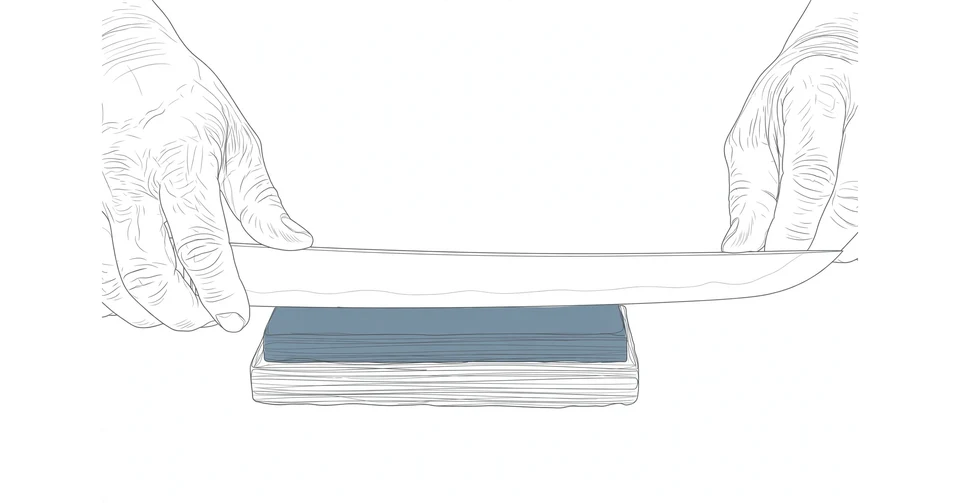
This article follows the togishi through his craft: the rough polish the smith does first, the foundation work that takes most of the week, the natural stones he matches to each blade, the fingertip finish that brings the hamon into view, and the hard truth that every polish removes steel a blade can never get back. It is slow work, and that slowness is the point.
The blade arrives grey and the togishi begins
A newly forged katana does not go straight from the smith to the togishi. The smith begins with a rough polish of his own, called kaji-togi, which sets the blade's lines and geometry and lets him check for hidden flaws such as cracks or defective welds before the blade leaves his hands. He also files the tang, signs it, and drills the hole for the bamboo retaining peg. Out of respect for his fellow craftsman, he does not pass along anything less than a sound blade. The Metropolitan Museum of Art describes the same handoff in its essay on the Japanese blade: once the smith is satisfied with the hardening, the blade is passed on to the togishi, who gives it its final mirrorlike polish. The steel for that blade, the jewel steel called tamahagane, is itself a story worth knowing, as told in tamahagane is the jewel steel behind every katana.
Only then does the togishi take over, and his first job is not beauty. It is honesty. He must look at the blade and judge how it was made, where it was made, and when, because a blade from one school and period answers the stones differently from a blade from another. Jon Bowhay, one of the very few Westerners to complete the full ten year apprenticeship as a togishi in Japan, writes that a togishi must know Japanese art, literature, and history well enough to judge the school, period, and general style of a blade before he touches it. That knowledge decides everything that follows, from the first stone to the last wipe. A togishi who misreads a blade will polish the wrong character into it, and no amount of later care can undo that first mistake.
The workshop itself is plain. There is a low stool, a row of stones, a bucket of water, and a wooden clamp worked by the togishi's foot. The togishi sits with his right knee tucked up almost into his armpit and his right foot resting on the clamp that holds the stone, a posture that lets him press evenly along the blade and release the clamp with a lift of his foot to change stones. Students find the position painful for the first six to twelve months, and Bowhay puts the adjustment at about a year. It is the first lesson of the craft, and it is a physical one: the work will hurt before it rewards you, and comfort is something you earn by staying.
Shitaji-togi, the foundation that takes most of the week
The first of the two great stages is shitaji-togi, the foundation polish, and it is where most of the time goes. Bowhay records that it usually takes a minimum of ten to twelve hours per day for four to six days, and that is for a blade in ordinary condition. A badly rusted blade can take one or two days of continuous work on the roughest stones just to redefine its lines. The Southern California Naginata Federation, in its detailed guide to the craft, puts the whole polishing process at ten to fourteen days, which matches the working rhythm of a week of foundation and several days of finish.
The togishi works through the stones in a fixed order, from coarse to fine, and each stone exists to erase the marks of the one before it. He starts with arato, a coarse natural sandstone around 180 grit, then moves to binsui at roughly 280 to 320 grit, then kaisei at 400 to 600 grit. Each step refines the shape a little further and takes off the scratches left by the coarser stone. After the rough stones come the nagura stones, chu-nagura at about 800 grit and the finer koma-nagura at 1,200 to 1,500 grit, the latter always a natural stone. The order is not a suggestion. Skip a grade and the scratches stay, buried under a shine that will betray the togishi the moment an expert looks closely.
Here the togishi holds the blade with the edge facing away from him and moves it back and forth over the fixed stone in short strokes, sometimes adding a slight rocking motion. He polishes the spine first, then the ridge area, the tip, and the flat of the blade, always starting at the end nearest the tang and working along the length. As he moves to each finer stone he changes the angle of the blade slightly, so the scratches from the new stone are easy to tell apart from the ones left by the old stone. Only when the old scratches are gone does he move on. That discipline is the whole secret of foundation work. It looks repetitive from the outside, and it is, but the repetition is what makes the later beauty possible.
By the end of shitaji-togi the blade's lines are firmly established, and no further changes should occur in them. The hamon is beginning to become visible, a faint suggestion of the line that the finish will bring forward. Bowhay's sequence ends the foundation with two hard stones, hato, which brings out the hamon and can take several hours just to complete the edge, and jito, the hardest stone of all, which brings out the grain of the steel. Jito demands the finest skill in the whole process. Used badly, it scratches the blade and ruins days of work in a single stroke. I think there is a lesson in that for any craft: the most delicate step often comes after the heaviest labour, and it asks for more care, not less, precisely when the worker is most tired.
The stones a togishi trusts
The tools of a togishi look simple, and that simplicity is deceptive. His most important tools are his polishing stones, called toishi, and the good ones are natural stones quarried from the earth, each with its own grit, hardness, and character. Some stages use artificial stones, but from the uchigumori stage onward only natural stones will do. The uchigumori stones, at roughly 3,000 grit, are the point where the hamon becomes clearly visible, and the togishi must watch constantly for defects in the stone itself, since a flaw in the stone can scratch the blade.
A togishi must own each type of stone in varying degrees of hardness and softness, coarseness and fineness, because every stone and every sword is different, and he must match stone to sword. If the match is wrong, the stone is ineffective no matter how skilled the togishi is. Bowhay writes that togishi are constantly searching for stones, and that their stock grows until it finally crowds them out of their house. Good stones are expensive and hard to obtain at any price, and a polisher's collection is a working library built over a career, not a set of tools bought once and forgotten.
That matching is where the togishi earns his standing. Two blades can look alike to an untrained eye and respond to the stones in completely different ways, because the steel inside them differs in carbon, in folding, and in age. The togishi reads those differences by feel, by the sound of the stone, and by the way the surface changes under his hands. There is no dial to turn and no gauge to read. There is only a hand, a stone, water, and attention, repeated for hours. In a world that keeps promising faster ways to do everything, I find something steadying about a craft that still refuses to be hurried, and that still measures quality in days rather than minutes.
Shiage-togi, the finish done with fingertips
If shitaji-togi is about the blade's shape, shiage-togi, the finishing polish, is about its soul. It takes about three days, and the method changes completely. Instead of moving the blade across a large fixed stone, the togishi now holds the blade still and passes small stones over it. These are the finger stones, paper thin wafers about an inch square, glued to translucent paper and lacquered together, held between the fingers and worked by feel. An entire day is frequently spent on just one stone.
The sequence Bowhay describes runs through seven steps, and each has a purpose a casual viewer would never guess. Tsuya finishes the grain with tiny pieces of jizuya stone and the edge with hazuya, thin rectangular wafers. Nugui wipes the blade with a mixture of oil and finely ground kanahada, an ash like byproduct of sword making, which makes the grain stand out evenly, darkens the steel slightly, and helps resist rust. Hadori uses an oval hazuya stone to whiten the top of the hamon, so the line stands out in what can look like a string of mountains. Shitamigaki and uemigaki burnish the area between the ridge and the spine with a steel rod called a migakibo, first as a preliminary polish and then as the final one, until it shines like a mirror. Sugikiri defines the yokote, the small line across the tip of the blade. Narume gives a whitish colour to the boshi, the temper pattern inside the tip.
The hadori step deserves a closer look, because it is a choice, not a rule. About eighty percent of togishi prefer the hadori style, and Bowhay notes that around ninety percent of the swords submitted to the annual polishing contest of the NBTHK, the Society for the Preservation of Japanese Art Swords, were polished in that style. Hadori makes the hamon white and easy to read at a glance. The alternative, sashikomi, leaves the steel closer to its natural colour, and the hamon sits quieter, asking for a slower look under the right light. Sashikomi shows more of the fine detail inside the line, while hadori can cloud some of it. Neither is wrong. A togishi chooses according to the blade, the school it came from, and what its owner wants to see. That choice, made in the last days of a long job, is where taste finally speaks louder than technique.
How polishing brings the hamon into view
The hamon is the reason the whole craft exists in the form it does, and the togishi is the only person who can show it to the world. A fresh blade out of the quench does not show its line. The temper pattern is inside the steel, real but invisible, hidden under grey scale and rough grinding. The togishi brings it out with the stones, and the story of that line, what it is and how the smith draws it with clay, is told in the hamon is the wavy line that proves a katana is real.
The work is not sharpening, though the edge is sharpened along the way. It is revelation. In the final stages the togishi uses stones shaved thinner than a fingernail, held on a fingertip, to coax the tiny crystals of the temper line out of the border between hard and soft steel. The fine mist is called nioi and the larger sparkles are called nie, and together they make a real hamon glow rather than shine. A step called hadori frosts the hardened zone white, so the line stands out, but the white area is not the hamon itself. The hamon is the fuzzy line inside that whitened zone, and a good togishi brings it forward without scrubbing away the texture that makes it real.
That is why the polish matters to everyone who judges swords, not only to collectors. Appraisers read the hamon with the grain of the steel, the shape of the blade, and the signature on the tang to place a blade in its school and period. A fake line made by acid or sandblasting sits flat on the surface, too crisp and too consistent, with no crystals that shift as the light moves. A real one has depth, and depth can only be shown by a polish that respects it. The togishi is therefore not only a craftsman. He is the person who decides what the next hundred years of looking at that blade will reveal.
A bad polish can ruin a blade
Here is the hard truth that every owner of a Japanese sword should know. Polishing removes steel, and steel removed is gone forever. A blade can only be polished a limited number of times before the togishi risks grinding through the outer jacket of steel, or through the hamon itself, and destroying the blade. That is why a good polish, properly cared for, is expected to last about a hundred years, and why a blade should not be polished again until it truly needs it. Each polish spends a little of the blade's life. A togishi knows this with every stroke, and the knowledge is part of the discipline. He is not only making the blade beautiful. He is deciding how much of its future to spend today.
A bad polish can ruin a blade in faster and more obvious ways too. A coarse stone used carelessly can destroy a sword almost immediately, and a hard finishing stone used badly can scratch the surface and waste days of work. Worse, an amateur with sandpaper or a buffing wheel can do damage that no professional can reverse. The buffing wheel heats the steel in small spots and changes its crystal structure, and ordinary abrasives leave scratches that do not match the traditional finish at all. The warning in the polishing guides is blunt: more blades are permanently damaged by amateurs attempting to polish them than by any other means. The honest advice is simple. Never try this at home. A katana is not a kitchen knife, and the stones in a hardware store are not toishi.
Even among professionals, a polish can fail quietly. Polish a blade in the wrong style for its school and the result looks wrong to a trained eye, even if a casual viewer finds it pretty. Whiten a hamon that should stay quiet and the fine detail inside the line disappears under the frost. Chase a mirror shine on steel that should show its grain and the blade loses the very character that made it worth polishing. A togishi who understands his craft knows that restraint is a skill too. The best polish is often the one that shows the most while removing the least, and that balance cannot be learned from a manual. It is learned from years of watching blades answer the stones, and from the mistakes a teacher catches before they become permanent.
Ten years to learn, a lifetime to master
Becoming a togishi takes ten years. Both of the great schools in Japan require an apprenticeship of about that length before a student is certified to work independently. The Hon'ami school, the stricter of the two, has appraised swords and taught polishing since at least the thirteenth century, and its students typically spend their first two years learning foundation polishing and the next three learning the finish. Only after that are they allowed to polish an entire blade from start to finish. The Fujishiro school moves students faster from one stage to the next, in the belief that they will see the effects of foundation mistakes sooner if they also do the finish on the same blade. The length of the road is the same either way. Ten years is the price of admission, and mastery comes after.
That length makes sense when you consider what the apprenticeship must teach. A student must learn the stones, the postures, the order of the work, and the judgment to match stone to blade. He must also learn to read a sword the way a scholar reads a manuscript, placing it in its school and period so the polish suits it. Bowhay himself spent six years as an apprentice when he first wrote about the craft and went on to complete the full ten years, one of very few Westerners ever to do so. His account makes the human cost plain: the work is demanding physically and emotionally, a togishi usually has little time for anything outside his work, and it takes years of best effort to reach the point of producing a fine, flawless polish. It is impossible to fake a quality polish, he writes, and a togishi's deficiencies are apparent to himself as well as to his fellow togishi.
The craft nearly died more than once. During the Warring States period there was no time for fine polishing, and most blades received only a plain white polish, often stopping at the koma-nagura stone. Peace in the Edo period brought time and money for artistic polish, and the Meiji era brought another change that sounds small and mattered enormously: the electric light bulb. Working under electric light, a togishi could see the grain and the temper line far more clearly than by candlelight, and the hadori style developed rapidly because the hamon is much more visible under that light. The sword ban of the Meiji era, which stopped people wearing swords but let them own them as art, pushed the craft further toward beauty. Each of these turns could have ended the tradition. Instead, the togishi adapted, and the work survived because the people doing it refused to let it go.
Today the number of working togishi is small, and the waiting lists of the best known masters stretch for years. That scarcity is not a marketing story. It is arithmetic. Ten years of training, two weeks per blade, and a lifetime of stones to collect will never produce a large workforce. The craft survives because a small number of people keep choosing it, and because owners of old blades keep bringing them back to be cared for. When a togishi finishes a blade that is seven or eight hundred years old, he is not improving it. He is handing it on to the next generation without diminishing it, and that is a quieter kind of greatness than forging a new sword. I believe crafts like this deserve our attention precisely because they do not scale, do not hurry, and do not compromise. They remind us that some things are worth doing slowly, by hand, for their own sake.
A katana is finished twice, once by the smith and once by the togishi, and the second finishing takes weeks because it cannot be rushed without losing what makes it matter. The next time you see a katana behind glass, look past the curve and the shine and find the wavy line along the edge. That line was drawn by clay and fire, and it was revealed by a person sitting on a low stool, moving a blade across a stone, one careful stroke at a time. The sword remembers the smith. The light remembers the togishi.
More in Culture & Society
- Koshirae Is the Formal Mounting That Turns a Blade Into a Katana
- Shirasaya Is the Plain White Scabbard Where a Katana Rests
- Kozuka Is the Small Knife Hiding in a Katana's Saya
- Wakizashi Was the Short Sword a Samurai Never Took Off
- Tsuba Is the Small Guard That Stops a Katana From Cutting Its Owner
- Yokote Is the Small Line That Tells a Katana's Age
Latest posts
- Seppa Are the Thin Washers That Keep a Katana From Rattling
- Kissaki Is the Small Tip That Finishes a Katana
- Nakago Is the Hidden Tang That Carries a Katana's Signature
- Mekugi Holds a Katana Together With a Single Bamboo Pin
- Why a Katana Stays Put, Thanks to the Koiguchi
- Tsuka-Ito Is the Cord That Binds a Katana Grip
- Fuchi Is the Collar That Frames a Katana Grip
- Kashira Is the Small Cap That Finishes a Katana Grip
- Sageo Is the Cord That Ties a Katana to Its Samurai
- Menuki Are the Small Ornaments Hidden Under a Katana Grip
- Habaki Is the Copper Collar That Locks a Katana in Its Sheath
- Maedate Is the Crest That Turned a Samurai Helmet Into a Banner
- Samegawa Is the Ray Skin Hiding Under Every Katana Grip
- Tatara Is the Clay Furnace Where Tamahagane Begins
- Tsuka Is the Wrapped Grip That Lets a Katana Speak