Shirasaya Is the Plain White Scabbard Where a Katana Rests
· 17 min read
A shirasaya is the plain white scabbard where a katana rests between uses, a simple mount of unfinished magnolia wood that protects the blade better than any lacquered sheath.
A katana has two homes, and the one it actually lives in is the one nobody photographs. When the sword is carried, it wears its koshirae, the complete formal mounting with a lacquered scabbard, a wrapped handle, a guard, and all the fittings. When the sword rests, it wears a shirasaya, a plain handle and a plain scabbard of unfinished magnolia wood, with no lacquer, no guard, and no decoration at all.
That plainness is easy to mistake for incompleteness. A first-time collector opening a box from Kyoto might wonder where the rest of the sword went. The answer is that nothing is missing. A shirasaya is the plain white scabbard where a katana rests, and it is designed from first principles around a single purpose: keeping the blade safe for as long as it needs to rest.
The word itself says it plainly. Shirasaya means white scabbard, and it is also called yasumesaya, the resting scabbard. It is not a cheaper version of the real mounting. It is a different object entirely, built for preservation rather than display or use, and every serious collector eventually learns to store blades in one.
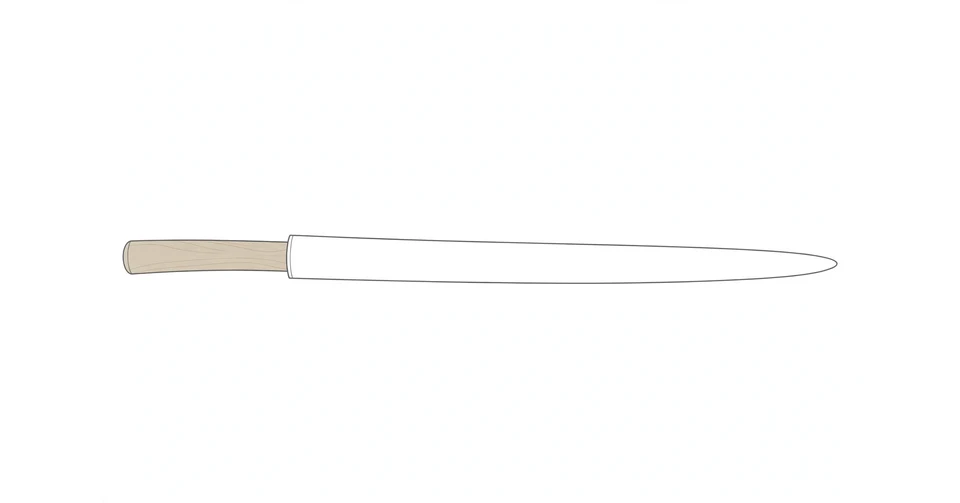
Look at a shirasaya next to a katana in full koshirae and the contrast tells the whole story. One is dressed for the world, black lacquer and silk cord and polished metal. The other is dressed for no one, pale wood and a single bamboo peg, as quiet as a closed book. The dressed sword is the one people admire. The resting sword is the one that survives.
What a shirasaya is, and what it is not
A shirasaya has exactly two parts, a saya and a tsuka, the scabbard and the handle, both made from unfinished, unlacquered honoki, Japanese bigleaf magnolia. There is no tsuba, no ray skin, no handle wrapping, and no lacquer of any kind. The wood is left in its natural state, pale, smooth, and slightly porous. The blade fits inside with precise tolerances, and the handle is held to the tang by a single bamboo peg, the mekugi. That is the entirety of its construction.
This simplicity is the point. The shirasaya is not a koshirae with the decoration removed. It is an object designed around one job, protecting the polished surface of the blade during storage, and every choice in its making serves that job directly. There are no metal fittings to touch the steel, no cord to trap moisture, and no lacquer to seal the wood shut. The shirasaya does nothing except protect, and it does that one thing better than any more elaborate mounting could.
It is also important to say what a shirasaya is not. It is not a sword. The term describes the mounting, not the blade, and calling a blade mounted in one a shirasaya katana is only a shorthand collectors use. It is not a weapon in its own right either. A traditional shirasaya was never meant for fighting or cutting practice, and treating it as one is a misunderstanding of the object and a risk to the person holding it.
The length of a shirasaya follows the blade it was made for. For a katana it runs around 40 to 42 inches, or 100 to 107 centimetres, in total. A wakizashi version is generally 24 to 30 inches, and a tanto version around 10 to 12 inches. Each one is fitted to one specific blade, to its length, its curve, and its cross-section, and it cannot simply be moved to another sword of different dimensions.
Why magnolia wood breathes
The choice of honoki, magnolia wood, is not an accident of availability. It reflects centuries of accumulated knowledge about what materials are safe for long contact with polished steel. Honoki, known botanically as Magnolia obovata, has a low resin content, which means it does not secrete oils or compounds that react with the blade. Its grain is fine and consistent, so the interior can be shaped to fit the blade closely without abrading the polish. And it is slightly absorbent, taking up and releasing atmospheric moisture in a way that helps steady the air around the blade and reduces the chance of condensation forming on the steel.
That gentle breathing is the whole secret of the shirasaya. A blade rusts fastest when the air around it swings between damp and dry, and the honoki wood softens those swings. It is soft enough not to scratch a polished surface, yet strong enough to hold its shape for decades. When properly seasoned, it carries almost no sap, so nothing seeps out to stain or corrode the steel.
The wood is seasoned for a long time before it is touched. Natural drying is preferred, and the process can take anywhere from six months to ten years. Wood for the finest sheaths is often dried for more than ten years, and the best magnolia is said to come from colder regions, such as the Kiso area of Nagano and the Aizu region of Fukushima, where the wood grows slowly and evenly. A modern factory could shape a scabbard in minutes from plastic or cheap timber. A traditional shirasaya asks for a decade of drying before the work even begins.
I find something quietly instructive in that patience. The material is chosen not for how it looks but for how it behaves over years of silence, and the maker invests the most time in the part of the process nobody will ever see. Care that is invisible is still care, and in the case of a shirasaya it is the only kind that matters.
Why the shirasaya wears no lacquer
If lacquer is so beautiful and so protective on a saya, why does the shirasaya leave it off? The answer is that lacquer protects the wood, not the blade, and for long storage those two interests pull in opposite directions. A lacquered saya is sealed. Its surface cannot breathe, and moisture can become trapped between the blade and the scabbard, creating exactly the conditions in which rust begins. A blade stored indefinitely in a fine lacquered koshirae, however beautiful, is at greater risk of surface damage than the same blade resting in plain honoki.
The plain wood of a shirasaya absorbs humidity naturally and releases it again, so the air inside stays steadier. That is why the lacquered sheath, for all its beauty, is the wrong home for a blade that will sit untouched for months or years. The lacquered scabbard belongs to the sword's public life. The shirasaya belongs to its private one.
This is also why collectors who own a blade in koshirae often have a shirasaya made for it as well, and store the blade in the plain mount while the formal mounting is kept separately. The koshirae is reserved for display, and the blade itself lives in the shirasaya. The saya that most people picture, black and glossy with lacquer, is the travelling outfit. The shirasaya is the home outfit, and the blade spends far more of its life at home.
There is a small irony here that I keep coming back to. The most expensive finish a sheath can carry is the one that makes it worse at its oldest job, keeping the blade alive. Beauty and preservation are not the same thing, and the shirasaya is the proof. It gives up every visible pleasure of the craft in exchange for one invisible one, and it is right to do so.
The joint that is meant to break
One of the most counterintuitive features of a shirasaya is that the glue holding its two halves together is deliberately weak. Traditionally it is rice paste, or a simple organic adhesive, chosen to be relatively easy to split. That sounds like a flaw until you understand what it is for.
If a blade rusts inside a shirasaya, through improper maintenance, storage in a humid place, or long neglect, it can become difficult or impossible to draw out normally. Forcing it would drag the rusted steel through the mouth of the scabbard and damage the polish. In that situation, the scabbard maker can split the saya along its glued joint and free the blade without forcing it at all. The weak joint is an emergency exit built into the design.
This is the same reversible construction used in the lacquered saya, where the two halves are glued with rice paste so they can be pulled apart again for cleaning. In the shirasaya, though, the weak joint matters more, because the blade may sit untouched for years and no one may notice a problem until it is already serious. A sealed scabbard would trap the blade with its rust. A shirasaya can be opened like a shell.
It is a good design principle in general, and not only for swords. The things we build to last should have a way to be opened without being broken, because the day will come when someone needs to get inside. The shirasaya was designed by people who expected trouble and planned for it in advance, which is a kinder kind of craftsmanship than pretending trouble will never arrive.
Saya-gaki, the writing on the wood
A shirasaya carries one feature that the koshirae does not, and it is the reason the plain wood is more informative than the decorated one. Saya-gaki is an inscription brushed in black ink directly on the pale surface of the scabbard, recording the blade's attribution, its quality, and the identity of the appraiser who made the assessment. In the age of the great lords, daimyo wrote such notes to keep track of their swords, recording the smith who made the blade, its length, and the date the inscription was written. After the samurai era ended, the writing passed to professional appraisers.
A shirasaya with sayagaki by a recognised authority is itself a significant document. Historically, inscriptions by figures such as Honma Kunzan or Sato Kanzan carry real weight in the world of Japanese swords, and the writing is treated as part of the blade's permanent record. The sayagaki typically sits on the saya where it can be read without drawing the blade, which is the whole point. It lets an owner, a dealer, or an appraiser know what is inside without exposing the steel to air and handling.
The plain white wood is also a label in a simpler sense. In a storehouse full of black lacquered scabbards, every sword looks alike from the outside. A row of shirasaya, each carrying its own brushed inscription, can be told apart at a glance. The saya that shows nothing is the one that tells you the most about the blade inside it, and I like that reversal. Decoration hides information. Plainness displays it.
There is a practical warning that belongs here too. Sayagaki is written in ink on unfinished wood, and it can fade, smudge, or be damaged by damp and careless handling. A shirasaya should be kept dry and handled with clean hands, not only for the blade's sake but for the writing's. When the inscription is lost, a piece of the blade's history goes with it, and no polish can bring it back.
Shirasaya against koshirae
Put the two mountings side by side and the difference is a difference of purpose, not of quality. The koshirae is the active mounting, designed for use and display. Its lacquered saya is beautiful but less breathable, its full set of fittings includes the tsuba, the collar and pommel caps, the grip ornaments, and the sageo cord, and its construction is more complex to take apart. It communicates the owner's status and taste, and a period koshirae with certified fittings adds significant value to a sword.
The shirasaya is the storage mounting, designed for preservation. It has no metal fittings, so nothing can touch the polished surface. Its minimal construction comes apart easily for inspection. Its intentionally weak glue lets the saya be split if the blade rusts inside. And it carries sayagaki, the written record of what the blade is. It has no aesthetic function at all, and that is not a failure. It is the design brief.
The two are not in competition. They are complementary, and a blade with both is a blade with a complete life: dressed for the world when it is shown, and resting in plain wood when it is not. As the Kyoto sword shop Tozando puts it in its guide to the shirasaya, the koshirae is what the sword shows the world, and the shirasaya is where the sword actually lives.
That sentence stays with me because it applies well beyond swords. Everything we own has a public face and a private life, and the private life is usually the longer one. The clothes we wear to be seen matter less, in the end, than the way we store the things we love when nobody is looking.
A short history, from the late Edo period to the Meiji ban
The shirasaya is believed to have originated in the late Edo period, which ran from 1603 to 1867. At first, storing a sword in a plain wooden mount was a practice associated with high-ranking samurai, who owned more blades than they could carry and needed a safe way to keep the rest. During long stretches of peace, when swords were not in regular use, the plain mount kept blades safe through years of sitting in storehouses.
Then came the change that made the shirasaya essential for everyone. In 1876, during the Meiji period, the Haitorei edict banned the public carrying of swords. Samurai could no longer wear their blades, and the swords had to be stored at home. Demand for the plain storage mount surged, and it has remained an essential part of sword ownership ever since. What began as a habit of the wealthy became the standard way to keep any blade.
The timing explains a great deal about the object. The shirasaya is a product of peace, not war. It belongs to the centuries when swords stopped being used in battle and became objects to preserve, study, and hand down. The lacquered koshirae reached its height as an art object in the same peaceful Edo period, when fittings became the place where a samurai showed his taste. The shirasaya grew up alongside it as its quiet twin, the mount for the blade that would not be shown at all.
How to keep a blade in a shirasaya
A shirasaya protects against almost everything except neglect, and the maintenance routine is what its design assumes is being performed regularly. The blade should be cleaned with uchiko powder and re-oiled with choji oil, then returned to its shirasaya promptly. A freshly oiled blade should not be left exposed to air for long, because the oil attracts dust and begins to oxidise. A blade with old, oxidised oil on its surface, stored in a shirasaya in a humid place, can still develop rust through the oil layer.
The storage place matters as much as the mount. A shirasaya should be kept somewhere dry, with steady temperature and humidity, away from damp walls and direct sun. Magnolia wood swells and shrinks with humidity, and a saya that has swollen may grip the blade too tightly, while one that has dried out may let it rattle. The room should be as stable as the wood itself is meant to be.
Handling matters too. When moving a complete shirasaya, always support it with two hands, one on the saya and one on the tsuka, and keep it horizontal. A vertical hold risks the blade sliding out if the fit has loosened, and a drop can damage both the mount and the blade inside. The shirasaya is lighter and less fragile than a koshirae, which makes it safer to transport, but it is still a wooden case holding a polished piece of steel, and it deserves two hands.
When a shirasaya becomes damaged or worn, when the wood cracks, the fit loosens, or the blade no longer withdraws smoothly, a new one should be commissioned. A shirasaya is made for one specific blade and cannot be transferred to another, so the replacement is fitted from scratch, a process that typically takes two to four weeks with the blade present. A well-fitted new shirasaya, made from quality honoki by an experienced saya-shi, is one of the most cost-effective investments a collector can make in a significant blade.
What a shirasaya cannot do
For all its virtues, it has firm limits, and respecting them is part of respecting the object. A traditional one is not made for fighting or cutting practice. It has no tsuba, so there is nothing to stop the hand from slipping onto the blade. The handle is unwrapped, which weakens the grip, especially when hands get sweaty. The glue is deliberately weak, and the wood is chosen for gentleness, not strength.
Some modern manufacturers make battle-ready versions that look similar, using stronger wood, tougher glue, and lacquered handles and scabbards, sometimes with extra pegs in the handle. These are different objects wearing a similar shape, and they should not be confused with the traditional storage mount. A detailed guide to the shirasaya makes the distinction clearly: in the traditional form, the answer to whether you can fight with it is no.
There is also the question of display. A shirasaya does not display well. It is pale, plain, and featureless, and a visitor to a collection will walk straight past it toward the lacquered swords. That is fine. The shirasaya was never designed to impress anyone, and judging it as a display piece misses the point entirely. Its job is to be unnoticed for years at a time while the blade inside stays exactly as it was.
The small knife that sometimes rides in the koshirae has its own story of quiet usefulness, told in the article about the kozuka, the small knife hiding in a katana's saya. Like the shirasaya, it is a small thing that does its work without ceremony, and the sword's mounting is full of such parts, each solving one problem and asking for no attention in return.
The blade's true home
The shirasaya has no lacquer, no fittings, and no decoration of any kind. It communicates nothing about the owner's status or taste. It does not display well, and it is not designed to impress anyone. It is designed to do one thing, keep the blade safe, for as long as the blade needs keeping.
That quality of quiet, purposeful, unostentatious function is something Japanese craft has always understood. The most important things are often the least decorated. A piece of honoki wood, shaped precisely around the blade it protects, performing its single function without distraction, for as long as it is needed, is the most honest object in the world of Japanese swords.
Every serious collector eventually comes to appreciate the shirasaya not as the absence of a koshirae, but as something in its own right: the environment in which the blade actually lives, the mounting that makes long-term preservation possible, and the quiet, unpretentious home that every Japanese sword deserves. The blade is the soul of the samurai, as the old saying goes. The shirasaya is the plain white room where that soul rests, and it has earned its place in the story.
More in Culture & Society
- Koshirae Is the Formal Mounting That Turns a Blade Into a Katana
- The Togishi Polishes a Katana for Weeks Before It Ever Cuts
- Kozuka Is the Small Knife Hiding in a Katana's Saya
- Wakizashi Was the Short Sword a Samurai Never Took Off
- Tsuba Is the Small Guard That Stops a Katana From Cutting Its Owner
- Yokote Is the Small Line That Tells a Katana's Age
Latest posts
- Seppa Are the Thin Washers That Keep a Katana From Rattling
- Kissaki Is the Small Tip That Finishes a Katana
- Nakago Is the Hidden Tang That Carries a Katana's Signature
- Mekugi Holds a Katana Together With a Single Bamboo Pin
- Why a Katana Stays Put, Thanks to the Koiguchi
- Tsuka-Ito Is the Cord That Binds a Katana Grip
- Fuchi Is the Collar That Frames a Katana Grip
- Kashira Is the Small Cap That Finishes a Katana Grip
- Sageo Is the Cord That Ties a Katana to Its Samurai
- Menuki Are the Small Ornaments Hidden Under a Katana Grip
- Habaki Is the Copper Collar That Locks a Katana in Its Sheath
- Maedate Is the Crest That Turned a Samurai Helmet Into a Banner
- Samegawa Is the Ray Skin Hiding Under Every Katana Grip
- Tatara Is the Clay Furnace Where Tamahagane Begins
- Tsuka Is the Wrapped Grip That Lets a Katana Speak