Gyoji Are Sumo's Referees in Silk and Calligraphy
· 14 min read
A gyoji is the referee inside the sumo ring, the man in silk who calls the bout, points the gunbai at the winner, and writes the banzuke by hand.
Watch a sumo bout and your eyes will follow the two wrestlers, as they should. But there is a third man in the ring, smaller than both of them, dressed in silk the color of a festival, holding a lacquered wooden fan. He does not wrestle, he does not cheer, and he never raises his voice beyond the ritual calls of his office. He is the gyoji, the referee of professional sumo, and no bout can begin or end without him.
A gyoji is an official employed by the Japan Sumo Association, and his work reaches far beyond the few seconds of a bout. He calls the wrestlers into the ring, watches the long staring contest that precedes the charge, decides the winner in the instant the bout ends, and announces the name in a clear voice. Away from the ring he writes the banzuke, the handwritten ranking sheet of the whole sport, and he performs the Shinto ceremony that blesses a new ring before a tournament begins.
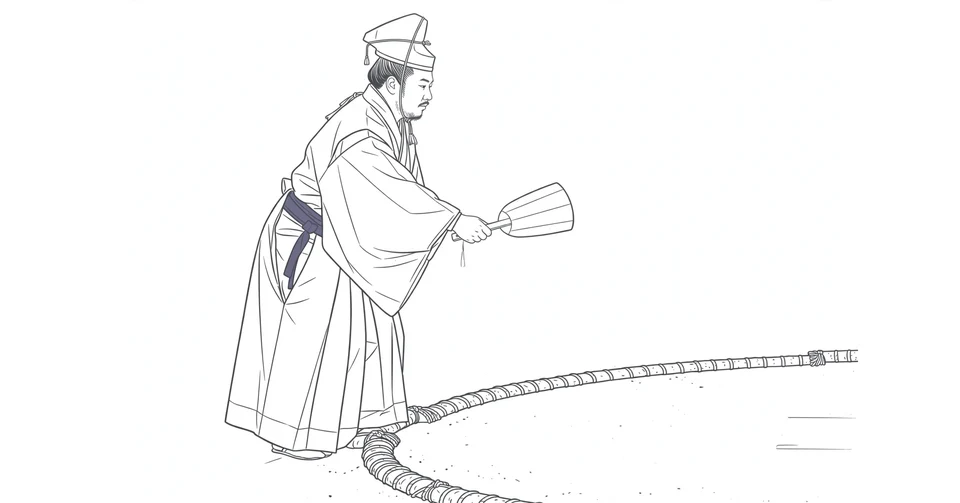
That range of duties is what makes the gyoji worth a closer look. In most sports the referee is a figure in black who tries to stay out of the way. In sumo the referee wears medieval court dress, carries a sword at the highest rank, and spends a week writing out the names of hundreds of wrestlers by hand. He is at once a judge, a priest, and a calligrapher, and the sport would look very different without him.
What a gyoji does in the ring
The most visible part of the job is the bout itself. A gyoji supervises the shikiri, the preparation ritual in which the two wrestlers throw salt, stamp, and stare at each other across two white starting lines. He stands at the north side of the ring, facing south, and when the preparation time runs out he holds his gunbai flat against his body, the signal that the fight must begin. He then coordinates the tachi-ai, the initial charge, and he can stop it before it starts if the two men are not ready together or if one of them jumps early. A false start sends both wrestlers back to their lines to try again.
Once the bout is under way the gyoji stays inside the ring with the wrestlers, moving to keep the action in front of him. His calls are codified shouts known as kakegoe, with no room for improvisation. If a bout drags past four minutes with little movement, he calls a water break, a mizu-iri, and he records the exact position of each wrestler's hands and feet so the bout can resume from the same spot. If a belt works loose he alone can halt the bout, in a pause called a mawashi-matta, and he reties the belt himself, the cord of his fan held between his teeth while he works.
The decision comes the moment a wrestler loses, and the gyoji makes it at once. He points his gunbai at the winner's side and announces the winner's ring name. The call is not quite final. Five judges seated around the ring, the shimpan, can object, and if they do they meet in the centre of the ring in a conference called a mono-ii. They can confirm the call, overturn it, or order a rematch. The gyoji does not join the discussion unless he is asked. When the verdict is settled he points the fan again and calls the name, and if the bout carried sponsor prizes he hands the envelopes of prize money to the winner on the face of his fan. Our earlier guide to Fifteen Days of Basho Decide Who Sumo Remembers explains how fifteen days of such decisions add up to a tournament result, and a new ranking.
The gunbai, the fan that decides
Every gyoji carries a gunbai, a solid wooden war fan shaped like a paddle, and it is the single most recognizable symbol of the job. Samurai commanders once used such fans to signal their troops on a battlefield, and sumo borrowed the object along with its air of command. There are no fixed rules about the material or the shape, and each gyoji has his own. A young gyoji receives his first gunbai from a senior referee or from his stablemaster, and the fans carried by the most senior men are lacquered and decorated with gold or silver. It is not a paper folding fan, and it is never waved about. It is rigid wood, lacquered, and it is pointed, once, at the winner.
Some gunbai are heirlooms. The gunbai of Kimura Shonosuke, the most senior referee, has been passed from one holder of the name to the next for more than 160 years. Small details in how the fan is held mark the two referee families apart. When a Kimura referee points his gunbai at a winner he keeps the back of his fist upward, while a Shikimori referee turns his palm upward. It is a tiny difference, invisible to most of the crowd, and it is exactly the kind of detail sumo preserves.
Silk that shows your rank
A gyoji in the ring wears a ceremonial costume called the shozoku or hitatare, modeled on the dress of medieval samurai officials and Heian court nobles, and the outfit changes with every promotion. Junior gyoji, ranked at makushita or below, wear a much simpler version in cotton, cut to about knee length, and they work barefoot with the robe tied above the knees. On promotion to juryo grade the referee changes into the full-length silk robe, and the silk grows more elaborate with each step upward. Each costume is as expensive as a wrestler's ceremonial apron of the same rank, and the kimono is often a gift from a patron.
Rank is written into the costume in color. The rosettes and tassels on the robe, called kikutoji and fusa, change color as the gyoji climbs, and the color of the tassel hanging from his gunbai says the same thing at a glance. Purple belongs to the two most senior referees alone. Below them the colors run vermilion for the sanyaku grade and red and white for makuuchi, while the lower grades wear green, blue, or black. Only the two men at the very top may use purple in their kimono, and they also wear tabi socks and straw sandals while lower referees go barefoot or in socks alone. A detailed guide to the gyoji, the yobidashi and the shimpan sets out the tassel colors grade by grade, and it is the clearest map I have found of a system the crowd reads without thinking.
The black lacquered hat is the same for every gyoji regardless of rank. Called an eboshi, it comes from the headgear of court nobility and Shinto priests, and some referees replace its dark cords with colored ones. The two most senior referees carry one more object that nobody else in the ring wears: a tanto, a short dagger, tucked into the left side of the belt. The Japan Sumo Association explains it plainly. Judging wrestlers of the highest ranks is a great charge, and the sword shows that the referee is prepared to take responsibility with his life if he calls a bout wrongly. Senior referees may also wear an inro, a small lacquered case, at the back of the belt. I find the combination striking. The silk says ceremony, the dagger says consequence, and the man wearing both has to live up to both.
Two names at the top
Every gyoji works under a professional name, in the same way a wrestler works under a ring name, and every one of them takes one of two surnames, Kimura or Shikimori. The two names descend from two referee houses that have dominated the profession since the middle of the eighteenth century, and a new recruit must choose one of the two lines when he joins. The Kimura family is much the larger of the two, with almost twice as many members as the Shikimori.
At the top of the ladder the names stop being personal and become titles. The two most senior referees are always called Kimura Shonosuke and Shikimori Inosuke, and those names pass from one holder to the next when the previous man retires. Shonosuke is the senior of the pair, and he referees the final bout of each day. A referee can even change families as he climbs. The man who holds the Shikimori Inosuke name today spent most of his career in the Kimura family before taking the senior title, and in 2012 a Kimura referee changed to the Shikimori line when he was promoted to the sanyaku grade. The names belong to the office, not to the man, and the man grows into the name over decades.
A career measured in decades
Promotion for a gyoji is slow, almost certain, and measured in decades. There are eight grades, from jonokuchi at the bottom to tate-gyoji at the top, and the grades carry the same names as the wrestlers' divisions, so a makuuchi grade referee handles top-division bouts and a juryo grade referee handles the division below. Only the two tate-gyoji are allowed to referee a bout involving a yokozuna. Promotions are decided once a year, at the ranking meeting held after the September tournament, and they take effect the following January. The Gyoji article on Wikipedia traces the full ladder, the history of the two referee families, and the duties that come with each grade.
A recruit usually begins at fifteen or sixteen, after finishing junior high school, and there is no height or weight requirement. A small referee is even preferred, because the contrast with the huge wrestlers looks better in the ring, and many recruits are former wrestlers who could not rise far enough as fighters. It usually takes a gyoji about fifteen years to reach the juryo grade and another fifteen to reach makuuchi, and the two men at the top usually carry forty to fifty years of experience. They retire at sixty five. The Association allows a maximum of forty five referees, and the current list holds forty two.
The workload runs in the opposite direction from the prestige. A young gyoji can referee up to ten bouts in a day, while his seniors referee two at most, and the two tate-gyoji usually referee a single bout each. A gyoji is expected to decide every bout on the spot, and mistakes carry a cost. Too many overturned decisions slow a promotion or cut a salary, and a makuuchi grade referee who makes more than nine mistakes in a year faces a penalty. A gyoji cannot be demoted, so the penalty for error is a stalled career rather than a fall. That seems fair to me. The ladder only goes up, but it goes up slowly, and only for referees the judges trust.
The gyoji who writes the banzuke
The gyoji's quietest job may be his most important one. High-ranking gyoji write the banzuke, the ranking sheet that lists every professional wrestler in order, and they have held that task since 1944. Only two or three senior gyoji are authorized to write it, and the work takes between seven and ten days. They write in sumo moji, a bold rounded calligraphy style also known as negishi-ryu, and every character is brushed by hand, without a word processor. The original sheet is more than a metre wide, and the writing runs from the lowest ranks upward, ending with the yokozuna, so that the hand climbs the same ladder the wrestlers climb.
Our guide to The Banzuke Remembers Every Basho in Calligraphy tells the full story of that sheet, and it is the source of this article. Its line about the men who write the sheet is worth repeating: high-ranking gyoji take on the laborious task of copying the new rankings onto a paper roll called a maki. The detail that stays with me is how seriously sumo guards the work. Since the Second World War only eight gyoji have ever been responsible for writing the banzuke, and the men who write it do not travel with the Association on tour, so that nothing interrupts the brush. The young referees have their own version of the task. After the banzuke is unveiled, two or three makushita grade gyoji write the ita-banzuke, the same ranking painted on a wooden board two metres high that hangs at the entrance to the tournament venue.
Priests of the ring
Before a tournament begins, the gyoji change out of silk and into white. When a new ring is built, a tate-gyoji and two senior referees perform the dohyo-matsuri, the ceremony that consecrates the ring, acting as Shinto priests in formal white robes with a wooden instrument of authority called a shaku. They recite prayers to the three deities of sumo, wave a sacred branch around the four corners of the ring, and pour sake into its corners. The same ceremony, simplified, is performed in the training rings of the stables and on regional tours.
At the end of a tournament a junior gyoji closes the circle with a ceremony called kami okuri, the sending of the gods, in which he stands in the centre of the ring holding a ritual wand while lower-ranked wrestlers toss him into the air. The gyoji also lead the ring-entering ceremonies, walking ahead of the ranked wrestlers from the walkway to the ring, and a tate-gyoji stands behind the yokozuna during his own ceremony, waving the cord of his gunbai as the champion performs his entrance. The referee who points at winners is the same man who blesses the clay they fight on. That double role is old. The gyoji took on religious functions at the end of the eighteenth century, and the role has carried them ever since.
Why the quietest man in the ring matters
It is easy to watch sumo for years and never learn a referee's name. The wrestlers are the story, the gyoji is the frame, and the frame is supposed to disappear. But the frame is doing more work than it seems. The gyoji decides the bout in the instant it ends, with no pause and no replay of his own, and he lives with the knowledge that five judges can overturn him in front of a full hall. He spends a week writing names that other men earned, he blesses a ring he will never fight in, and he climbs a ladder that takes forty years to finish, knowing he can never be demoted and never be hurried.
There is something admirable in a job defined by that kind of patience. Most of modern sport wants its officials invisible and its decisions instant, and sumo asks its referee to be visible, ceremonial, and accountable in a way no other sport does. The silk, the fan, and even the dagger are not decoration. They are a statement that judgment is a serious thing, and that the man making it should look like he understands the weight of it. The next time a bout ends, watch the third man in the ring for one second longer. He has already pointed, already called the name, and already turned toward the next bout. The wrestlers get the applause. The gyoji gets the next name on the list, and the brush, and the ring, waiting to be blessed again.
More in Culture & Society
- Japanese Baseball and the Game Japan Made Its Own
- The Banzuke Remembers Every Basho in Calligraphy
- Fifteen Days of Basho Decide Who Sumo Remembers
- Kojiri Is the End Cap That Takes Every Knock for a Katana
- Kurikata Is the Chestnut Knob That Holds a Katana at the Hip
- Koshirae Is the Formal Mounting That Turns a Blade Into a Katana
Latest posts
- Kuromame Turns Black Beans Into a Wish for Health
- Jubako Layers a Family's Luck One Box at a Time
- Osechi Packs a Whole Year of Luck Into Stacked Boxes
- Shirasaya Is the Plain White Scabbard Where a Katana Rests
- The Togishi Polishes a Katana for Weeks Before It Ever Cuts
- Kozuka Is the Small Knife Hiding in a Katana's Saya
- Wakizashi Was the Short Sword a Samurai Never Took Off
- Tsuba Is the Small Guard That Stops a Katana From Cutting Its Owner
- Yokote Is the Small Line That Tells a Katana's Age
- Seppa Are the Thin Washers That Keep a Katana From Rattling
- Kissaki Is the Small Tip That Finishes a Katana
- Nakago Is the Hidden Tang That Carries a Katana's Signature
- Mekugi Holds a Katana Together With a Single Bamboo Pin
- Why a Katana Stays Put, Thanks to the Koiguchi
- Tsuka-Ito Is the Cord That Binds a Katana Grip