Kojiri Is the End Cap That Takes Every Knock for a Katana
· 26 min read
A kojiri is the small end cap of a katana saya that protects the tip of the scabbard and the blade inside it from knocks and wear, and this is the story of that quiet fitting.
Every katana has a part that nobody photographs. The blade gets the light, the handle gets the grip, and the saya gets admired for its lacquer. The kojiri sits at the far end of the scabbard, a cap no bigger than a fingertip, and it does the least glamorous job on the whole sword. It takes the knocks so that nothing else has to.
A kojiri is the end cap of the saya, the wooden scabbard of a Japanese sword. It is traditionally made of buffalo horn, though metal versions exist, and its job is to protect the tip of the scabbard and the tip of the blade inside it from knocks and wear. The saya article on this site puts it in a single quiet sentence: "At the far end sits the kojiri, the end cap, which protects the tip from knocks and wear." That sentence is the seed of this whole article, because a part that small deserves more than a single sentence.
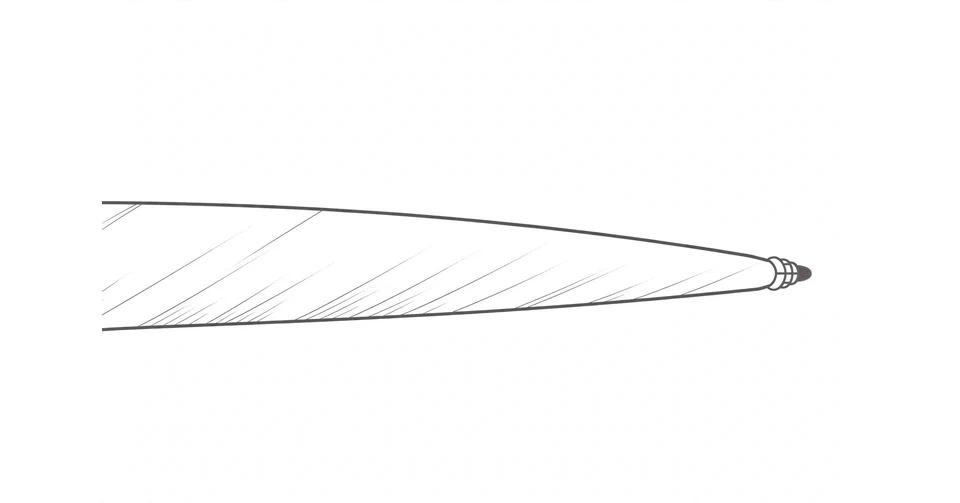
Look at a sheathed katana lying on a table and your eye travels from the handle down the long curve of the lacquered wood to the far tip. That tip is where the sword meets the world. It bumps into door frames, it taps the floor when the sword is set down, it catches on the ground when the sword is carried low. Every one of those small collisions lands on the kojiri first. The lacquer never feels it, the wood never feels it, and the blade tip inside never feels it, because the cap is standing in the way.
What a kojiri is and where it sits
The kojiri is the fitting at the far end of the saya, the end farthest from the handle. The word names both the tip of the scabbard itself and the protective cap fitted over it. In Japanese it is written with the characters for a metal cap, and it is the term used for the mountings of an uchigatana, the katana worn edge up through the belt. On a tachi, the older sword worn edge down and hung from straps, the equivalent fitting goes by a different name, ishizuki kanamono, which tells you something about how carefully Japanese sword culture names its parts. The same job gets a different word when the sword is carried differently.
A saya is a long, tapered tube of wood, made from two halves of magnolia fitted around a single blade and sealed with lacquer. It is not a uniform tube. It narrows toward the tip, following the taper of the blade inside, and it ends in a thin edge of wood that would be fragile on its own. The kojiri caps that thin edge. It wraps the last short stretch of the scabbard the way a cap wraps the end of a walking stick, and it turns the most vulnerable point of the saya into one of its toughest.
The size of the cap surprises people who see one up close for the first time. It is short, often only a few centimetres long, and it adds almost nothing to the length of the sword. It is not there to be noticed. On many swords it is a plain dark cap of horn that blends into the black lacquer of the saya, and a visitor to a museum can look at a dozen sheathed katana without ever registering that the cap is a separate part at all. That invisibility is the point. A kojiri that draws attention to itself is failing at its job, which is to disappear into the shape of the sword while doing the hard work.
The fitting sits at the opposite end of the saya from the koiguchi, the mouth where the blade enters. The two caps are a pair, and thinking of them as a pair is the fastest way to understand the saya. The mouth is reinforced because the blade collar wedges into it every time the sword is sheathed. The tip is reinforced because the world bumps into it every time the sword is carried, stored, or set down. One end faces the blade, the other end faces everything else, and the kojiri is the one that faces everything else.
Why the tip of the saya needs a kojiri
The tip of a saya is the part of the sword that leads the way through life. When a sword is carried at the hip, the tip swings with every step. When a sword is leaned against a wall, the tip takes the weight. When a sword is laid on the floor of a house, the tip is the part that touches the ground. A scabbard made of lacquered wood is beautiful, but lacquer chips and wood dents, and the tip is where chipping and denting would start. The cap exists because the tip cannot defend itself.
There is a second reason, and it matters more than the first. Inside the tip of the saya sits the kissaki, the pointed tip of the blade. The blade tip is the most delicate part of the whole sword. It is thin, it is hard, and it is the part that a polisher works on with the greatest care. If the tip of the scabbard is crushed or split, the shock can reach the blade tip, and a chipped kissaki is a serious injury to a sword. The kojiri protects the scabbard, and by protecting the scabbard it protects the blade. A guide to the fitting puts it plainly: the cap protects the tip of the saya and the tip of the blade, and it prevents external damage to both.
This double duty is what makes the kojiri interesting rather than merely useful. Most fittings on a katana do one thing. The guard protects the hand. The collar locks the blade in the scabbard. The cord ties the scabbard to the belt. The cap protects two things at once, the container and the thing inside the container, and it does so without moving parts, without maintenance, and without ever being looked at. It is a piece of armour for a piece of armour.
Think about what a saya goes through in an ordinary day in the Edo period, when swords were worn every day rather than kept in cases. The wearer walks through narrow streets, sits on tatami, rides in a palanquin, climbs stairs, and enters rooms where the sword must be handled, set down, and picked up again. The tip of the scabbard taps stone, wood, and packed earth hundreds of times a week. Without a cap, the lacquer at the tip would wear through in months, and the wood beneath would start to fray and split. With a cap of horn, the same scabbard can serve for years. The kojiri is what makes a lacquered wooden tube durable enough to be a daily object rather than a display piece.
Buffalo horn, metal, and the other materials of a kojiri
The most common material for a katana kojiri is buffalo horn. That is the traditional choice, and it is the choice you will find on most swords, from working blades to high end pieces. Buffalo horn is hard, it is tough, and it can be shaped and polished to a smooth dark finish that sits quietly against black lacquer. It resists knocks without cracking, and when it does wear, it wears slowly and evenly rather than chipping away in flakes. On a sword that is used often, a horn kojiri is the practical choice, and the sources agree that it is the perfect option for swords that see frequent use.
Metal is the other traditional material, and it opens a different set of possibilities. A metal cap can be engraved, inlaid, and shaped into forms that horn cannot easily take. Silver, copper, blackened steel, and antique gold plated metal all appear in the record, and copper treated with ferric chloride can be given a dark traditional look that suits a formal mounting. Metal is easier for an artisan to decorate, which is why the most elaborate kojiri are usually metal, while the plainest and most hardworking ones are usually horn. The choice between horn and metal is a choice between durability and decoration, and most swords resolve it in favour of durability.
There are other materials too, though they are less common. Wood can be used, finished to match the saya, and some kojiri are covered with ray skin, the same rough textured skin that wraps the handle of the sword. These are rarer, and they tend to appear on unusual or highly individual mountings rather than on standard ones. The koiguchi article on this site records the plain version of the rule in its table: a kojiri is made of buffalo horn or metal, and it caps the tip of the saya and protects it from knocks. That short line covers almost everything a beginner needs to know about materials.
The pairing with the koiguchi matters here. The mouth of the scabbard and the tip of the scabbard are traditionally made of the same material, usually horn, so that the two ends of the saya match. A saya with a horn mouth and a horn tip looks balanced, and the two caps age together. When the fittings are metal, they usually match as well, and the whole mounting reads as one deliberate design rather than a collection of spare parts. The kojiri is small, but it is part of a visual system, and a mismatched cap would stand out to anyone who knows what to look for.
One more detail about horn is worth knowing. Buffalo horn is an animal product, and its use in sword fittings comes from a time when every part of an animal was used with care. Modern makers sometimes choose metal or synthetic substitutes instead, and that is a reasonable choice for a modern sword. But on an antique blade, the horn cap is part of the original mounting, and replacing it with something else changes the character of the sword. Conservators treat a horn kojiri the way they treat the lacquer around it: as a material that belongs to the history of the object, not just to its function.
The shapes a kojiri can take
The cap is not one shape. It comes in several traditional forms, and each form has a name, a purpose, and a place in the etiquette of sword mountings. The best known are the kuwagata, the hoe shape, the fukurogata, the bag shape, and the nagakuwagata, the long hoe shape. There is also the ichimonji, a straight cut across the end, popularly known as the kiri cut. These names describe the silhouette of the cap as it meets the wood of the saya, and a trained eye can read the form of a kojiri the way a reader reads a signature.
The straight cut is the most common form, and it is worth pausing on. The ichimonji kojiri ends in a clean straight line across the tip of the scabbard, and it is said that samurai of equal rank preferred it. Whether that rule was always followed is hard to prove, and the guides that repeat it are describing a social custom rather than a law. But the shape itself is honest. It does not pretend to be anything other than a cap, and it suits a sword that is meant to be used rather than admired. A plain straight cut kojiri is the default, and defaults exist for a reason.
The hoe shape and the bag shape are more decorative. The kuwagata curves like the blade of a hoe, and the fukurogata swells like a small bag tied at the neck. The long hoe shape stretches the curve further along the scabbard. These forms take more work to make, and they signal that the owner cared about the appearance of the sword as well as its function. They also change the way the tip of the scabbard meets the world, spreading an impact across a curve rather than a flat edge. Form and function are not separate here. A curve that looks good also absorbs a knock differently from a flat cut.
There are rarer forms too. Round kojiri, sometimes called mam, are covered with ray skin. Jidai-mono, old style pieces, and sewa-mono, narrow pieces, and wagoto, a style associated with the stage, appear in the literature as uncommon forms used very rarely. Most people will never see one, and that is fine. The point of knowing they exist is to understand that the kojiri was never a single standard part stamped out in a factory. It was a small fitting made by hand, and handwork always produces variation.
The shape of the cap also has to match the shape of the blade inside. A scabbard is made to fit one blade and no other, and the tip of the scabbard follows the curve and taper of that blade. Some guides go further and say that the saya is made to fit the kojiri, not the other way around, which sounds backwards until you think about it. The cap is the fixed point, the part with a definite shape, and the wood is carved to meet it cleanly. Either way, the lesson is the same. The kojiri is not an afterthought glued onto a finished scabbard. It is part of the plan from the beginning, and the wood is shaped around it.
How a kojiri is fitted to the saya
Fitting the cap is quiet work, and it is work that rewards patience. The end of the saya is shaped to receive the cap, the cap is shaped to sit flush against the wood, and the join between them must be tight enough that no dirt or moisture can get in. A loose cap rattles, and a rattling cap is a warning. It means the cap is no longer protecting the tip, and it means the wood underneath is exposed to the air.
The join is part of the beauty of the fitting. On a well made saya, the line where the horn meets the lacquer is clean and even, a thin dark seam that runs around the scabbard. There is no gap, no overlap, and no glue showing. That seam is the signature of the craftsman who made the scabbard, and it is one of the first things a knowledgeable buyer checks. A scabbard that looks perfect from a distance can reveal its flaws at the kojiri, where two different materials have to meet perfectly.
The lacquer complicates the job. A saya is coated in layer after layer of lacquer, and the kojiri sits at the end of that lacquered surface. The cap must be fitted so that it does not crack the lacquer at the join, and so that the lacquer does not creep under the cap and push it loose. This is one reason a saya takes so long to make. The woodwork, the lacquer work, and the fitting work all have to be planned together, and the smallest part of the assembly can cause the largest delay if it is fitted badly.
On the finest swords, the kojiri is more than a cap. It can carry engraving, inlay, or a family crest, and it can be made to match the other metal fittings on the mounting. A metal kojiri with a crest turns the tip of the scabbard into a signature, a small statement of identity at the end of the sword. This is where the protective fitting becomes a decorative one, and where the line between function and art disappears. The same piece of metal that stops the scabbard from chipping also tells you who owned the sword.
The kojiri and the koiguchi, a pair at opposite ends
The saya has two ends, and each end has a guardian. At the mouth sits the koiguchi, and at the tip sits the kojiri. The koiguchi is the part that works hardest in one sense, because it must survive the blade collar wedging into it every time the sword is sheathed. The cap works hardest in a different sense, because it must survive the world bumping into it every time the sword is carried. One faces inward toward the blade, the other faces outward toward everything else, and together they protect the scabbard from both directions.
The two fittings are made of the same materials, usually buffalo horn, and they wear in different ways. A koiguchi wears from the inside, as the metal collar of the blade presses and rubs against it. The cap wears from the outside, as floors and door frames and the ground press and rub against it. A worn koiguchi is dangerous, because a sword that slips out of its scabbard is a danger to everyone nearby. A worn kojiri is less dramatic, but it is still serious, because it means the tip of the scabbard is no longer protected, and the damage will travel inward to the wood and then to the blade.
If you want to understand the design of the saya, compare the two ends. The mouth is a precision fit, carved to hold the blade collar exactly. The tip is a shield, built to absorb impact. The mouth is about retention, the tip is about protection, and the scabbard needs both. A saya with a good koiguchi and a bad kojiri is a scabbard that holds its sword well and still falls apart at the tip. A saya with a good kojiri and a bad koiguchi is a scabbard with a perfect tip and a sword that might fall out. Neither is acceptable, and the craftsmen who made these scabbards knew it.
The koiguchi article on this site tells the story of the mouth in detail, and it is worth reading alongside this one, because the two fittings only make full sense together. The article explains how the mouth is reinforced with horn to survive the wedging of the blade collar, and it notes that the kojiri is the mirror of the koiguchi, reinforced against the knocks of everyday life. That mirror image is the right way to think about the pair. They are not two separate parts. They are one idea, protection, applied at the two ends of the same object.
There is a small practical lesson in this pairing for anyone who handles a sheathed sword. When you pick up a katana, your hand goes to the handle, and your eye goes to the mouth of the scabbard, because that is where the blade comes out. Train yourself to look at the other end too. The kojiri tells you how the sword has been treated. A clean, tight cap means the sword has been cared for. A chipped, loose, or missing cap means the sword has been knocked around, and the damage may run deeper than the tip.
What happens when a kojiri fails
A kojiri fails slowly, and that is what makes its failure easy to miss. It does not break in one dramatic moment. It wears, it loosens, and one day it is gone, and the owner notices the bare wood at the tip of the scabbard and wonders when it happened. By then the damage has already started. The lacquer at the tip chips, the wood underneath frays, and moisture gets into the end grain of the wood. Wood that has been sealed with lacquer for years is suddenly open to the air, and it begins to move, swelling and shrinking with the seasons.
The blade inside suffers next. The tip of the scabbard is the part that holds the kissaki, the point of the blade, and when the scabbard tip is damaged, the blade tip loses its protection. A knock that would once have landed on horn now lands on wood, and a knock that lands on wood can travel through to the steel. The kissaki is thin and hard, and it does not forgive impact. A chip at the tip of a blade is one of the most expensive injuries a sword can suffer, because repairing it means removing steel, and steel once removed cannot be put back.
The honest truth is that most kojiri do not fail at all. A horn cap on a sword that is stored properly and handled with care can last for generations. The failures happen to swords that are carried daily, stored badly, or handled roughly, and they happen to swords whose owners never learned to look at the tip. That is the quiet moral of this small fitting. The parts that fail are the parts nobody checks, and the parts nobody checks are the parts that protect everything else.
Replacing a kojiri is possible, and it is work for a specialist. A new cap must be shaped to the scabbard, fitted to the wood, and matched to the other fittings, and on an antique sword the replacement must respect the age and character of the original mounting. A modern horn cap on an old scabbard can look wrong, and a metal cap where horn once sat changes the balance of the whole mounting. The best repair is the one you never need, and the best way to avoid needing one is to notice the kojiri before it fails.
How to look after a kojiri
Looking after a kojiri is simple, and that simplicity is part of its charm. Keep the sword stored so that the tip of the scabbard does not rest on a hard surface. When you set a sheathed sword down, set it down gently, and do not let the tip tap the floor. When you carry a sword, be aware of where the tip is pointing, and keep it clear of door frames, walls, and furniture. These are small habits, and they cost nothing, but they are the difference between a kojiri that lasts a lifetime and one that wears out in a few years.
Check the cap when you check the rest of the sword. Look at the seam where the kojiri meets the lacquer, and make sure it is tight and even all the way around. Press the cap gently and feel for movement. A good kojiri does not move. If it rattles or shifts, take the sword to a specialist rather than trying to fix it yourself. Glue is not a solution for a loose fitting on a valuable blade, and a bad repair can do more harm than the looseness itself.
Keep the scabbard dry. Horn and lacquer both dislike damp, and the join between them is the place where damp does its worst work. A sword stored in a damp room will show the damage at the tip first, because the end grain of the wood at the tip absorbs moisture faster than the sealed sides. A dry room, a stable temperature, and a scabbard that is not left leaning against a cold wall will keep a kojiri sound for decades.
There is also a habit of mind involved. The kojiri rewards the person who pays attention to small things. It is not the part that impresses visitors, and it is not the part that gets photographed, but it is the part that tells you whether a sword has been loved or merely owned. A person who checks the tip of the scabbard is a person who understands that a sword is a system, and that the system is only as strong as its smallest part.
The fittings around the kojiri
The kojiri does not work alone. It is one of a small set of fittings that turn a wooden tube into a saya, and each fitting has a job that the others depend on. The table below lists the main fittings of the scabbard and what each one does, so the place of the kojiri in the whole assembly is easy to see.
| Fitting | Position on the saya | Job | | Koiguchi | Mouth of the scabbard | Reinforced with horn, holds the blade collar and keeps the sword from slipping out | | Kurikata | Outer side, halfway down | Knob through which the sageo cord is threaded | | Kaerizuno | Near the kurikata | Small hook that stops the cord from slipping | | Shitodome | Holes for the cord | Tiny caps that finish the holes where the cord passes through | | Kojiri | Tip of the scabbard | End cap of horn or metal that protects the tip from knocks and wear |
The table makes the design of the saya visible at a glance. The fittings are small, they are spread along the length of the scabbard, and each one solves a single problem. The koiguchi solves retention. The kurikata and the cord solve carrying. The kojiri solves protection at the tip. None of them is impressive on its own, and together they make the sword wearable, storable, and safe. That is the nature of good design. It does not announce itself. It disappears into the object it serves.
It is worth noting that a shirasaya, the plain wooden mounting used for long term storage, has none of these fittings. A shirasaya is a simple wooden scabbard and handle with no lacquer and no decoration, made to keep a blade safe while it rests. It has no koiguchi and no kojiri, because it is not meant to be worn or carried in daily life. The contrast is instructive. The formal mounting, the koshirae, needs a kojiri because it goes out into the world. The storage mounting does not, because it stays at home. The kojiri belongs to the life of the sword, not to its rest.
The quiet craft of the kojiri
There is something quietly moving about a craft that lavishes skill on a part almost nobody will see. The makers of sword fittings could have made the kojiri a plain plug of wood and nobody would have complained. Instead they made it from horn and metal, shaped it into named forms, engraved it, inlaid it, and sometimes decorated it with gods and crests. They did this for a cap that sits at the far end of a scabbard, pointing at the ground, seen by nobody except the person carrying the sword. That is not vanity. It is a standard, and it is a standard that says every part of a thing deserves care, even the part that faces away.
I think about this whenever I see a modern object that is beautiful on the front and careless on the back. A phone with a perfect screen and a cheap back panel. A chair with a polished seat and rough legs. A website with a handsome home page and broken links everywhere else. The kojiri is the opposite of that habit. It is the part of the sword that nobody looks at, made as carefully as the parts everybody looks at, and that care is what makes the sword feel like a single thing rather than a collection of showpieces. The lesson is not about swords. It is about the way we make anything, and the way we decide which parts deserve our attention.
The sources for this article agree on the facts even when they disagree on the details. Wikipedia defines the kojiri as the end of the saya or the protective fitting at the end of the saya, traditionally made of buffalo horn, and it places the fitting in the same list as the koiguchi, the kurikata, and the other parts of the mounting. A dedicated guide to the fitting adds the shapes, the materials, and the decorative tradition, and it notes that the saya is made to fit the kojiri, not the other way around. The two sources come from different worlds, an encyclopedia and a specialist guide, and they tell the same story. That agreement is reassuring when the subject is a fitting only a few centimetres long.
There is also a doubt worth recording, because honesty about doubt is part of writing about craft. Some guides say the straight cut kojiri was preferred by samurai of equal rank, and others describe it simply as the most common form. The first version is a social claim, and it is hard to verify from the sources available. The safe version, the one used in this article, is that the straight cut is the most common form, and that the rank story is a tradition attached to it rather than a proven rule. When sources conflict or overreach, the conservative version is the right one, and the reader deserves to know that the grander claim is a story rather than a fact.
A small cap that carries a large lesson
A kojiri is a small thing. It is a cap of horn or metal, a few centimetres long, sitting at the far end of a scabbard, doing a job that nobody applauds. It protects the tip of the saya from knocks and wear, and by doing that it protects the tip of the blade inside. It comes in named shapes, it is made from materials chosen for durability or for beauty, and it is fitted with a care that the eye can barely see. It is the last thing you notice on a katana, and it is one of the first things a knowledgeable person checks.
The lesson of the kojiri is not that small things matter. Everybody says that, and it is true in a way that is too easy to agree with. The lesson is more specific. The kojiri matters because it stands between the sword and the world, taking the knocks that would otherwise land on something more precious. Every well made thing has a part like that, a part that absorbs the wear so the rest can last. A house has its threshold. A book has its cover. A life has its habits, the small daily practices that take the friction so the larger things do not have to. The kojiri is a reminder to look for those parts, to notice them, and to keep them in good repair.
The next time you see a sheathed katana, in a museum or in a photograph, look past the blade and past the lacquer, all the way to the far tip. There, small and dark and easy to miss, sits the kojiri. It has been taking every knock for the katana since the day the sword was made, and it has never asked to be noticed. That is a kind of service worth a moment of attention, and a small cap worth a whole article.
More in Culture & Society
- Fifteen Days of Basho Decide Who Sumo Remembers
- Kurikata Is the Chestnut Knob That Holds a Katana at the Hip
- Koshirae Is the Formal Mounting That Turns a Blade Into a Katana
- Shirasaya Is the Plain White Scabbard Where a Katana Rests
- The Togishi Polishes a Katana for Weeks Before It Ever Cuts
- Kozuka Is the Small Knife Hiding in a Katana's Saya
Latest posts
- Osechi Packs a Whole Year of Luck Into Stacked Boxes
- Wakizashi Was the Short Sword a Samurai Never Took Off
- Tsuba Is the Small Guard That Stops a Katana From Cutting Its Owner
- Yokote Is the Small Line That Tells a Katana's Age
- Seppa Are the Thin Washers That Keep a Katana From Rattling
- Kissaki Is the Small Tip That Finishes a Katana
- Nakago Is the Hidden Tang That Carries a Katana's Signature
- Mekugi Holds a Katana Together With a Single Bamboo Pin
- Why a Katana Stays Put, Thanks to the Koiguchi
- Tsuka-Ito Is the Cord That Binds a Katana Grip
- Fuchi Is the Collar That Frames a Katana Grip
- Kashira Is the Small Cap That Finishes a Katana Grip
- Sageo Is the Cord That Ties a Katana to Its Samurai
- Menuki Are the Small Ornaments Hidden Under a Katana Grip
- Habaki Is the Copper Collar That Locks a Katana in Its Sheath