Fifteen Days of Basho Decide Who Sumo Remembers
· 18 min read
A basho is one of six official sumo tournaments held each year, and over fifteen days it sorts every wrestler by wins and losses, decides the champion, and rewrites the rankings for the next tournament.
A sumo bout can end in seconds. A basho takes fifteen days. That contrast is the whole sport in miniature. The clash at the centre of the ring is sudden and physical, but the tournament around it is slow, patient, and exact. Every morning the wrestlers return, every afternoon the results accumulate, and by the final Sunday the record tells a story no single bout could tell on its own.
The word basho simply means a tournament, a place where the bouts happen. In professional sumo it usually means one of the six official tournaments, the honbasho, whose results decide promotion and demotion. Those fifteen days are the only ones that count toward a wrestler's rank. Everything else in the sumo calendar, the tours, the practice sessions, the ceremonies, exists to prepare a man for the next basho or to let him recover from the last one.
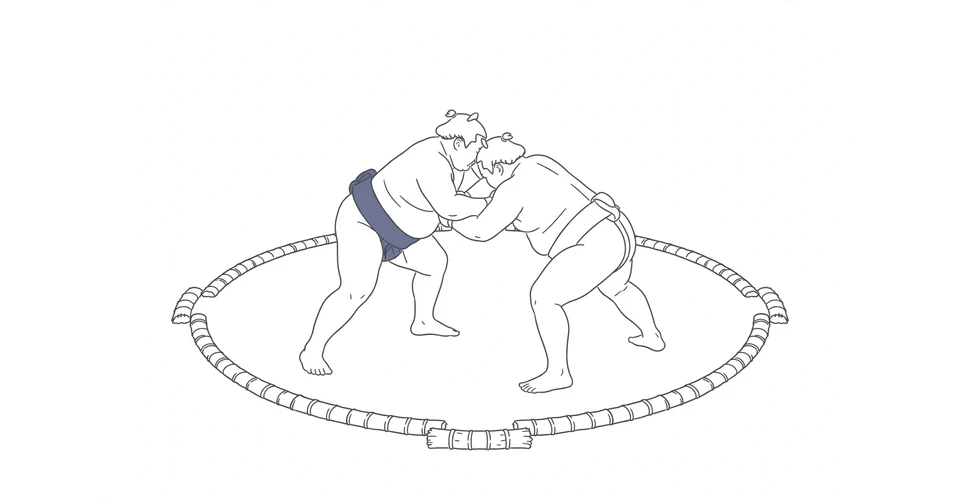
If you have ever watched sumo and wondered why the commentators keep returning to the win and loss columns, this is why. A basho is not a festival with a winner chosen by judges. It is a ranking machine, a test that runs for two weeks and then publishes its verdict in the form of a new banzuke, the ranking sheet. This guide explains how a basho works, from the six tournaments on the calendar to the final day, when the champion lifts the Emperor's Cup.
What a basho actually is
A basho is an official professional sumo tournament. The full term is honbasho, which means the main tournament, and it is used to separate these six ranked events from exhibition sumo on regional tours. A wrestler can look impressive on tour and earn applause, but a tour bout does not move him up or down the rankings. Only a basho does that. The Japan Sumo Association has organised the honbasho since 1926, and the modern shape of the event has been stable for decades. The tournaments were extended from ten days to fifteen in 1949, and the number held each year rose to six in 1958. That structure has held ever since, which is part of its appeal. A fan can learn it once and use it for life.
Each basho lasts fifteen consecutive days, opening on a Sunday and closing on a Sunday two weeks later. Wrestlers in the top two divisions, makuuchi and juryo, fight once a day. Wrestlers in the lower divisions fight seven times in total, roughly once every other day, with the lower division bouts beginning in the morning. The rhythm matters more than the raw number of bouts. A top division wrestler cannot hide from a bad week. He fights every day, against a new opponent, while his record is displayed for everyone to see. There is no rest day to reset a slump, and no easy opponent to pad the numbers.
That daily grind is what makes a basho feel different from a single match in another sport. In a knockout competition, one bad day ends the run. In a basho, one bad day is only a mark in the loss column, and the wrestler must come back the next day and fight again. I find that honesty refreshing. Sumo does not ask who was best on one afternoon. It asks who could keep winning, or keep recovering, for fifteen days in a row.
Six tournaments, four cities
The calendar is fixed, and its simplicity is a gift to fans. Six basho are held every year, in the odd numbered months, in four cities. Three take place in Tokyo, and one each in Osaka, Nagoya, and Fukuoka. The pattern never changes, so a fan can plan a trip years ahead and know exactly where sumo will be.
The year opens with the Hatsu basho in Tokyo in January, the opening tournament. March brings the Haru basho, the spring tournament, in Osaka. May returns to Tokyo for the Natsu basho, the summer tournament. July belongs to Nagoya, September returns to Tokyo for the Aki basho, the autumn tournament, and November closes the year with the Kyushu basho in Fukuoka. The official schedule is published years in advance by the Japan Sumo Association, and the dates for the next basho are worth checking on the Japan Sumo Association official site before making travel plans, since the exact Sundays shift slightly from year to year.
The venues carry their own history. Tokyo tournaments are held at the Ryogoku Kokugikan, the home of sumo, which the Association owns and keeps set up for the sport all year round. Osaka uses the Osaka Prefectural Gymnasium, known as Edion Arena Osaka. Nagoya moved to the Aichi International Arena, also called IG Arena, and Fukuoka uses the Fukuoka Kokusai Center. Preparing the three venues outside Tokyo takes about a week, since the ring, the seating, and the staging must be built up for each basho and taken down again afterwards. That travelling character is part of the charm. Sumo belongs to Tokyo, but for three weeks a year it belongs to Osaka, Nagoya, or Fukuoka, and the local crowds treat the visit as their own festival.
| Tournament | Month | City | Venue |
|---|---|---|---|
| Hatsu basho | January | Tokyo | Ryogoku Kokugikan |
| Haru basho | March | Osaka | Osaka Prefectural Gymnasium |
| Natsu basho | May | Tokyo | Ryogoku Kokugikan |
| Nagoya basho | July | Nagoya | Aichi International Arena |
| Aki basho | September | Tokyo | Ryogoku Kokugikan |
| Kyushu basho | November | Fukuoka | Fukuoka Kokusai Center |
The table looks tidy, but the lived experience of a basho is messier. A wrestler arrives in a new city, settles into temporary lodgings with his stable, trains in an unfamiliar hall, and then fights in front of a crowd that may be seeing him live for the first time. A Tokyo regular can feel like a visitor in Fukuoka, and a young wrestler from Kyushu can feel like a local hero when the basho comes to his home region. The calendar spreads the sport across Japan, and that spread keeps it from becoming only a Tokyo story.
Fifteen days, one bout at a time
A basho unfolds in two halves, and the matchmaking changes as the days pass. The bout schedule is set by a committee of elders a day or two in advance, and it is announced from the ring the day before. In the first half, the higher ranked wrestlers in the top division generally face lower ranked opponents, while the lower ranked men fight among themselves. In the second half, the leaders start to meet each other, and the pairings follow the win and loss records more closely. The aim is to make the final days decisive, with the contenders for the championship facing each other rather than coasting past weaker opponents.
Two rules shape the schedule. Wrestlers from the same stable never fight each other, and neither do wrestlers related by blood. Those are not small exceptions in a sport built around stables, where men live, eat, and train together. They mean the committee must work around real gaps in the draw, and they are one reason the schedule is only fixed a day or two ahead. On the final day, wrestlers with seven wins and seven losses are paired against each other where possible, so that nobody can be handed a winning record as a favour. The system is designed to make every record earned, not gifted.
The daily order of a basho follows the divisions from the bottom up. The lowest ranked wrestlers fight first in the morning, and the top division comes last in the afternoon, when the arena is fullest and the television cameras are watching. A fan who arrives early can watch the future of the sport in the lower divisions, where teenagers and newcomers fight for their first winning records. A fan who arrives late sees only the stars. Both are watching the same basho, but they are watching different stages of it. I think the early hours are underrated. The lower divisions are where a wrestler learns whether he can win seven bouts in a basho at all, and that lesson stays with him when he reaches the top.
Injury is part of the fifteen day test. If a wrestler withdraws, his scheduled opponent wins by default, and any bouts he misses afterwards count as losses when the next rankings are drawn up. A withdrawal is therefore not a pause. It is a decision with a price, and wrestlers often fight hurt rather than pay it. That is not something to celebrate without reservation. The courage is real, but so is the cost to a body that must return in two months for the next basho. The calendar does not wait for anyone to heal.
The banzuke decides everything
Before a basho begins, the banzuke is published, usually about two weeks before the first day. It is a large sheet, written in elegant calligraphy, that lists every professional wrestler in rank order. The top division is makuuchi, fixed at forty two wrestlers, and below it sit juryo, makushita, sandanme, jonidan, and jonokuchi. The two top divisions together are the sekitori, the salaried wrestlers, and reaching them changes a wrestler's life. You can read how that change looks up close, in the white training belt and the ginkgo leaf topknot, in White Silk Means You Made It as a Sekitori.
The ranks inside makuuchi run from yokozuna at the top, through ozeki, sekiwake, and komusubi, down to the maegashira, who are numbered in order. The top four ranks are known together as sanyaku, although yokozuna is in practice a rank apart, since a yokozuna cannot be demoted and is expected to retire if he can no longer compete at the highest level. Promotion to yokozuna has no fixed formula, but the usual standard is winning two consecutive tournaments as an ozeki, or an equivalent run of results, together with the dignity the rank demands. That combination of numbers and character is what makes the rank so rare. Only seventy five wrestlers had reached it by May 2025, according to the Japan Sumo Association's records, which averages out to roughly one new yokozuna every three years since formal record keeping began.
A basho is the only evidence the banzuke committee uses, and the committee reads it strictly. A winning record, called kachi-koshi, normally means promotion for the next basho. A losing record, called make-koshi, normally means demotion. The line is simple. In the top division, where a wrestler fights fifteen bouts, eight wins against seven losses is the smallest winning record, and seven wins against eight losses is the smallest losing record. There is no middle ground, no draw, no points for effort. The record is the record, and the next banzuke reflects it.
That strictness can feel cruel, and it can also feel fair. A wrestler who goes eight and seven moves up, sometimes only by a single rank, sometimes by several places if he beat strong opponents. A wrestler who goes seven and eight moves down. The system rewards consistency over brilliance, and it punishes a slow start even when the finish is strong. I have come to think that is the point. Sumo is a sport of routine as much as of strength, and the banzuke is the sport's memory. It remembers every basho, and it forgets nothing.
Eight wins change a life
For most wrestlers, the first aim in a basho is not the championship. It is kachi-koshi, a majority of wins. Eight wins in the top division, or four wins from seven bouts in the lower divisions, secures a winning record and a step up the ladder. Seven wins and eight losses does the opposite. The difference between eight and seven and seven and eight is a single bout, but it can decide whether a wrestler spends the next basho fighting stronger opponents or weaker ones, whether he keeps his salary, and whether he stays in the top division at all.
That single bout explains the tension of the middle days of a basho. The championship race may still be wide open, but for a dozen wrestlers the real contest is the race to eight wins. A man at seven wins and five losses still has three chances to reach the line. A man at seven wins and seven losses has one bout left, and it is winner takes all, not for a trophy, but for the direction of his career. The crowd knows this. The cheers for a mid ranking wrestler fighting for his eighth win can be as loud as the cheers for a title contender, because everyone in the arena understands what is at stake.
The stakes are highest at the boundary between the divisions. A juryo wrestler who finishes with a strong winning record can be promoted to makuuchi, and a makuuchi wrestler who finishes with a poor losing record can fall to juryo and lose his place among the sekitori. Falling out of the top two divisions means losing a salary, a private room, and the right to wear the white silk belt in training. Climbing into them means gaining all of those things. A basho can therefore change a wrestler's daily life, not just his position on a sheet of paper. That is why the lower ranked bouts matter, even when the champion has already been decided. For the men fighting them, the basho is still deciding their future.
The race for the yusho
The championship of a basho is called the yusho, and it goes to the wrestler with the most wins in his division. Each division has its own champion, but the one that draws the attention is the makuuchi yusho, the top division title. The word yusho once meant a perfect record, but it now means the tournament champion whatever his record. A wrestler can win the title with fourteen wins and one loss, or with twelve wins and three losses in a crowded field. What matters is finishing ahead of everyone else in the division.
If two or more wrestlers finish tied at the top, a playoff is held on the final day to decide the champion. The playoff is a sudden and dramatic end to a slow tournament, a reminder that fifteen days of careful accumulation can still come down to a single bout. The schedule for the final day is arranged to make such a finish more likely, with the leading wrestlers facing each other, so the title is settled in the ring rather than by arithmetic. A basho that ends in a playoff feels like a gift to the crowd, but it is not an accident. The matchmakers have spent the second week steering the leaders toward each other.
The yusho also carries three special prizes in the top division, called sansho, which have been awarded since 1947 for exceptional performances. They go to wrestlers below the top two ranks, and they recognise fighting spirit, outstanding performance, and technique. A wrestler who beats a yokozuna, or who wins far more bouts than his rank would suggest, can leave a basho with a special prize even if he did not win the title. Those prizes matter because they mark a wrestler as someone to watch in the next basho, and because they are decided by people who have watched every bout, not by the win column alone.
The Emperor's Cup and the prizes
The winner of the top division receives a collection of trophies and prizes, but the most famous is the Emperor's Cup, a sterling silver cup weighing about thirty kilograms. It is presented to the makuuchi champion at the end of the basho, and photographs of the winner struggling to lift it have become part of the tournament's iconography. The cup is heavy on purpose. It is meant to feel like the weight of fifteen days, and the wrestler who lifts it is usually smiling through the effort.
The prizes do not stop there. The champion receives trophies from sponsors, regions, and organisations, and the full list can run long. Yet the cup is the one that matters in memory. A wrestler's career is often counted in yusho, and each yusho is remembered by the basho in which it was won. Fans say a wrestler won the Kyushu basho or the Haru basho, and the name of the tournament becomes part of the title. That is why the word basho carries so much weight in sumo. It is not just a date on a calendar. It is the unit in which a career is measured.
There is also a quieter prize, which is the record itself. A wrestler who finishes fifteen and zero, a perfect record, earns a special place in the history of the basho, and the term for it, zensho yusho, is one of the proudest phrases in the sport. A perfect basho is rare, and it is remembered long after the details of individual bouts fade. The history of sumo is, in large part, a list of basho and the men who mastered them.
What a fan should watch for
A first time viewer can enjoy a basho without knowing any of this, but a little structure makes the fifteen days far richer. Start by picking a wrestler to follow, ideally one in the middle of the rankings, and watch his record day by day. The championship race is the headline, but the middle of the banzuke is where the most human stories live. A wrestler fighting for his eighth win, or fighting to stay in the top division, is fighting for his livelihood, and his bouts carry a tension that a title favourite, safely ahead, may not feel.
Watch the second week more closely than the first. The first days establish the records, but the second week decides them. The leaders begin to meet, the seven and seven wrestlers face each other on the final day, and the playoff, if there is one, arrives without warning. The Honbasho page on Wikipedia sets out the schedule, the venues, and the format in full, and it is a useful companion for a first basho, especially for the dates and the division structure.
Watch the rituals as well as the bouts. The salt thrown into the ring, the leg stomping, the long stare before the charge, all of it is part of the basho, and it slows the sport down in a way that modern sport rarely allows. The pause before a bout can last longer than the bout itself, and that pause is not wasted time. It is the wrestler gathering himself, and the crowd gathering its attention. I used to find the waiting frustrating. Now I think it is the most honest part of the event. Sumo refuses to hurry, and the basho is the reason why. Fifteen days is a long time to wait for a result, and the sport is built to make the wait feel worthwhile.
If you attend a basho in person, the advice is simple. Arrive early enough to see the lower divisions, stay for the top division, and do not leave before the final bout of the day. The lower divisions are quieter and closer, and the top division is louder and faster. Together they show the whole ladder of the sport, from teenagers fighting their first bouts to champions fighting for the Emperor's Cup. The history of the sport is part of the same story. Our earlier guide to Sumo, Japan's Oldest Sport sets out where the sport came from, and a basho is where that history is still being written, one bout at a time.
Why fifteen days matter
A basho is a small invention with a large effect. Fifteen days is long enough for luck to even out, short enough for a single hot streak to matter, and regular enough, six times a year, for a career to be built from it. The calendar gives every wrestler six fresh chances a year, and it gives every fan six fresh stories. A man who fails in January can return in March. A man who wins in May must defend his record in July. Nobody is finished by one basho, and nobody is made by one either, except in the rare case of a perfect run that enters the record books.
That rhythm is what I admire most about sumo. Most sports are built around a single final, a single match that decides everything. A basho spreads the decision across fifteen days, and in doing so it spreads the pressure, the hope, and the disappointment across fifteen days as well. The wrestler who wins is not the man who was best for a minute. He is the man who was best, or most consistent, or most resilient, for two weeks. The banzuke that follows is the proof, written in calligraphy, that the fifteen days happened and that they mattered.
So when the next basho begins, do not look only at the first day. Look at the record as it grows, watch the middle of the rankings as closely as the top, and wait for the final Sunday, when the champion lifts the cup and the new rankings begin to take shape. Fifteen days is a long time in sport, and in sumo it is exactly long enough to decide who the sport will remember.
More in Culture & Society
- Kojiri Is the End Cap That Takes Every Knock for a Katana
- Kurikata Is the Chestnut Knob That Holds a Katana at the Hip
- Koshirae Is the Formal Mounting That Turns a Blade Into a Katana
- Shirasaya Is the Plain White Scabbard Where a Katana Rests
- The Togishi Polishes a Katana for Weeks Before It Ever Cuts
- Kozuka Is the Small Knife Hiding in a Katana's Saya
Latest posts
- Osechi Packs a Whole Year of Luck Into Stacked Boxes
- Wakizashi Was the Short Sword a Samurai Never Took Off
- Tsuba Is the Small Guard That Stops a Katana From Cutting Its Owner
- Yokote Is the Small Line That Tells a Katana's Age
- Seppa Are the Thin Washers That Keep a Katana From Rattling
- Kissaki Is the Small Tip That Finishes a Katana
- Nakago Is the Hidden Tang That Carries a Katana's Signature
- Mekugi Holds a Katana Together With a Single Bamboo Pin
- Why a Katana Stays Put, Thanks to the Koiguchi
- Tsuka-Ito Is the Cord That Binds a Katana Grip
- Fuchi Is the Collar That Frames a Katana Grip
- Kashira Is the Small Cap That Finishes a Katana Grip
- Sageo Is the Cord That Ties a Katana to Its Samurai
- Menuki Are the Small Ornaments Hidden Under a Katana Grip
- Habaki Is the Copper Collar That Locks a Katana in Its Sheath