Kissaki Is the Small Tip That Finishes a Katana
· 25 min read
The kissaki is only a few centimetres of steel, yet it decides whether a katana looks right, cuts cleanly, and earns the respect of an appraiser.
Look at a katana from across a room and your eye travels along the long curve of the blade. Look closer, and the eye stops at the end. The kissaki is the small pointed section at the front of the blade, and it is where the whole design has to make sense. A blade can have a fine curve and a bright polish, but if the tip looks wrong, the whole sword looks wrong.
That is not only a matter of taste. The kissaki is where the edge changes direction, where the temper line turns back on itself, and where the polisher does some of the most delicate work on the entire blade. It is also the part that meets the target first in many cuts and in every thrust. In other words, the smallest part of the blade carries a large share of its meaning, and that is why it deserves a closer look.
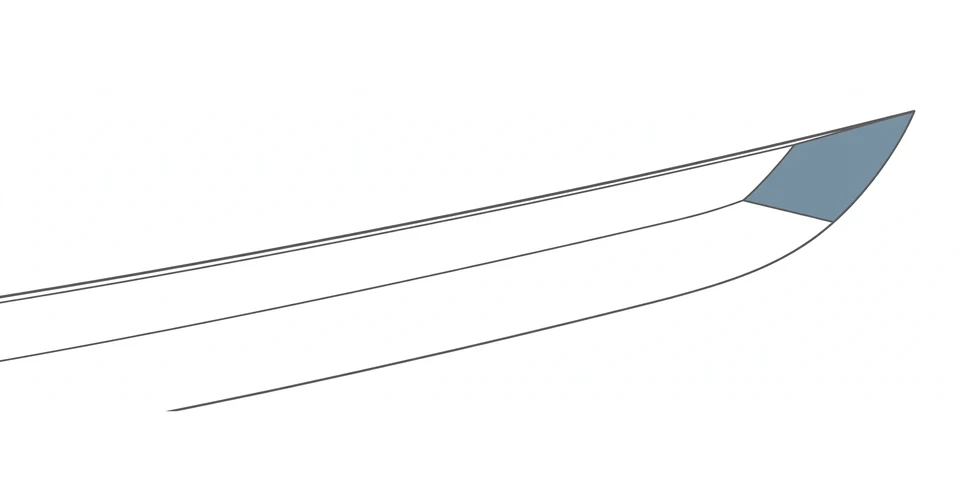
This article grew out of a single line in How the Katana Became the Soul of the Samurai, which says, "The tip is the kissaki, separated from the rest of the blade by a small angled line called the yokote." Its table adds, "Tip | Kissaki | The point, shaped separately and finished by the polisher". Those two sentences name the subject, but they leave the interesting questions open. Why is the tip shaped separately at all, why does its size change from one period to another, and why do appraisers spend so much time staring at a few centimetres of steel? The answers sit at the meeting point of craft, history, and use.
What the kissaki actually is
The kissaki is the tip section of a Japanese sword blade. It runs from the yokote line to the very point, and it includes the curved part of the edge that sweeps up to meet that point. It is not simply the sharp end of a long edge. It has its own geometry, its own polish, and its own temper pattern, and each of those things is judged on its own terms.
Think of the blade as having two jobs that meet at the tip. The long part of the blade does most of the cutting in a sweeping stroke. It finishes the stroke, or starts it, depending on the cut. In a thrust, the tip does almost all the work. That dual role explains why smiths and polishers treat the tip as a separate project rather than as an afterthought. The steel there has to be hard enough to hold a point, tough enough not to snap, and shaped well enough to enter and leave a cut cleanly.
One useful distinction, made clearly in the sources I read, is between the tip and the boshi. The physical tip, a matter of shape and geometry. The boshi is the hamon, the temper line, as it runs inside the kissaki. People sometimes use the two words as if they meant the same thing, but they do not. A blade can be described by its kissaki shape quite separately from its boshi pattern, and an appraiser will look at both, one after the other.
The tip also has its own small vocabulary. The curve of the edge as it rounds toward the point is called the fukura. A full, rounded fukura gives a broader tip, while a straighter, more withered fukura gives a narrower and more pointed one. The point where the yokote, the ridge line, and the small ridge of the tip meet is called the mitsukado. These are small details, but they are the details that let an expert tell one school from another, and they are worth learning if you want to look at a katana with more than a passing glance.
There is a traditional saying, quoted by the Tozando katana shop, that the tip is the face of the sword, and that a wound on the body is forgivable while a wound on the face is not. The same source notes that a sword with a damaged or missing tip was historically called kubi nashi, or headless, and considered without value, however fine the rest of the blade might be. That sounds harsh, and it is meant to. It tells you how seriously the tradition takes this small section. A blade is judged as a whole, but the tip is where the judgement often begins.
The yokote line that draws the boundary
If you hold a katana in good light and look at the tip, you will see a short line running across the blade at a slight angle. That is the yokote. It marks the boundary between the main body of the blade and the tip, and it is one of the first things a specialist checks. On a well made blade, the yokote is crisp and clean. On a poor blade, or one that has been polished carelessly, it can look soft, uncertain, or almost absent.
The yokote matters for two reasons. First, it is a visual line, and the eye reads it at once. A sharp yokote gives the tip a clear, deliberate shape. A blurred yokote makes the whole end of the blade look tired, as if the smith and the polisher could not agree where the tip should begin. Second, it is a structural line. The geometry changes at the yokote. The flat surfaces of the blade body give way to the different, more steeply angled surfaces of the kissaki, and the polisher has to handle that change without leaving a visible step or a soft smear.
Not every Japanese blade has a yokote in the same form. On a conventional shinogi-zukuri blade, the kind most people picture when they think of a katana, the yokote is a clear feature. On some other blade shapes, such as shobu-zukuri, there is no conventional yokote, because the cross section is different. That is a useful reminder that the kissaki is not a universal shape stamped onto every sword. It belongs to a particular way of building a blade, and it changes when that way changes.
The polisher plays a large part here. The yokote is not only forged, it is finished. A polisher who rushes the tip can soften the line, and once the line is gone, it is hard to bring back without removing more steel and changing the shape of the tip itself. This is one reason the final polish of the tip is treated as a separate stage of work, with its own small stones and its own patience. A good yokote looks simple, and that simplicity is the result of care.
I find something quietly instructive in that. In many crafts, the boundary is where the work shows. Anyone can make a long, smooth surface look good. The test comes at the corner, the joint, or the line where one surface meets another. The yokote is that test on a katana, and it is visible to anyone willing to look closely, not only to an expert with a magnifier.
Ko-kissaki, chu-kissaki, and o-kissaki
The most common way to classify a tip is by its size. The three main types are ko-kissaki, the small tip, chu-kissaki, the medium tip, and o-kissaki, the large tip. There are other, rarer forms, including the short and wide ikubi-kissaki, sometimes called the boar's neck tip, and the very early kamasu-kissaki, but the three main sizes cover most of what you will see.
Ko-kissaki is compact and tightly built, with a full and rounded fukura that gives it a soft, curved character. It appeared widely in the late Heian through early Kamakura period, when the tachi form was reaching its classical shape and refinement was the dominant value. It came back later in the Kanbun Shinto period, in the middle of the seventeenth century, when smiths working in a restrained style deliberately recalled that early elegance. A ko-kissaki on a blade claimed to be from the Kamakura period is consistent with the claim. The same tip on a blade claimed to be from the Nanbokucho period, the era of civil war from 1336 to 1392, would be unusual, because that period favoured the opposite extreme.
Chu-kissaki is the middle size and the standard against which the others are measured. It represents the balance reached in the mid-Kamakura period, between the refined small tip of the early period and the dramatic large tip of the later period, and it remains the most common kissaki size across all periods, schools, and regions. Because it is so widely distributed, a chu-kissaki on its own tells an appraiser very little about the date of a blade. Its value comes from its relationship to the other elements, the overall shape, the curvature, and the hamon, which together point toward a period or a school. The modern wooden training sword, the bokken, is shaped with a chu-kissaki as its default, which shows how thoroughly this middle size has become the normal idea of a tip.
O-kissaki is large, elongated, and assertive. It extends the visual length of the blade and gives the sword a dramatic, powerful character. Its main historical association is with the Nanbokucho period, when sword dimensions grew sharply to meet the demands of mounted combat, and the huge nodachi and odachi of that time carried extreme o-kissaki as part of their exaggerated proportions. Later, in the Keicho and Genna eras of the early Edo period, from 1596 to 1624, some smiths revived the Nanbokucho look on purpose, and the Shinshinto period saw a second revival. An o-kissaki combined with a long, wide blade and shallow curvature therefore suggests Nanbokucho with some confidence, while the same tip on a blade with Edo period features points toward one of the revivals instead.
How long is each type in centimetres? Here the sources do not agree, and it is worth saying so plainly. Some guides give the most common tip length as about 3 to 4 centimetres, with ko-kissaki at 2 to 3 centimetres, chu-kissaki at 3 to 4 centimetres, and o-kissaki at more than 5 centimetres. Other guides give larger figures, with chu-kissaki at 4 to 6 centimetres and o-kissaki at 7 to 8 centimetres. The difference probably comes from different ways of measuring, whether from the yokote straight to the point or along the curve, and from whether the writer is describing antique blades or modern reproductions. The conservative way to read the numbers is as rough bands, not as exact rules, and the relative order is more reliable than any single figure. Ko is small, chu is middle, o is large, and the proportions matter more than the centimetres.
The ikubi-kissaki deserves a brief mention because it shows how specific the language can get. It is short in length but unusually wide for that length, giving a powerful, almost blunt appearance, as if the tip had been compressed while its width was kept. It is strongly associated with the Yamato-den tradition and with the warrior monks of the great temple complexes of Nara, and its presence narrows the field of possible attributions in a useful way. You do not need to memorise every variant to enjoy a katana, but knowing that such a variant exists helps you see that the tip is not a generic point. It is a choice, and choices leave traces.
A good overview of these sizes, with their period associations and their use in appraisal, is given in the Tozando guide to the tip, which treats the tip as the most information dense area of the blade and works through each size in turn. Reading it alongside a photograph of a real blade makes the abstract names concrete, because you can see the small tip, the balanced tip, and the long tip as three different answers to the same question, which is how a sword should end. The Kissaki, the Tip That Reveals Everything
The boshi inside the kissaki
Inside the tip runs the boshi, the continuation of the hamon into the point. The hamon is the visible temper line along the cutting edge, created when the smith coats the blade in clay and quenches it, so that the edge cools fast and hardens while the body cools more slowly and stays softer. In the tip, that line has to turn. It runs past the yokote, follows the curve of the fukura toward the point, and then turns back toward the spine. That turn is called the kaeri, and the point where it reaches the spine is called the tome, or stop.
The boshi is one of the most carefully studied elements in kantei, the formal appraisal of a Japanese sword, because it is a direct record of the smith's control. Hardening a small, bevelled area in a uniform and controlled way is difficult, and a smith who gets the boshi right is unlikely to have made a mess of the rest of the hamon. Markus Sesko, in his kantei series, calls the boshi a sensitive point and says that judging it is usually the last fine tuning in an appraisal. It either confirms the conclusions drawn from the shape, the steel, and the hamon, and lets the appraiser narrow the judgement to a particular smith, or it is so unusual that the appraiser has to go back and reconsider the school. That is a large job for a pattern only a few centimetres long.
The boshi comes in many named forms, and the names describe what the eye sees. Ko-maru is a small, gentle rounded turn, associated particularly with the Bizen and Yamashiro traditions. O-maru is a larger, more sweeping rounded turn. Midare-komi is an irregular hamon that continues into the kissaki rather than resolving into a simpler pattern at the yokote, and it is associated with the Soshu tradition and its dynamic, crystal rich hamon. Jizo boshi is named for its resemblance to a Jizo statue seen in profile, with a distinctive rounded shape at the tip. Kaen, or flame boshi, has irregular, flame like extensions into the kissaki and is rare. Ichimai boshi is a tip that is fully or almost fully hardened, with no soft turn back visible.
Two other details matter when reading a boshi. The first is where the kaeri begins. If it begins early, soon after the yokote, it is called sagari-kaeri. If it begins late, close to the point, it is called agari-kaeri. A late turn can be deliberate, but it can also mean that the kissaki has lost material over time, through polishing or repair, so an appraiser has to be careful before treating it as a school feature. The second detail is whether the boshi continues the rhythm of the main hamon or changes abruptly at the yokote. In older koto work, the hamon often ran out naturally into the kissaki. In shinto work, when the artistic aspect of the sword grew stronger, the hamon was more often painted as a deliberate pattern framed by the yokote. That is a rule of thumb, not a law, and Sesko warns that it has to be put in context with everything else the blade shows. Still, it is a good example of how a small pattern can carry a large historical signal.
The hamon itself deserves its own study, because the boshi only makes sense once you understand what the temper line is doing along the rest of the edge. The kissaki is where that line has to solve its hardest problem, which is how to turn a corner without losing control. When it does so cleanly, the result is beautiful. When it does not, the result is visible at once, and no amount of polish can hide it.
For the full vocabulary of boshi forms, from ko-maru and o-maru through midare-komi, jizo, kaen, and ichimai, the clearest single source I read is Markus Sesko's kantei chapter on hamon and boshi, which defines each form, explains the kaeri and its variations, and warns where a feature may be the result of lost material rather than a smith's choice. Kantei 3, Hamon and Boshi
How a polisher finishes the kissaki
The smith forges the tip, but the polisher finishes it, and the finish is where the tip becomes legible. The polisher is called a togishi, and the work is done in stages with progressively finer natural stones. The early stages shape the blade and remove the marks of forging. The later stages, the final polish known as shiage togi, bring out the hamon, define the geometry, and give the steel its quiet, misty brightness. The kissaki gets its own attention at the end of this process, in a stage sometimes called kissaki-narume, in which the polisher works on the tip, the yokote, and the boshi with small stones and soft buffers.
Why does the tip need its own stage? Because its surfaces are different from the rest of the blade. The main body of the blade has long, relatively flat surfaces that a polisher can work in smooth, even strokes. The kissaki has short, bevelled surfaces that meet at angles, and the aesthetic of the sword asks for a contrast between the tip and the body. The polisher therefore has to treat the tip differently from the ji, the main surface, and from the shinogi-ji, the surface above the ridge line. A single mistake, a slip of the stone or a moment of uneven pressure, can soften the yokote or blur the boshi, and Sesko notes from his own experience that the polishing of the tip is often neglected, or that so much emphasis is placed on the contrasting effect that the boshi itself becomes hard to see. In the worst case, he writes, you are left with a scratchy white surface that hides the actual hardening.
That is why a good polish is so valued, and why a bad polish is so hard to forgive. The steel is the same steel. The difference is in the hands that finished it, and the tip is where those hands are most exposed. A polisher who understands the tip will keep the yokote crisp, keep the two faces of the tip balanced, and let the boshi show without forcing it. A polisher who does not will leave a tip that looks cloudy, uneven, or oddly flat, and the blade will lose value even if the forging underneath is sound.
There is a lesson in this that goes beyond swords. Finishing is not decoration. It is the stage where the work becomes readable, and where small errors become visible. The kissaki is small enough that there is nowhere to hide a mistake, and that is exactly why it is such a good test of a craftsperson. I think about that whenever I see a job that looks fine from a distance and falls apart up close. The distance is forgiving. The close look is not.
Why a damaged kissaki is so hard to repair
A chip in the middle of a long edge is a problem, but it is a familiar one. A chip at the tip is a different matter, because the tip is where the geometry is most concentrated and the margin for error is smallest. Remove a little steel from the edge and the blade is slightly shorter in that spot. Remove a little steel from the point and the whole shape of the tip changes. The fukura flattens, the point moves, the yokote shifts, and the boshi may be cut through or lost entirely.
That is why the tradition treats damage to the tip so severely, and why the old saying about a headless blade carries real weight. A blade that has lost its tip has lost the part that completes its shape, and no repair can restore the original steel. What a repair can do is reshape what remains into a new, smaller kissaki, and that is a compromise. The blade may still be usable, and it may still be beautiful, but it is no longer the blade the smith made. Its proportions have changed, and an appraiser will read that change at once.
Repair also has to deal with the boshi. If the damage cuts into the hardened area, the temper pattern in the tip is interrupted, and the polisher has to work around a break or an island of hardened steel that does not match the rest of the pattern. Sesko points out that breaks or islands inside the kissaki suggest a tip that has been re-hardened or repaired, and that is treated as a major appraisal flaw. A larger kissaki is sometimes said to be easier to repair after damage, because there is more steel to work with, but that advantage only helps if the geometry is right. A big tip with the wrong curve is no better than a small tip with a chip.
The practical advice that follows from all of this is simple, and it is the same advice that applies to any fine tool. Protect the tip. Keep the blade in its sheath when it is not in use, handle it with care, and never use it for a job it was not made for. A katana is not a pry bar, a can opener, or a prop for a photograph. The kissaki is the part most likely to meet a hard surface first, and it is the part least able to forgive the meeting.
The kissaki in cutting and thrusting
So far this article has treated the tip mainly as an object to look at. It is also an object to use, and its shape affects how a cut behaves. In a descending cut, the tip is often the first part of the blade to meet the target, and it helps to start the cut cleanly. In a draw cut, where the blade is pulled through the target, the curve of the fukura helps the edge to keep moving rather than catching. In a thrust, the kissaki does the work almost alone, and its point, its width, and its curve decide whether it enters smoothly or stops short.
That is one reason the size of the tip changed with the way swords were used. A small, elegant ko-kissaki suited a period when the sword was as much a symbol of rank and refinement as a weapon, and when the fighting it saw was often on foot and at close quarters. A large o-kissaki suited the Nanbokucho period, when battles were larger, armour was heavier, and swords were carried on horseback, where a long, assertive tip could reach further and cut with more authority. The chu-kissaki, the middle size, suited the long middle of the tradition, when the sword had to do a bit of everything and do it well. None of these is simply better than the others. Each is an answer to a different set of demands, and the demands changed over time.
The boshi matters in use as well as in appraisal. If the hardening in the tip is uncontrolled, the tip can become brittle and chip. If the boshi is missing, as happens on some mass produced blades with an acid etched imitation hamon, the tip is structurally weak no matter how good the rest of the edge looks. That is a useful warning for anyone buying a modern katana. A bright, wavy line along the edge is not proof of a real hamon, and a tip without a proper boshi is a tip that may not survive real use. The eye can be fooled, but the steel cannot.
I do not practise with a live blade, and I would not pretend to speak from experience in cutting. What I take from the sources is a humbler point, which is that form and function are not separate here. The kissaki looks the way it does because it has to do a job, and it does its job well because it is shaped with care. When you see a tip that looks right, you are seeing a shape that has been tested, not only admired.
What an appraiser reads from the kissaki
Kantei, the formal appraisal of a Japanese sword, is a disciplined way of looking, and the tip is one of its richest sources of evidence. An appraiser does not look at the tip in isolation. The tip is read together with the sugata, the overall shape of the blade, the jigane, the steel and its grain, and the hamon, the temper pattern along the edge. Each element narrows the field, and the kissaki often provides the final confirmation, or the detail that sends the appraiser back to reconsider.
The size of the tip points toward a period, as the previous sections show. Ko suggests the early classical period or a deliberate later revival. O suggests Nanbokucho or a revival of that style. Chu suggests almost any period, and so it narrows nothing on its own. The fukura adds a second clue, because a full, rounded curve and a straight, withered curve belong to different aesthetic moments. The yokote adds a third, because a crisp line speaks of good workmanship, while a soft or absent line speaks of damage, careless polishing, or a blade that was never well made.
The boshi adds the finest detail of all. Its form, ko-maru, o-maru, midare-komi, jizo, kaen, or ichimai, points toward a tradition or even a particular smith. Its kaeri, the way it turns back toward the spine, adds another layer. A kaeri that begins early is sagari-kaeri. A kaeri that begins late is agari-kaeri, and it may mean that material has been lost. A kaeri that leans toward the edge, or that approaches the cutting edge because the kissaki has been shortened, is called taore-boshi, and it has to be read with care, because it can be either a deliberate feature of certain schools or a sign of an altered tip. Sesko gives a clear warning on this point, that a feature caused by loss of material can look like a school feature, and that the appraiser has to specify which one is meant.
None of this is guesswork, but none of it is certain on its own either. A single feature can be misleading, and a good appraiser holds several features in mind at once, checking each against the others. That is what makes kantei difficult, and what makes it rewarding. It is a way of looking that respects the object, and that refuses to settle for a first impression. The kissaki rewards that kind of looking more than almost any other part of the blade, because it packs so much information into so little steel.
For a collector, the practical lesson is to spend time with the tip before spending money on the blade. Look at the yokote in good light. Follow the fukura to the point. Try to see the boshi, and notice whether it continues the hamon or breaks away from it. Ask whether the size of the kissaki fits the period the blade is claimed to come from. You will not become an appraiser in an afternoon, but you will start to see what appraisers see, and you will be less likely to be fooled by a blade that looks impressive from a distance and falls apart up close.
A small ending that carries a large lesson
The tip is a few centimetres of steel at the end of a long blade. It is easy to overlook, and it is easy to think of it as a detail, a finishing touch, a small point on a large object. Everything in this article points the other way. The tip is where the blade is finished, in both senses of the word. It is where the forging ends, and it is where the quality of the whole sword is completed or undone.
That is why the tradition gives the tip so much attention, why the polisher spends so much care on it, and why the appraiser reads it so closely. A small part can carry a large meaning, and the meaning is not decorative. It is structural, historical, and practical all at once. The shape tells you when the blade was made and how it was meant to be used. The temper pattern tells you who made it and how well they controlled their craft. The polish tells you whether the hands that finished it understood what they were finishing.
There is a quiet encouragement in that, for anyone who makes things, or who cares about how things are made. The end of a job matters as much as the beginning. The last few centimetres, the final line, the small turn of a pattern, these are the places where care becomes visible, and where its absence becomes visible too. A katana does not hide that truth. It puts it right at the tip, where anyone willing to look can see it.
More in Culture & Society
- Wakizashi Was the Short Sword a Samurai Never Took Off
- Tsuba Is the Small Guard That Stops a Katana From Cutting Its Owner
- Yokote Is the Small Line That Tells a Katana's Age
- Seppa Are the Thin Washers That Keep a Katana From Rattling
- Nakago Is the Hidden Tang That Carries a Katana's Signature
- Mekugi Holds a Katana Together With a Single Bamboo Pin
Latest posts
- Why a Katana Stays Put, Thanks to the Koiguchi
- Tsuka-Ito Is the Cord That Binds a Katana Grip
- Fuchi Is the Collar That Frames a Katana Grip
- Kashira Is the Small Cap That Finishes a Katana Grip
- Sageo Is the Cord That Ties a Katana to Its Samurai
- Menuki Are the Small Ornaments Hidden Under a Katana Grip
- Habaki Is the Copper Collar That Locks a Katana in Its Sheath
- Maedate Is the Crest That Turned a Samurai Helmet Into a Banner
- Samegawa Is the Ray Skin Hiding Under Every Katana Grip
- Tatara Is the Clay Furnace Where Tamahagane Begins
- Tsuka Is the Wrapped Grip That Lets a Katana Speak
- The Tanto Was the Small Blade a Samurai Trusted With His Life
- Tamahagane Is the Jewel Steel Behind Every Katana
- Seppuku Was the Ritual a Samurai Chose Over Disgrace
- Saya Is the Lacquered Sheath That Guards the Katana