Tsuba Is the Small Guard That Stops a Katana From Cutting Its Owner
· 20 min read
A tsuba is the round hand guard of a Japanese sword, a small disc of metal that keeps the hand from sliding onto the blade and quietly carries centuries of craft.
Pick up a katana, even in a museum photograph, and your eye goes straight to the blade. The curve, the polish, and the wavy hamon line along the edge pull attention away from the small disc of metal that sits between the blade and the grip. That disc is the tsuba, the hand guard of the Japanese sword, and it is the part that keeps the hand from sliding forward onto the edge in a thrust. It is small, it is quiet, and it is the reason a sword can be gripped hard without punishing the hand that holds it.
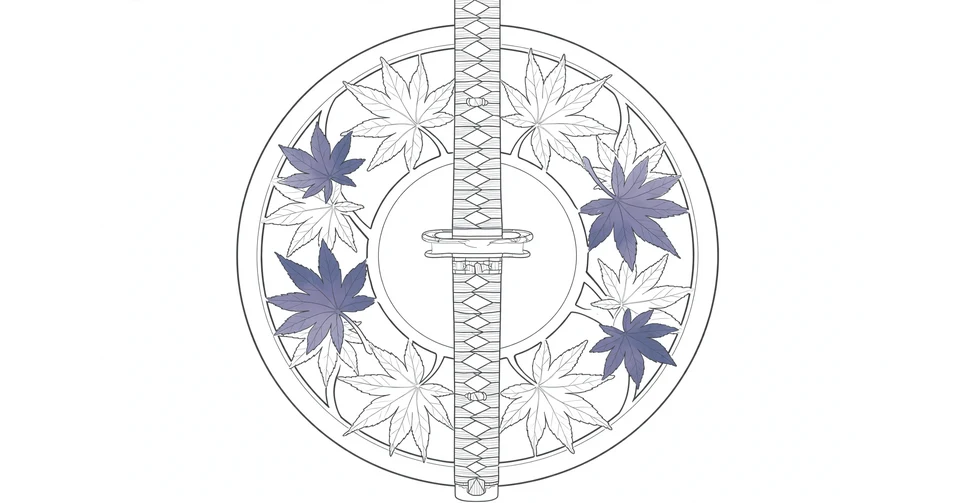
A tsuba is usually round, sometimes squarish, and it sits at the end of the grip where the handle meets the blade. The tang of the blade passes through a central opening in the tsuba, and the whole fitting is held in place by a wedge shaped collar called the habaki on one side and the wrapped grip on the other. It does not look like much. A typical tsuba for a katana measures about 7.5 to 8 centimetres across, roughly the width of a small saucer, while the tsuba for a shorter wakizashi runs about 6.2 to 6.6 centimetres and the one for a tanto about 4.5 to 6 centimetres. The numbers come from the standard reference on Japanese sword mountings, and they explain why this little guard feels so modest in the hand. It was sized to the sword it served, not to the eye of the person looking at it.
That modesty is exactly what makes it worth a closer look. The tsuba began as a practical piece of iron and ended up as one of the most expressive surfaces in Japanese metalwork, a palm sized canvas where smiths carved landscapes, animals, family crests, and scenes from folktales. This article follows that journey, from the battlefield to the display case, and explains what the tsuba is, how it works, and why collectors still study it centuries after the last samurai put his swords away.
What a tsuba actually does
The first thing to understand about a tsuba is what it is not. It is not a shield. In films, a swordsman catches an enemy blade on the flat disc of his guard and holds it there while the two men stare at each other. Real guards can do that in a bind, and the locked guard position has a name, tsubazeriai, but blocking was never the main job. The main job was simpler and more urgent: to stop the hand from sliding forward onto the cutting edge when the sword was thrust. A thrust pushes the hand toward the blade, and without a guard in the way, the fingers would follow the grip straight onto the edge. The disc puts a firm wall between the hand and that outcome.
The tsuba also helps the sword balance. It sits at the meeting point of blade and handle, and its weight, small as it is, shifts the balance of the whole weapon slightly toward the hand. A heavy iron guard steadies a long blade, while a lighter guard lets a shorter blade feel quicker. Swordsmiths and mounters thought about this balance the way a carpenter thinks about the weight of a hammer head, not as an abstract number but as something the hand notices in the first second of holding the sword.
There is a third job, one that belongs to the stance rather than the hand. In kendo, the middle guard position called chudan no kamae is determined by the tsuba and the curvature of the blade. The tsuba marks the line from which the point is presented to the opponent, and when two swordsmen lock guards and push against each other, the contest is decided by footwork and nerve as much as by strength. That locked position, tsubazeriai, is still a common sight in modern kendo, and the word has even passed into everyday Japanese as a way of describing fierce competition. A small piece of metal gave the language a metaphor for a dead heat.
The two faces of the tsuba are not treated the same way, and that detail tells you how much thought went into it. The obverse side, the face that points toward the opponent, carries the decoration. The reverse side, the face that rests against the hand, was traditionally kept smooth. The museum description from Cornell University puts it plainly: the reverse side would come in contact with the hand of the user, so makers kept it smooth on that side. Beauty faced outward, comfort faced inward, and the tsuba managed to do both jobs without compromise.
Where the tsuba sits in the mounting
To see the tsuba clearly, it helps to know its neighbours. Moving from the blade toward the handle, the order of the mounted parts is generally the blade, the habaki, a seppa washer, the tsuba itself, another seppa washer, and then the fuchi, followed by the tsuka, the wrapped grip. The fuchi is the metal collar that frames the mouth of the handle, and the passing mention of the tsuba in the article about that collar is where this story began. That article described the fuchi as sitting directly behind "tsuba, the hand guard, and it forms the transition point between the guard assembly and the wrapped grip." The tsuba is the hinge of the whole assembly, the piece everything else is arranged around.
The seppa washers on either side of the tsuba deserve a sentence of their own, because they explain why a sword can feel rock solid even though it is made of separate pieces. A seppa is a thin washer, sometimes plain and sometimes ornate, that takes up the slack between the handle, the tsuba, and the habaki. Without them, the grip would rattle against the tsuba, and no swordsman tolerates a loose hilt. The habaki, the wedge shaped collar at the base of the blade, locks the tsuba in place and also keeps the sword seated in its scabbard. Press the tsuba with the thumb and the blade loosens just enough to draw, a small movement with a name of its own, koiguchi no kirikata, cutting the mouth of the scabbard. The tsuba is therefore not only a safety device but the thumb rest that starts the draw.
The whole mounting has a name, koshirae, and it refers to the ornate fittings of a sword that is worn, as opposed to the plain wooden shirasaya used for storage. A stored blade needs no guard at all, and the plain wooden mounting has none. That contrast is instructive. When a sword was put away for months or years, the tsuba came off with the rest of the mounting, and the blade rested in featureless wood. When the sword was worn, the tsuba went back on, because a worn sword is a sword that might be drawn in a hurry, and a hurried hand is exactly the hand that needs a wall between itself and the edge.
How big is a tsuba, and what is it made of
Size is the easiest way to tell which sword a guard belonged to, and the measurements are consistent enough to be useful. The standard reference gives a katana guard at 7.5 to 8 centimetres, a wakizashi guard at 6.2 to 6.6 centimetres, and a tanto guard at 4.5 to 6 centimetres. A guard of about 8 centimetres would look oversized on a short tanto, and a 5 centimetre guard would look lost on a long katana. Collectors use these numbers the way a tailor uses measurements, as a first check before looking at style or signature.
| Sword | Typical tsuba diameter |
|---|---|
| Katana | 7.5 to 8 cm |
| Wakizashi | 6.2 to 6.6 cm |
| Tanto | 4.5 to 6 cm |
The material tells a second story, about the period in which the tsuba was made. Early guards were usually iron, thick and well forged, made by swordsmiths and armourers rather than by specialists. The great armour making families, the Miochin and the Umetada, produced guards that resembled tempered plates of armour, thin, large, and hard. Later guards were made from a wider range of metals and alloys, including steel, brass, copper, and shakudo, the dark gold and copper alloy that gives many Edo period fittings their deep, almost black lustre. A guard in shakudo with gold inlay belongs to a different world from a plain iron guard, and the difference is not only decorative. Iron says battlefield, shakudo says drawing room, and the metal alone can place a guard within a century or two.
That shift from iron to softer, more decorative metals follows the history of Japan itself. During the Muromachi period, from 1333 to 1573, and the Momoyama period, from 1573 to 1603, guards were made more for function than for decoration, from stronger metals and with sturdier designs. During the Edo period, from 1603 to 1868, Japan was at peace, and guards became more ornamental, made from less practical metals such as gold. The sword stopped being a daily tool of war and became a badge of rank, and the tsuba followed it. What had been armour became jewellery, and nobody at the time seems to have thought that was a loss.
From battlefield iron to Edo art
The change did not happen all at once. Before the 16th century, most early guards were thick, unsigned, well forged products that came from the swordsmith's anvil and were supplied with the purchase of each blade. The tsuba was part of the sword the way a sheath is part of a knife, not a separate purchase and not a signed work of art. As decorative techniques grew more refined, the makers of guards became specialists, and whole dynasties of craftsmen did nothing but make guards. By the 19th century, the best metal carvers were producing guards that were appreciated as objects of art in their own right, independent of the sword they were made for.
Peace changed what people wanted from a guard. Where only a small number of motifs had been used until around the 1650s, artists in the later Edo period took inspiration from images in books, characters in folktales, and popular cultural and natural motifs. A guard might show a sika deer, a dragonfly, autumn flowers, a monkey teasing an elephant, or a lotus pond. The owner would select motifs that expressed his tastes, values, and interests, and the sword became a quiet statement about the man who carried it. Swords and their fittings served as status items for samurai, and the tsuba, being the largest of the fittings, offered the most room for that statement.
This is where my own view of the tsuba settles. I think the Edo period guard is best understood not as a weapon part that became art, but as a small public surface in a society that allowed samurai almost no other personal adornment. The extravagant enrichment of sword mounts was, as the Peabody Museum catalogue notes, a means of compensation for the unique lack of personal adornment characteristic of the Japanese warrior. A samurai could not wear bright clothes or flashy jewellery, but he could carry a guard carved with a scene from a story he loved, and everyone who saw the sword would know it. The tsuba was the one place where taste was allowed to show, and the makers rose to that occasion with astonishing skill.
The tsuba also became an heirloom. Guards were often passed from one generation to the next, and Japanese families with samurai roots sometimes had their family crest, the mon, crafted onto a guard. A guard that had been carried by a grandfather carried his crest and his taste into the next generation, and the object became a piece of family memory as well as a piece of craft. That is a lot of meaning for a disc of metal the size of a saucer, and it helps explain why guards survived in such numbers after the swords themselves were put away. People kept the tsuba when they had no more use for the blade.
The shapes a tsuba can take
Most guards are round, but round is only the beginning. The Peabody Museum catalogue, a 1975 study of the museum's collection of more than six hundred guards, identifies five general shapes, with the majority round and circular variations tending toward elliptical or chrysanthemum forms. The square occurs frequently with rounded corners, and less often in octagonal, hexagonal, lozenge, and aori shapes, the last being a rounded trapezoid named after the flanchard like horse trapping placed under a saddle. There is also the four lobed mokko shape, which takes its name from a cross section of the tree melon, with variations that include the cross shaped kaku mokko and the otafuku shape, whose lobes connect in a gentle curve resembling the Noh mask of the chubby faced girl Otafuku.
Other shapes are rarer and more playful. The shitogi shape resembles a Shinto religious rice cake offering shaped by squeezing a handful of boiled rice, and it was used mainly on ceremonially mounted swords. There are guards shaped like a fist or a bowl, and irregular shapes that fall into no category at all. The variety is part of the pleasure of looking at guards. A maker who had to fit a design around a central hole, keep the piece balanced, and keep it strong enough to do its job still found room to make it square, lobed, or shaped like a rice cake, and the result feels inventive rather than merely decorative.
The central hole is the one feature every guard shares, and it is the hardest part of the design problem. The opening, called the nakago ana, is the hole through which the tang of the blade passes, and any design must form around it while fitting inside the confines of the overall shape. Around the opening sits a normally undecorated area called the seppa dai, against which the seppa washers press. It is usually on the seppa dai that the artist placed his signature. The catalogue describes how a maker might add a retired Buddhist name, an art name, the province or town where he lived, his age, the date of manufacture, or the name of the person the tsuba was made for. On guards of the 18th and 19th centuries, seal signatures appear in two forms, inlaid characters inside a cartouche called kakihan, or an incised cursive form of the name called ka o. These marks are unreadable on their own, but each is unique to one smith, so with research they can be identified.
Reading the holes and the signature
Look closely at a guard and you will usually find more than one hole. On either side of the central opening there are often additional openings called ryohitsu, through which extend the handles of the utility knife, the kozuka, and the skewer, the kogai, that were carried in side pockets of the scabbard when a short sword was fully mounted. The opening for the skewer is differentiated from the semicircular opening for the knife by its smaller size or its trefoil shape. On a long katana, which was not provided with a kogai and only seldom with a kozuka, an unnecessary opening might be filled with a copper or pewter plug called a hitsu ume. The single additional hole on the Cornell guard was plugged with another piece of metal in exactly this way, a small repair that tells a careful viewer the tsuba was once mounted on a shorter sword and later moved to a longer one.
The edges of these side openings matter too. On iron guards, the edge of the side opening might scratch the soft metal handles of the kozuka or kogai, so the openings were lined with a similarly soft metal called sekigane. The same soft metal pads sit at the top and bottom of the central opening to ensure a snug fit between guard and blade, and they may still be present if the tsuba was intended to be mounted. Some late 19th century guards, made solely as art objects, were not meant to be mounted at all and were given no sekigane, which is itself a useful clue. A guard with no provision for a snug fit was probably never worn, and was made for the collector's cabinet from the start.
Early guards sometimes show two small round holes of unequal size near the rim, called udenuki ana, through which passed the cords of the sword knot. Looped around the wrist, the cord prevented the owner from being completely disarmed if he lost his grip. It is a small, practical detail, easy to miss, and it says something about how seriously the makers took the problem of keeping a sword in the hand. Every opening in a guard has a reason, and learning to read them is like learning to read the wear on an old tool. The object explains itself to anyone willing to look slowly.
Collectors read the signature the same way. A guard may be signed with the maker's professional name, and on finer pieces the signature sits on the seppa dai where it will not interfere with the design. The signature is not a guarantee of quality on its own, and many fine early guards are unsigned, but when a signature is present and matches a known maker, it anchors the tsuba in a school, a town, and a period. The great schools, the Nara school, the Choshu school of Hagi, the Mito school, and others, each had their own habits of metal, motif, and carving, and a student of guards can often name the school before reading the signature. That kind of knowledge takes years to build, and it is built one guard at a time.
Tsubazeriai, when two guards meet
There is one moment in a duel when the tsuba stops being a safety device and becomes the centre of the fight. Two swordsmen may lock their katana together at the point of the tsuba and push, trying to gain a better position from which to strike the other down. This is tsubazeriai, literally pushing guard against guard, and it is a common sight in modern kendo. The two blades cross, the two guards meet, and for a few seconds the contest is a shoving match decided by balance, breathing, and nerve.
It is a strange and revealing position. Both swordsmen are too close to cut, both are holding a live blade, and the tsuba is the only thing between the two hands and the two edges. The position rewards the swordsman who stays calm, who keeps his weight low and his breathing steady while the other man pushes. I find that oddly moving. The tsuba, which exists to protect the hand, becomes the point of contact between two people, and the fight pauses on that small disc of metal while each man decides what to do next. It is the closest a sword fight comes to a conversation.
The word has outlived the duel. In modern Japanese, tsubazeriai has come to mean being in fierce competition, a dead heat between two rivals. That is a fine afterlife for a technical term. A word that once described two guards pressed together now describes two companies, two teams, or two candidates locked in a contest neither can win quickly. The tsuba gave the language a picture of equality under pressure, and the picture stuck.
How to look at a tsuba today
Guards survive in large numbers, and they are among the most accessible pieces of samurai art a person can see. The Metropolitan Museum of Art in New York holds guards carved with a sika deer, with koi and seaweed, and with scenes from legend, and the Peabody collection alone holds more than six hundred. Many museums display guards in cases where the visitor can walk around them, and the best way to look at one is to give it the time it deserves. First, look at the shape and the weight of it. Then look at the design, and ask what story the maker chose and why. Then turn it over, or look for a photograph of the reverse, and notice how much plainer the back is. That difference between the decorated front and the smooth back is the tsuba's whole philosophy in miniature: beauty where it can be seen, comfort where it is held.
If you ever handle a reproduction, notice the fit. A good guard sits snugly on the blade with its washers, and the handle does not rattle. A cheap reproduction often gets the decoration right and the fit wrong, with a central opening too large or too rough, and the whole mounting feels loose. The old makers understood that a guard is a working part before it is a picture, and the fit is the test that separates craft from decoration. The same test applies to the fuchi and the other fittings. A mounting that fits well feels like one object, and a mounting that does not feels like a collection of parts that happen to be near each other.
The paired swords of a samurai, the daisho, are the natural place to see guards in context. A matched long and short sword would carry a pair of guards, often made by the same maker or in the same style, and the pair shows how a maker varied a design across two sizes. The article on daisho, the pair of swords that marked a samurai, explains how the two swords together signalled rank, and the guards are part of that signal. Seeing a pair side by side is worth more than seeing a dozen single guards in a row, because the pair shows the system the tsuba belonged to.
There is also a quiet lesson in how the tsuba outlived the sword. When the samurai class was abolished and the wearing of swords was banned, the blades were put away, sold, or melted down, but the guards were kept. They were small, beautiful, and easy to store, and they carried no edge that could cut anyone. Families kept them as heirlooms, collectors bought them as art, and museums catalogued them by the hundred. The tsuba survived because it was the least dangerous part of a dangerous object, and the most expressive. It is a good reminder that the parts of a culture that last are not always the sharpest ones.
A tsuba is a small thing, and that is the point. It does one job, it does it without fuss, and it leaves room for beauty in the space that the job creates. The hand stays safe, the sword stays balanced, and the maker gets a palm sized canvas on which to carve a deer, a flower, or a scene from a story. The next time you see a katana in a photograph or a museum case, look past the blade for a moment and find the tsuba. It is the quiet piece in the middle, holding the whole thing together, and it has been doing that job for centuries.
More in Culture & Society
- Wakizashi Was the Short Sword a Samurai Never Took Off
- Yokote Is the Small Line That Tells a Katana's Age
- Seppa Are the Thin Washers That Keep a Katana From Rattling
- Kissaki Is the Small Tip That Finishes a Katana
- Nakago Is the Hidden Tang That Carries a Katana's Signature
- Mekugi Holds a Katana Together With a Single Bamboo Pin
Latest posts
- Why a Katana Stays Put, Thanks to the Koiguchi
- Tsuka-Ito Is the Cord That Binds a Katana Grip
- Fuchi Is the Collar That Frames a Katana Grip
- Kashira Is the Small Cap That Finishes a Katana Grip
- Sageo Is the Cord That Ties a Katana to Its Samurai
- Menuki Are the Small Ornaments Hidden Under a Katana Grip
- Habaki Is the Copper Collar That Locks a Katana in Its Sheath
- Maedate Is the Crest That Turned a Samurai Helmet Into a Banner
- Samegawa Is the Ray Skin Hiding Under Every Katana Grip
- Tatara Is the Clay Furnace Where Tamahagane Begins
- Tsuka Is the Wrapped Grip That Lets a Katana Speak
- The Tanto Was the Small Blade a Samurai Trusted With His Life
- Tamahagane Is the Jewel Steel Behind Every Katana
- Seppuku Was the Ritual a Samurai Chose Over Disgrace
- Saya Is the Lacquered Sheath That Guards the Katana