Osechi Packs a Whole Year of Luck Into Stacked Boxes
· 15 min read
Osechi is Japan's traditional New Year feast, small symbolic dishes packed into stacked lacquered boxes and eaten over the first three days of January.
Open a lacquered box on the morning of January 1 in Japan and you will not find breakfast. You will find a wish list. Osechi is the traditional New Year feast of Japan, a set of small dishes packed into stacked boxes called jubako, each one carrying a hope for the year ahead. Nothing in the box is there by accident, and nothing in it is only about flavour.
The black beans wish you health. The herring roe wishes you children. The golden chestnut paste wishes you money, and the curved prawn wishes you a long life. It sounds like superstition until you taste it, and then it tastes like a family recipe that has survived for centuries because it works, quietly, one small dish at a time.
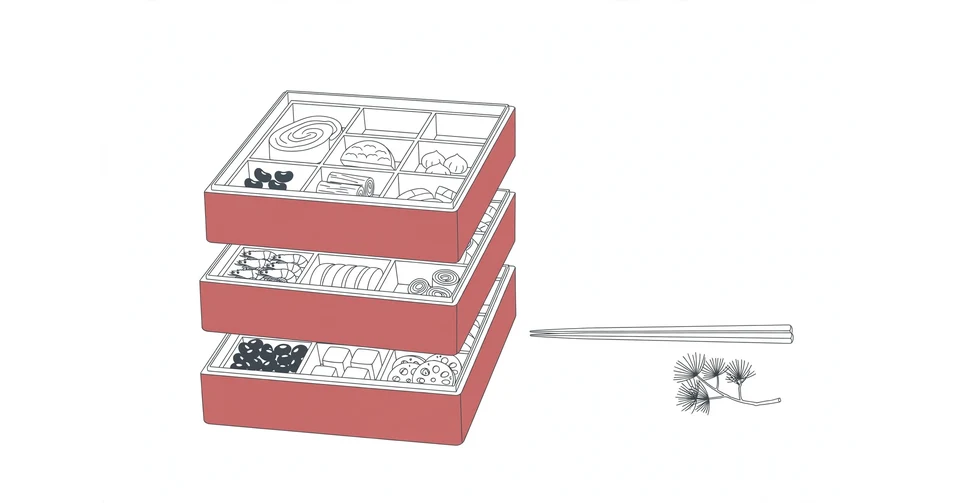
I first met osechi at a friend's house in Shizuoka, where the boxes were set out on the low table before anyone had properly woken up. I expected something formal and stiff, the kind of meal you admire and do not enjoy. What I found was closer to a picnic that had been planned for a week: cold dishes, small portions, everyone reaching across everyone else, and a grandmother watching to see which dish each person took first. She told me the dish you reach for says something about what you want from the year. I reached for the prawn. She laughed and said I had chosen a long life, which seemed like a safe bet.
What osechi is and where it comes from
Osechi, short for osechi ryori, is not one dish. It is a whole feast made of many small dishes, prepared in advance and eaten during the first three days of January, a period called sanganichi. The dishes are sweet, salty, sour, and savoury in turn, and they are served cold or at room temperature, straight from the boxes. The only hot thing on the table is usually the soup that comes with it.
The tradition is old. Just One Cookbook traces it back more than a thousand years to the Heian period, when food was offered to the gods at seasonal court ceremonies, and notes that by the late Edo period it had become the New Year feast we know today. The word itself comes from the seasonal festival days of the old calendar, of which the New Year was the first. That history explains the feeling of the meal. Osechi began as an offering, and it still eats like one: careful, deliberate, and shared.
For a long time the meal was also practical. The first days of the year were a holiday for the kitchen as much as for everyone else. In the past, families avoided cooking with fire, using knives, and serving meat during those days, because the food was a sacred offering and the hearth was meant to rest. Cooking everything in advance, in flavours that keep, was how a household could eat well for three days without lighting the stove. Most families no longer follow those old taboos strictly, but the shape of osechi still follows them: food made ahead, food that keeps, food that asks nothing of the cook on the day itself.
Inside the jubako, where the tiers do the talking
The boxes matter as much as the food. A jubako is a set of square lacquered boxes, usually black outside and red inside, that stack into a tower of two, three, four, or even five tiers. The stacking is itself the first wish. Layer upon layer, the boxes are said to represent happiness piling up on happiness, good fortune stacked the way the boxes are stacked.
There is a traditional order to the tiers, though few households follow it strictly today. The top box holds the celebratory dishes and sweets: kuromame, kazunoko, tazukuri, datemaki, kamaboko, and kuri kinton. The middle tier holds grilled and vinegared foods, prawns, sea bream, yellowtail, and kohaku namasu. The bottom tier holds the simmered foods: lotus root, taro, carrot, shiitake, and burdock. A fuller guide to the tiers and the dishes in them is laid out in the Food in Japan guide to osechi, which also explains how the arrangement varies by household and seller.
At the table, the tower comes apart. The tiers are unstacked and laid side by side, so everyone can reach every dish, and the boxes become a spread rather than a monument. Good jubako are often passed down through families, and the scratches on a well used set are part of its value. I like that detail. A box that has held a family's New Year for decades carries more meaning than a new one ever could, and the lacquer seems to know it.
The dishes and the wishes they carry
Every dish in osechi is an edible good luck charm, and most of the meanings come from wordplay. A name that sounds like a happy word, a shape that suggests a long life, a colour that means celebration. The meanings differ a little between regions and sources, so it is best to treat them as the common readings they are, not as rules carved in stone. With that caution in mind, here are the dishes that turn up in most boxes.
| Dish | What it is | The wish it carries |
|---|---|---|
| Kuromame | Black soybeans simmered sweet | Health and diligent work |
| Kazunoko | Salted herring roe | Many children, a flourishing family |
| Tazukuri | Small dried sardines, glazed | A bountiful harvest |
| Datemaki | Sweet rolled omelette | Learning and progress in studies |
| Kobumaki | Kelp rolls around fish | Joy and happiness |
| Kurikinton | Chestnut and sweet potato mash | Wealth, from its golden colour |
| Ebi | Simmered or grilled prawn | Long life |
Kuromame leads the top tier for a reason. The word mame means bean, but it also sounds like the word for working diligently and staying healthy, so the glossy black beans carry a wish to work hard and stay well through the year. Black is also the colour used in Japan to ward off evil, which gives the humble bean a second job. Kuromame is sometimes served with red pickled chorogi, a small curled tuber, for colour.
Kazunoko is the dish that surprises first timers most. It is herring roe, salted and then soaked in a light seasoned dashi, and it comes as a firm, golden sheet that breaks apart into thousands of tiny eggs. Because the eggs are so numerous, the dish stands for a family that continues and prospers. The wordplay helps too: kazu suggests number, and ko suggests children. It is briny and crisp, and it tastes like the sea decided to make a wish.
Tazukuri, also called gomame, is a handful of tiny dried sardines roasted and glazed with soy sauce, sugar, and sake until they shine. Farmers once used small sardines as fertiliser for rice fields, and a good catch meant a good harvest, so the little fish came to stand for plenty. In Kansai, pounded burdock root called tataki gobo often takes the place of tazukuri in the trio of essential dishes. Burdock puts down strong, deep roots, so it carries a wish for a long life and a stable household instead.
Datemaki is the sweet rolled omelette, made from egg mixed with fish paste or mashed shrimp, baked soft and rolled into a spiral. Its rolled shape resembles a scroll, so the common reading links it with learning and knowledge. Other sources disagree, and the agriculture ministry ties the dish to a kimono pattern and a wish never to lack clothing. I enjoy the disagreement. A dish with two explanations has been loved by two different kinds of people, and both of them were probably right about their own family.
Kobumaki is a roll of kelp wrapped around herring or another fish and tied with a strip of dried gourd. Kobu sounds like the end of yorokobu, the Japanese word for feeling happy, so the roll carries joy. Kurikinton is the golden mash of chestnut and sweet potato in syrup, and its colour does the talking: gold suggests coins, and coins suggest wealth. The prawn, ebi, is there for its shape. A cooked prawn curves like the bent back of an old person, so it wishes the eater a life long enough to bend the same way.
The full list of dishes and their meanings, with recipes for each one, is gathered in the Just One Cookbook guide to osechi ryori, which is the clearest English language starting point I have found for anyone who wants to cook a box from scratch.
Why osechi is cooked days ahead
Osechi is a meal that begins before the year does. Just One Cookbook suggests starting about five days before New Year, cooking the long lasting dishes first, then the vinegared dishes, and finishing with the simmered ones closest to the day. Kuromame simmers for hours. Kazunoko needs days of soaking and desalting. Nothing in the box is quick, and that is the point. The work is the offering.
The flavours are built to last. Sugar, salt, and vinegar are not just seasoning in osechi, they are preservation. Traditionally the dishes were seasoned heavily so they would keep for days without refrigeration, and modern recipes have lightened the seasoning now that every house has a fridge. Most dishes keep for two or three days chilled, which is exactly the length of sanganichi. The calendar and the cooking fit each other like the tiers of the box.
That is also why osechi tastes the way it does to a first timer: sweeter and saltier than an everyday Japanese meal, with a vinegared dish waiting to reset the palate between bites. Some people love it at once. Others need a year or two to come around, and that is normal. I did not love kuromame the first time I tried it. The beans were sweeter than I expected, and I ate them politely and moved on. By the third New Year, I was reaching for them first, and I understood that osechi is not a meal you judge in one sitting. It is a meal you grow into, the way you grow into a family.
How osechi changes by region
There is no single correct osechi, and the regions make sure of that. The celebratory trio at the top of the box is the clearest example. In Kanto, around Tokyo, it is usually kazunoko, kuromame, and tazukuri. In Kansai, around Kyoto and Osaka, pounded burdock often replaces the little sardines. The difference is small, three dishes on a crowded table, but it tells you how local the New Year is in Japan. Even the wishes change their accent from one region to the next.
Local specialties join the standard dishes all over the country. In Iwate, the vinegared dish may be hizu namasu, made from salmon head cartilage, thin and crunchy. In Kyoto, dried cod called bodara is simmered slowly until it turns tender. In Niigata, a thick simmered stew of taro and root vegetables called noppe may appear. In Kagawa, the New Year soup itself is the famous one, with mochi filled with sweet bean paste in white miso. These are not decorations on a standard meal. They are the meal, in the form each place knows best.
The modern box has widened further. Many households now buy ready made sets from department stores, supermarkets, convenience stores, restaurants, and hotels, and mix them with a few homemade dishes. A survey cited by Food in Japan reported an average price of about 29,098 yen for comparable three tier sets, which shows how seriously the market takes the tradition, and how widely the price can range. Some boxes now include roast beef, ham, smoked salmon, and other Western dishes beside the classics. Purists may grumble, but I think the grumbling misses the point. A tradition that cannot make room for a family's actual tastes is a museum piece, and osechi has survived for a thousand years precisely because it makes room.
How families eat osechi across sanganichi
The eating of osechi is slow, and the slowness is deliberate. The boxes are opened on the morning of January 1, and the family picks at them through the day, then again on January 2 and January 3. There is no fixed hour, no courses, no rush. People eat a little, leave the table, come back, and eat a little more. The food is there all day, like the holiday itself.
Beside the cold boxes sits the one hot dish of the season. Ozoni, the soup of pounded rice cakes, is made fresh each morning, and it is the most regional dish of the New Year. Our article on ozoni and the argument over what goes in it follows the broth from clear Kanto soup to white miso Kansai soup and the sweet filled mochi of Kagawa. Osechi and ozoni belong together on the table, the cold boxes and the hot bowl, the food made days ago and the food made that morning, and a household that serves one without the other is missing half the season.
The three days end the way they began, with a small ceremony. The kagami mochi, the pair of stacked rice cakes that has stood as an offering through the holiday, is broken open around January 11, and the pieces go into soup and sweet red bean dishes. The reason it is never cut with a knife is a story of its own, and it is the same instinct that runs through osechi: some things are not to be cut, only opened, shared, and eaten together.
Not everyone eats osechi every year. A survey of students in the Tohoku region, carried out between 1999 and 2004, found that about 79 percent ate ozoni every year, compared with about 48 percent for osechi. The survey covered one specific student group, so it is not a national estimate, but the gap feels honest to me. Soup is easy. A whole box of symbolic dishes takes planning, money, and a family that still gathers. The numbers suggest the tradition is alive but not automatic, and that is probably the truest thing you can say about any old custom.
What osechi tastes like the first time
If you are tasting osechi for the first time, start small and aim for contrast. Take one sweet dish, one vinegared dish, one seafood dish, and one simmered vegetable, and eat them slowly, with a bowl of hot soup if you can get one. Do not try to finish a tier. Nobody finishes a tier, and nobody is supposed to.
Expect the sweet and the salty to sit side by side in a way that feels unfamiliar at first. The kurikinton is dessert and not dessert. The kazunoko is crunchy and briny and gone in two bites. The kamaboko, the red and white fish cake, is mild and springy, and its half moon shape is said to recall the first sunrise of the year. The kohaku namasu, shredded daikon and carrot in vinegar, is the dish that saves the meal from its own richness, bright and crisp and sour in the best way.
My honest advice is to let the symbolism do its work and then forget about it. Eat the beans because they are good, not because they promise health. Eat the prawn because you like prawns, not because you want a long life. The wishes are a lovely frame, but the food has to stand on its own, and on a good year it does. The best osechi I have eaten was not the most expensive box or the most traditional one. It was the one where the cook had made the dishes her family actually liked, and left out the ones nobody touched, and nobody apologised for it.
A quiet way to start the year
Osechi packs a whole year of luck into stacked boxes because Japan once believed, and in some way still believes, that the way you begin a year shapes the year itself. Begin with food made slowly, begin with wishes spoken out loud in the form of dishes, begin with three days of not cooking and simply being together, and the year starts on a gentler note.
I think that is the real reason osechi has lasted. The luck is not magic. It is the effect of a household that took five days to cook for three days of rest, that sat down together on the first morning of the year, and that ate small dishes full of old meanings without needing to believe in all of them. The boxes stack, the days pass, and by the time the last piece of kamaboko is gone, the year has already begun, quietly, and with everyone fed.
More in Food & Travel
- Japan Goes Maple Hunting Every Autumn and Calls It Momijigari
- Koyo Turns Japan Into a Country That Forecasts Leaves
- Momiji-Gari Is Japan's Autumn Answer to Hanami
- Momiji Turns Japan Red Every Autumn
- Japanese Castles and the Samurai Fortresses That Still Stand
- Kongobuji Still Runs the Mountain Kukai Chose
Latest posts
- Fifteen Days of Basho Decide Who Sumo Remembers
- Kojiri Is the End Cap That Takes Every Knock for a Katana
- Kurikata Is the Chestnut Knob That Holds a Katana at the Hip
- Koshirae Is the Formal Mounting That Turns a Blade Into a Katana
- Shirasaya Is the Plain White Scabbard Where a Katana Rests
- The Togishi Polishes a Katana for Weeks Before It Ever Cuts
- Kozuka Is the Small Knife Hiding in a Katana's Saya
- Wakizashi Was the Short Sword a Samurai Never Took Off
- Tsuba Is the Small Guard That Stops a Katana From Cutting Its Owner
- Yokote Is the Small Line That Tells a Katana's Age
- Seppa Are the Thin Washers That Keep a Katana From Rattling
- Kissaki Is the Small Tip That Finishes a Katana
- Nakago Is the Hidden Tang That Carries a Katana's Signature
- Mekugi Holds a Katana Together With a Single Bamboo Pin
- Why a Katana Stays Put, Thanks to the Koiguchi