A Desa Adat Is a Village That Governs Itself
· 10 min read
A desa adat is Bali's customary village, a self governing community with its own members, temples, written rules and sanctions, running beside the state's administrative village and often mattering more in daily life.
Every village in Bali exists twice. On paper, it is an administrative unit of the Indonesian state, with an office, a letterhead, and a place in the regency's filing system. Underneath that paper village, older and much harder to abolish, runs a desa adat, a customary village that organises the same people's ceremonies, temples, land and obligations according to rules the community wrote for itself.
The two villages share the same streets and the same families, but they do different work and answer to different authorities. The state village can issue your documents. The desa adat can tell you when to build, where you may be buried, and what you owe the gods this month, and in the texture of ordinary Balinese life its voice is usually the louder one.
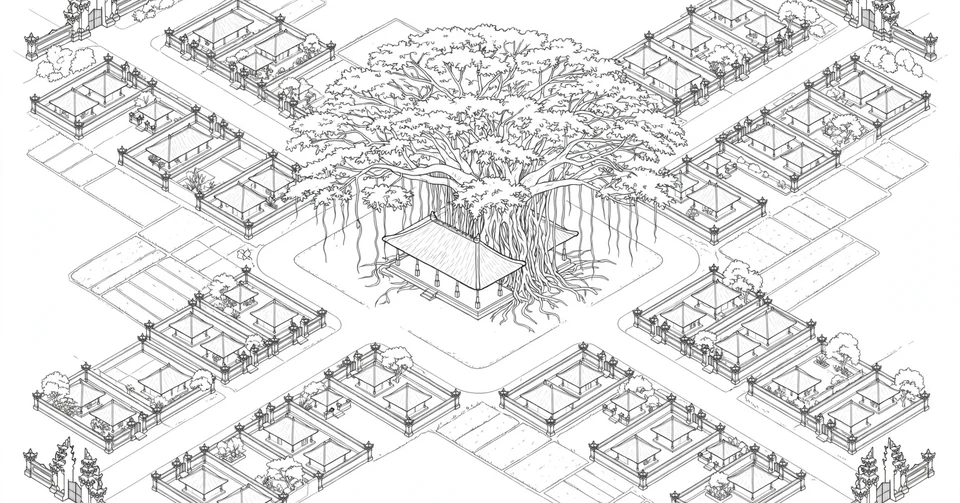
None of this is a survival or a museum piece. The desa adat is not what is left of Bali's village life after modern government arrived. It is a working government in its own right, running in parallel with the state one, and the arrangement is deliberate enough that Bali has written it into provincial law.
Two villages at the same address
The administrative half of the pair is the desa dinas, the service village. It is the lowest rung of Indonesian government, the office that handles identity cards, permits, correspondence with the regency, and the flow of state programs and state money into the village. Its officers work within the national bureaucracy, and its territory is drawn on official maps.
The desa adat works a different register entirely. Its concerns are custom, ceremony and the sacred geography of the village: the temples, the ritual calendar, the communal land, the order of processions, the settlement of disputes between neighbours. Where the desa dinas represents the state to the village, the desa adat represents the village to itself, and to its ancestors.
The two maps do not even match. Bali counts 636 administrative villages, while a senior provincial official, speaking in 2023, put the number of traditional villages at about 1,500 across the island's nine regencies and cities. There are far more customary villages than state ones, their borders were drawn by custom rather than by survey, and a single desa dinas may overlap several desa adat or sit inside just one. Nobody in Bali experiences this as duplication. It reads, from inside, as a simple division of labour: one village for the paperwork, one village for everything that makes the place Balinese.
What a desa adat actually runs
A desa adat is recognised by a set of features that researchers of Balinese custom have listed for decades. It has a defined territory, often bounded by natural lines, a river, a forest edge, a ravine, a ridge, a stretch of coast. It has a defined membership. It has its own customary government, a board of officers called prajuru adat, chosen from within the community. And it has the kahyangan tiga, the set of three village temples that anchor its ritual life, or temples serving the same functions.
Above all, it has autonomy. The customary village manages its own household: it holds assets, maintains its temples and public spaces, organises the ceremonies that structure the year, and decides its own internal affairs. Bali's 2019 provincial regulation on customary villages defines the desa adat in almost domestic terms, as a customary law community with its own territory, its own assets and traditions handed down through generations, and the right to organise and manage its own household.
The working philosophy underneath is tri hita karana, the threefold harmony that Balinese officials and scholars alike name as the frame for village life: parahyangan, harmony with the divine; pawongan, harmony among people; and palemahan, harmony with the natural world. It can sound like a slogan on a tourism banner, but at village level it is closer to a job description. The desa adat is the institution charged with keeping all three relationships in repair, through offerings and temple maintenance, through meetings and mutual help, through rules about land, water and trees.
I find this the most underreported fact about Bali. Visitors see temples, dances and offerings and file them under culture, as decoration on top of ordinary life. Underneath the decoration sits this dense, unpaid, self governing machinery that produces it all, village by village, meeting by meeting. The culture is not floating above the island. It is administered.
Membership is a job, not an address
Belonging to a desa adat is not automatic, and it is not free. The registered members of the customary village are called krama, and membership carries a defined bundle of rights and duties. A krama household has a voice in the paruman, the village assembly where decisions are made, officers are appointed and disputes are argued out. In return, the household owes the village its labour and its presence.
Much of that labour goes under the name ngayah, voluntary service offered to the community and its temples. Ngayah is the workforce behind everything the desa adat does: preparing ceremonies, repairing temple walls, cooking for festivals, standing guard. The village guards who keep order at ceremonies, the pecalang, are drawn from the krama of their own village and appointed through its assembly, a system I wrote about in You Can Read a Pecalang From Across the Street. The black and white checked cloth those guards wear, the same cloth that wraps the island's statues, is another piece of this membership made visible, as Bali Wraps Its Statues in Saput Poleng describes.
The rules of membership are written down. Each desa adat keeps an awig-awig, a customary rulebook that sets out the rights and obligations of the village and its krama: who belongs, what they owe, what is forbidden, and what happens to those who break the rules. The awig-awig is not folklore recited from memory. It is a document, drafted and revised by the community itself, and it functions as the village's constitution, customary in origin but legal in effect.
The village also runs a bank
The self government extends into money. Many desa adat own a financial institution of their own, the LPD, or Lembaga Perkreditan Desa, a village credit institution that takes savings from members and lends within the community. The LPD belongs to the customary village rather than to the state banking system, and its profits are expected to flow back into village life, supporting ceremonies, temple work and communal projects.
That arrangement makes the bank an organ of the desa adat, not a separate business that happens to share the village name. A debt to the LPD is, in the community's eyes, a debt to the village itself. Researchers writing about a case in Karangasem, in east Bali, describe a family that fell behind on its loan from the local LPD and found itself answering not to a collections department but to its own customary village, with consequences far beyond the loan. When the lender is also your temple community, your neighbours and your burial society, finance and custom are the same conversation.
Rules with teeth
A government that cannot punish is a suggestion, and the desa adat can punish. Its sanctions climb a ladder. At the lower rungs sit warnings, fines and forms of public shaming, calibrated to the offence and set out in the awig-awig. At the top sits kasepekang, the most severe sentence a Balinese customary authority can impose: the offending person, or an entire family, is cut off from membership and shunned by the community. A 2010 report in The New York Times, describing the growing weight of customary law in Indonesia, likened kasepekang to a social and spiritual death sentence, and the phrase has stuck because it is close to accurate.
The weight is practical, not just emotional. A family under kasepekang loses its standing as krama, and with it the services of the village: help at ceremonies, the labour of neighbours, access to communal facilities. Research on kasepekang cases has examined what happens to rights over village land held through the desa adat, and legal scholars have written at length about the bleakest edge of the sanction, the death of a person under kasepekang, in a place where burial itself is arranged by the village they have been expelled from. To be put outside the desa adat in Bali is to be put outside the structure that carries a life from birth to cremation.
This is also where the system grates against modern legal instincts. Indonesian law journals regularly debate whether kasepekang, imposed by an assembly under customary rules, can stand beside national law and basic rights, and cases occasionally force the question into the open. The tension is real and unresolved. Customary autonomy is protected and celebrated in principle; its harshest instrument tests the limits of that protection in practice.
The law caught up in 2019
For most of their history, these villages, long known as desa pakraman, ran on custom alone, recognised by the state in a general way but governed by their own documents. That changed in form, if not in spirit, with Bali Provincial Regulation Number 4 of 2019 on Customary Villages, which set the desa adat down in provincial law as an autonomous legal community and treated the awig-awig as a formal part of its structure. Scholars studying how the two village forms now operate together, as in a study of a village pair in Jembrana published by Universitas Negeri Surabaya, describe the same division of labour the law assumes: the customary village carries community participation and custom, the service village carries formal administration, and the two coordinate through meetings and deliberation.
Provincial support has followed the recognition. Bali's government speaks of strengthening the desa adat as cultural policy, and its governor has proposed that customary villages receive state financial support in the way administrative villages do. The direction of travel is clear. Rather than being absorbed into the state village or left to fade, the desa adat is being written more firmly into the formal structure of the island, on something close to its own terms.
What stays with me about the desa adat is how much of it runs on obligation rather than money. The state village has budgets, salaries and forms. The customary village has meetings that run long, labour that is owed rather than hired, rules that everyone helped to write and everyone is expected to keep. It asks a great deal of its members, and occasionally it punishes them harder than a modern reader will find comfortable. But it also explains something no ministry could organise from Jakarta or Denpasar: why, on an island of four million people and millions of visitors, the ceremonies are still prepared, the temples still repaired, and the calendar still kept. A desa adat is a village that governs itself, and in Bali, self government is not an idea. It is the roster for next week's work.
More in Culture & Society
Latest posts
- Shimekasu Was Herring You Never Ate
- A Hana Donko Wears Its Cracks Like Flowers
- A Lembaga Perkreditan Desa Is a Bank the Village Owns
- Kaburiyu Is How You Talk Your Body Into the Bath
- Kuki Is the Spring the Sea Turned White
- Tatsuko Wished for Beauty and Became a Statue
- Warangan Is the Wash That Reveals the Pattern
- Ganbanyoku Is Bathing Without Water
- The Obuki Throws Out Nine Thousand Litres a Minute
- Every Village Writes Its Own Awig-Awig
- Sainokawara Is a Bath You Share With a Hundred Strangers
- Umaji Refused to Disappear
- Rwa Bhineda Keeps Opposites From Going to War
- Kasepekang Is Exile Without Leaving Home
- Jamasan Washes a Blade Thinner Every Year