Nyepi Stops an Entire Island for a Day
· 9 min read
Nyepi is the Balinese day of silence, when an entire island closes for 24 hours, with no fire, no work, no travel and no entertainment, and even the airport shuts. This is how Bali keeps its new year, and why everyone on the island, visitors included, is bound by it.
Once a year, one of the busiest tourist islands on earth switches itself off. For 24 hours there are no flights, no traffic, no open shops and no lights showing after dark, and an island of millions stays indoors. This is Nyepi, the Balinese day of silence, and it is not a metaphor or a marketing slogan. The whole island really does stop.
The silence of Nyepi runs from six in the morning until six the following morning. Bali's only airport closes for the entire day, the roads empty completely, and the only people outside are village guards on patrol. Everyone else, Balinese Hindu or visiting tourist, Muslim or Christian, resident or backpacker, stays inside and keeps the lights off.
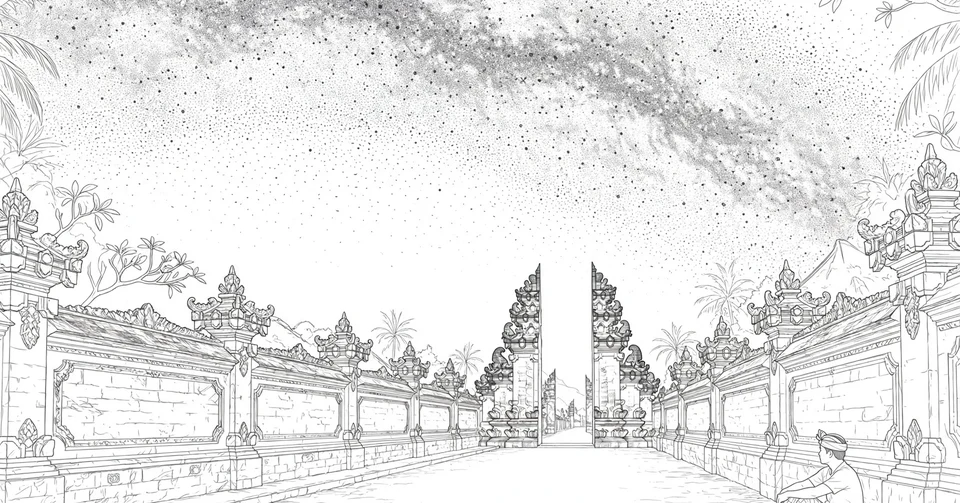
What surprises most people is that this total shutdown is a new year celebration. Nyepi is the new year of the Balinese Saka calendar, and where most cultures greet a new year with fireworks, countdowns and noise, Bali greets its own with fasting, meditation and absolute quiet.
A new year that begins with nothing
The word Nyepi comes from the Balinese word sepi, which means silent. The observance marks the turning of the Saka year, a calendar whose era is traced back to 78 AD, and Nyepi usually falls in March, on a date that shifts from year to year with the lunar cycle. Wikipedia's entry on Nyepi traces the custom to the start of that era, which makes it one of the oldest continuously kept new year observances anywhere.
The logic behind the silence works on two levels at once. On the surface, the darkness and emptiness are meant to fool passing demons and malevolent spirits into believing the island is uninhabited, so that they move on and leave Bali alone for another year. Underneath that story sits a plainer and more demanding purpose: the day is set aside for self reflection, fasting and meditation, a deliberate pause in which people examine the year behind them before stepping into the next one.
I find that combination hard to argue with. Most new year traditions ask you to celebrate your way into January and hope the resolutions survive the month. This one asks you to stop first, sit with yourself in the dark for a day, and only then begin. It is a severe idea, but there is an honesty to it that fireworks never quite manage.
The four restraints of Nyepi
The day is governed by four prohibitions known together as the catur brata penyepian. The first is amati geni, no fire and no light. Cooking fires stay cold, lamps stay off, and electricity is kept to the barest minimum, so that after sunset on the night of Nyepi the island is genuinely dark in a way few inhabited places ever are.
The second is amati karya, no working. Shops, offices, markets and restaurants close, hotel staff stop cooking and cleaning rooms, and the ordinary machinery of a tourism economy is simply switched off. The third is amati lelungan, no travelling. Nobody journeys anywhere, nobody is out on the roads, and the streets belong to the patrols alone. The fourth is amati lelanguan, no entertainment and no indulgence, which for the devout also means fasting and silence in the fullest sense.
How strictly each household keeps the four restraints depends on how religious that household is. The devout spend the day in meditation and fasting. Others observe the outward rules, staying home and keeping the lights off, while eating and reading quietly indoors. What nobody does, whatever their private practice, is break the public shape of the day. The streets stay empty and the island stays dark, and that shared surface is what makes Nyepi visible from space rather than merely felt at home.
The loudest night of the year comes first
Nyepi does not arrive quietly. Three or four days beforehand, villages hold the Melasti ritual, carrying sacred temple objects in procession to the sea to be purified and to draw sacred water for the year ahead. Then, on the eve of Nyepi, Bali holds what might be the loudest night of its entire year.
The eve belongs to the Bhuta Yajna ceremonies, also called Tawur Kesanga, held to restore balance and to drive out negative forces before the new year. In homes, the pengerupukan ritual fills the dusk with noise as families bang pots and pans and wave burning torches of dried coconut leaves to chase demons out of every corner. Outside, the villages parade their ogoh ogoh, huge demonic statues built over months from bamboo, papier-mâché, cloth and tinsel, each one carried on the shoulders of a dozen or more men.
The bearers spin the figures three times at road intersections to disorient the spirits they represent, gamelan crashes, crowds shout, and the whole island seems determined to use up a year's worth of noise in a single evening. Afterwards the statues are burned in the village cemeteries, the crowds go home, banks switch off their cash machines, restaurants close early, and the roads fall silent on schedule. The contrast is the point. Bali is not an island that has forgotten how to make noise. It is an island that chooses, with total discipline, when the noise stops for Nyepi.
This is also a culture entirely comfortable with ceremony at full volume. The same villages that keep the silence stage cremations that take a whole community years of preparation, as I wrote about in my piece on how a ngaben can take a village years to prepare. Nyepi is the other end of that same ceremonial spectrum, proof that the island's restraint is as organised as its spectacle.
The day the airport closes
The most famous single fact about Nyepi is what happens at Ngurah Rai International Airport. For the full 24 hours of the silence, the airport closes completely. No arrivals, no departures, no exceptions for commercial flights, and the closure is printed into airline schedules long in advance. The South China Morning Post's account of surviving Nyepi describes it as the only airport in the world that closes all day for religious reasons, a claim that official tourism sources in Indonesia repeat often, and one that no other airport seems in a hurry to dispute.
The closure catches out a few travellers every year, usually people who booked a multi leg trip without checking the Balinese calendar. Ferries stop too, so once Nyepi has begun there is no leaving by sea either. Outside the island, meanwhile, nothing changes at all. On nearby Lombok the beaches and shops stay open and the lights stay on, and a share of Bali's foreign residents traditionally decamp there the day before. The silence is not an Indonesian thing or a regional thing. It is a Balinese decision, kept inside Balinese borders, and it ends exactly at the water's edge.
Who keeps the silence, and who it binds
A shutdown this complete needs somebody awake inside it. The only people allowed on the streets of Bali during Nyepi are the pecalang, the traditional security officers of the customary villages, who patrol through the day and night to make sure the prohibitions are kept. I described their checked cloth and their unpaid service in my article on how you can read a pecalang from across the street, and Nyepi is the day their role matters most, because they are quite literally the island's only moving authority. The sole other exceptions are emergency vehicles answering life threatening calls, and women on their way to give birth.
Nobody on the island is exempt, and that includes the visitors. Tourists are free to do as they like inside their hotel rooms, but they may not go out onto the streets or the beaches, and hotels themselves dim their lights, stop noisy activities and serve food prepared in advance. Rule breakers can be detained by the pecalang whatever their nationality, and visitors have in past years been deported for ignoring the restrictions. It sounds harsh written down, but one day of stillness is a small price for being a guest in somebody else's new year, and most travellers who plan for Nyepi honestly end up describing the day as the best part of their trip.
A sky that cities never see
There is one reward the island keeps for those who keep the rules, and it comes after dark. With every lamp, sign and streetlight switched off across an entire island, light pollution does not merely dip. It collapses. On a clear night the stars come out over the middle of ordinary villages with a density that people from big cities simply never see, and the band of the Milky Way stands overhead in full view of anyone sitting quietly in a dark garden.
Photographers and sky watchers who have spent the night in Bali regularly describe it as one of the great stargazing nights of the year, and the Nyepi night happens not on a remote mountain but above rooftops, rice fields and temple streets. The next morning, waking before dawn on the day after the silence, travellers report a sky still brimming with stars as the birdsong starts up again. For one night a year, an island famous for what it shows tourists in daylight becomes famous for what it hides from them after dark.
The morning the fire comes back
At six the following morning, the day ends as precisely as it began. The day after Nyepi is called Ngembak Geni, the relighting of the fire, and cooking resumes, families and friends visit one another, and people ask forgiveness of each other for the faults of the year just closed. The airport reopens, the scooters come back, the cafes lift their shutters, and Bali returns to being Bali with a speed that makes the previous 24 hours feel almost like a shared dream.
What stays with me about Nyepi is not the strangeness of an island switching itself off. It is the agreement underneath it. Millions of people, plus every guest among them, accept the same four restraints on the same day because their community decided, centuries ago, that a year should begin in silence rather than in noise. Modern life is mostly a competition to be louder, brighter and harder to ignore. Once a year, Bali runs the experiment in reverse, and finds the demons, and perhaps a few of its own, have moved on.
More in Culture & Society
Latest posts
- Shimekasu Was Herring You Never Ate
- A Hana Donko Wears Its Cracks Like Flowers
- A Lembaga Perkreditan Desa Is a Bank the Village Owns
- Kaburiyu Is How You Talk Your Body Into the Bath
- Kuki Is the Spring the Sea Turned White
- Tatsuko Wished for Beauty and Became a Statue
- Warangan Is the Wash That Reveals the Pattern
- Ganbanyoku Is Bathing Without Water
- The Obuki Throws Out Nine Thousand Litres a Minute
- Every Village Writes Its Own Awig-Awig
- Sainokawara Is a Bath You Share With a Hundred Strangers
- Umaji Refused to Disappear
- Rwa Bhineda Keeps Opposites From Going to War
- Kasepekang Is Exile Without Leaving Home
- Jamasan Washes a Blade Thinner Every Year