A Rotenburo Is a Bath With Weather
· 12 min read
A rotenburo takes the Japanese hot spring bath outdoors, where snow, rain, autumn leaves and the night sky all become part of the soak. Here is what makes an open air bath different, and where to find the great ones.
Every onsen promises hot water. A rotenburo promises hot water plus whatever the sky happens to be doing that day. It is the same bath, moved outside, and that single change quietly rewrites the whole experience, because the weather stops being something you escape on your way in and becomes something you soak in once you are there.
The word itself is honest about this. A rotenburo is simply an open air bath, a tub of hot spring water with no roof over it, or at most a small shelter above one end. An indoor bath is a controlled room, identical in January and in August. An outdoor one is never the same bath twice, and regulars will tell you that is precisely the point.
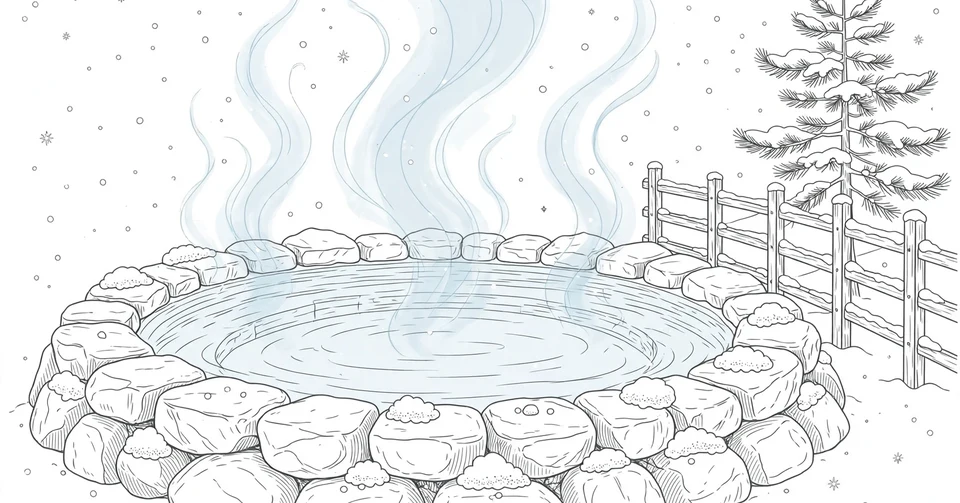
I live in Shizuoka, where outdoor baths look out over tea fields and, on the clearest days, the long shoulder of Mount Fuji. My favourite soaks here have rarely been the warmest or the grandest. They have been the ones where something was happening overhead, a shower of rain, a full moon, the first cold wind of October. The water does its work below the surface. The sky does the rest.
What a rotenburo is, and what it is not
A rotenburo can be almost any shape. The classic version is a pool of rough stone set into a garden or a hillside, but you will also find tubs of cedar wood, of ceramic tile, even a single round pot sunk into a wooden deck for one person at a time. Some are fed by famous mineral springs and some by plain, clear water that smells of nothing at all. A few are wild things, pools dammed off at the edge of a river or dug where hot water seeps out of a beach, but most belong to a ryokan or a day spa and are looked after as carefully as any indoor bath.
What it is not is a swimming pool, and it is not a jacuzzi. The water is for sitting in, up to your shoulders, doing nothing. There are no lanes, no jets worth mentioning, and usually no roof, which means there is also no ceiling between you and the season. Many rotenburo do have a partial cover, a thatch or wooden canopy over one corner, so you can choose between full exposure and a little shelter. That small choice, out in the weather or tucked under the eaves, is one of the quiet pleasures of the format.
The other thing a rotenburo changes is your body. Indoors, everything is warm, including the air on your face. Outdoors, your body sits in water at around 40 degrees while your head stays out in the cold, and the contrast is the sensation people travel for. Your shoulders steam. Your cheeks go pink and stay cool. Snow, when it comes, lands on your hair and melts there slowly. Japanese has a relaxed fondness for this arrangement, and once you have felt it on a winter night, indoor baths can start to feel faintly airless by comparison.
One rotenburo, four different baths
Ask a Japanese bather when to visit a rotenburo and the honest answer is that it depends which bath you want, because the pool stays the same and everything above it changes.
Winter is the season the rotenburo is famous for. Bathing while snow falls has its own name, yukimi-buro, snow viewing bathing, and it is exactly what it sounds like. You slide into water hot enough to make the air above it shimmer, and the flakes come down through the steam and settle on the stones, on the fence, on the bathers. Mountain inns in the snow country of Tohoku and the Japan Alps can sit inside two or three metres of accumulated snow, and guides to snow onsen suggest planning for January or February, when the cover is most reliable. On the coldest, stormiest days some inns close their outdoor baths altogether, which tells you something about how real the weather is up there.
Spring softens everything. The maples and mountain cherries around the bath turn fresh green, petals drift onto the water, and the evenings stop biting. Rain, which sounds like a reason to stay inside, turns out to be one of the great rotenburo weathers. Sitting in hot water while rain stipples the surface around your shoulders, listening to it drum on the wooden fence, is a soak people describe to each other for years.
Summer moves the bath to dusk. A mountain rotenburo in the early evening, with cicadas going in the trees and the air finally cooling, is a different creature from the same bath at noon in August heat, when even the keenest bather keeps the soak short. And autumn is the season the photographers wait for, when the maples over the fence turn and the whole pool borrows their colour. By night, at altitude, a clear rotenburo offers the simplest luxury of all, a dark sky full of stars and nobody asking you to look at anything else. Manza Onsen in Gunma, at 1,800 metres, markets itself as the hot spring closest to the stars, and sitting in its outdoor bath after dark, you can see why the claim sticks.
Three outdoor baths worth the trip
Takaragawa Onsen in Minakami, Gunma, is the rotenburo most people picture first. A single inn, established in 1923, keeps four enormous baths strung along the clear Takara River, adding up to some 470 tatami mats of bathing space. The oldest, Maka-no-yu, dates from 1940, and the water runs through all of them free and fast, around 1,800 litres a minute, faintly milky and smelling of sulfur. Three of the big pools are mixed bathing, with simple bathing garments provided, and one is reserved for women. It is busy, famous and completely unbothered by either fact.
Tsurunoyu, in the Nyuto Onsen group in the mountains of Akita, is the other end of the scale. It is the oldest inn in a cluster of seven, a place of thatched roofs and oil lamp light, and its outdoor pool is filled with opaque milky blue water that hides everything more than a few centimetres below the surface. Women reach that rotenburo through a corridor at water level, so they are covered by the water itself from the moment they enter. In winter the whole valley is buried in snow, and the bath steams away under it as if nothing unusual were happening.
Shirahone Onsen, in a valley of the Northern Alps in Nagano, takes its name from the colour of its water, white as bone. The best known inn there, Awanoyu, keeps a wide, shallow rotenburo of bluish white sulfur water, gentle at around 37 degrees, that you can sit in for a long time watching the light change on the opposite slope. Three famous baths, three completely different arguments for leaving the roof off.
When the outdoor bath is shared by everyone
Many of the great rotenburo are konyoku, mixed bathing pools, and that is not a modern experiment. For most of Japanese history, bathing together was simply the default, at village springs and town bathhouses alike. It was only in the Meiji era, when the government wanted to look respectable to Western visitors, that separation was pushed and mixed bathing began its long retreat. What survived is almost entirely rural, the mountain inns and old spring villages where the custom never quite died.
Today a mixed rotenburo runs on the house rules of the particular inn, and they vary. Some ask everyone to wear a yuamigi, a thin bathing garment handed out at the door. Some set women only hours each day. The opaque, milky waters of places like Tsurunoyu do a lot of the work by themselves. If you want the fuller picture of how these baths work and why they are disappearing, this guide to mixed bathing in Japan is worth reading before you go. The short version is that a konyoku rotenburo asks for the same thing every Japanese bath asks for, washed bodies, quiet behaviour and eyes politely on the scenery, and in return it gives you the oldest version of the culture there is.
Garden tubs, room baths and the private option
Not every rotenburo is a destination in itself. The commonest kind in Japan is the garden bath of an ordinary ryokan, a modest pool behind the building where guests drift out after dinner in their yukata. It might hold six people, it might look at nothing more special than a pine tree and a bamboo fence, and on a cold night it is still the best seat in the house. A step up from that, many inns now build rooms with their own small rotenburo attached, a private tub on a balcony or terrace where the weather is included but the company is your own. These rooms cost more, and for people who plan their whole trip around one long evening soak, they tend to be worth it.
If you want the open air without either strangers or a luxury room bill, there is a middle path. Plenty of inns rent their baths out privately by the hour, and my guide to kashikiri, the private onsen bath you book by the hour, covers how that system works. Some of those bookable baths are rotenburo, fenced off behind the inn, and they are the easiest first outdoor bath I know for couples, families and anyone with tattoos to worry about. Day visitors can use many shared rotenburo too, usually for a few hundred yen on top of the normal bathing fee, as long as they arrive before the afternoon cut off time.
The water matters more outdoors
A big open pool is thirsty. It cools at the surface, it gathers leaves and dust, and it can hold a lot of bathers at once, so the inns that run famous rotenburo tend to be proud of how their water arrives. At Takaragawa the flow is the headline number, all those litres a minute pouring in at one end and out at the other. The proudest phrase in the onsen world is gensen kakenagashi, spring water that flows straight from the source into the bath and away, never recycled, and it is no accident that so many celebrated outdoor baths make a point of it. Indoors, treated and recirculated water can hide. Under an open sky, with steam coming off the surface and the weather getting in, fresh water simply feels different, cleaner on the skin and livelier, and bathers learn to tell.
Same rules, fresh air
The etiquette of a rotenburo is the etiquette of any Japanese bath, worn outdoors. You wash your whole body at the washing stations before you get in, thoroughly, because the bath is for soaking and never for cleaning. Your small towel stays out of the water, folded on the rim or on your head. Long hair gets tied up. Phones and cameras stay in the changing room, a rule that matters even more where the bath is open to the sky and the view is tempting. If the rotenburo is mixed, the current health ministry guidance puts the age limit for children bathing across the sexes at around seven, though prefectures set their own numbers, so families should check the local rule rather than assume.
Two small outdoor habits are worth adding. Move slowly between the changing room and the water in winter, because the deck and the stone steps ice over, and inns in snow country lay out mats and ropes for a reason. And when the wind is up, keep your soaks a little shorter than usual. A cold head can trick you into thinking the rest of you is fine, long after the hot water has done enough.
The honest trade offs
An open roof lets in everything, and not everything is poetry. Autumn leaves fall into a rotenburo by the handful, and while the staff skim the surface constantly, you will share the water with the occasional leaf, pine needle or adventurous beetle. Summer brings insects to the evening lamps. Rain can turn the short walk back to the changing room into a cold dash, and a genuinely stormy day can close a mountain bath entirely, for falling branches as much as for comfort. None of this is a flaw in the design. It is the design. The same opening that lets the snow in lets the beetle in, and you do not get to order one without the other.
I have come to think that is the rotenburo's real lesson, if a bath can be said to have one. An indoor bath is Japan taking perfect care of you, every variable controlled. A rotenburo is Japan inviting you outside and trusting you to enjoy what the day actually brought. The water is always ready. The weather is whatever it is. Sit down in the warmth, put your head out into the cold, and take both as they come.
More in Life & Style
Latest posts
- Kombu Is the Quiet Half of Dashi
- Irezumi Was an Art Before It Was a Warning
- The Oshi Kept Fuji's Pilgrims Fed, Housed, and Devout
- Every Prefecture Argues About What Goes in Ozoni
- Japan's Population Decline and the Villages It Leaves Behind
- Kecap Manis and the Sweet Soy Sauce of Indonesia
- In Mamoiada, Two Hundred Families Still Make Wine at Home
- Shochu and the Quiet Spirit of Japan
- A Dried Shiitake Is Louder Than a Fresh One
- Maruten Numazu and the Towering Kakiage Bowl of the Port
- The Three Sisters Grow Better Together
- Half the Old Springs in Japan Thank Kobo Daishi
- Tatamiishi Terraces Filter a River Through Stone
- Wasabi-Zuke Puts the Whole Plant in Sake Lees
- Karo Is the Tengger's Other Great Gathering