Jakarta's MRT, the Subway That Changed a Megacity
· 8 min read
The Jakarta MRT opened in 2019 as Indonesia's first metro railway, and it now carries an average of about 127,000 passengers a day. This is how it happened, and where the line goes next.
Jakarta spent decades as the biggest city in Southeast Asia without a subway. Its traffic jams were famous around the world, and every plan for a metro seemed to stall. Then, on 24 March 2019, the Jakarta MRT opened its doors, and the city finally had a train that ran under its streets. It was Indonesia's first metro railway, a 15.7 kilometre line from Lebak Bulus in the south to Bundaran HI in the centre, and it changed how millions of people think about getting around.
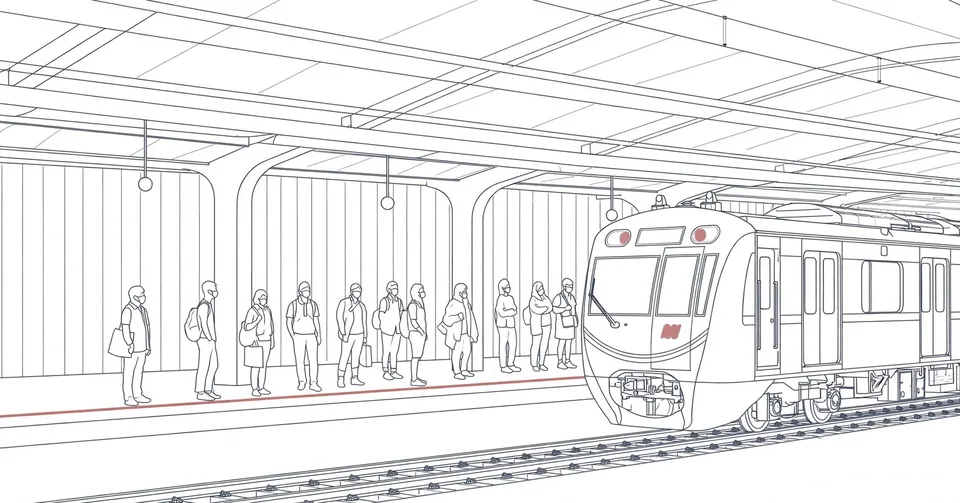
The numbers tell the story. In 2025 the Jakarta MRT carried an average of about 127,000 passengers a day, and in 2026 a single day set a record of 204,570 riders. For a line with just 13 stations, that is a remarkable load. It shows that Jakartans were ready for a train all along. They only needed someone to build one.
A city that waited decades for a subway
Jakarta first talked about a subway in the 1980s. The city was growing fast, the roads were filling up, and a train seemed like the obvious answer. But the plans kept collapsing. Money ran out, governments changed, and the 1997 Asian financial crisis buried the idea for years. It was not until 2013 that construction finally began, with funding and engineering support from Japan, the country that built the world's first bullet train. Six years later, the first trains were running. The wait had lasted more than three decades, which is why the opening felt like a national event rather than just a new train line.
Anyone who has sat in Jakarta traffic understands the appeal of the Jakarta MRT. A trip of ten kilometres can take two hours in a car, and the city's buses fight the same jams. The Jakarta MRT simply goes underneath all of it. The southern half of the line runs on elevated tracks above the traffic, and the northern half dives underground through the busiest streets in the city. For the first time, a journey across Jakarta had a time you could trust, and that changed how people planned their days.
Building it was the hard part. The southern stations went up quickly on elevated viaducts, but the northern half had to be dug by hand and machine through some of the busiest ground in the city, under roads that could not close and buildings that could not move. The tunnels pass beneath the Thamrin and Sudirman corridors, the financial heart of Jakarta, and the stations there sit deep underground, reached by long escalators. When construction reached the old town for Phase 2A, diggers found historic remains buried under Kota, and the design was adjusted to preserve them rather than push through. A subway under a four-hundred-year-old city has to negotiate with history, not just with rock.
What the Jakarta MRT looks like today
The Jakarta MRT line has 13 stations. The seven southern stations, from Lebak Bulus to ASEAN, stand on elevated tracks, while the six northern stations, from Senayan to Bundaran HI, run underground. Trains come every few minutes during rush hour, and the ride from one end to the other takes about half an hour, a trip that can take two hours by road. The stations are clean, air-conditioned and easy to navigate, with clear signs in Indonesian and English, and the fare is paid with a card or a phone, much like the tap-in systems that Japanese commuters have used for years.
The trains themselves are six-car sets built by Japanese manufacturers, the same kind of partnership that supplied the first 16 train sets for Phase 1 and eight more for Phase 2A. Inside they are wide, bright and air-conditioned, with priority seats and space for wheelchairs and prams. There is nothing flashy about them, and that is the point. A metro train is a tool, and the Jakarta MRT treats it as one: built to carry a lot of people, every few minutes, without fuss. You can read the full history of the system on Wikipedia.
The ridership of the Jakarta MRT keeps growing. An average of about 127,000 passengers a day in 2025 is far above the early years, and the record day of 204,570 riders in 2026 shows how much headroom the line still has on its busiest days. The stations fill up with office workers in the morning, students in the afternoon, and families on weekends heading to the malls and parks around Bundaran HI. What began as a single line has become part of the city's daily routine, and Jakartans now plan their lives around the Jakarta MRT.
The Jakarta MRT line to Kota
The next step is Phase 2A, a 5.8 kilometre underground extension from Bundaran HI to Kota, the old city in the north. It will add seven stations: Thamrin, Monas, Harmoni, Sawah Besar, Mangga Besar, Glodok and Kota. As of September 2026, construction was about 65 percent complete. The first segment, from Bundaran HI to Monas, is targeted for completion by the end of 2027, and the full route should open in 2029. The project costs about Rp25.3 trillion, funded through a loan under cooperation between the Indonesian and Japanese governments, a reminder that the Jakarta MRT has been a joint effort from the start.
When it opens, the Jakarta MRT will finally reach the places tourists actually want to see. Monas, the National Monument, sits at the heart of the city, and Kota is home to the colonial-era old town, museums and cafes. Today those places are a long bus ride from the nearest MRT station. After 2029, a visitor will be able to ride one train from the south of the city to the old town in the north, and that will change the map of Jakarta for tourists as much as for residents. The new stations are being built as transit-oriented developments, with offices, shops and public space above and around them, and the Harmoni station area is already being shaped into one of the biggest such hubs on the line, as Berita Jakarta reported.
Here is how the Jakarta MRT network looks today, and what is coming next.
| Line | Length | Stations | Status |
|---|---|---|---|
| Phase 1, Lebak Bulus to Bundaran HI | 15.7 km | 13 | Open since 2019 |
| Phase 2A, Bundaran HI to Kota | 5.8 km | 7 | Opening in stages to 2029 |
| East-West, Balaraja to Cikarang | Not yet announced | Not yet announced | Construction from 2026 |
The East-West line and what comes after
The line after that runs east to west. The East-West line of the Jakarta MRT will connect Balaraja in the west to Cikarang in the east, crossing the whole of Greater Jakarta, and construction starts in 2026. It is the most ambitious part of the plan, because it links the industrial towns on the edge of the city with the centre, where most of the jobs are. For the thousands of workers who now spend hours on buses and motorcycles every day, a cross-city train would be the biggest change of all.
What riding the Jakarta MRT feels like
Riding the Jakarta MRT is a quiet experience, and that is part of the point. The trains are cool and clean, the announcements are calm, and passengers mostly keep to themselves, phones in hand, headphones in. It feels different from the rest of Jakarta, which is loud and crowded and always in a hurry. That contrast is probably why people love the Jakarta MRT. For half an hour, the city stops pushing you around, and you get to sit still and watch it pass by through the window.
Why the Jakarta MRT matters beyond the ride
A subway does more than move people. Property prices near the Jakarta MRT stations have risen, new offices and apartments cluster around the stops, and the city is slowly learning to build upwards instead of outwards. The stations are also becoming interchanges. At Dukuh Atas, the Jakarta MRT meets the KRL Commuterline, the airport rail link and the TransJakarta busway, so one station can start a journey almost anywhere in the region. That kind of connection is what turns a single line into a network, and it is the reason the area around Dukuh Atas is now one of the busiest transport hubs in the city. There is also a quieter change. Jakarta's air is cleaner on the corridors the train serves, because every rider is one less car on the road. The Jakarta MRT will not solve the city's traffic on its own, and nobody serious claims it will. But it proved something important: that Jakarta can build world-class infrastructure, and that its people will use it the moment it exists.
The Jakarta MRT began as a promise that took thirty years to keep. Today it is the most reliable way to cross the city, and in a few years it will reach the old town and then run east to west across the whole metropolis. The next time you are stuck in Jakarta traffic, look down. Somewhere below the jam, a train is already moving.
More in Tech & Internet
Latest posts
- Love Live Sunshine and How Anime Changed Numazu
- Numazu Deep Sea Aquarium and the Creatures of Suruga Bay
- Numazu Himono and the Art of Dried Fish
- Numazu Imperial Villa and Japan's Seaside Imperial Retreat
- Numazu Port and the Freshest Seafood in Shizuoka
- The E33G Remote Worker Visa and How to Legally Work from Bali
- Wabi-Sabi and the Japanese Beauty of Imperfect Things
- Bullet Climbing Mount Fuji, the Overnight Ascent Japan Is Trying to Stop
- Women Only Train Cars in Japan and the Problem They Answer
- Climbing Mount Semeru, Java's Highest Volcano
- Maneki Neko and Japan's Beckoning Lucky Cat
- Tamago Sando and Japan's Konbini Egg Sandwich
- The Baduy People and Life Without Modern Technology
- The Salaryman and Japan's Loyal Office Culture
- Onsen Tattoo Rules in Japan and How They Are Slowly Changing