Okonomiyaki and the Savory Pancake Japan Cooks at the Table
· 10 min read
Okonomiyaki is Japan's savory pancake, a cabbage and batter dish that Osaka mixes and Hiroshima layers, born from wartime scarcity and now cooked at the table across the country.
Stand in front of a hot iron plate in Osaka and you will smell okonomiyaki before you see it. Cabbage sweetens as it cooks, batter crisps at the edges, and a sweet brown sauce goes on last with a zigzag of mayonnaise. It looks like a pancake, it eats like a meal, and it is one of the most democratic dishes in Japan, because the name itself tells you to make it your own way.
Okonomiyaki means, roughly, grilled as you like it. The base is simple, wheat flour batter, shredded cabbage, egg, and a filling of your choice, usually pork belly or seafood. What makes the dish interesting is not the recipe but the argument around it. Osaka and Hiroshima both claim it, both cook it differently, and both are right. This is the story of a dish that started as a cheap snack, survived a war, and became a point of civic pride.
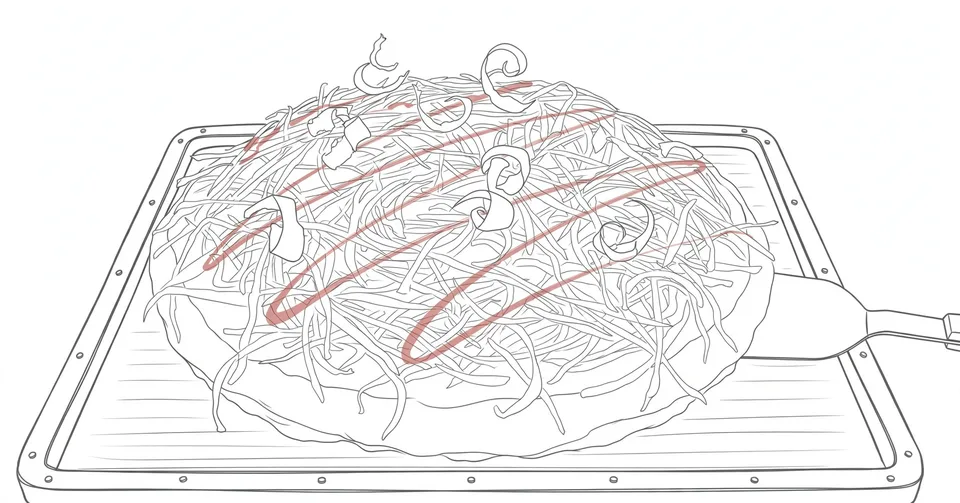
What the name means
The word okonomiyaki breaks into two parts. Okonomi means as you like it, or what you like, and yaki means grilled. Put together, the name is less a recipe than a permission slip. There is no single correct filling, no fixed list of toppings, and no authority that can tell a cook they have done it wrong. If it is grilled and it is as you like it, it qualifies.
That freedom is built into the way the dish is classified. Okonomiyaki belongs to konamono, the family of flour-based Japanese food that also includes takoyaki, the octopus balls sold on the same streets of Osaka, and the noodles that fill so many bowls across the country. Flour, water, and heat are the foundation. Everything else is a choice, and the choice is the point.
The freedom also explains why the dish travels so well. A cook in Osaka, a cook in Hiroshima, and a cook at home in Tokyo can all make something they call okonomiyaki, and all three can be right, even though the three plates look nothing alike. The name does not describe a shape. It describes an attitude.
From a tea sweet to a wartime meal
Okonomiyaki did not appear out of nowhere. Its family tree reaches back to the sixteenth century, to a thin crepe-like sweet called funoyaki, which tea master Sen no Rikyu is credited with serving. The sweet evolved over the centuries, and by the Meiji era a related snack called monjiyaki was popular with children at dagashiya, the small shops selling cheap sweets, where letters and pictures were drawn in flour batter on a hot iron plate. The line from a tea ceremony sweet to a street snack took three hundred years, and it was still moving.
The word okonomiyaki itself first appeared at a shop in Osaka in the 1930s, as Wikipedia's history of the dish records. Two hardships then pushed the dish into its modern form. After the Great Kanto earthquake of 1923, when people in Tokyo lacked amenities, cooking these crepes became a popular pastime. Then, after the Second World War, when rice was in short supply, okonomiyaki emerged as an inexpensive and filling dish for all ages, made from flour, cabbage, and whatever savory topping was at hand. Scarcity gave the dish its shape. Cabbage was cheap, flour was cheaper than rice, and a hot plate could turn both into dinner.
Hiroshima has its own version of that story. After the atomic bombing of 1945, food was scarce, and locals began cooking a cheap snack called issen yoshoku, a flour and water batter fried on an iron plate, topped with green onion or bonito flakes, and folded in half. Gradually they added cabbage, egg, slices of pork, and fried noodles, and the snack grew into the layered dish the city is now famous for. The dish carries that history in its construction. It was built up, layer by layer, because each layer was added when it became available.
Osaka mixes, Hiroshima layers
The rivalry between the two great styles is friendly, but it is real, and every visitor to Japan is eventually asked to pick a side. The difference is not the ingredients, which are mostly the same, but the method. Osaka mixes everything into the batter and cooks it like a pancake. Hiroshima builds the dish in layers, like a cake, and finishes it with noodles and egg.
| Aspect | Osaka style | Hiroshima style |
|---|---|---|
| Batter | Mixed with all ingredients before cooking | Spread thin as a crepe base, ingredients layered on top |
| Cabbage | A modest handful, mixed in | Three to four times as much, piled high |
| Noodles | Rarely included | Yakisoba or udon noodles, plus a fried egg |
| Sauce | A little spicy | Sweeter |
| Cooking | Cooked like a thick pancake | Built in layers on the iron plate |
The table makes the difference look neat, and in practice it is messier, which is part of the fun. In Hiroshima the cabbage is piled so high that the cook has to press it down as it wilts, adding more as it cooks down, and bean sprouts are a signature addition. In Osaka the batter does the work, holding pork belly, shrimp, or squid in a soft, savory crumb. Both are finished the same way, with a sweet brown sauce, mayonnaise, a dusting of green seaweed, and bonito flakes that curl and dance in the steam.
Hiroshima takes the rivalry seriously enough to count it. The city has more than 2,000 okonomiyaki restaurants, more per capita than anywhere else in Japan, and the dish is a point of local identity in a way few foods manage. Asking a Hiroshima cook whether Osaka style counts as okonomiyaki is a good way to start a long conversation. Asking the same question in Osaka gets the same answer in reverse.
My own view is that the argument misses what makes the dish special. The two styles are not rivals competing for one crown. They are two answers to the same question, what can you make from flour, cabbage, and a hot plate, and both answers are good. The dish is at its best when the cook stops defending a style and starts cooking for the person in front of them.
Tokyo's runny cousin
Tokyo has its own branch of the family, and it is the odd one out. Monjayaki, often shortened to monja, uses a much runnier batter, with more water, and the ingredients are cooked first before the batter is poured over them. The result is not a pancake at all but a soft, half-liquid spread that is eaten with a small spatula, straight off the plate, while it is still bubbling.
The Tsukishima district of Tokyo is the famous home of monjayaki, and its main street is lined with shops serving it. The dish is closer to the old monjiyaki of the Meiji era than to modern okonomiyaki, and it is an acquired taste. People who love it describe the texture as comforting, almost like a savory porridge. People who do not love it describe it as soup that never quite became a pancake. Both descriptions are accurate.
Monjayaki matters because it shows how far the family stretches. The same idea, flour batter on a hot plate, produced a thick pancake in Osaka, a layered stack in Hiroshima, and a runny spread in Tokyo, and each city insists its version is the natural one. A dish that can hold three such different answers is not a recipe. It is a framework.
How to eat it at the table
Much of the pleasure of okonomiyaki is in the cooking, and many restaurants put the hot plate right in front of you. The cook works on a teppan, a flat iron griddle, and shapes the pancake with two metal spatulas called hera. If you are cooking it yourself, the spatulas are also your tools, and part of the fun is learning to flip a pancake that is mostly cabbage without breaking it. The trick, experienced cooks say, is patience. Leave it alone, let the bottom crisp, and flip it once, not three times.
Once it is cooked, the sauce goes on first, then the mayonnaise in thin lines, then aonori seaweed and katsuobushi flakes. The flakes are so thin that the heat makes them wave, which is why first-time eaters often stare at their plate before eating it. The pancake is then cut into squares with the spatula and eaten straight off the plate, while it is still hot. There is no ceremony to it, and that is the ceremony.
A few practical notes help. The first piece is always too hot, and everyone burns their mouth anyway. The sauce is sweet, so a little goes a long way, and extra sauce is always available. And if you are offered tenkasu, the crunchy scraps left over from frying tempura, say yes. They add a crispness that the soft batter needs, and they connect the dish to kakiage, the tempura fritter that is built from the same idea of hot oil and batter.
Where to try it first
If you are choosing where to eat okonomiyaki for the first time, let the city choose the style for you. In Osaka, head for Dotonbori, the neon-lit street where the city eats, and order the Osaka style where it was born. The same street is also the home of takoyaki, so a walk down Dotonbori is a tour of the two dishes that define Osaka street food, one round and one flat, both cooked on iron in front of you.
In Hiroshima, any small counter restaurant will do, and there are more than two thousand of them. Order the version with noodles and egg, watch the cook build it layer by layer, and notice how much cabbage goes on the plate. The dish is a meal in itself, and one pancake is usually enough, though nobody will judge you for ordering a second.
In Tokyo, go to Tsukishima for monjayaki, and go with someone who has eaten it before, because the first time is easier with a guide. The small spatula, the runny batter, and the habit of eating it straight off the plate take a little getting used to, and a local will show you the rhythm.
For a deeper read on the history and the regional differences, Tofugu's guide to okonomiyaki covers the Osaka and Hiroshima styles in detail, and it is a good companion to a first visit. The guide agrees with the cooks on the one point that matters most, which is that the best version is the one made fresh, in front of you, on a plate that is too hot to touch.
Okonomiyaki endures because it asks so little and gives so much. Flour, cabbage, egg, and a hot plate are all it needs, and everything else is up to the cook. It fed people when rice was scarce, it gave two cities something to argue about for ninety years, and it still tastes best eaten standing at a counter, too hot, too fast, with sauce on your fingers. A dish that began as a way to stretch a meal became a reason to gather around a hot plate, and that is a better legacy than any recipe could promise. Like Japanese curry, another import that Japan made entirely its own, okonomiyaki proves that the dishes a country loves most are often the ones it invented out of necessity and then refused to give up.
More in Food & Travel
- Yakitori and the Smoky Alleys Where Tokyo Learned to Love Chicken Skewers
- Takoyaki and the Ninety-Year-Old Shop That Still Serves the Original
- Japanese Whisky and How a Scottish Spirit Became Japan's Own
- Japanese Curry and How a British Stew Became Japan's Comfort Food
- Sushi, the Japanese Dish That Conquered the World
- Kakiage and the Tempura Bowl That Towers Over Rice
Latest posts
- Omamori, Japan's Pocket-Sized Amulets of Protection
- Japanese Festivals, From Snow Sculptures to Summer Fireworks
- The Daruma Doll, Japan's Round Symbol of Perseverance
- Kotatsu, Japan's Heated Table That Warms Winter
- The History of the Bicycle From Wooden Wheels to Japanese City Bikes
- the-javanese-of-suriname-and-the-language-they-kept-alive
- Kanban and the Japanese System That Organized Work
- Shichi-Go-San and the Day Japan Dresses Its Children in Kimono
- Desa Pakraman Is the Name the Law Gave the Old Village
- A Primbon Reads Your Life From the Day You Were Born
- Pasaran Is the Five-Day Week Java Never Gave Up
- A Ceper Folds a Coconut Leaf Into a Crescent Moon
- Your Neptu Is the Number Hidden Inside Your Birthday
- Tilem Is the Dark Moon Bali Counts Its Year By
- The Saka Calendar Sets Nyepi on a Different Date Every Year