Takoyaki and the Ninety-Year-Old Shop That Still Serves the Original
· 13 min read
Takoyaki was invented in Osaka in 1935, when a street vendor swapped beef for octopus in a ball of dashi batter. Ninety years later the original shop still serves it the same way.
Osaka has a saying about itself, kuidaore, which roughly means eat until you drop. No dish proves the saying better than takoyaki, the small round balls of batter with a piece of octopus at the centre. They are cheap, they are sold on almost every busy street in the city, and they are eaten standing up, straight from the paper tray, usually too hot, usually too fast, and always with a small burn on the roof of the mouth that everyone pretends not to mind.
Takoyaki looks simple, and in a way it is. A batter flavoured with dashi, a piece of octopus, a hot iron mould, and a quick hand with a metal pick. But the dish is only ninety years old, which makes it a newcomer next to sushi and ramen, and its whole history can be traced to one man, one shop, and one remark from a customer. That shop is still open in Osaka today, and it still serves takoyaki the way its founder made it, without sauce and without mayonnaise.
The vendor who swapped beef for octopus
Takoyaki was invented in 1935 by Tomekichi Endo, a street vendor in the Namba district of Osaka, as Wikipedia's history of the dish records. Endo was born in Aizu, in Fukushima Prefecture, and had moved to Osaka in 1933 to open a small food stall. Two years earlier he had started selling a round batter snack called rajioyaki, filled with beef, konjac, and tenkasu, the crunchy scraps left over from frying tempura. It sold well enough, but it was not special. Osaka already had plenty of cheap batter snacks.
The change came from a customer. According to the history kept by Endo's shop, Aizuya, a customer from Akashi, a city in neighbouring Hyogo Prefecture, ate the rajioyaki and said something like, in Akashi we put octopus in our dumplings. Akashi had its own round snack, a soft egg-rich dumpling filled with octopus, eaten dipped in a light dashi broth. It was later called akashiyaki. Endo took the hint. He kept his own batter, swapped the beef for octopus, and in 1935 he started selling the result under a new name, takoyaki, which literally means grilled octopus.
Endo had already made one important change before that. Instead of dissolving his flour in plain water, he mixed it with dashi and soy sauce, so the batter itself carried flavour. That is why takoyaki tastes like something even before the toppings go on. The original Aizuya shop still stands in Osaka, and it still serves the original takoyaki without sauce or mayonnaise, the way Endo made it, alongside the older rajioyaki. Ninety years of imitators have not changed the recipe at the source.
What is inside a ball
A single piece of takoyaki is built from a short list of ingredients, and every one of them matters. The batter is wheat flour, eggs, and dashi, the stock made from kombu seaweed and katsuobushi, dried bonito flakes, that sits underneath almost everything Japan cooks. Pickled red ginger, beni shoga, adds a sharp pink bite. Chopped green onion adds freshness. Tenkasu adds crunch. And at the centre, one small cube of boiled octopus, firm enough to survive the heat and chewy enough to be noticed.
The octopus is the point, but it is not the whole flavour. A good ball tastes first of dashi, then of the crisped batter, then of the ginger and onion, and only then of the octopus itself. That layering is deliberate. Endo's batter was seasoned from the start, which is why the original version needs no sauce at all. Modern takoyaki, the kind most visitors meet first, is finished with a sweet and savoury brown sauce, a zigzag of Japanese mayonnaise, a dusting of aonori seaweed, and a handful of katsuobushi flakes that curl and dance in the heat. The flakes are so thin that the steam makes them move, which is part of the theatre of eating takoyaki fresh from the pan.
Size matters too. A ball is usually about the size of a ping pong ball, small enough to eat in one bite, which is exactly how most people eat it, and exactly why so many people burn their mouths. The outside should be crisp and golden. The inside should stay soft, almost liquid, like a savoury custard with a piece of octopus hiding in it. If the inside is firm all the way through, the ball was cooked too long or the batter was too thick. If the outside is pale and soft, the pan was not hot enough.
The flip that makes it
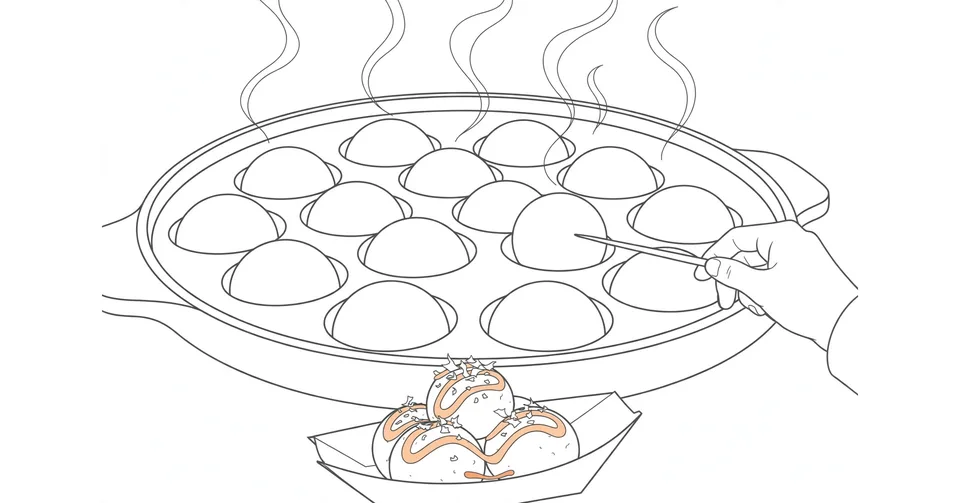
Takoyaki is cooked in a special pan, a heavy cast iron plate full of hemispherical holes. The cook pours batter into the holes, drops in the fillings, and then, as the bottom sets, turns each half-cooked ball with a metal pick, rotating it 180 degrees so the liquid batter on top flows down and forms the other half of the sphere. A skilled cook can turn a whole pan of balls in under a minute, each one spinning neatly into shape.
The technique is the whole craft. Pour too much batter and the balls join into a lumpy sheet. Turn too early and they collapse. Turn too late and the outside burns while the inside stays raw. Street vendors make it look easy because they have done it thousands of times, often while talking to a queue of customers and taking money with the other hand. Watching a good vendor work is half the pleasure of buying takoyaki, and the sound of the pick scraping the iron is as much a part of the dish as the smell of the batter.
At home, the same pan exists in electric form, and takoyaki parties, called takopa, are a common way to spend an evening with friends in Japan. Everyone gathers around the hot plate, everyone takes a turn with the pick, and everyone eats the failures first. The results are rarely as neat as a professional's, but neatness is not really the point. The point is that a dish invented by a street vendor is simple enough to cook in a living room, and that is part of why it spread so far.
Sauce or no sauce
Visitors who try takoyaki for the first time usually meet the dressed version first, covered in sauce and mayonnaise. That is the standard style in Dotonbori, the neon-lit street in Osaka where stall after stall sells it, and it is delicious. But it is worth knowing that the sauce is a later addition, not part of the original design. At Aizuya, the original shop, takoyaki comes plain, seasoned only by the dashi in the batter, with a little soy sauce on the side if you want it.
There is no right answer to the sauce question, and arguing about it is a favourite pastime in Osaka. The plain version lets you taste the batter and the octopus. The sauced version is richer, sweeter, and messier, and the mayonnaise cools the ball just enough to eat it sooner. My own view is that both are worth trying, and that the plain version is the better test of a shop. If a vendor's takoyaki tastes good with nothing on it, the batter is doing its job. If it only tastes good under a centimetre of sauce, the sauce is doing the work instead.
The toppings themselves tell a small story about Japanese cooking. The sauce is a thick, sweet and savoury brown sauce in the Worcestershire family, similar to the sauce on okonomiyaki. The mayonnaise is sweeter and lighter than Western mayonnaise. The aonori is powdered green seaweed. And the katsuobushi, shaved so thin it moves in the steam, is the same ingredient that flavours the dashi in the batter. A single ball of takoyaki manages to contain the whole logic of Japanese flavour in miniature, which may be why it travelled so well.
Osaka, the city that eats flour
Takoyaki belongs to a family of foods Osaka calls konamon, flour-based food, and the city takes this family very seriously. Okonomiyaki, the savoury pancake cooked on a griddle, is its most famous sibling. Akashiyaki, the dish that inspired takoyaki, is its cousin from across the prefectural border. Flour is cheap, it fills you up, and it can be cooked fast on a hot plate in front of a customer, which is exactly what a working city with little time and little money needs.
Osaka was once called the kitchen of the nation, the place where rice, sake, and soy sauce from all over Japan were gathered and traded. That history of feeding people on a large scale never really went away. It turned into a culture of street food, of standing bars, of small shops that do one thing and do it for decades. Takoyaki fits that culture perfectly. It is fast, it is cheap, it is eaten without a table, and it is hard to make badly and easy to make well if you respect the pan.
That is also why takoyaki became a symbol of Osaka in a way that fancier dishes never did. Sushi belongs to the whole country now, and so does ramen. Japanese curry is another foreign idea that became unmistakably Japanese, but takoyaki still belongs to Osaka first. Other cities make it, and the frozen kind is sold in every supermarket, but the standard everyone judges it against is still a stall in Namba or Dotonbori, with a queue, a hot pan, and a cook who has been flipping balls since before you were born.
How to eat it without burning your mouth
Every guide to takoyaki includes the same warning, and every visitor ignores it at least once. The balls come off the pan at a temperature that can genuinely burn, and the molten centre holds its heat far longer than the crisp outside suggests. The trick is to bite a small hole in the ball first and let the steam out, then wait a few seconds before the rest. Nobody does this the first time. Everybody does it the second time.
Takoyaki is usually sold in sets of six or eight, in a paper tray or a small paper boat, with a pair of toothpicks instead of chopsticks. A set costs a few hundred yen, which makes it one of the cheapest hot meals in Japan. It is a snack rather than a meal for most people, the thing you eat between other things, while walking, while waiting for friends, or as a late-night stop on the way home. That is how it is meant to be eaten, standing up, in the street, while it is still too hot.
If you are in Osaka, the best approach is simple, and LIVE JAPAN's guide to eating takoyaki agrees on the essentials. Go to Dotonbori in the early evening, when the signs light up and the queues form, and try two shops. Order one set plain if the shop offers it, and one set with the full toppings. Eat them both while they are hot, standing on the street like everyone else. Then, if you have time, take the short walk to Aizuya and try the original, the way Tomekichi Endo made it in 1935. Ninety years is a long time for a recipe to survive unchanged, and tasting the first version, after all the copies, is a small piece of food history you can hold in your hand.
Takoyaki beyond Osaka
From Osaka, takoyaki spread across the whole country, and then beyond it. Today you can find it at festivals all over Japan, in the food courts of department stores, in convenience stores, and in the freezer aisle of every supermarket. It is a standard item at summer matsuri, where the smell of the batter joins the smell of yakisoba and grilled corn. It is also one of the first Japanese street foods many visitors try abroad, in the food halls of Bangkok, Taipei, and Los Angeles, where the balls are often larger, softer, and more heavily sauced than the Osaka original.
The spread changed the dish, and not always for the better. Mass-produced takoyaki, cooked in advance and reheated, loses the contrast that makes it special, the crisp shell against the molten centre. A ball that has sat in a warmer for an hour is still recognisable, but it is a shadow of the fresh one. That is the honest trade-off of popularity. The more people eat takoyaki, the more of it is made by people who have never stood at a hot pan in Namba.
And yet the original survives, which is the more interesting fact. Aizuya still cooks it without sauce. Vendors in Dotonbori still flip it by hand. Families still gather around electric pans at home. A dish that began as one vendor's experiment with a customer's suggestion has lasted ninety years without losing its shape, its method, or its city. Most foods that old have become museum pieces or luxury items. Takoyaki is still street food, still cheap, still eaten standing up, and still slightly too hot. That is a good way for a dish to grow old.
Why a ball of batter matters
It is easy to treat takoyaki as a joke food, a snack for tourists and teenagers. That would miss what it actually is. Takoyaki is a record of how Osaka cooks, fast, cheap, and without pretension, and of how a good idea travels, from a street stall in Namba to festival stalls across Japan and food halls around the world. It is also a reminder that invention in cooking does not need a laboratory or a famous chef. It needs a vendor listening to a customer, a pan hot enough, and the willingness to swap beef for octopus.
I think the reason takoyaki endures is that it asks so little of the person eating it and gives so much back. A few hundred yen, a few minutes standing in the street, and you get something hot, crisp, soft, and savoury all at once, made in front of you by someone who has done it ten thousand times. Not every dish needs to be an occasion. Some dishes just need to be good, cheap, and honest, and takoyaki has been exactly that since 1935.
More in Food & Travel
- Okonomiyaki and the Savory Pancake Japan Cooks at the Table
- Japanese Whisky and How a Scottish Spirit Became Japan's Own
- Japanese Curry and How a British Stew Became Japan's Comfort Food
- Sushi, the Japanese Dish That Conquered the World
- Kakiage and the Tempura Bowl That Towers Over Rice
- On Koyasan the Founder Is Said to Be Still Meditating
Latest posts
- Omamori, Japan's Pocket-Sized Amulets of Protection
- Japanese Festivals, From Snow Sculptures to Summer Fireworks
- The Daruma Doll, Japan's Round Symbol of Perseverance
- Kotatsu, Japan's Heated Table That Warms Winter
- The History of the Bicycle From Wooden Wheels to Japanese City Bikes
- the-javanese-of-suriname-and-the-language-they-kept-alive
- Kanban and the Japanese System That Organized Work
- Shichi-Go-San and the Day Japan Dresses Its Children in Kimono
- Desa Pakraman Is the Name the Law Gave the Old Village
- A Primbon Reads Your Life From the Day You Were Born
- Pasaran Is the Five-Day Week Java Never Gave Up
- A Ceper Folds a Coconut Leaf Into a Crescent Moon
- Your Neptu Is the Number Hidden Inside Your Birthday
- Tilem Is the Dark Moon Bali Counts Its Year By
- The Saka Calendar Sets Nyepi on a Different Date Every Year