Japanese Whisky and How a Scottish Spirit Became Japan's Own
· 9 min read
Japanese whisky began in 1923 with two stubborn men, one distillery near Kyoto, and a dream borrowed from Scotland. A century later it is one of the most admired whiskies on earth.
A century ago, nobody outside Scotland took whisky seriously as a Japanese product. Today a bottle of Japanese whisky can cost more than a weekend in Kyoto, and collectors argue over it the way art buyers argue over prints. The story of how that happened is not really about a drink. It is about two men who disagreed about almost everything except one idea, that Japan could make whisky as good as Scotland, and who spent their lives proving it in opposite ways.
Japanese whisky is still a small industry by world standards. Only a handful of distilleries make most of it, and the two companies that dominate the market were founded by the same two men. That concentration is part of the charm. Every bottle traces back, in one way or another, to a single hillside near Kyoto and a windswept town in Hokkaido.
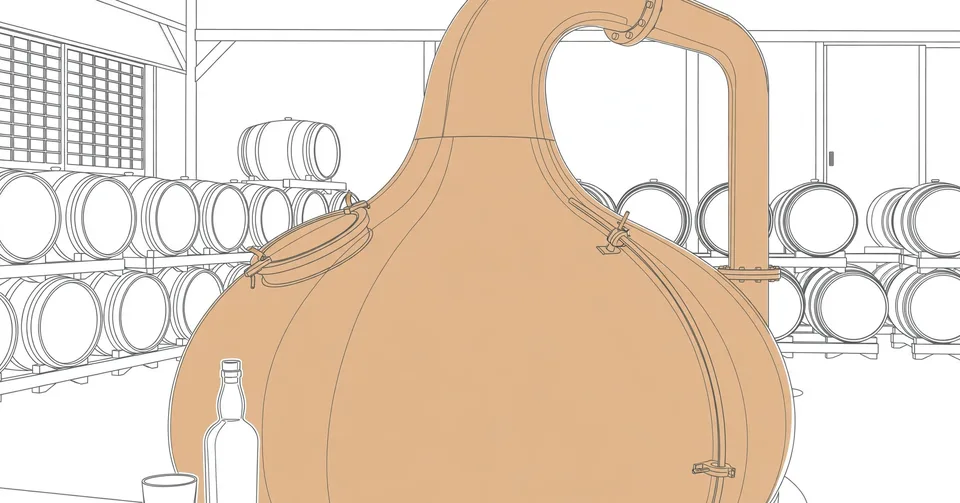
Two men and one stubborn idea
Japanese whisky starts with Shinjiro Torii, a liquor merchant from Osaka, and Masataka Taketsuru, a young chemist from Hiroshima. Torii had built a fortune on wine and spirits and believed Japan deserved its own whisky. Taketsuru had gone to Scotland in 1918 to study chemistry at the University of Glasgow, worked in distilleries in Speyside and Campbeltown, and came home with a Scottish wife, Rita Cowan, and notebooks full of distilling methods.
In 1923 Torii hired Taketsuru to build Japan's first whisky distillery at Yamazaki, a town at the foot of Mount Tennozan, southwest of Kyoto. The location was a compromise. Taketsuru wanted Hokkaido, whose cold climate reminded him of Scotland. Torii wanted to stay close to the big markets of central Japan. Torii won the argument, and Yamazaki became the birthplace of Japanese whisky.
Taketsuru ran the distillery as its first manager. It took years before the first spirit was ready. In 1929 Suntory released its first product, Shirofuda, or White Label, a whisky aged about four and a half years. The Japanese public did not like it. It was too smoky, too peaty, too Scottish for a market that had never drunk whisky before. The failure was honest, though. It proved the distillery worked, even if the taste was wrong for its audience.
The split that made two companies
Torii and Taketsuru were never an easy pair. Torii was a merchant who wanted a product people would buy. Taketsuru was a craftsman who wanted to make whisky the Scottish way, even if the market was not ready. In 1934 Taketsuru left and founded his own company, Dai Nippon Kaju, in Yoichi, a small town on the coast of Hokkaido. It was the place he had wanted all along, cold, damp, and far from the crowds.
The Yoichi distillery fired up its stills in 1936, and its first Nikka whisky reached the market in 1940. The company took the name Nikka Whisky Distilling in 1952, a contraction of Nippon Kaju. Taketsuru built a second distillery, Miyagikyo, in 1969, giving Nikka two very different flavour profiles, the heavy, peaty spirit of Yoichi and the lighter, fruitier spirit of Miyagikyo.
Meanwhile Suntory found its footing. In 1937 it released Kakubin, a blended whisky in a square bottle that became one of the best selling whiskies in Japan. After the war, cheap blended whisky such as Torys kept the company growing, and the distillery added Hakushu in the mountains in 1973 and the grain distillery at Chita in 1972. Today Suntory runs Yamazaki, Hakushu, and Chita, and the two companies founded by Torii and Taketsuru still dominate Japanese whisky between them.
The slow decades
For most of the twentieth century, Japanese whisky was a domestic drink, barely known abroad. That was not a failure. It was the point. Distillers tuned their whisky for Japanese tastes, lighter, smoother, and more delicate than the big smoky Scotches that had inspired them. The single malt Yamazaki, launched in 1984, was built around that idea, a whisky that could sit comfortably next to Japanese food without overwhelming it.
The outside world began to pay attention in 2001, when Nikka's Yoichi 10 Year Old was named the best of the best at the Whisky Magazine awards. Two years later, a Yamazaki 12 year old won gold at the International Spirits Challenge. Then in 2014, the Yamazaki Sherry Cask 2013 was named the best whisky in the world in Jim Murray's Whisky Bible, and the quiet industry suddenly had a global spotlight.
The attention changed everything. Prices for age statement bottles climbed, old stock ran low, and distilleries started releasing more bottles without an age statement. If you walk into a liquor shop in Tokyo today, the famous names are often missing from the shelves, or priced like antiques. That scarcity is real, and it is also a sign of how far Japanese whisky has travelled from a drink nobody wanted in 1929.
The highball years
Ask a Japanese drinker what Japanese whisky means, and the answer is more likely to be a highball than a rare bottle. A highball is whisky mixed with soda water and ice, served in a tall glass, and it is the everyday form of the drink. It is cheap, refreshing, and everywhere, from tiny izakaya counters to family restaurants.
Suntory pushed the highball hard from the late 2000s, and the timing was perfect. Young drinkers who would never order whisky neat found they liked it long and cold with food. Kakubin, the same square bottle from 1937, became the default highball whisky, and its sales climbed again after decades on the shelf.
There is a quieter tradition beside it. Mizuwari is whisky diluted with water, usually in a ratio the drinker chooses, and it is how many older drinkers take their evening glass. Both styles say something about how Japanese whisky is meant to be drunk, not worshipped, but fitted into daily life. I find that more appealing than the collector's market. A great bottle kept unopened on a shelf is a museum piece. A highball at a counter in Numazu on a summer night is the drink doing its job.
The 2021 rulebook
Success brought a problem. As Japanese whisky became fashionable, bottles appeared that had little to do with Japan, imported spirit, blended and bottled in Japan, and sold under Japanese sounding names. In February 2021 the Japan Spirits and Liqueurs Makers Association set out a standard for what may be called Japanese whisky on a label.
Under the standard, a whisky must be distilled in Japan, matured in Japan for at least three years, and bottled in Japan. It is a voluntary industry rule, not a law, but the big producers follow it, and it gives buyers a way to tell the real thing from a label that only borrows the name. If you are shopping for a bottle, that 2021 standard is the single most useful thing to know. A bottle from a member distillery that meets it is Japanese whisky in the full sense. A bottle that does not is something else wearing the costume.
How to drink it like a local
You do not need a rare bottle to understand Japanese whisky. Start with what is actually on the shelf. A bottle of Kakubin or a standard Nikka blend costs little, mixes beautifully into a highball, and tastes like the Japan most people actually drink in. If a bar has Yamazaki or Hakushu by the glass, try it neat first, then add a little water and notice how the flavour opens up.
Distillery visits are worth the trip if you plan ahead. Yamazaki sits between Kyoto and Osaka, an easy stop on the way between the two cities, and its museum tells the story of Torii and Taketsuru better than any book. Yoichi is a longer journey, on the coast west of Sapporo, but the town keeps the memory of Taketsuru and Rita alive, and the distillery still uses coal fired stills, a method almost nobody else keeps.
Pairing matters more than price. Japanese whisky was shaped around Japanese food, so try it with grilled fish, yakitori, or a small plate of pickles rather than a heavy steak. The whisky is built to sit beside food, not to fight it. If you want to understand the difference between Japanese whisky and Scotch, that is where it shows, in restraint rather than power.
What the boom left behind
The boom has a cost, and it is worth naming. Age statement bottles that once cost the price of a good dinner now trade for many times that, and some bottles are bought only to be resold. The distilleries have answered by releasing younger, no age statement whiskies, and by expanding production, but whisky needs years in a barrel, so the gap will not close quickly.
There is also a quieter loss. As the world chases the famous names, smaller craft distilleries struggle to be heard, even though some of them make excellent whisky. If you visit Japan, ask a bartender what they like that is not on the tourist lists. That question has led me to better glasses than any award list ever did.
For all that, the core of the story has not changed since 1923. Two men disagreed about where to build a distillery and how a whisky should taste, and their argument produced two companies, two styles, and a drink that now belongs to the world. Japanese whisky began as an imitation of Scotland, and it became something else entirely, a whisky shaped by Japanese water, Japanese climate, and Japanese patience. The best way to respect it is the simplest one, pour a glass, share it with someone, and let it be a drink again, not a trophy.
The wider table
Japanese whisky makes more sense when you taste it beside the other drinks Japan has spent centuries refining. Japanese sake shows the same patience in a different form, rice polished and fermented into something delicate, while shochu shows the other side of Japanese spirits, distilled, strong, and often mixed with hot water on a cold night. Even the Japanese tea ceremony belongs in the same story, because it taught Japan that a drink can be a ritual, not just refreshment. Whisky arrived last, and it learned from all of them.
For the history behind this article, see the guide to Japanese whisky at The Whisky Exchange and the account of its birth at Hackstons.
More in Food & Travel
- Japanese Curry and How a British Stew Became Japan's Comfort Food
- Sushi, the Japanese Dish That Conquered the World
- Kakiage and the Tempura Bowl That Towers Over Rice
- On Koyasan the Founder Is Said to Be Still Meditating
- Sudachi Is the Sharpest of Japan's Sour Citrus
- Oi-Nishin Sent Tohoku Farmers Chasing Herring Every Spring
Latest posts
- Omamori, Japan's Pocket-Sized Amulets of Protection
- Japanese Festivals, From Snow Sculptures to Summer Fireworks
- The Daruma Doll, Japan's Round Symbol of Perseverance
- Kotatsu, Japan's Heated Table That Warms Winter
- The History of the Bicycle From Wooden Wheels to Japanese City Bikes
- the-javanese-of-suriname-and-the-language-they-kept-alive
- Kanban and the Japanese System That Organized Work
- Shichi-Go-San and the Day Japan Dresses Its Children in Kimono
- Desa Pakraman Is the Name the Law Gave the Old Village
- A Primbon Reads Your Life From the Day You Were Born
- Pasaran Is the Five-Day Week Java Never Gave Up
- A Ceper Folds a Coconut Leaf Into a Crescent Moon
- Your Neptu Is the Number Hidden Inside Your Birthday
- Tilem Is the Dark Moon Bali Counts Its Year By
- The Saka Calendar Sets Nyepi on a Different Date Every Year