Shichi-Go-San and the Day Japan Dresses Its Children in Kimono
· 12 min read
Shichi-Go-San falls on Sunday 15 November 2026, when families take children aged three, five and seven to a shrine in kimono to give thanks for their health and pray for their future.
On Sunday 15 November 2026, the gravel paths of shrines across Japan will fill with small children in bright kimono, their hair tied up and their sandals clicking on stone. Parents will walk a step behind, one hand holding a camera, the other carrying a long red and white bag of candy. It is Shichi-Go-San, the day Japan dresses its children in kimono and takes them to a shrine to say thank you for growing up safely, and to pray for the years ahead.
The festival's name, Shichi-Go-San, means seven-five-three, and it describes exactly who is celebrated. Girls take part at three and seven, boys at five, and three-year-old boys join in some families too. The date is fixed, 15 November every year, but it is not a national holiday, so most families come on the nearest weekend instead. In 2026 the date itself falls on a Sunday, which makes the weekend of 14 and 15 November the busiest of the season.
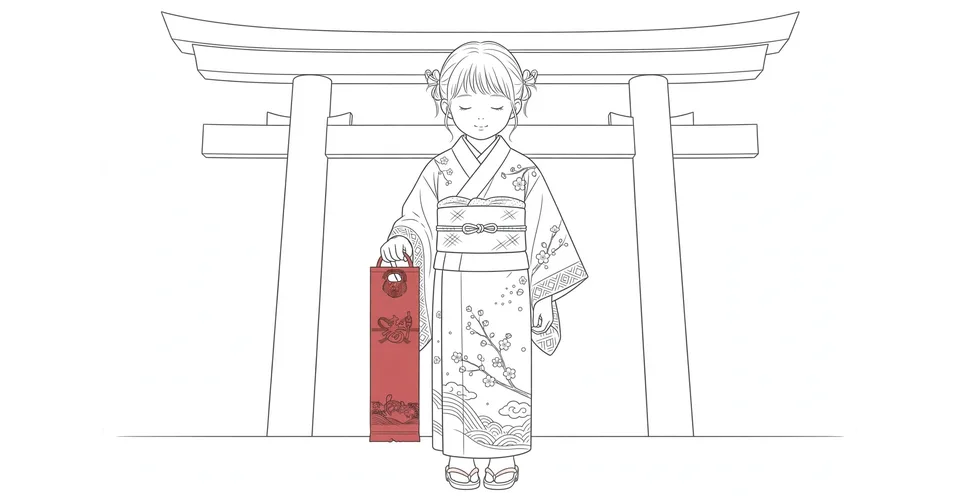
What looks from the outside like a photo opportunity is, at its root, a prayer. Shichi-Go-San grew out of three separate rites of passage once held by court nobles, and each age still carries its own ceremony, its own outfit and its own meaning. This article walks through all three, explains what happens inside the shrine, what the day costs in 2026, and where to watch Shichi-Go-San without getting in the way of the families it belongs to.
What Shichi-Go-San means
Shichi-Go-San is a rite of passage, not a birthday party. Families visit a shrine, usually the one near their home or a large well known one, and a priest prays for the child's health and future. The family gives an offering, the child receives a bag of chitose-ame, long red and white candy sticks that symbolise a thousand years of life, and then everyone takes photographs on the shrine grounds. The whole visit often takes less than an hour, but families remember it for years, and the photographs tend to stay on the wall long after the child has outgrown the kimono.
The festival is easy to misunderstand if you only see the clothes. The kimono is the visible part, but the point is gratitude. In the centuries when these rites began, many children did not survive early childhood, so reaching three, five or seven was a genuine milestone, and a shrine visit put the child under the protection of the gods for the next stretch of life. That is why the prayer, not the photograph, is still the centre of the day. I find that honesty refreshing. In a season full of festivals that exist mostly to be photographed, Shichi-Go-San still asks the family to stop, bow, and say thank you first.
Three ages, three old ceremonies
Shichi-Go-San bundles three older ceremonies into one day, and the odd numbers are no accident. In Japan, odd numbers are considered lucky, and each of these rites once marked a visible change in how a child looked and was treated by the community.
| Age | Who | Ceremony | What changes | | 3 | Girls and boys | Kamioki | The child stops having the head shaved and begins to grow the hair out | | 5 | Boys | Hakamagi | The boy wears formal hakama trousers for the first time | | 7 | Girls | Obitoki | The girl swaps simple tie cords for a proper adult obi sash |
At three, both boys and girls went through kamioki, which means placing the hair. In the Heian period it was customary to shave a baby's head on the seventh day after birth and keep it shaved until the age of three. From that day the child was allowed to grow the hair out, which marked the end of infancy. Today a three-year-old girl wears a festive kimono with a sleeveless vermilion vest called a hifu over it, and no obi, which keeps the outfit light enough for a small child to wear for an hour or two.
At five, boys went through hakamagi, the first time they wore hakama, the formal pleated trousers worn over a kimono, together with a crested kimono and a haori jacket. The outfit is often finished with a white fan and a small protective sword called a mamori-gatana, tucked at the waist. At seven, girls went through obitoki, also called himotoki, the first time they tied the kimono with a proper obi instead of simple cords. A seven-year-old girl typically wears a yuzen-patterned kimono tied with a maru-obi, and her hair is arranged in a traditional nihongami style, which is one reason the seven-year-old's outfit usually costs more than the three-year-old's.
How the date became November 15
The three rites began among court nobles in the Heian period, from 794 to 1185, and later spread to samurai households. By the Edo period, from 1603 to 1868, wealthier townspeople had taken up the custom, the three ceremonies had come to be known together as Shichi-Go-San, and shrine visits with a priest's prayer became part of it. The date, though, comes from a single story. According to the most quoted account, the fifth Tokugawa shogun, Tsunayoshi, held a kamioki celebration for his young son Tokumatsu on 15 November 1681, and the date stuck. The practice was set to the fifteenth of the month even earlier, during the Kamakura period, and 15 November was long considered an auspicious day on the traditional calendar. The three rites and the 1681 story are recorded in detail on Wikipedia's Shichi-Go-San page.
The name itself is younger than the custom. Shrines such as Meiji Jingu note that the words Shichi-Go-San only came into common use in the Meiji era, from 1868 to 1912, and an 1878 newspaper article already mentions the term. The lively crowds of today date from the Taisho era onward, and the celebration spread across the whole country after the Second World War. Knowing that history changes how the day looks. It is not an ancient festival frozen in time. It is three old court rituals that ordinary families adopted, one by one, until they became a single November tradition.
What happens at the shrine
A Shichi-Go-San visit follows a simple pattern. The family registers at the shrine's blessing office, pays the offering, which is called hatsuho-ryo, and waits for its turn. A priest then performs a short prayer for the child, often together with several other families, and the child receives chitose-ame and sometimes a small amulet. Photographs follow, on the shrine steps, under the torii gate, and along the gravel paths. Some families then go for a meal together, often with grandparents, which is part of the day for many. Most Shichi-Go-San visits take place on weekends from mid-October to late November, with the weekends around 15 November the busiest of all.
The offering is usually between ¥5,000 and ¥10,000 per child, paid in an envelope at the office. At Meiji Jingu, Tokyo's best known shrine, prayers run daily from about 9:00, roughly every 30 minutes, with an offering from ¥5,000 and no reservation needed for individuals. Hie Jinja in Akasaka and Suitengu in Nihonbashi, a shrine associated with safe childbirth, ask from ¥10,000. Kanda Myojin near Akihabara is another central Tokyo choice. Buddhist temples join in too. Senso-ji in Asakusa holds a Buddhist blessing around 15 November, and the neighbouring Asakusa Shrine runs its Shichi-Go-San period from October to the end of November, with booking recommended.
Chitose-ame deserves a closer look, because children remember it longer than the prayer. The name means thousand-year candy, and the sticks are long, thin, red and white, colours that stand for celebration and long life. They come in a paper bag printed with a crane and a turtle, two animals that symbolise longevity in Japan. The candy is often included free with the blessing, or sold for a few hundred yen at the shrine shop.
What Shichi-Go-San costs in 2026
A Shichi-Go-San day can cost very little or a great deal, and the difference is almost entirely the kimono and the photographs. A family that borrows a kimono, pays only the shrine offering, and takes its own photographs can spend as little as ¥5,000. A family that rents, dresses, styles and photographs a child at a major studio can spend ¥100,000 or more. Most families land somewhere in between, and the table below shows the usual ranges, checked against prices published in October 2026 in this Shichi-Go-San 2026 guide to dates, shrines, costs and etiquette.
| Item | Typical price in 2026 | | Shrine prayer offering per child | ¥5,000-10,000 | | Child kimono rental, half day | ¥8,000-30,000 | | Rental with dressing and hair | ¥14,000-30,000 | | Photo studio session fee per family | ¥5,500 | | Studio photo package | ¥20,000-100,000 | | Buying a new kimono | ¥35,000-100,000 or more |
Two details are worth knowing before booking. First, photo studios such as Studio Alice and Studio Mario charge a session fee of ¥5,500 per family, including costumes, dressing and hair, and then rent the kimono for the shrine visit at a discount if the family spends enough on photographs. In November 2026, Studio Alice's outing rental runs from ¥7,700 on weekdays to ¥13,200 on Sundays and public holidays for families that spend ¥20,000 or more on a shoot. Second, prices fall sharply outside the season. Families who book a studio session between January and August often pay far less, which is why some parents do the photographs months early and keep only the shrine visit for November.
Renting is the normal choice, and for good reason. A good kimono is expensive, children outgrow it in a year, and the dressing, which is called kitsuke, is a skilled job that most parents cannot do at home. Rental shops dress the child, arrange the hair, and take everything back at the end of the day, usually by 17:30. That single fact explains why the whole industry exists. The clothes are beautiful, but they are also complicated, and a family wants the morning to feel like a celebration, not a struggle with a sash.
Where to see Shichi-Go-San
Any neighbourhood shrine will have some Shichi-Go-San activity on a November weekend, but a few large shrines draw the crowds and put on the best show. Meiji Jingu in Harajuku is the biggest, a forest shrine where the long gravel approaches fill with families all through November, and Shichi-Go-San prayers run there daily through the season. Its gates close at 16:10 in November, so the blessing office stops taking families well before that. Hie Jinja in Akasaka is a quieter alternative with a steady run of family blessings on weekend mornings, and Kanda Myojin near Akihabara is the third of Tokyo's big three for the festival.
Outside Tokyo, Kitano Tenmangu in Kyoto charges ¥5,000 per child and has volunteers to help with kimono on early to mid-November weekends. Dazaifu Tenmangu in Fukuoka is the major draw in Kyushu. The best time to watch is a weekend morning before 11:00, when the light is good and the families are still arriving. By early afternoon the shrine grounds are at their busiest, and the wait for a prayer can stretch to about an hour.
Mid-November is also one of the best weeks of the year to be in Japan for another reason. The autumn leaves are turning, and the same shrine visit that brings you to Meiji Jingu or Kitano Tenmangu puts you under some of the finest maple trees in the country. Our guide to Japan's autumn leaves and where to find them covers the timing, which runs from mid-November in Tokyo to late November in Kyoto.
If you are visiting Japan that weekend
Visitors are welcome to watch, and nobody will mind a respectful tourist with a camera, but a few points of etiquette matter. Ask before photographing a family, and never step into their photographs. Keep out of the prayer hall during a blessing, and do not follow a family around the grounds. The children are not performers. They are usually tired, sometimes cold, and almost always more interested in the candy bag than in the ceremony, which is exactly as it should be.
If you want photographs of your own, the shrine buildings, the torii gate and the autumn leaves make better subjects than other people's children, and they never object. And if a family smiles at you, smile back. Shichi-Go-San is a happy day, and a little goodwill from a stranger fits it better than a long lens pointed at a seven-year-old.
The part that lasts
The kimono will be returned on Monday, the candy will be eaten within a week, and the photographs will fade a little each year. What lasts is the habit the day teaches. A child learns that growing up is something to be grateful for, not just something that happens, and parents get one morning a year when the whole family stops and marks the fact that their child is healthy, here, and a little taller than last year. Japan marks its seasons with family rituals, from cherry blossom viewing in spring to Shichi-Go-San in autumn, and each one says the same thing in a different season. Pay attention now, because this age will not come back.
There is something in that which goes beyond Japan. Shichi-Go-San began because children died young, and it survives because parents still feel the same relief when a child reaches another birthday in good health. The clothes change, the cameras change, and the shrines now take bookings online, but the feeling underneath has not changed in a thousand years. That is the same quiet idea behind ikigai, the Japanese sense that a life has a reason to be lived. A seven-year-old in a kimono does not need to understand any of that yet. She only needs to know that today, her family dressed her up, walked her to a shrine, and thanked the gods she is here. That is enough, and it is the whole point.
More in Culture & Society
- Desa Pakraman Is the Name the Law Gave the Old Village
- A Primbon Reads Your Life From the Day You Were Born
- Pasaran Is the Five-Day Week Java Never Gave Up
- A Ceper Folds a Coconut Leaf Into a Crescent Moon
- Your Neptu Is the Number Hidden Inside Your Birthday
- Tilem Is the Dark Moon Bali Counts Its Year By
Latest posts
- The Saka Calendar Sets Nyepi on a Different Date Every Year
- On Tumpek Kuningan Bali Feeds Its Ancestors
- Garuda Carried a Mountain to the Middle of the Ocean
- Vasuki Was the Rope That Churned the Ocean of Milk
- En No Gyoja, the Mystic Shugendo Calls Its Patriarch
- A Saito Goma Burns Its Prayers Outdoors
- Kongobuji Still Governs the Mountain Kukai Left Behind
- A Shukubo Lets You Sleep Inside a Working Temple
- Okunoin Is Japan's Largest Cemetery and Its Quietest Forest
- Suka Duka Means the Banjar Shows Up for Joy and Grief Alike
- Tabuh Rah Spills Blood So the Ground Stays Calm
- The Bendesa Adat Speaks for a Village That Has Two Governments
- Catur Brata Is Four Silences Kept at the Same Time
- On Koyasan the Founder Is Said to Be Still Meditating
- Your Weton Is the Day You Were Born, Counted Two Ways