A Ceper Folds a Coconut Leaf Into a Crescent Moon
· 15 min read
A ceper is the small folded tray of young coconut leaf that carries a canang sari, and its square shape stands for Ardha Candra, the crescent moon.
In Bali, the day starts with hands, not with words. Before the shops open and before the scooters fill the road, a woman sits on the floor of her family compound with a strip of pale green leaf in her lap. She folds it once, twice, and a few minutes later she is holding a small square tray with raised edges. That tray is a ceper, and by nightfall it will be gone.
The ceper is the part of the canang sari that most visitors never learn to see. They notice the flowers, the colour, the smoke from the incense. The tray underneath gets no attention at all, which is strange, because without it there is no offering. Everything else in a canang sari rests on a ceper.
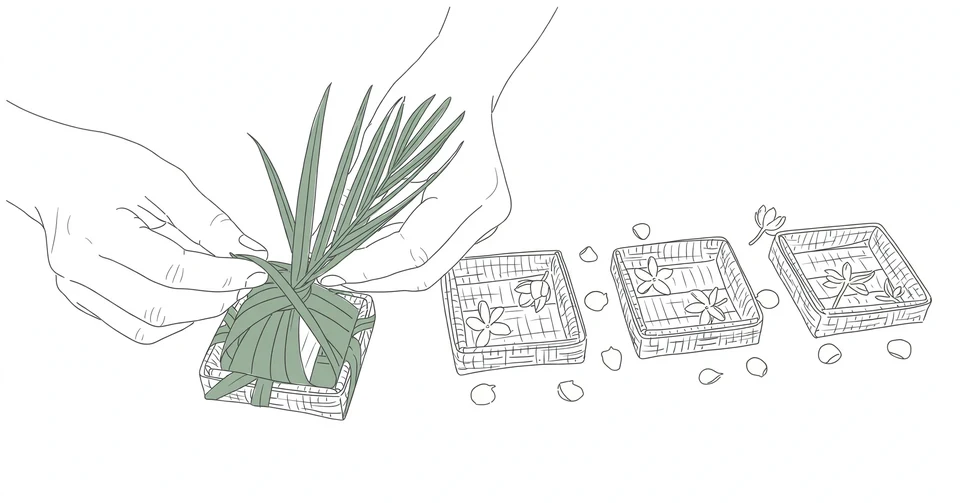
A ceper is folded by hand from janur, the young leaf of the coconut palm, into a small square with raised edges. It is the base of the daily offering, and it stands for Ardha Candra, the crescent moon. A square tray standing for a curved moon sounds like a contradiction. It is not. It is the kind of quiet symbolism Bali is built on, where a shape means more than it shows.
What a ceper is
A ceper is the tray of a canang sari. It is made from janur, the young leaf of the coconut palm, which is pale green, soft, and easy to fold while it is fresh. The maker folds a strip of the leaf into a small square, turning up the edges so that it becomes a shallow tray, and the folds hold themselves together without pins or string. The whole thing is about the size of a palm, and it is made to be used once.
The word canang itself points to the same object. Canang means a small palm leaf basket used as a tray, and sari means essence. So a canang sari is, in the plainest sense, the essence presented in a small palm leaf tray. The ceper is that tray. It is the part that carries everything else, and it is the part that disappears first, because the leaf dries out and the offering is swept away by the end of the day.
That disposability is the point. A ceper is not a plate to be washed and kept. It is made fresh every morning, used once, and then let go. The offering it carries is a daily act of gratitude, and the tray is part of the message: nothing about it is meant to last, and nothing about it needs to last, because tomorrow morning another ceper will be folded in its place.
The folding itself is a skill passed down through generations. Girls in Bali learn to fold a ceper as children, watching their mothers and grandmothers, and the making of canang sari is known as matanding or majejahitan. The work is usually done early in the morning, after bathing and household chores, with a focused and almost meditative quality. It is not a craft done for show. It is housework with a sacred edge, repeated so often that the hands know the folds before the mind has to think about them.
You can also buy a ready made ceper at the market, and many women do, especially on busy days. But the habit of folding your own is still strong, and the choice is not really about saving time. Folding your own ceper is part of the offering. The time and the care are the offering, as much as the flowers that go on top of it.
The ceper and the crescent moon
The most interesting thing about a ceper is what it is said to stand for. Sources agree that the ceper is a symbol of Ardha Candra, the crescent moon. The square tray represents the moon, and through the moon it represents the cycle of time, the waxing and waning that governs the Balinese calendar and the rhythm of temple days.
There is a second reading worth mentioning, because the sources do not all say it the same way. One guide to the offering says the square shape of the ceper can symbolize the earth, or sometimes the larger cosmos, the Anda Bhuana. The two readings do not really fight each other. The moon is part of the cosmos, and the earth sits inside it. What matters is that the tray is not just a container. It is a small model of the world the offering is addressed to.
I find that quietly moving. The cheapest object in the whole ritual, a folded leaf that will be swept up by evening, is asked to carry the largest meaning. It holds the flowers and the rice and the incense, and at the same time it stands for the moon and the cosmos. Bali does this often. It takes something small and ordinary and lets it stand for something vast, without making a fuss about it.
The shape itself helps. A square has four corners, and the offering placed on it is arranged by direction, with different flowers pointing to different gods. The tray gives the offering its orientation. It turns a handful of petals into a compass, and the compass points to the gods of the four directions and to Shiva in the centre. Without the square of the ceper, the flowers would just be flowers. With it, they become a map.
What sits on top of a ceper
A ceper is only the beginning of a canang sari. Once the tray is folded, the maker builds the offering on top of it, layer by layer, and every layer has a meaning.
The first thing placed on a ceper is usually the peporosan, the core of the offering. It is a small bundle made from betel leaf, lime, gambier, areca nut, and tobacco, and its materials symbolize the Trimurti, the three great gods of Hinduism. Lime stands for Shiva, the betel nut stands for Vishnu, and gambier stands for Brahma. The bundle is small, but it carries the heaviest theology in the whole offering, three gods folded into a parcel the size of a thumb.
On top of that come the raka-raka, small pieces of food such as banana, sugarcane, and cake, and then the sampian urasari, a small decorative base made from palm leaf, which holds the flowers. The flowers are placed by direction, and the colours are not random. White flowers point east for Iswara, red flowers point south for Brahma, yellow flowers point west for Mahadeva, and blue or green flowers point north for Vishnu. A flower in the centre, often frangipani or marigold, stands for Shiva and gathers the whole arrangement together.
A sprinkle of uncooked white rice is usually added too. It stands for Sang Hyang Atma, the seed of life, the soul or the essence of divinity inside all living beings. And the offering is completed with a coin, a kepeng or a small note, which is said to make up the sari, the essence, of the offering. Finally a stick of incense, dupa, is lit beside it. The smoke purifies the offering and carries its essence upward, and it represents Agni, the god of fire, who acts as a messenger in Hindu ritual.
None of this works without the ceper underneath. The tray is what makes the arrangement an offering instead of a pile of leaves and petals. It gives the peporosan and the flowers a place to sit, and it gives the whole small construction a shape that can be carried, placed, and presented. I think of it as the stage of the ritual. The actors are the flowers and the smoke, but the stage is the folded leaf.
A ceper is made fresh every morning
The life of a ceper is a single day. It is folded in the morning, filled, blessed with holy water, carried to its place, and left there while the incense burns down. Once the incense has burned out, the Balinese believe the sari, the essence, has been received. The physical offering has done its work, and the leaf tray can be swept away.
That is why a canang sari is made fresh every morning and gone by night. The ceper is not built to survive. It is built to be used and then released, and the release is part of the philosophy. The offering is an act of self sacrifice in the gentlest sense: it takes time and effort to prepare, and then it is given away. The tray, like the flowers on it, is a gift that is not expected back.
The daily rhythm matters more than any single offering. A canang sari is offered every day to Sang Hyang Widhi Wasa, the supreme god, as thanks for the peace given to the world. It is the simplest daily household offering, and its simplicity is the point. A family does not need a temple ceremony to say thank you. It needs a leaf, some flowers, and a few minutes of attention.
The making of the ceper is where that attention lives. Folding the leaf is quiet, repetitive work, and it asks for the same care every day. There is no way to rush a ceper without it looking rushed. The folds show. The tray either holds together or it does not, and the maker knows the difference. I admire that kind of honesty in a ritual. It cannot be faked with money. A bought tray works, but a folded one carries the hands that made it, and everyone in the house knows whose hands those were.
The ritual of placing the offering is called mebanten saiban or mesaji. The person making the offering, often the female head of the household, dresses respectfully in a sarong and sash, sprinkles holy water on the canang sari, lights the incense, and recites a prayer, sometimes silently, sometimes softly. Then the offering is placed where it belongs, and the day goes on.
Where the ceper goes
A canang sari, with its ceper underneath, can be placed almost anywhere, and each place has its own intention. Household shrines receive them every day. Family temples, the sanggah or merajan, get more elaborate ones. Community temples get them too. They are placed at the entrances of homes and businesses for protection and blessing, on desks and cash registers at work, on the dashboards of cars and scooters for safe travel, and in rice fields as offerings to Dewi Sri, the goddess of rice.
Offerings placed on the ground have a different purpose. Those are usually segehan, a slightly different form, meant to appease the lower spirits, the bhuta kala, keeping them satisfied so they do not cause disruption. The canang sari itself is offered upward, in gratitude to the higher powers. The two kinds of offering work together, and they express a central idea in Balinese thought: balance between the positive and the negative, the divine and the earthly, the seen and the unseen. The ceper sits at the bottom of that balance, holding the offering that goes up and standing on the ground where the other kind is placed.
There are days when a canang sari is not offered at all. When there is a death in the community or the family, the daily offering is paused. It is also used on special days such as Kliwon, Purnama, and Tilem, the full moon and the dark moon, when the regular offering takes on extra weight. The same calendar that sets those days also sets Tumpek Landep, the day Bali blesses everything made of metal, and the offerings placed that morning sit on a ceper like any other. The ceper is the same on those days. What changes is the occasion, not the tray.
The daily practice also embodies Tri Hita Karana, the Balinese philosophy of three causes of well being: harmony between humans and God, between humans and each other, and between humans and nature. Making a ceper touches all three. The offering connects the maker to the divine, the work is often shared within the family, and the materials are leaves and flowers, gifts of nature. It is a whole philosophy folded into a square of leaf, and it is repeated every morning without anyone needing to explain it.
Janur beyond the ceper
The leaf that becomes a ceper has other work to do in Bali. Janur, the young coconut leaf, is one of the most useful materials on the island, and the ceper is only one of its shapes.
The best known is probably ketupat, the rice cake cooked in a woven pouch of janur, which appears at festivals and celebrations across Indonesia. The same pale green leaf that holds a morning offering also holds the rice of a feast day. Janur is also used for decorations, for the ornaments on a penjor, the tall bamboo pole raised outside a house during Galungan, and for the small woven figures and ornaments that appear at temple ceremonies.
That range tells you something about the leaf itself. Janur is soft when fresh and strong when woven, and it can be folded, plaited, and shaped without tools. It is the kind of material that invites the hands to work with it, and Bali has built a whole craft tradition around that invitation. The ceper is the smallest and quietest product of that tradition, and also, in a way, the most honest one. It does not try to be decorative. It tries to be useful, and its usefulness is to carry a prayer.
I like that the same leaf serves both the sacred and the everyday. A ceper and a ketupat are made from the same material, by the same kind of hands, for the same kind of reason: to hold something worth giving. One holds rice for a feast, the other holds flowers for a god. The leaf does not seem to mind the difference, and neither do the people who fold it.
How to look at a ceper as a visitor
For a visitor, the most useful thing to know about a ceper is simple: do not step over it. When you see a canang sari on the ground, on a sidewalk, on a step, or at a doorway, walk around it, not over it. Stepping over an offering is considered disrespectful, because it contains sacred elements and represents a spiritual connection that should not be broken. Locals navigate these pathways carefully every day, and visitors are kindly asked to do the same.
It is also worth knowing what happens after the offering has served its purpose. Once the incense has burned out, the essence has been received, and the physical offering is no longer sacred in the same way. That is why you will see offerings swept up later in the day, or disturbed by animals and foot traffic. It is not disrespect. It is the end of the cycle. The ceper was made to be let go, and being swept away is part of its life, not an insult to it.
If you see someone folding a ceper or placing an offering, the polite thing is to watch quietly from a distance and not interrupt. If you want a photograph of a person making an offering, ask first. A smile and a gesture toward your camera usually works. Photographing the offerings themselves, on the ground or in a shrine, is best done discreetly and respectfully.
And if you are offered the chance to learn to fold a ceper, in a cultural class or a village workshop, take it. The folding looks simple until you try it, and the trying teaches you something no explanation can. Your first ceper will probably be lopsided. The second will be better. The lesson is not really about the leaf. It is about the attention the leaf asks for, and the patience it rewards.
A small square that holds the morning
A ceper is easy to miss, and that is part of its charm. It is a square of folded leaf, a few flowers, a stick of incense, and by evening it is gone. But it carries the whole morning with it: the hands that folded it, the prayer that was said over it, the gods it was offered to, and the balance it was meant to keep.
The next time you see one on a step or a shrine, look at the tray before you look at the flowers. Notice the folds, the raised edges, the pale green of the janur. It is the smallest part of the offering and the one that makes all the rest possible. A ceper folds a coconut leaf into a crescent moon, and then it lets the day begin.
More in Culture & Society
- Desa Pakraman Is the Name the Law Gave the Old Village
- A Primbon Reads Your Life From the Day You Were Born
- Pasaran Is the Five-Day Week Java Never Gave Up
- Your Neptu Is the Number Hidden Inside Your Birthday
- Tilem Is the Dark Moon Bali Counts Its Year By
- The Saka Calendar Sets Nyepi on a Different Date Every Year
Latest posts
- On Tumpek Kuningan Bali Feeds Its Ancestors
- Garuda Carried a Mountain to the Middle of the Ocean
- Vasuki Was the Rope That Churned the Ocean of Milk
- En No Gyoja, the Mystic Shugendo Calls Its Patriarch
- A Saito Goma Burns Its Prayers Outdoors
- Kongobuji Still Governs the Mountain Kukai Left Behind
- A Shukubo Lets You Sleep Inside a Working Temple
- Okunoin Is Japan's Largest Cemetery and Its Quietest Forest
- Suka Duka Means the Banjar Shows Up for Joy and Grief Alike
- Tabuh Rah Spills Blood So the Ground Stays Calm
- The Bendesa Adat Speaks for a Village That Has Two Governments
- Catur Brata Is Four Silences Kept at the Same Time
- On Koyasan the Founder Is Said to Be Still Meditating
- Your Weton Is the Day You Were Born, Counted Two Ways
- Rahu and Ketu Still Chase the Sun and Moon Across the Sky