Japanese Curry and How a British Stew Became Japan's Comfort Food
· 12 min read
Japanese curry is a thick, mild, slightly sweet roux stew served over rice, and it arrived in Japan through the British navy before becoming one of the country's most loved home dishes.
Japanese curry is not the curry most of the world knows. It is thick where Indian curry is thin, mild where Thai curry is fiery, and sweet where both are sharp. It comes as a glossy brown sauce ladled over a mound of short grain rice, with soft chunks of potato, carrot, and onion, and a spoon rather than chopsticks. Ask someone in Japan what they ate for dinner last night and Japanese curry is one of the most likely answers. It is school lunch, weeknight dinner, navy mess hall food, and late night comfort, all in one bowl.
The dish is called kare raisu, curry rice, and it is so ordinary in Japan that visitors sometimes miss how strange its story is. The spices came from India, the recipe came from Britain, and the finished dish belongs to neither. Japan took a foreign idea, rebuilt it for Japanese tastes, and made it so thoroughly its own that most people in Japan now think of curry as Japanese food first. That transformation took about a century, and it happened in navy galleys, home kitchens, and factory lines.
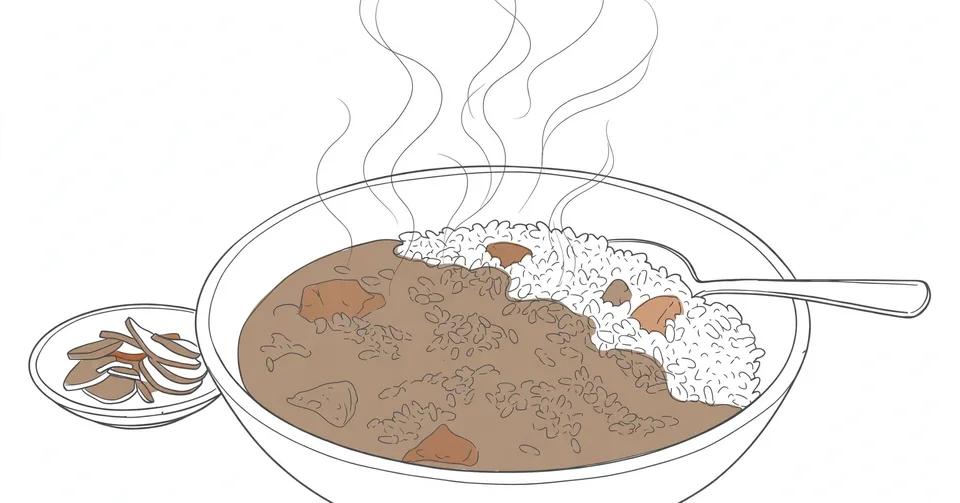
I first understood what Japanese curry really was not in a restaurant but in a supermarket, staring at a wall of roux blocks. There were mild, medium hot, hot, and extra hot, plus apple and honey versions, plus black curry, plus curry aimed at children, and every box promised the same thing, dinner in twenty minutes. The wall told the whole story. Japanese curry is not a recipe guarded by chefs. It is a system, built to be cooked by anyone, and that is exactly why it conquered the country.
What Japanese Curry Actually Is
Japanese curry is a stew thickened with a roux, a cooked mixture of flour and fat blended with curry spices, then simmered with meat and vegetables and served over steamed rice. The sauce clings to the rice instead of pooling around it, and the flavour leans mild and slightly sweet, with warmth rather than heat. The classic plate uses onion, carrot, and potato, with pork, chicken, or beef, and the most common accompaniment is fukujinzuke, sweet pickled daikon radish, which cuts through the richness with a sharp, crunchy bite.
The contrast with other curries is the point. Indian curries are usually built from whole spices fried in oil and simmered in a thin, watery or tomato based sauce, and they are eaten with bread or long grain rice. Thai curries are built on coconut milk and fresh chillies, and they hit fast and hot. Japanese curry sits apart from both. It is closer to a European stew that happens to be seasoned with curry powder, and that is no accident, because that is literally what it started as.
The roux is what makes the dish Japanese. Home cooks almost never grind their own spices. They buy a block of solid roux, break off a few squares, and stir them into the pot until the sauce turns glossy and thick. Restaurants may build their stock from scratch, but the block is the standard at home, and it is why a beginner can cook a pot of Japanese curry on the first try. The dish was designed, over decades, to be forgiving.
How Japanese Curry Reached Japan
Japanese curry arrived through Britain, not directly from India. When Japan opened to the world after the Meiji Restoration in 1868, Western food, technology, and fashion poured in, and among them came a factory made curry powder from the British brand Crosse and Blackwell. British sailors used the powder to season ship rations on long voyages, and the Japanese navy, which was modernising along British lines, adopted the dish for its own crews.
Early recipes appear in Japanese cookbooks as early as 1872, and a detailed history of kare traces how the dish travelled from British naval rations into Japanese kitchens. The dish was first served in Western style restaurants in the cities, where it was expensive and unfamiliar. What moved it from a curiosity to a national dish was the navy. The Japanese navy faced a serious problem in the 1870s and 1880s, beriberi, a disease caused by too little vitamin B1 in a diet based almost entirely on polished white rice. Navy surgeon Takaki Kanehiro noticed that officers, whose diet included more meat and vegetables, rarely suffered, while ordinary crewmen fell ill in large numbers. As part of the dietary reform that followed, the navy put a meat and vegetable stew thickened with curry sauce, served over rice, on the standard menu. It was easy to cook in large batches, filling, and nutritious enough to keep sailors healthy on long voyages, and it became a weekly ritual. Even today, the Maritime Self-Defense Force serves curry every Friday, a tradition that traces straight back to those navy mess halls.
From the navy, Japanese curry spread into civilian life. After the Great Kanto earthquake of 1923 devastated Tokyo, cheap curry stalls popped up across the city, offering an inexpensive and hearty meal to people rebuilding their lives. In 1930, the Japanese company S and B began selling curry powder under its own brand, which made the dish reachable for home cooks for the first time. The final step came in the 1960s, when companies began selling solid roux blocks, S and B with Golden Curry in 1966 and House Foods with Vermont Curry in 1963, a timeline another account of the dish confirms. A block that melted into a pot in minutes turned curry from a weekend project into a weeknight staple, and by the 1970s Japanese curry was firmly established as one of the most cooked dishes in the country.
The Roux Block That Changed Home Cooking
It is hard to overstate what the roux block did for Japanese curry. Before it, making curry meant grinding spices, cooking flour and fat into a paste, and balancing heat and sweetness by feel. After it, the whole dish came down to a pot, some vegetables, and twenty minutes. The block standardised the flavour, so a pot cooked in Hokkaido tastes much like a pot cooked in Okinawa, and it made the dish cheap, which mattered in a country rebuilding after the war. It did for curry what instant noodles did for a quick meal, turning a slow dish into something any household could cook on a busy night.
The brands on the supermarket shelf each have their own character. S and B Golden Curry leans fragrant and a little sharp, and it is the one many families reach for by habit. House Vermont Curry is milder and sweeter, with apple and honey in the mix, and it is the one often given to children. House Java Curry is darker and hotter, aimed at adults who want more bite. The heat scale on the box runs from mild to extra hot, and most families pick their level the way other households pick a brand of soy sauce, by loyalty rather than by tasting notes.
That loyalty is part of the dish. Japanese curry is one of the few foods in Japan where people argue about a factory product the way others argue about a family recipe, and the argument is usually settled by the box their mother used. The roux block did not just simplify cooking. It gave every household its own version of the same dish, and that is why Japanese curry feels personal even though millions of people cook it from the same few boxes.
The Many Plates of Japanese Curry
Once the sauce existed, it spread to everything. The classic plate is kare raisu, curry over rice, but the sauce also shows up as katsu curry, where a breaded pork cutlet is laid over the rice and drowned in sauce, as kare udon, where the sauce is thinned into a noodle soup, and as kare pan, a deep fried bread roll filled with curry that you buy at a convenience store or a bakery and eat on the train. Each version keeps the same mild, thick sauce and changes only the vehicle, which is a good test of how thoroughly a dish has been adopted. When a sauce starts appearing inside bread, it is no longer foreign food.
The most famous curry chain in Japan is CoCo Ichibanya, founded in 1978, which lets customers choose their rice portion, spice level from one to ten, and toppings, from cheese to fried chicken to vegetables. It is the closest thing Japanese curry has to a fast food empire, with more than a thousand shops in Japan and branches overseas, and it proved that a dish this plain could support a whole restaurant concept. At the other end sits the school lunch tray, where curry appears about once a week and is often the most popular lunch of the month. January 22 is Curry Day in Japan, a date picked by the school lunch association in 1982 to celebrate the dish, which says something about how deeply it is tied to childhood.
Japanese curry also travels well in a different sense. It is one of the first dishes many people cook when they move abroad, because a box of roux survives a suitcase, and it is one of the dishes Japanese restaurants overseas are most often asked for, after sushi and ramen. I have eaten Japanese curry in Jakarta, in London, and in a small shop in Shizuoka, and the version in Shizuoka was not the best of the three, which is the point. The dish is forgiving enough to survive a bad cook, and that is a rare quality.
Japanese Curry Next to Other Curries
The easiest way to understand Japanese curry is to put it beside its relatives. The table below is a rough guide, not a rulebook, because every cook bends the dish, but the broad differences hold.
| Curry | Base | Heat | Served with |
|---|---|---|---|
| Japanese curry | Flour roux, mild spices | Mild, slightly sweet | Short grain rice |
| Indian curry | Whole spices, tomato or water | Varies, often hot | Bread, long grain rice |
| Thai curry | Coconut milk, fresh chillies | Hot, fast heat | Jasmine rice |
What the table cannot show is the texture. Japanese curry is the only one of the three that behaves like a stew, thick enough to sit on a spoon, and the only one where the sauce is expected to be the same every time. An Indian curry changes with the cook and the region. A Thai curry changes with the chillies in season. A Japanese curry changes with the brand of roux, and even then only a little. That consistency is the dish's strength and, to some palates, its weakness. If you want surprise, order something else. If you want exactly the dinner you remember, Japanese curry will give it to you.
The sweetness is the part that divides people. A little sugar, honey, or grated apple goes into many recipes, and it gives the sauce a roundness that can taste strange if you grew up on sharper curries. I think the sweetness is the whole point. It is what lets a child eat the same pot as an adult, and it is what makes the dish taste like home rather than like a restaurant. A curry that a family can share without negotiation is a curry that gets cooked every week.
How to Eat Japanese Curry Like a Local
There is no ceremony to Japanese curry, which is part of its charm, but a few habits make the meal better. Eat it with a spoon, not chopsticks, because the sauce is too thick to chase with sticks. Put the rice on one side of the plate and the sauce on the other, and mix them as you eat rather than stirring the whole plate at once. Take a bite of fukujinzuke between spoonfuls. The sweet pickle resets your palate and keeps the richness from getting heavy.
If you order at a curry shop, start at spice level two or three, even if you like hot food, because the scale at a chain like CoCo Ichibanya runs hotter than the boxes at home, and level ten is a genuine challenge rather than a marketing joke. If you cook it yourself, brown the onions longer than the recipe says. Ten extra minutes of slow browning gives the sauce a depth that no extra spice can replace, and it is the one step that separates a good pot from a great one. And if you have leftovers, eat them the next day. Japanese curry, like most stews, tastes better after a night in the fridge, and many families deliberately cook a double batch for exactly that reason.
The best place to try Japanese curry for the first time is not a famous restaurant but a home kitchen or a school cafeteria, because that is where the dish does its real work. A curry shop will give you a polished version. A home pot will give you the honest one, a little too thick, a little too sweet, served in a bowl that has seen a thousand dinners. That is the version worth remembering.
Japanese curry began as a British powder, passed through a navy galley, and ended up as the dish Japan cooks when it wants to feel at home. It is not the most refined food in Japan, and it does not try to be. It is the food that shows up on a rainy Tuesday, feeds a family for very little money, and tastes the same as it did when you were ten. That is a small miracle, and it is why a stew that started as an import is now one of the most Japanese dishes there is. If you have never cooked it, buy a box of roux, brown your onions slowly, and see how quickly a foreign idea becomes your own dinner.
More in Food & Travel
- Japanese Whisky and How a Scottish Spirit Became Japan's Own
- Sushi, the Japanese Dish That Conquered the World
- Kakiage and the Tempura Bowl That Towers Over Rice
- On Koyasan the Founder Is Said to Be Still Meditating
- Sudachi Is the Sharpest of Japan's Sour Citrus
- Oi-Nishin Sent Tohoku Farmers Chasing Herring Every Spring
Latest posts
- Omamori, Japan's Pocket-Sized Amulets of Protection
- Japanese Festivals, From Snow Sculptures to Summer Fireworks
- The Daruma Doll, Japan's Round Symbol of Perseverance
- Kotatsu, Japan's Heated Table That Warms Winter
- The History of the Bicycle From Wooden Wheels to Japanese City Bikes
- the-javanese-of-suriname-and-the-language-they-kept-alive
- Kanban and the Japanese System That Organized Work
- Shichi-Go-San and the Day Japan Dresses Its Children in Kimono
- Desa Pakraman Is the Name the Law Gave the Old Village
- A Primbon Reads Your Life From the Day You Were Born
- Pasaran Is the Five-Day Week Java Never Gave Up
- A Ceper Folds a Coconut Leaf Into a Crescent Moon
- Your Neptu Is the Number Hidden Inside Your Birthday
- Tilem Is the Dark Moon Bali Counts Its Year By
- The Saka Calendar Sets Nyepi on a Different Date Every Year