Tilem Is the Dark Moon Bali Counts Its Year By
· 13 min read
Tilem is the dark moon that ends every month of the Balinese Saka calendar, a night of cleansing, quiet prayer, and preparation for the month ahead.
There is one night a month when the moon simply does not show up in Bali. The sky goes dark, the stars take over, and the island quietly marks the end of another month. That night is tilem, and for the Balinese it matters as much as the full moon does.
Tilem is the dark moon of the Balinese Saka calendar. Each month of that calendar ends on the dark moon, and the next month begins the day after. It is the full stop at the end of every lunar month, and the island treats it as a time for cleansing, reflection, and protection before the cycle starts again.
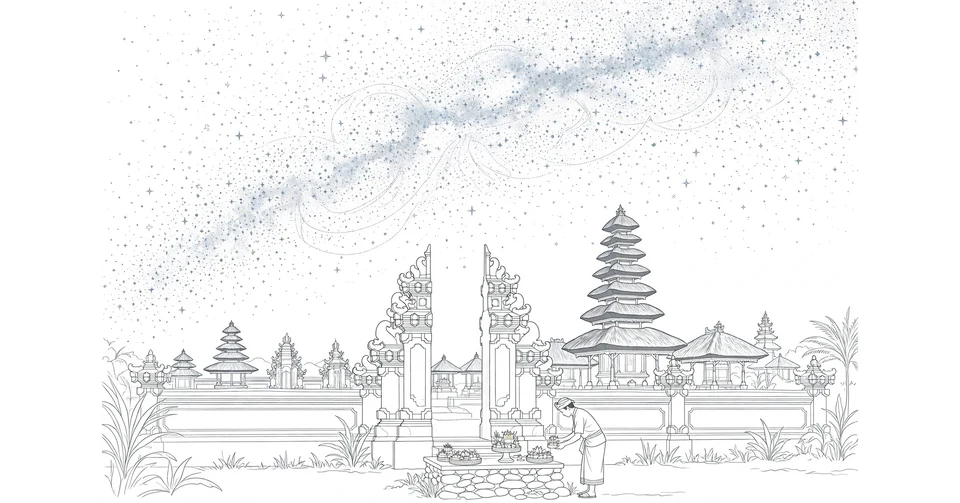
If you visit Bali on a dark moon night, you will not find a festival with gamelan and dancing. You will find something quieter: families preparing offerings, people heading to temples in the dark, and a whole island briefly slowing down to take stock. That quiet is the point.
What tilem means in the Saka calendar
The Balinese Saka calendar is one of two calendars used on the island, alongside the 210 day pawukon calendar. Unlike pawukon, the Saka calendar follows the phases of the moon, and it is roughly the same length as the solar year. Its year is made of 12 months, called sasih, and each sasih has 30 days.
Each sasih begins the day after a new moon. The first 15 days are the waxing moon, counted as pananggal, rising toward the full moon, which is purnama. The next 15 days are the waning moon, counted as panglong, falling back toward darkness. The 15th day of panglong is the new moon itself. So the dark moon is both the last day of the month and the hinge on which the whole calendar turns.
The word itself is often translated simply as new moon, but in Bali it carries more weight than a date on a calendar. It is a sacred day, and like purnama it comes around every 29 or 30 days, in a rhythm that never stops. Because the Saka calendar is lunar, the exact dates shift each year when they are mapped onto the Gregorian calendar, so a visitor who wants to be in Bali for the dark moon needs to check a Balinese calendar first.
How the Saka calendar keeps tilem in step with the sun
A lunar month is slightly shorter than 30 days, and a lunar year of 12 months runs to only 354 or 355 days. Left alone, the calendar would drift away from the seasons. The Saka calendar has two adjustments to stop that happening, and the dark moon sits at the center of both.
The first adjustment is a skipped day. Every nine weeks, two lunar days are allocated to a single solar day, a day called ngunalatri, from the Sanskrit for minus one night. The second adjustment is an extra month. When it is needed, an intercalary month is inserted after the 11th month, where it is known as Mala Jiyestha, or after the 12th month, where it is known as Mala Sadha. The rule for adding it is tied directly to the dark moon: the extra month is added whenever it is needed to prevent the final day of the seventh month, known as Tilem Kapitu, from falling in the Gregorian month of December.
That detail tells you how seriously Bali takes its dark moon. The calendar itself is tuned around the dark moon, so that the darkest night of the seventh month never slips into the wrong season. The year numbering of the Saka calendar is 78 years behind the Gregorian calendar, counted from the beginning of the Saka era in India, and the same calendar was used in Java until Sultan Agung replaced it with the Javanese calendar in 1633.
The twelve sasih, in order, are Kasa, Karo, Katiga, Kapat, Kalima, Kanem, Kapitu, Kawalu, Kasanga, Kadasa, Jyestha, and Sadha. Each one ends in its own dark moon: Tilem Kasa, Tilem Karo, Tilem Katiga, and so on through the year. The first day of the year is usually the day after the first new moon in March, and Nyepi falls on the first day of Kadasa, the tenth month, which is why the years of the Saka era are counted from that date.
Tilem and purnama, the two halves of the month
The dark moon only makes full sense next to its partner, purnama. Purnama is the full moon, the 15th day of pananggal, and it is the bright half of the month. On purnama, the Balinese believe divine beings descend to bless the earth, and temples fill with offerings, incense, flowers, and gamelan. It is a night of light, energy, and celebration.
The dark moon is the other half. Where purnama is about receiving blessings, the dark moon is about letting go. The new moon is a time for introspection, purification, and releasing negativity, and it is believed that darkness is strongest on this night. That makes the dark moon an important time to seek protection from negative forces through ritual and prayer.
On the dark moon, Balinese families prepare offerings of gratitude and protection for their ancestors and deities. Many also perform melukat, a spiritual cleansing with holy water, either in a temple or at the sea. The ceremonies are quieter than those of purnama, and deliberately so. The island does not try to fill the darkness with noise. It sits with it.
There is a simple beauty in that pairing. Purnama says the light is here, and the dark moon says the dark is here too, and both deserve a ceremony. A calendar that only celebrated the full moon would be a calendar that only liked half the month. Bali counts both, and the dark moon is the proof.
I find that honest in a way few calendars are. Most of us live by a calendar that pretends every day is the same, and then wonder why the year feels like a blur. The Saka calendar does the opposite. It asks you to notice the moon, to notice when it is gone, and to mark the going as carefully as the coming.
What happens on a tilem night
A dark moon observance is a family and temple affair rather than a public show. In the morning and through the day, families prepare canang sari, the small palm leaf baskets filled with flowers, rice, and incense, and place them at the family shrine, at the gate, and at the temple. The offerings on the dark moon are made to express gratitude, to seek forgiveness, and to prepare for the new cycle.
Devotees go to temples to pray, and many go for melukat, the cleansing ritual in which holy water is poured over the head and body. Pura Tirta Empul in Tampaksiring is one of the best known places for this, and it draws people on the dark moon as it does on purnama. Other temples see large gatherings on the dark moon too. Goa Lawah, the Bat Cave Temple, and Pura Luhur Batukaru are both named as places where devotees come in numbers to cleanse their minds and spirits in preparation for the new lunar cycle.
The prayers on the dark moon are directed, in part, to Surya, the sun god, asking for the blessing of light to guide people through the darkest night. It is a small, practical theology: when the moon is gone, you ask the sun for help. The darkness is not treated as an enemy to be defeated. It is treated as a condition to be met with care, light, and prayer.
Visitors who happen to be in Bali on a dark moon night can feel the change in the air even without knowing the calendar. The temples are busier than usual in the evening, the smell of incense is stronger, and the streets are a little quieter. It is not a spectacle, and that is exactly why it is worth noticing. If you are invited to a temple on a dark moon night, go quietly, wear a sarong and sash, stay silent during prayers, and never step on an offering. Ask before taking photos, because some rituals are sacred and do not allow them.
Tilem Kesanga, the dark moon before the silence
Not all dark moon nights are equal. The most famous dark moon of the year is Tilem Sasih Kesanga, the dark moon of the ninth month, and it is the night of Tawur Kesanga. On that night, Bali holds the great purification ritual that comes the day before Nyepi, with ogoh ogoh effigies paraded through the streets and burned, and the whole island preparing to fall silent.
Tawur Kesanga is the loudest dark moon of the year, and the contrast is the point. On Tilem Kesanga, the demons are invited out to feast and party, and the noise and fire are meant to drive the negative forces away. The next day is Nyepi, the day of silence, the first day of Kadasa and the first day of the new Saka year. So the darkest moon of the ninth month is the doorway into the new year itself. Without the dark moon, there would be no Nyepi, because Nyepi is dated from the Saka calendar and the Saka calendar is dated from the moon.
That is why the tawur kesanga article on this site opens with the line that Tawur Kesanga falls on Tilem Sasih Kesanga. The date is not an accident of scheduling. It is the calendar doing what it was built to do: ending a month, and a year, in darkness, so that the new one can begin in silence. If you want to understand Tawur Kesanga, you have to understand the dark moon first, because the whole ceremony is built on top of it.
The same logic runs through Nyepi itself. Nyepi is the day after Tilem Kesanga, and it is the first day of the new Saka year. The silence of Nyepi only makes sense as the morning after the dark moon, the quiet that follows the cleansing. The dark moon closes the old year. Nyepi opens the new one.
Tilem Kapitu and the night of Shiva
The second most important dark moon of the year is Tilem Kapitu, the last day of the seventh month. It is known as Siwa Ratri, the night of Shiva, and it is a night dedicated to the god Shiva. Devotees stay up all night and meditate, and the night is counted among the darkest and most powerful of the year.
Siwa Ratri is sometimes described as the darkest of all nights, and it is easy to see why the description sticks. It falls on the dark moon, at the end of the seventh month, and the practice is to stay awake through the darkness rather than sleep through it. The meditation is not a celebration. It is a vigil, and the vigil is the offering.
The calendar guards this night carefully. The intercalary month exists, in part, to keep Tilem Kapitu from falling in December, which would pull Siwa Ratri out of its proper season. That is a remarkable thing to say about a calendar: that it will add a whole month to itself rather than let its darkest night land in the wrong month. It tells you that the dark moon is not a footnote in the Saka system. It is one of the load bearing parts.
There are another 24 ceremonial days in the Saka year, and most of them are usually celebrated at purnama, the full moon. The dark moon has fewer named festivals than its bright partner, and that is fitting. Its work is quieter. It closes months, it clears the way, and it holds the two great nights of the year, Tilem Kesanga and Tilem Kapitu, without making a show of either.
When tilem meets the other calendars
Bali does not run on the Saka calendar alone. The 210 day pawukon calendar runs alongside it, and the two systems overlap in ways that give some days extra weight. When the dark moon falls on the same day as Kajeng Kliwon, a powerful day in the pawukon cycle, the combination is known as Tilem Kajeng Kliwon, and it is treated as a day of particular spiritual attention. The dark moon and the pawukon day amplify each other, and people mark the day with extra care in their prayers and offerings.
The naming of the dark moon days shows the same layering. A dark moon is named for its sasih, so Tilem Kapat is the dark moon of the fourth month, Tilem Kelima the dark moon of the fifth, and so on. Each dark moon is a monthly event, but each one is also a specific night with its own place in the year. The rhythm is regular, one dark moon every 29 or 30 days, and the names keep the rhythm anchored to the seasons.
For a visitor, the practical lesson is simple. Purnama and Tilem are the two great monthly markers of Balinese Hindu life, and they alternate every two weeks. If you plan a trip around the full moon, you will see Bali at its brightest and most festive. If you plan it around the dark moon, you will see Bali at its quietest and most inward. Both are worth seeing, and neither is complete without the other.
Why the dark moon is worth counting
It is easy to love the full moon. It is bright, it is photogenic, and it asks nothing of you except that you look up. The dark moon asks more. It asks you to look up and find nothing, and to treat that nothing as a real event. It asks you to clean, to forgive, to let go, and to start again, and to do all of that in the dark.
That is a harder discipline, and I think it is the more useful one. The full moon is a reminder that things go well. The dark moon is a reminder that things end, and that endings need care too. A month that ends without being marked is a month that just disappears. A month that ends on the dark moon is a month that is closed properly, with offerings, with water, with prayer, and with a night of quiet.
Bali has been closing its months this way for centuries, under a calendar that is 78 years behind the Gregorian count and still running on time. The moon rises, the moon fills, the moon empties, and on the night it empties completely, the island gathers in the dark and starts again. The dark moon is the night that makes the counting honest, and the year that counts its dark moons is a year that does not pretend the light was ever the whole story.
More in Culture & Society
- Desa Pakraman Is the Name the Law Gave the Old Village
- A Primbon Reads Your Life From the Day You Were Born
- Pasaran Is the Five-Day Week Java Never Gave Up
- A Ceper Folds a Coconut Leaf Into a Crescent Moon
- Your Neptu Is the Number Hidden Inside Your Birthday
- The Saka Calendar Sets Nyepi on a Different Date Every Year
Latest posts
- On Tumpek Kuningan Bali Feeds Its Ancestors
- Garuda Carried a Mountain to the Middle of the Ocean
- Vasuki Was the Rope That Churned the Ocean of Milk
- En No Gyoja, the Mystic Shugendo Calls Its Patriarch
- A Saito Goma Burns Its Prayers Outdoors
- Kongobuji Still Governs the Mountain Kukai Left Behind
- A Shukubo Lets You Sleep Inside a Working Temple
- Okunoin Is Japan's Largest Cemetery and Its Quietest Forest
- Suka Duka Means the Banjar Shows Up for Joy and Grief Alike
- Tabuh Rah Spills Blood So the Ground Stays Calm
- The Bendesa Adat Speaks for a Village That Has Two Governments
- Catur Brata Is Four Silences Kept at the Same Time
- On Koyasan the Founder Is Said to Be Still Meditating
- Your Weton Is the Day You Were Born, Counted Two Ways
- Rahu and Ketu Still Chase the Sun and Moon Across the Sky