The Daruma Doll, Japan's Round Symbol of Perseverance
· 11 min read
The daruma doll is a round, red good luck charm modelled on the monk Bodhidharma, and it only gets its second eye when a wish comes true.
Walk into a shop, a shrine, or a family home in Japan around New Year and you will probably meet a round red face staring back at you with one eye painted in and the other blank. That is a daruma doll, a papier-mache good luck charm modelled on Bodhidharma, the monk credited with bringing Zen Buddhism to China. It is part decoration, part goal setting ritual, and one of the most recognisable symbols in Japanese folk culture.
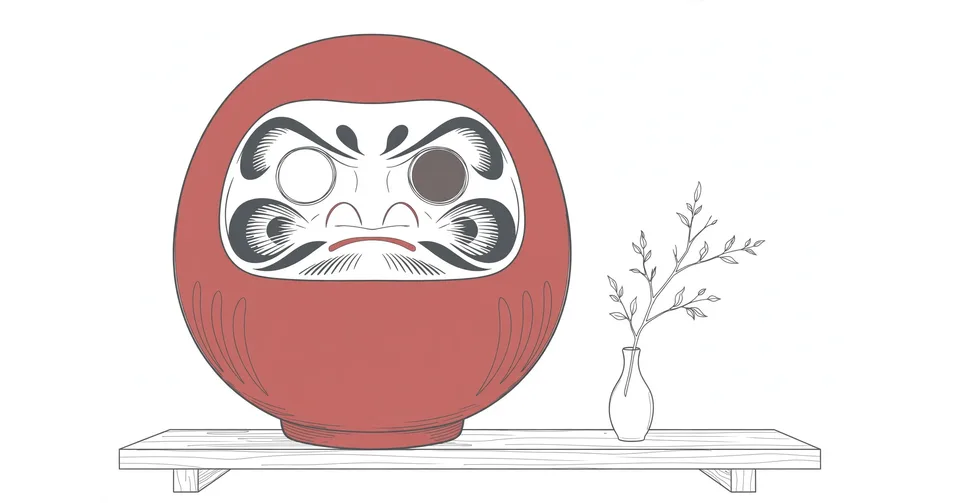
A daruma doll is not a toy, though it looks like one. Its round body rights itself whenever it is pushed over, and that small trick carries the whole meaning of the object. The Japanese saying is nanakorobi yaoki, fall down seven times, get up eight. A daruma doll is that proverb in physical form, and it sits on a desk or a shelf as a daily reminder to keep going when a plan falls apart.
The ritual is simple, and it is the reason the doll starts with blank eyes. When you set a goal, you paint in one eye. When the goal is done, you paint in the other. Between those two moments the half finished face watches you work, which is exactly the point. A daruma doll does not grant wishes on its own. It keeps the wish in sight until you finish the work yourself.
The monk behind the daruma doll
Daruma is the Japanese name for Bodhidharma, an Indian monk who lived in the 5th or 6th century and is traditionally credited with carrying Chan Buddhism, the school that became Zen in Japan, from India to China. Legend says he meditated facing a cave wall at the Shaolin Monastery for nine years, so still and so long that his arms and legs withered away. That legend is why a daruma doll has no limbs. The round, limbless shape is a portrait of the monk after nine years of sitting still.
The colour has its own story too. Red was the colour of Bodhidharma's robes, and in East Asian tradition red also means luck, protection, and health. The doll is made of hariko, papier-mache pressed over a mould, which is why it feels so light in the hand despite its size. Its bottom is weighted, so the centre of gravity stays low and the doll rolls back upright whenever it is knocked down. In Japanese the word for this kind of self righting toy is okiagari, and the daruma doll is the most famous example of it.
The modern daruma doll took shape in the Edo period, from 1603 to 1868, when good luck charms became a common part of New Year markets across Japan. Like the idea of ikigai, a reason to get up in the morning, the daruma doll turns an abstract value into something you can see on a shelf. It is easy to forget a resolution written in a notebook. It is harder to ignore a stern red face that is missing one eye.
How to use a daruma doll
The ritual is called me-ire, painting the eye, and it has a clear order. First, buy the doll, usually at a New Year market or a temple fair. Second, decide on one specific goal. A vague wish does not work well here, because the doll is meant to hold a single promise in view. Third, paint in one eye with black ink while you state the goal to yourself. Most people paint the doll's left eye first, which is on your right as you face it, though some traditions reverse the order. Fourth, put the daruma doll somewhere you will see it every day, a desk, a shelf, or a home altar. Fifth, when the goal is actually achieved, paint in the second eye.
Japanese politicians follow the same ritual in public. A candidate paints one eye of a large daruma doll when the campaign begins and paints the other on election night if the seat is won. The cameras catch both moments, and the doll becomes a very visible record of a promise made and kept. It is the same idea as the one on a student's desk before entrance exams, only bigger and louder.
There is one rule that matters more than the rest. Paint one eye only, and paint the second only when the goal is done. A daruma doll with both eyes filled in on the first day is a decoration, not a ritual. The blank eye is the whole point. It is the unfinished business, kept where you cannot pretend it is not there.
Why the daruma doll never falls over
The weighted base is not a gimmick. It is the reason the doll became a symbol of perseverance rather than just another souvenir. Push a daruma doll and it rocks, wobbles, and comes back to centre. The proverb it illustrates, nanakorobi yaoki, is one of the best known sayings in Japan, and it shows up everywhere from school sports days to business speeches. Fall seven times, get up eight.
The idea sits close to another Japanese tradition. Kintsugi, the art of repairing broken pottery with gold, makes the same point in a different material, that damage is not the end of the story and that a repaired object can be more interesting than a perfect one. A daruma doll makes the point in a simpler way. It does not break at all. It just gets back up, again and again, until you stop pushing it.
That is also why the doll works as a gift. Giving someone a daruma doll is not giving them luck in a box. It is giving them a visible, slightly pushy reminder that the goal they mentioned is still waiting. For a friend starting a business, a student facing exams, or a colleague recovering from an illness, the message is the same. Keep going. The doll will be watching.
Takasaki, the town that makes most daruma dolls
About 80 percent of all daruma dolls made in Japan come from one city, Takasaki, in Gunma Prefecture, north of Tokyo. The tradition there goes back to the late 1700s, when the Shorinzan Daruma-ji temple began selling papier-mache Bodhidharma figures. The story most often told is that the temple's ninth priest, Togaku, started the trade during a famine so that struggling farmers could earn income in the winter, making dolls as a sideline and selling them at the temple.
The craft has barely changed since. Local workshops still paint each doll by hand, and the Takasaki style is easy to recognise. The eyebrows are painted in the shape of cranes and the whiskers in the shape of tortoises, both animals that stand for long life in Japanese tradition. The character fuku, meaning good fortune, is painted on the belly. A Takasaki daruma doll is therefore not just red and round. It carries three more wishes on its face and body, for luck, for long life, and for a long life again.
Every year on January 6 and 7, Takasaki holds the Shorinzan Daruma Fair, known as Daruma Ichi, at the Daruma-ji temple. More than 200,000 visitors come to buy a new doll for the year, and the temple grounds fill with stalls selling dolls in every size, from palm sized ones for a desk to giants taller than a child. It is the largest daruma market in Japan, and for the workshops of Takasaki it is the busiest two days of the year.
What the colours of a daruma doll mean
Red is the original colour and still the most common, but a daruma doll now comes in many colours, and each one is said to suit a different kind of wish. The meanings are modern conventions rather than ancient rules, and no old text settles them, but shops and buyers follow them consistently.
| Colour | Usually said to bring |
|---|---|
| Red | General luck, protection, and health |
| Gold or yellow | Money, prosperity, and business success |
| White | Purity, fresh starts, and exam success |
| Pink | Love and good relationships |
| Black | Warding off evil and bad luck |
| Green | Health, fitness, and a sound body |
The colour changes the wish, not the ritual. A gold daruma doll on a shop counter and a white one on a student's desk are used in exactly the same way, one eye at the start, one eye at the finish. The choice is personal, and the honest advice is to pick the colour that matches the goal you actually have, not the one that looks best on the shelf. A daruma doll is a tool for remembering, and the wrong colour is still better than no doll at all.
The doll has a close relative in the same family of lucky objects. The maneki neko, the beckoning cat with one paw raised, sits by shop tills across Japan for the same reason a daruma doll sits on a desk, to keep a wish where it can be seen. Both belong to a larger group called engimono, objects that carry good fortune, and both are bought at New Year, used through the year, and retired at the year's end. The cat beckons customers in. The doll keeps a promise in view. They do different jobs, and many shops keep both.
What happens to a daruma doll at the end of the year
A daruma doll is not meant to last forever. At the end of the year, the old doll is returned to a temple for a ritual burning called daruma kuyo, and a new doll is bought for the year ahead. The burning is not a punishment for a failed wish. It is a closing ceremony, a way of thanking the doll for its service and clearing the space for a new goal.
If the goal was achieved, the doll goes to the fire with both eyes painted in, a finished job. If the goal was not achieved, it goes with one eye still blank, and the unfinished wish is let go rather than carried into another year. That, I think, is the most honest part of the whole tradition. The daruma doll does not pretend that every wish comes true. It gives you a year to try, a face that will not let you forget, and a clean ending either way.
You can also see the dolls outside Takasaki. Temples sell them at New Year fairs across Japan, souvenir shops stock them in every size, and the small ones cost only a few hundred yen, while large hand painted ones can cost several thousand. When buying one, it is worth checking that it is made of papier-mache rather than moulded plastic if you want the traditional craft, and choosing a size that fits the place where it will actually sit. A daruma doll hidden in a cupboard cannot do its job.
The best place to start is the source. Shorinzan Daruma-ji in Takasaki is open to visitors through the year, and the Daruma Fair in early January is the obvious time to go, though it is crowded. For the history and the meanings, the guides at Bokksu and Japan Objects cover the legend, the eye painting ritual, and the colours in detail, and both agree on the facts that matter: Bodhidharma, Takasaki, one eye at the start, one at the finish.
I like the daruma doll because it asks for so little and gives so much back. It is cheap, it is simple, and it makes no promise it cannot keep. It does not claim to bring luck by itself. It only promises to sit there, one eye open, until you either finish what you started or decide, honestly, to let it go. That is a fair deal, and it is probably why a round red monk from the 6th century is still staring back at us from desks and shop counters across Japan.
More in Culture & Society
- Japanese Festivals, From Snow Sculptures to Summer Fireworks
- Shichi-Go-San and the Day Japan Dresses Its Children in Kimono
- Desa Pakraman Is the Name the Law Gave the Old Village
- A Primbon Reads Your Life From the Day You Were Born
- Pasaran Is the Five-Day Week Java Never Gave Up
- A Ceper Folds a Coconut Leaf Into a Crescent Moon
Latest posts
- Kotatsu, Japan's Heated Table That Warms Winter
- Kakiage and the Tempura Bowl That Towers Over Rice
- The History of the Bicycle From Wooden Wheels to Japanese City Bikes
- the-javanese-of-suriname-and-the-language-they-kept-alive
- Kanban and the Japanese System That Organized Work
- Your Neptu Is the Number Hidden Inside Your Birthday
- Tilem Is the Dark Moon Bali Counts Its Year By
- The Saka Calendar Sets Nyepi on a Different Date Every Year
- On Tumpek Kuningan Bali Feeds Its Ancestors
- Garuda Carried a Mountain to the Middle of the Ocean
- Vasuki Was the Rope That Churned the Ocean of Milk
- En No Gyoja, the Mystic Shugendo Calls Its Patriarch
- A Saito Goma Burns Its Prayers Outdoors
- Kongobuji Still Governs the Mountain Kukai Left Behind
- A Shukubo Lets You Sleep Inside a Working Temple