The Saka Calendar Sets Nyepi on a Different Date Every Year
· 14 min read
The Saka calendar is Bali's lunar calendar, and it is the reason Nyepi never falls on the same Western date twice. Here is how its twelve months, its new moons, and its leap month work.
Bali keeps two calendars at once, and the one that decides its new year is the one most visitors never see. The Saka calendar is a lunar calendar of twelve months, and its first day is Nyepi, the day the whole island falls silent.
That is why Nyepi moves. The Saka calendar follows the moon, so its new year lands on a different Western date every year, usually in March. If you plan a trip around it, you have to ask the moon, not the wall calendar in your kitchen.
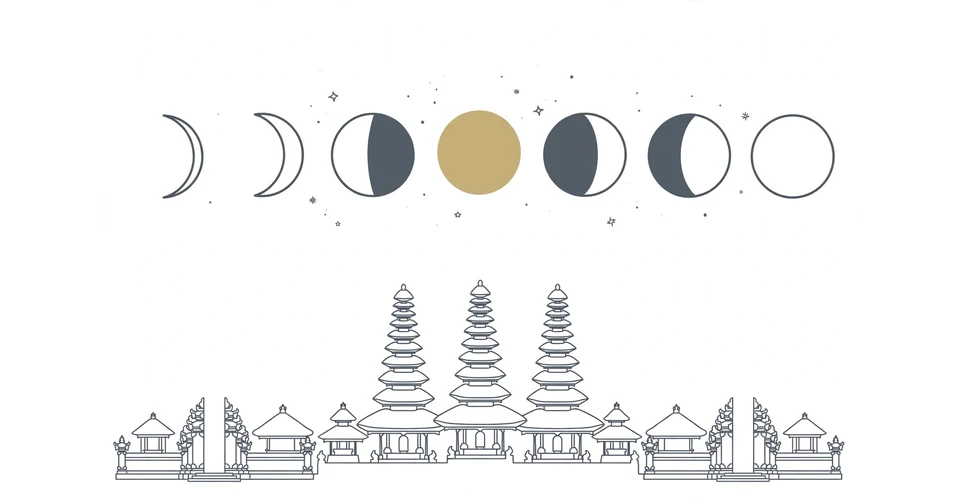
I find that strangely reassuring. A year that begins with a day of silence, counted from the moon, feels like a calendar that still belongs to the people who use it rather than to the office that prints it. The Saka calendar is old, practical, and quietly stubborn, and it has outlasted every attempt to replace it with something simpler.
The saka calendar follows the moon, not the sun
The Saka calendar is what scholars call lunisolar, which is a plain idea hiding behind a long word. It counts the moon, twelve months to a year, and then it corrects itself so it does not drift away from the sun. Each month, called a sasih, has 30 days. Twelve of those months add up to a lunar year of 354 or 355 days, which is about eleven days shorter than the year on a Western calendar. Left alone, a calendar like that would slide backwards through the seasons, the way the Islamic calendar does, and its new year would eventually arrive in a different season altogether. The Saka calendar refuses to do that.
It stays in step with two small corrections. The first is a quiet piece of arithmetic. Because a lunar cycle is slightly shorter than 30 days, the calendar folds two lunar days into one solar day every nine weeks. That day is called ngunalatri, a Sanskrit word that means minus one night. The second correction is larger and rarer. When the count needs it, the Saka calendar adds a whole extra month, an intercalary month, after the eleventh month, when it is called Mala Jiyestha, or after the twelfth, when it is called Mala Sadha. The rule for adding it is simple to state and careful in practice: the extra month is inserted whenever it is needed to stop the last day of the seventh month, known as Tilem Kapitu, from falling in the Gregorian month of December. In other words, the Saka calendar watches December the way a sailor watches a reef, and it steers around it.
The result is a calendar that is almost the same length as the tropical year, the year of the seasons, while still being a calendar of moons. That is the whole trick of the Saka calendar, and it is why it has survived for centuries in a place that also runs a perfectly good solar calendar for business and travel. It does two jobs at once. It keeps the festivals in their season, and it keeps them on the moon.
The structure is laid out plainly in the reference work on the subject, and the details in this article follow the Balinese saka calendar as it is described there, checked against a modern guide to how the two Balinese calendars work in daily life.
Twelve months, each one a sasih
The twelve months of the Saka calendar run in this order:
- Kasa
- Karo
- Katiga
- Kapat
- Kalima
- Kanem
- Kapitu
- Kawalu
- Kasanga
- Kadasa
- Jyestha
- Sadha
Their names come from a mixture of Old Balinese and Sanskrit words for the ordinal numbers from one to twelve, so the calendar is, in a sense, simply counting. Kasa is the first, Karo the second, and so on down to Sadha, the twelfth. A few of the names have variant spellings in different sources. The eighth month, Kawalu, sometimes appears as Kaulu, and the eleventh, Jyestha, sometimes appears as Jiestha. The differences are small and old, the kind of variation that appears when a calendar has been copied by hand for centuries, and they do not change the count.
The first month, Kasa, begins after the Pleiades rise, which ties the calendar to the stars as well as to the moon. The ninth month, Kasanga, is the one that matters most for the new year, because its last day is the dark moon that closes the old year. The tenth month, Kadasa, opens with Nyepi, the first day of the new Saka year. Everything else in the calendar is arranged around that hinge.
How a month is counted: penanggal, purnama, pangelong, tilem
Each sasih begins the day after a new moon, and it is counted in two halves of fifteen days. The first half is called penanggal, the waxing days, and it climbs from the new moon to the full moon. The full moon itself is called purnama. The second half is called pangelong, the waning days, and it falls from the full moon back to the new moon. The new moon is called tilem. Both sets of days are numbered from one to fifteen, so a Balinese date can be named by its moon day as precisely as a Western date is named by its number in the month.
Purnama and tilem each fall once in every sasih, and both are holy days of prayer and offerings. A few of them carry the great rites of the year. Tilem Kapitu, the last day of the seventh month, is Siwaratri, a night dedicated to the god Shiva, when devotees stay up all night and meditate. There are another 24 ceremonial days in the Saka year, and they usually fall on purnama, the full moon.
One detail is worth knowing if you ever compare a Balinese calendar with the sky. The full and new moons of the Saka calendar are set by a traditional reckoning called pengalantaka, which is kept on palm leaf manuscripts, lontar, in the village of Kemenuh and elsewhere. Because of that reckoning, the Balinese purnama can differ by a day from the astronomical full moon. The calendar is not wrong. It is simply following its own count, the way it has for centuries, and the temples follow the calendar rather than the telescope.
Why Nyepi moves, and why the year starts in silence
Nyepi falls on the first day of Kadasa, the tenth month, and the years of the Saka era are counted from that date. The day before it, Tilem Sasih Kesanga, is the dark moon of the ninth month, and it belongs to tawur kesanga, the great offering that settles the island's debts to the unseen world before the silence begins. The first day of the year is usually the day after the first new moon in March, which is why Nyepi usually falls in March, but the moon does not keep office hours, so the exact Western date shifts from year to year.
The Saka calendar has had to defend that March position more than once. In 1991, Bali's Hindu council adopted an Indian system called nirayana for the reckoning, and under it Tilem Kesanga and Nyepi in the years from 1993 to 1998 were found to shift from their usual March into April. High priests met in council in September 2001 to settle the count, and the new year came back to its season. The episode is a reminder that a lunar calendar is not a machine that runs itself. It is a living agreement, kept by people who meet, argue, and decide.
The year number is easier to work out than the date. The Saka calendar counts 78 years behind the Western one, because its era begins in 78 CE in India. Subtract 78 from the Western year and you have the Saka year, so a Western year of 2026 is Saka 1948. The number is small and the history behind it is long, and that gap of 78 years is itself a kind of memory. It says that Bali's calendar began somewhere else, in India, and travelled a long way before it settled here.
What the new year asks of the island is the most famous part of the whole calendar. Nyepi is kept under four restraints, the Catur Brata Penyepian: no fire or light, no work, no travel, and no revelry, from six in the morning until six the following morning. The island stops, the airport closes, and the streets empty. The full story of that day, and of the silence that fills it, is told in the article on Nyepi itself. What matters here is the logic of it. The Saka calendar does not open its year with fireworks or a countdown. It opens it by asking everyone to be still, and to let the world reset.
Two calendars at once: saka calendar and pawukon
The Saka calendar is only half of Bali's timekeeping. The other half is the pawukon, a cycle of 210 days that runs alongside it, and the two divide the work between them. The pawukon is built from ten weeks of different lengths, all turning at once, with thirty seven day weeks called wuku, from Sinta to Watugunung. It sets Galungan, Kuningan, Tumpek, Kajeng Kliwon, and most temple anniversaries, and it sets a person's pawukon birthday, the otonan, which returns every 210 days. The Saka calendar sets Nyepi, purnama and tilem, and Siwaratri. The Western calendar runs on top of both, for work, flights, and bookings.
The division is clean enough to remember. If a holy day is tied to the moon, it belongs to the Saka calendar. If it is tied to the 210 day cycle, it belongs to the pawukon. A temple anniversary, the odalan, can belong to either one, depending on the temple. Some follow the pawukon, and some follow the moon. A good modern guide to the two systems, and to how to read any Balinese date from them, is the Northbound Bali guide to the Balinese calendar, which sets out the rules with examples drawn from Bali's provincial government and the Ministry of Religious Affairs.
The two calendars can even disagree about the same festival, and Bali lets them. Besides the Nyepi kept across the whole island, some villages keep a Nyepi of their own. Banyuning, a customary village in Buleleng, keeps one that follows the pawukon rather than the Saka calendar, as part of the Ngusaba Desa village festival held on Purnama Sasih Kalima, the full moon of the fifth month. Members of the village must keep the four restraints, while newcomers who live there but do not belong to it are not required to. The tradition is dated to the thirteenth century. It is a small, stubborn reminder that in Bali a calendar is not a single national standard. It is a set of agreements, village by village, and each village keeps the one it trusts.
What the saka calendar decides in daily life
For most Balinese families, the Saka calendar is not an object of study. It is a tool, consulted the way a farmer consults the weather. The knowledge of good and bad days is called wariga, and its verdict on a given day is the ala ayuning dewasa. Families read it before they act: before a wedding, before building a house, before planting rice, before cutting hair for a ceremony. The Saka calendar supplies the moon half of that reading, and the pawukon supplies the rest.
The moon days shape the rhythm of worship. On purnama, families come to the village temple in the late afternoon or evening to pray. On tilem, the dark moon, they pray again, often more quietly. The great rites cluster on the moon days that the Saka calendar marks out, and the temples fill accordingly. A visitor who learns to watch for purnama and tilem will find Bali at its most open, because those are the evenings when the temples are busy and the offerings are fresh.
For a traveller, the Saka calendar matters most in one practical way. Nyepi is the one date that changes a trip. Ahead of it, Bali's religious leaders issue a joint appeal with the provincial office of the Ministry of Religious Affairs, and the appeal stops land, sea, and air transport from six in the morning on Nyepi until six the next morning. It takes radio and television off air and asks mobile providers to switch off data. Residents and visitors stay indoors, with no fireworks, loudspeakers, or bright lights. The evening before brings the ogoh-ogoh parades, and the day after, Ngembak Geni, is for visiting family and neighbours. If your dates touch March, find that year's Nyepi date in the joint appeal before you book a flight, and plan the day where you are staying, with food and water bought the day before.
A calendar that arrived from India and stayed
The Saka calendar did not begin in Bali. Its era begins in 78 CE in India, and the Indian Saka calendar was used for royal decrees as early as the ninth century. The same calendar was used in Java until Sultan Agung replaced it with the Javanese calendar in 1633, which is a useful reminder that calendars are also politics. A ruler can change the calendar, and when he does, the old one survives only where people keep using it.
Bali kept using it. The Saka calendar arrived with Hinduism and stayed through every change of ruler, every new port, and every new calendar that came with trade. It stayed because it was not only a way of counting days. It was the frame for the island's biggest festival, and a festival that stops an entire island for a day is not something a calendar change can easily move. The pawukon is older and more local, the Western calendar is newer and more convenient, and the Saka calendar sits between them, lunar and patient, keeping the new year in March.
How to read a Balinese date without getting lost
A Balinese date is read in two halves, one from each calendar, and the Saka calendar supplies the second half. Take a Nyepi day as an example. Read the Balinese way, it is Wraspati Kliwon Kelawu, penanggal 1 sasih Kadasa, Saka 1948. Each part of that name comes from a different piece of the system.
Wraspati is the seven day name, the Thursday. Kliwon is the five day name. Kelawu, also spelt Kulawu, is the wuku, the 28th of the thirty weeks. Penanggal 1 is the moon day, the first day of the waxing moon. Kadasa is the sasih, the tenth month. Saka 1948 is the year. The pawukon half, Wraspati Kliwon Kelawu, returns 210 days later. The Saka half, penanggal 1 sasih Kadasa, returns only when the moon brings it round again.
To read any day yourself, start with the three pawukon names, then add the moon. A printed Balinese calendar, or a digital one such as Kalender Bali Digital, gives the penanggal or pangelong count and the sasih for any day. After a little practice, the names stop looking like a code and start looking like what they are: a short description of where the day sits in two cycles at once.
I like that about the Saka calendar. It does not pretend that time is a single straight line. It says that a day has a moon and a week and a season, all at once, and that the honest way to name it is to name all three. A calendar that can hold that much at once, and still fit on a wall, has earned its place.
The year turns on a new moon, and the island answers with a day of silence. The Saka calendar asks for nothing more than attention, and it repays it with a new year that never arrives on the same date twice, and never arrives by accident.
More in Culture & Society
- Desa Pakraman Is the Name the Law Gave the Old Village
- A Primbon Reads Your Life From the Day You Were Born
- Pasaran Is the Five-Day Week Java Never Gave Up
- A Ceper Folds a Coconut Leaf Into a Crescent Moon
- Your Neptu Is the Number Hidden Inside Your Birthday
- Tilem Is the Dark Moon Bali Counts Its Year By
Latest posts
- On Tumpek Kuningan Bali Feeds Its Ancestors
- Garuda Carried a Mountain to the Middle of the Ocean
- Vasuki Was the Rope That Churned the Ocean of Milk
- En No Gyoja, the Mystic Shugendo Calls Its Patriarch
- A Saito Goma Burns Its Prayers Outdoors
- Kongobuji Still Governs the Mountain Kukai Left Behind
- A Shukubo Lets You Sleep Inside a Working Temple
- Okunoin Is Japan's Largest Cemetery and Its Quietest Forest
- Suka Duka Means the Banjar Shows Up for Joy and Grief Alike
- Tabuh Rah Spills Blood So the Ground Stays Calm
- The Bendesa Adat Speaks for a Village That Has Two Governments
- Catur Brata Is Four Silences Kept at the Same Time
- On Koyasan the Founder Is Said to Be Still Meditating
- Your Weton Is the Day You Were Born, Counted Two Ways
- Rahu and Ketu Still Chase the Sun and Moon Across the Sky