Kanban and the Japanese System That Organized Work
· 12 min read
Kanban began as a paper card on a Toyota factory floor and became the way software teams, hospitals, and households organize work. This is the story of the signboard that taught the world to pull instead of push.
Walk into almost any software company today and you will find a wall, or a screen, divided into three columns. To do, doing, done. Cards move from left to right as the work moves with them, and nobody is allowed to start more than the board can hold. The system behind that board is called kanban, and it started about seventy years ago on a factory floor in Japan, as a paper card attached to a bin of parts.
Kanban is the Japanese word for signboard, written 看板, and the name is literal. The original kanban was a card that carried a signal: this part has been used, make another one. Nothing in the system is more complicated than that, and that is exactly why it spread from car factories to offices, hospitals, and kitchen tables all over the world. This article traces how kanban was invented at Toyota, how a supermarket taught a factory to listen, and why a card from the 1950s still runs so much of modern work.
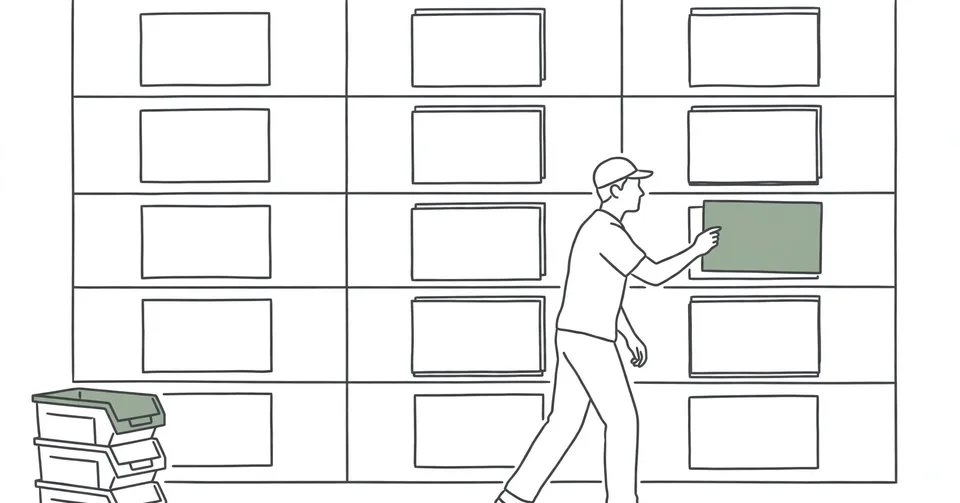
Before kanban, factories mostly worked by push. A plan was drawn up, each department produced its share, and the parts piled up whether the next department needed them or not. The result was warehouses full of half finished goods, money tied up in stock that nobody had asked for, and a constant scramble to find the one part that was missing. Toyota, rebuilding after the war in a country short of cash, space, and materials, could not afford that kind of waste. The company needed a way to make only what was needed, when it was needed, and in the amount needed. Kanban became the mechanism that made that possible.
What kanban means
A kanban card is a work order that travels in the opposite direction to the parts. When a worker takes a bin of bolts from a shelf, the card attached to the bin goes back to the station that made the bolts. That card is the order to make one more bin, no more and no less. Until the card arrives, the station makes nothing. Demand pulls production along, one card at a time, instead of a forecast pushing it forward.
The idea sounds almost too simple to matter, and that is the point. Kanban does not need software, sensors, or a planning department. It needs a visible signal, a fixed number of cards in circulation, and the discipline to stop when no card is asking for more. The signal can be a card, a bin, a marked space on a shelf, or a square painted on the floor. What matters is that everyone can see it and everyone obeys it.
Kanban began in a Toyota machine shop
The system was developed by Taiichi Ohno, an industrial engineer at Toyota who joined the company in the 1940s and became a machine shop manager in 1949. Ohno was one of the central architects of the Toyota Production System, and kanban was his answer to a practical problem. Toyota's factories were producing parts faster than the next process could use them, and the excess inventory was hiding every other problem in the plant: broken machines, bad quality, and slow changeovers all disappeared under piles of stock.
Ohno began experimenting with pull production in the late 1940s. In 1953, Toyota applied the logic in the machine shop of its main plant, where a later process began pulling parts from an earlier one by sending back a card. The method worked well enough that by 1963 kanban was in use across all Toyota plants. Ohno wrote the system down in his book Toyota Production System: Beyond Large Scale Production, first published in Japan in May 1978, and the book became the manual for a generation of factory managers.
The timing mattered. Japan in the 1950s could not copy the American model of mass production, which depended on huge volumes, cheap capital, and endless warehouse space. Toyota had to build cars in small batches, with little money and less room, and kanban let it do that without drowning in inventory. A system born from scarcity turned out to be better than the system born from abundance, and the rest of the world eventually noticed.
The supermarket that taught a factory to listen
The most famous part of the kanban story is the supermarket. The popular version says Ohno walked into an American grocery store and had a flash of inspiration. The real story is more ordinary and more interesting. In the early 1950s, a Toyota colleague who had visited the United States came home with photographs of a supermarket and an explanation of how it worked. Ohno himself visited American supermarkets in 1956, including the Piggly Wiggly chain, and watched the same pattern.
A supermarket does not guess what customers will buy and fill the shelves in advance. It stocks a fixed amount, watches what leaves the shelf, and replaces exactly what was taken. The customer, by picking up a product, sends the signal to restock. Ohno saw that the factory could work the same way. The next process in the line was the customer of the previous one, and the card it sent back was the same as the empty space on a shelf. Produce only what was taken, and the warehouse stops growing.
Toyota's own company history adds a second input: a 1954 report on a Lockheed aircraft plant in the United States, which was said to have saved 250,000 dollars a year by using the supermarket method to assemble jet bombers. Whatever the exact mix of influences, the principle was settled by the mid 1950s. A detailed timeline of kanban traces the same path from the 1950s machine shop to the software board, and it agrees on the essentials. Let the next step in the work say what it needs, and stop making more than it asks for.
How a kanban card actually works
Toyota built kanban around six rules, and they are worth knowing because they explain why the system works and where it breaks. First, a later process takes only what it needs from an earlier one, in the amount it needs and at the time it needs it. Second, the earlier process produces only what was taken, so production is always a response, never a guess. Third, nothing is made or moved without a kanban card, which means no card, no work. Fourth, the card stays attached to the goods it describes, so the signal and the product never get separated. Fifth, defective products are never passed to the next process, because a bad part hidden in the flow poisons everything downstream. Sixth, the number of cards is reduced over time, which tightens the system and exposes problems instead of burying them.
Two kinds of card do most of the work. A withdrawal kanban authorizes taking parts from a shelf, and a production kanban authorizes making replacements. In practice, the two travel as a pair. The withdrawal card moves upstream with the empty bin, the production card comes back with the full one, and the loop repeats. Because the number of cards is fixed, the amount of inventory in the loop is fixed too. Want less inventory? Take cards out of circulation. The system makes the trade off visible, which is the opposite of what a warehouse full of buffer stock does.
It is worth noting what kanban does not do. It does not plan the factory, schedule the week, or decide what to build. It is a control system, not a planning system, and it assumes demand is fairly stable. A sudden spike in orders, a supplier that stops delivering, or a machine that breaks down will starve a kanban loop fast, because there is deliberately no pile of spare parts to fall back on. Toyota accepted that risk on purpose. A system with no slack shows its problems immediately, and a problem you can see is a problem you can fix. A system with deep buffers hides its problems until they are too big to fix. The same culture of relentless efficiency has a darker edge in Japan, and the story of karoshi, death by overwork, is a reminder that a system built to squeeze out waste can also squeeze people if nobody watches the human cost.
Kanban left the factory
For about twenty years, kanban stayed inside Toyota and its suppliers. It reached Western management in the late 1970s and 1980s, carried by the same wave of interest in Japanese manufacturing that brought just in time production and quality circles to American and European factories. The oil shock of 1973 had made fuel and materials expensive, and suddenly Toyota's frugal methods looked less like a quirk of a poor country and more like a preview of the future. The same Toyota group later produced another quiet invention that took over the world: the QR code, invented by Denso, a Toyota group company, which I wrote about in the story of how the QR code was invented in Japan. And the obsession with timing and flow that kanban embodies is visible every day on Japanese trains, which run on schedules so precise that a delay of one minute is news.
The second great migration happened in software. In 2004, David J. Anderson designed a pull system for a sustaining engineering team at Microsoft, and later applied the same ideas at Corbis. His book, Kanban: Successful Evolutionary Change for Your Technology Business, published in 2010, gave knowledge workers a version of the card that fit their world. The factory bin became a task on a board. The shelf became a column. The fixed number of cards became a limit on work in progress, usually written as a small number at the top of the Doing column.
That limit is the heart of the software version. Most teams fail not because they work too slowly, but because they start too much at once, and half finished work piles up exactly the way half finished parts once piled up at Toyota. A work in progress limit forces a choice. Finish something before starting the next thing, and the board starts to move. The idea spread through agile teams so fast that many people who use a kanban board today have never heard of Toyota, which is probably the best measure of how completely the system won.
The kanban board on your wall
A modern kanban board is usually three columns, To Do, Doing, and Done, but the columns are the least important part. What matters is the discipline the board imposes. Every task is visible. Every task has one owner. The Doing column has a limit, often two or three tasks per person, and a new card cannot enter it until an old one leaves. Work that is stuck gets a mark, so a blocked card is visible to the whole team instead of quietly aging in somebody's inbox.
The same board works outside software, which is why kanban has turned up in hospitals tracking patients, in newsrooms tracking stories, and in homes tracking chores. Personal kanban, the practice of running your own life on a small board, has its own books and followers. The reason is the same in every setting. When everything you have started is visible in one place, you can see how much you have bitten off, and the board makes the cost of starting one more thing impossible to ignore.
I have come to think the real lesson of kanban is not about cards or columns at all. It is about respecting a limit. Most of us, and most organizations, treat starting work as progress and finishing it as an afterthought, so we keep starting things until nothing gets finished. Kanban reverses the reward. The only way to start something new is to finish something old, and that single rule quietly reorganizes everything downstream of it: meetings get shorter, half done projects get killed instead of nursed, and the work that matters gets the attention it was starved of. A paper card from a 1950s machine shop still teaches that lesson better than most management books.
Why kanban still works
Kanban has survived for seventy years because it is a system that makes reality visible. A warehouse full of stock hides problems. A board full of stuck cards shows them. A forecast hides the gap between what you planned and what customers actually want. A card that only moves when something is consumed shows that gap in real time. The system does not pretend the world is predictable. It assumes the world will surprise you, and it gives you the smallest possible tool for responding: a signal that says make one more, right now.
That is also why kanban keeps finding new homes. Every field has its version of excess inventory, whether it is unfinished code, unread email, unedited drafts, or patients waiting in a corridor. The kanban answer is always the same. Make the work visible, limit what is in progress, and let real demand pull the next step. The signboard that organized Toyota's factory floor turned out to organize work itself, and it shows no sign of stopping. If you run a team, a project, or just your own week, try putting three columns on a wall and a limit on the middle one. The card will do the rest.
More in Money & Work
- A Lembaga Perkreditan Desa Is a Bank the Village Owns
- Bureiko, the Drinking Party Where Rank Is Left at the Door
- Nomi-Hara, When After-Work Drinks in Japan Turn Into Harassment
- Nomikai, the After-Work Drinks That Are Part of the Job in Japan
- The E33G Remote Worker Visa and How to Legally Work from Bali
- The Salaryman and Japan's Loyal Office Culture
Latest posts
- the-javanese-of-suriname-and-the-language-they-kept-alive
- Shichi-Go-San and the Day Japan Dresses Its Children in Kimono
- Desa Pakraman Is the Name the Law Gave the Old Village
- A Primbon Reads Your Life From the Day You Were Born
- Pasaran Is the Five-Day Week Java Never Gave Up
- A Ceper Folds a Coconut Leaf Into a Crescent Moon
- Your Neptu Is the Number Hidden Inside Your Birthday
- Tilem Is the Dark Moon Bali Counts Its Year By
- The Saka Calendar Sets Nyepi on a Different Date Every Year
- On Tumpek Kuningan Bali Feeds Its Ancestors
- Garuda Carried a Mountain to the Middle of the Ocean
- Vasuki Was the Rope That Churned the Ocean of Milk
- En No Gyoja, the Mystic Shugendo Calls Its Patriarch
- A Saito Goma Burns Its Prayers Outdoors
- Kongobuji Still Governs the Mountain Kukai Left Behind