Your Neptu Is the Number Hidden Inside Your Birthday
· 12 min read
Your neptu is the single number hidden inside your Javanese birth date, and it is worked out by adding the values of your weekday and your pasaran day together.
Your birthday in Java carries a second date, and inside that date hides a single number. The number is your neptu, and for many Javanese families it is the first thing anyone asks about a newborn, a bride, or a groom. It is not a horoscope in the Western sense. It is arithmetic, two small numbers added together, and the sum is believed to say something about the person who carries it.
I first met the idea through a simple question. An older relative, hearing a birth date, did not ask for the year or the hospital. She asked what day it fell on, in both calendars at once. That is the heart of it. A Javanese birth date runs on two cycles at the same time, a seven day week and a five day market week, and your neptu is the number that comes out when the two meet.
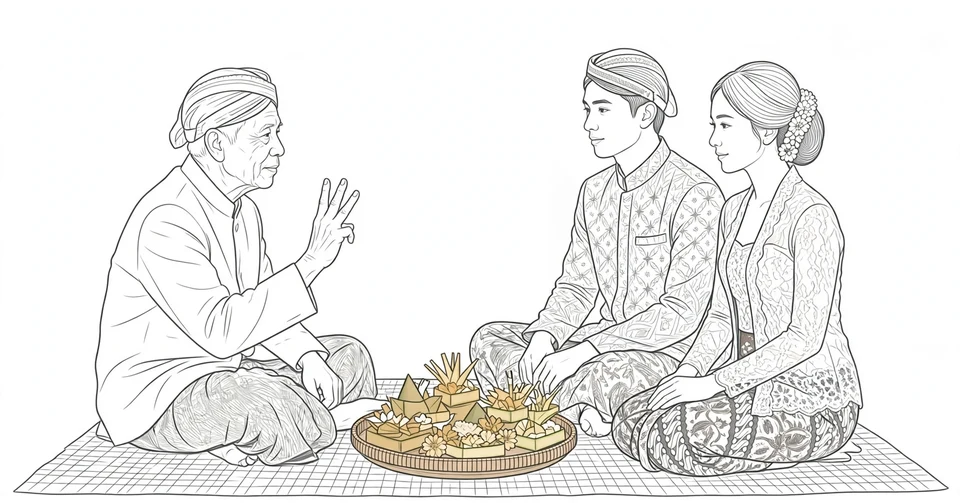
This article explains what the number is, how it is worked out, and what people do with it. The readings belong to belief and custom, not to science, and this article treats them that way. The calculation itself, though, is exact, and it has been done the same way for centuries.
What neptu is
A neptu is a fixed number attached to a day. Every day in the seven day week carries one, and every day in the five day pasaran cycle carries one too. Your weton is the pairing of the two days you were born on, for example Friday Kliwon, and your neptu is the sum of the two values. Add the weekday number to the pasaran number and you have it.
The result is always between 7 and 18. The smallest possible neptu comes from Tuesday, worth 3, plus Wage, worth 4, which gives 7. The largest comes from Saturday, worth 9, plus Pahing, worth 9, which gives 18. There are only twelve possible totals, and each one has a traditional reading attached to it in the primbon, the Javanese almanacs that record this knowledge.
That narrow range is part of the charm. A whole life is reduced, for a moment, to one number between 7 and 18, and then the conversation begins. People compare numbers, argue about them, and consult them before weddings, house building, and business openings. Your weton, the day you were born counted two ways, is the pairing itself. That sum is the weight of that pairing, expressed as a single figure.
Two cycles, one number
To understand the number, you have to hold two calendars in your head at once. The first is the familiar seven day week, called Saptawara. Its Javanese day names come from Arabic, through the spread of Islam: Senin, Selasa, Rebo, Kemis, Jemuwah, Setu, and Minggu. The second is the older five day market week, called Pasaran or Pancawara. Its days are Legi, Pahing, Pon, Wage, and Kliwon.
The pasaran is the truly Javanese half of the pair. The name comes from pasar, meaning market, because village markets once rotated through these five days, and each village held its market on its own pasaran day. The cycle is older than the seven day week in Java, and it still runs underneath daily life. When the two cycles are laid on top of each other, a particular pairing, say Friday Kliwon, comes around again only every 35 days, since 7 times 5 is 35. That 35 day round is called the wetonan cycle, and a person's birthday, in the full Javanese sense, recurs every 35 days rather than once a year.
There is a detail worth knowing. In the Javanese calendar, days begin at sunset rather than at midnight. That is a calendar fact, not a rule about birthdays, but it hints at how differently time is cut up in this system. The day is not a neutral box on a wall calendar. It is a meeting point of two rhythms, and the neptu is the number that meeting produces.
How to work out your neptu
The calculation is simple, and that simplicity is the point. You look up two numbers and add them. The weekday values are Sunday 5, Monday 4, Tuesday 3, Wednesday 7, Thursday 8, Friday 6, and Saturday 9. The pasaran values are Legi 5, Pahing 9, Pon 7, Wage 4, and Kliwon 8.
| Weekday | Neptu |
|---|---|
| Sunday | 5 |
| Monday | 4 |
| Tuesday | 3 |
| Wednesday | 7 |
| Thursday | 8 |
| Friday | 6 |
| Saturday | 9 |
| Pasaran day | Neptu |
|---|---|
| Legi | 5 |
| Pahing | 9 |
| Pon | 7 |
| Wage | 4 |
| Kliwon | 8 |
Take a Wednesday born on Legi. Wednesday is worth 7, Legi is worth 5, so the total is 12. Take a Friday born on Kliwon. Friday is worth 6, Kliwon is worth 8, so the total is 14. The most famous example in Indonesian history is 17 August 1945, the day of the Proclamation of Independence, which fell on Jumat Legi. Friday gives 6, Legi gives 5, so the neptu of that day is 11. That same weton, Jumat Legi, is also recorded as the birth and death day of Sultan Agung, the king who shaped the modern Javanese calendar.
A full guide to the calculation, with the same tables and worked examples, is given in a detailed guide to weton and neptu. It is worth reading the tables there slowly, because the numbers are the whole system. Everything else, the character readings, the matchmaking, the choice of good days, is built on top of two small additions.
What your neptu total is said to mean
Each total from 7 to 18 has a traditional name and a character reading in the primbon. These are matters of belief, and different primbon books do not always agree on the details. What follows is the common set of readings, given as tradition rather than fact.
A neptu of 7 is called Pendito Kang Lelaku, the wandering sage, and is said to belong to a restless traveller who dislikes staying in one place. A neptu of 8 is Laku Geni, the path of fire, quick to anger and hard to hold. A neptu of 9 is Laku Angin, the path of wind, easily influenced but quick and agile. A neptu of 10 is Pendito Mbangun Teki, the sage who solves riddles, keen to advise and slow to take advice.
A neptu of 11 is Laku Setan, a difficult label that the tradition attaches to indecision and unsuitability for leadership. A neptu of 12 is Laku Kembang, the path of the flower, peace loving and willing to follow rather than lead. A neptu of 13 is Laku Lintang, the path of the star, charming and elusive, happiest with room to move. A neptu of 14 is Laku Rembulan, the path of the moon, a good listener and a natural adviser.
A neptu of 15 is Laku Geni again, the path of fire, fiery and firm and quick to take offence. A neptu of 16 is Laku Bumi, the path of the earth, gentle and nurturing, but frightening when angered. A neptu of 17 is Laku Gunung, the path of the mountain, quiet and kind, sometimes slow to see when trust is being used. A neptu of 18 is Laku Paripurna, the path of completion, the highest total, said to bring power and dominance that must be watched carefully.
I would not treat any of this as a verdict on a person. The same total gets different readings in different books, and the books themselves warn that a full reading needs more than the total alone, including the wuku, the week of the 210 day Pawukon cycle in which the person was born. What the list does show is how the system works as a language. A neptu gives a family a shared vocabulary for talking about a child, and that conversation matters more than the label.
Neptu and marriage
The most common use of neptu is in matchmaking. Before a wedding, families compare the neptu of the bride and the groom, and the calculation has a name of its own: tibo rampas. The two neptu totals are added together and divided by three. If the remainder is 1, the match is considered unfavorable. If the remainder is 2, it is considered good for household life, with a balanced distance between husband and wife. If the remainder is 0, the marriage is said to face many obstacles.
Other methods exist, and that is worth saying plainly. Some practitioners divide the combined total by seven instead, and read the remainder against a different set of named outcomes. The existence of more than one method is itself the lesson. The number opens a discussion, and different elders will read it differently.
In practice, an unfavorable remainder rarely ends a match on its own. Families weigh it alongside many other considerations, and plenty of couples go ahead anyway. The calculation is a prompt for a conversation about two people, not a ruling handed down by arithmetic. That is how living traditions usually work, whatever the books say.
The pasaran day on its own
The neptu total is not the only reading a birth date gives. The pasaran day alone is believed to shape character too, and it carries its own set of associations. Each pasaran day is linked to a direction and a colour. Legi belongs to the east and to white. Pahing belongs to the south and to red. Pon belongs to the west and to yellow. Wage belongs to the north and to black. Kliwon belongs to the centre, where the colours blur.
The primbon also gives each pasaran day a bird. Legi is the manuk kuntul, the egret, noble and charismatic, inclined toward luxury. Pahing is the manuk ulung, the hawk, and the reading is a hard one, tied to betrayed trust. Pon is the manuk podang, the oriole, wise and fond of giving advice. Wage is the manuk gagak, the crow, a sweet talker who is not always consistent with the truth. Kliwon is the manuk pelatuk, the woodpecker, independent and assertive toward others.
The weekday has its own reading as well. Sunday is tied to the sun, and is said to bring a bright and sincere heart. Monday follows the moon, and is tied to truthfulness and quick work. Tuesday follows fire, Wednesday the earth, Thursday wind and thunder, Friday the stars, and Saturday the water. None of this is science, and none of it needs to be. It is a system for paying attention to a birthday, and for giving a newborn a story to grow into.
Where neptu comes from
The calendar that carries neptu is not ancient in its present form. The current system of the Javanese calendar was inaugurated by Sultan Agung of Mataram in 1633. Before that, the Javanese used the Saka calendar, whose epoch falls in 78 CE. Sultan Agung kept the Saka count of years but measured the year by the lunar system of the Islamic calendar instead of the solar year.
That history explains why the system feels layered. A Hindu Saka count of years sits underneath an Islamic lunar year, and underneath both sits the older pasaran, which may come from indigenous gods or old market rhythms. Nobody knows the origin of the pasaran names for certain. The Javanese calendar is a stack of histories, and neptu lives in the middle of the stack, where the seven day week and the five day week cross.
The same calendar shapes public life in ways that reach beyond birthdays. The weton of 17 August 1945, Jumat Legi, is taught in Indonesian primary schools, and the night of Jumat Legi is considered important for pilgrimage. The ritual dance bedhaya may only be performed on Kemis Kliwon. These are not small superstitions kept in a drawer. They are rules that govern ceremony, and they show how seriously the calendar is still taken.
That seriousness shows up in craft as well. The empu asks the customer for their weton before he begins work on a blade, because the keris is meant to suit the person who will carry it. The number is consulted before the hammering starts. A blade made for one neptu is not quite the same as a blade made for another, and that is a practical use of a number most people would call mystical.
A number, not a verdict
I like neptu for a reason that has little to do with belief. It is honest about what it is. Two numbers, added together, in the open, where anyone can check the sum. There is no secret ingredient and no hidden authority. An elder who tells you your neptu can show you the tables, and you can do the addition yourself at the kitchen table.
That openness is also its limit, and it is a limit worth respecting. A number between 7 and 18 cannot hold a person. It cannot predict a marriage, a career, or a life. The families who use it best seem to know this. They treat the number as a starting point for attention, a reason to talk about who a child is becoming, rather than a verdict on who the child must be.
If you know your birth date, you can work out your neptu in a minute. Find your weekday, find your pasaran day, add the two values, and you have a number that people in Java have been adding up for centuries. Whether you believe the reading or not, you will have done something quietly old fashioned. You will have counted your birthday twice, and found a small hidden sum inside it.
More in Culture & Society
- Desa Pakraman Is the Name the Law Gave the Old Village
- A Primbon Reads Your Life From the Day You Were Born
- Pasaran Is the Five-Day Week Java Never Gave Up
- A Ceper Folds a Coconut Leaf Into a Crescent Moon
- Tilem Is the Dark Moon Bali Counts Its Year By
- The Saka Calendar Sets Nyepi on a Different Date Every Year
Latest posts
- On Tumpek Kuningan Bali Feeds Its Ancestors
- Garuda Carried a Mountain to the Middle of the Ocean
- Vasuki Was the Rope That Churned the Ocean of Milk
- En No Gyoja, the Mystic Shugendo Calls Its Patriarch
- A Saito Goma Burns Its Prayers Outdoors
- Kongobuji Still Governs the Mountain Kukai Left Behind
- A Shukubo Lets You Sleep Inside a Working Temple
- Okunoin Is Japan's Largest Cemetery and Its Quietest Forest
- Suka Duka Means the Banjar Shows Up for Joy and Grief Alike
- Tabuh Rah Spills Blood So the Ground Stays Calm
- The Bendesa Adat Speaks for a Village That Has Two Governments
- Catur Brata Is Four Silences Kept at the Same Time
- On Koyasan the Founder Is Said to Be Still Meditating
- Your Weton Is the Day You Were Born, Counted Two Ways
- Rahu and Ketu Still Chase the Sun and Moon Across the Sky