Pasaran Is the Five-Day Week Java Never Gave Up
· 13 min read
The pasaran is Java's older five-day week, Legi, Pahing, Pon, Wage and Kliwon, and it still runs beside the seven-day week in markets, calendars and birthdays.
Java keeps two weeks running at the same time. One is the seven-day week the rest of the world uses. The other is the pasaran, a five-day cycle of Legi, Pahing, Pon, Wage and Kliwon that is older, stranger and, against all odds, still alive.
The pasaran does not belong to a museum. It sets the day a village market opens, it names the day you were born, and it helps decide whether a wedding date is lucky. Ask a Javanese friend for their weton and they will answer with a weekday and a pasaran day, the way you might answer with a star sign.
I find that quietly remarkable. Most calendars shed their old gears when a new one arrives. Java kept both, and the pasaran is the gear that never stopped turning.
Where the pasaran came from
The name gives the game away. Pasaran comes from pasar, the Javanese word for market. Long before the five-day cycle became a spiritual system, it was a practical one: it told neighbouring villages which day to hold their market, so that traders could move from one to the next and no two nearby markets clashed. The cycle was a roster before it was a cosmology.
The British scholar John Crawfurd, writing in 1820, suggested that the length of the cycle had something to do with the number of fingers on a hand, and that travelling merchants rotated their visits to different villages on a five-day round. It is only a suggestion, and the origin of the day names themselves is still unclear. But the market logic is easy to believe. Five days is about the right size for a circuit of villages, and the name stuck even after the cycle grew meanings far beyond trade.
The pasaran is the native Javanese part of a calendar that has been rebuilt more than once. The current system of the Javanese calendar was inaugurated by Sultan Agung of Mataram in 1633. Before that, Java used the Saka calendar, which counts its years from 78 CE. Sultan Agung kept the Saka year count but switched the lunar year to the system used by the Islamic calendar. What he did not touch was the pasaran. The five-day week survived the reform intact, which tells you how deep its roots already ran. It was not a royal invention. It was a village habit that a king decided to keep.
Each day of the pasaran carries two names, because Javanese has two registers of politeness. The everyday ngoko names are the ones everyone uses: Legi, Pahing, Pon, Wage and Kliwon. The formal krama names are Manis, Pait, Pethak, Cemeng and Asih. The krama names are much less common in daily speech, but they survive in old texts and in formal use, and they carry the meanings that the cycle is built on: sweet, bitter, bright, dark and loving.
The five days of the pasaran
Every pasaran day has a direction, a colour and a number, and Javanese tradition reads character and fortune out of all three. The associations are consistent across the sources, but the interpretations vary from one primbon to another, so what follows is the common reading rather than a single rulebook.
Legi, or Manis, is the sweet day. It belongs to the east and the colour white, and it carries the neptu value 5. Tradition treats it as a day of beginnings, optimism and growth, the energy of the rising sun. People born on a Legi day are often described as open, honest and good at winning people over, and the day itself is considered good for starting new projects and for trade.
Pahing, or Pait, is the bitter day. It belongs to the south and the colour red, and it carries the neptu value 9, the highest of the five. It is the day of fire, passion and ambition. People born on Pahing are often described as driven and spirited, sometimes quick to anger, and the day is considered powerful for competition and creative work but volatile for negotiations.
Pon, or Pethak, is the bright day. It belongs to the west and the colour yellow, and it carries the neptu value 7. It is the day of the setting sun, associated with strength, leadership and clear judgement. People born on Pon are often described as natural leaders, thoughtful and respected, and the day is considered good for important decisions and for showing your work.
Wage, or Cemeng, is the dark day. It belongs to the north and the colour black, and it carries the neptu value 4, the lowest of the five. It is the day of the night, associated with introspection, mystery and steady thought. People born on Wage are often described as grounded, watchful and independent, and the day suits planning, research and quiet reflection more than large gatherings.
Kliwon, or Asih, is the loving day. It belongs to the centre and to blurred, many colours, and it carries the neptu value 8. It is the spiritual pivot of the whole cycle, the point where all the directions meet. Tradition holds Kliwon to be the most spiritually potent of the five days, a day of intuition, artistry and charisma, and a good day for prayer, meditation and visiting sacred places.
I would not claim that a day can fix your character. But I like the shape of the system. Five days, five directions, five colours, and a centre that holds them together. It is a small cosmology you can carry in your head, and it turns an ordinary week into a map.
Two weeks running at once
The clever part of the pasaran is what happens when it runs beside the seven-day week. Five and seven share no common factor, so the two cycles only line up again after 35 days. That 35-day round is called the wetonan cycle, and the pairing of a weekday with a pasaran day inside it is a weton. Your weton is the day you were born, counted two ways at once.
Our article on your weton, the day you were born counted two ways explains the pairing in full. The point here is that the pasaran is what makes the pairing possible. Without the five-day cycle, a birthday would just be a weekday. With it, two people born on the same Tuesday can carry entirely different wetons, because one was born on a Tuesday Legi and the other on a Tuesday Kliwon. The pasaran is the extra digit that makes the date personal.
The two cycles run continuously and simultaneously, each moving forward one day at a time regardless of the other. A certain Friday may fall on a Kliwon day and be called Jumat Kliwon. A Tuesday may fall on Wage and be called Selasa Wage. The combination repeats only every 35 days, so a weton returns roughly ten times a year, and Javanese families still mark it. The selapanan, the celebration held every 35 days for a baby, follows this rhythm, and so do many anniversaries.
There is one more detail that shows how old the system is. In the Javanese calendar, a day begins at sunset, not at midnight. The pasaran day you were born on is the one that was running when the sun went down. It is a small fact, but it tells you the calendar was built by people who watched the sky, not the clock.
The pasaran also sits inside a much larger machine. The Javanese year counts from the Saka era, so the year 2026 is the Javanese year 1959. The lunar year is 11 or 12 days shorter than the civil year, so the Javanese new year, 1 Sura, falls 11 or 12 days earlier each Gregorian year, drifting slowly backwards through the seasons. Around it run the other cycles: the solar months called mangsa, which follow the farming year and begin near the June solstice, the eight-year windu, and the 120-year kurup. The pasaran is the smallest gear in that machine, and the one that turns fastest. It is also the one ordinary people meet every day.
The numbers inside the pasaran
What turns the pasaran from a label into a tool is that every day in both cycles carries a number, called neptu. The pasaran days run Legi 5, Pahing 9, Pon 7, Wage 4 and Kliwon 8. The weekdays run Sunday 5, Monday 4, Tuesday 3, Wednesday 7, Thursday 8, Friday 6 and Saturday 9. Add the weekday number to the pasaran number and you have the neptu of your weton, so every weton in existence lands somewhere between 7 and 18. A person born on Saturday Pon holds 9 plus 7, a neptu of 16. A person born on Wednesday Kliwon holds 7 plus 8, a neptu of 15.
That sum is the input for petungan, the traditional calculation method recorded in the primbon, the Javanese almanacs that are part calendar and part handbook. A guide to Javanese numerology lays out the same fixed values and the same method, and notes that the calculation is the standard part while the interpretations vary. Petungan is consulted before fixing a wedding date, a circumcision, a move to a new house, or the first digging on a building plot. The neptu of two people can be added together and sorted into categories to judge how a marriage might run. Families planning a wedding will often ask an elder familiar with the primbon to check both partners' wetons before settling on a date, and some will ask a second, more experienced reader if the two families disagree.
The honest caveat belongs here too. Interpretations of particular neptu sums vary between primbon sources and between practitioners, so the meanings given anywhere are common readings rather than one canonical rulebook. The calculation itself is the only part that is fully standard. And a neptu sum does not predict events or decide whether a relationship will succeed. Plenty of Javanese people weigh an inauspicious pairing alongside many other considerations, and plenty set the reckoning aside entirely. The numbers are a guide to timing, not a verdict on a life.
I respect that honesty. A system that admits its own limits is easier to trust than one that pretends to certainty. The pasaran does not tell you what will happen. It tells you when people think it is wise to act, and it leaves the acting to you.
Jumat Kliwon, Jumat Legi and the famous pairings
Some pairings of weekday and pasaran day have grown famous enough to have lives of their own. The best known is Jumat Kliwon, Friday Kliwon. Friday is the most sacred day of the Islamic seven-day week, and Kliwon is the pasaran day held to carry the most spiritual power, so their meeting is treated as a spiritual apex, a peak time for prayer, meditation and visiting the graves of ancestors. In modern Indonesia the name is often attached to horror films and ghost stories, which is a misunderstanding of the tradition. The day is not feared. It is respected, and used.
The other famous pairing is Jumat Legi, Friday Legi. The Proclamation of Indonesian Independence on 17 August 1945 fell on a Jumat Legi, and so, by tradition, did both the birth and the death of Sultan Agung, the king who gave Java its modern calendar. That coincidence has made Jumat Legi a night for pilgrimage, and it is still taught in primary schools as a date worth remembering.
There are taboos tied to the cycle as well. The ritual dance bedhaya, one of the most sacred dances of the Javanese courts, can only be performed on Kemis Kliwon, Thursday Kliwon. The dance moves to the sound of the gamelan, the bronze orchestra that is the sound of Java and Bali, and the restriction is absolute: the wrong day means no performance at all. A calendar that can forbid a dance is a calendar with real authority.
The market that still keeps the pasaran
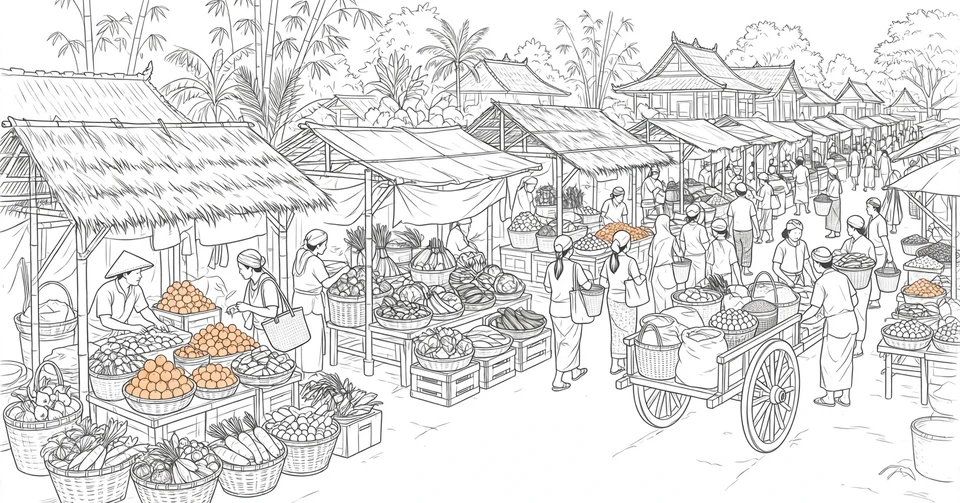
The pasaran began as a market roster, and the market is where it is easiest to see it still working. Most markets in Java no longer operate under the traditional cycle and stay open every day of the Gregorian week. But many keep the old names that show they once opened only on certain pasaran days, names like Pasar Legi and Pasar Kliwon. And in smaller towns, the market on its name day is still much busier than on other days. Travelling sellers appear with livestock, plants and goods that are bought less often or cost more, which lets a small number of merchants serve a much larger area, much as in bygone days.
The market day was never only about buying and selling. Villagers gathered at local markets to meet, to talk, to buy farm produce and cooked food and things made by home industries. The pasaran gave that gathering a rhythm. You knew which day your neighbours would be there, and which day the traders from the next valley would pass through. The cycle turned commerce into a social calendar, and the social calendar into a habit that outlived the commerce.
I think that is why the pasaran survived when so many old calendars did not. It was never only a way of counting days. It was a way of arranging people. A market needs a day, a wedding needs a date, and a newborn needs a name for the day it arrived. The seven-day week can give you a date, but it cannot tell you when the market is full or whether the day suits a wedding. The pasaran can, or at least it can tell you what your grandparents believed about the day. That is a useful thing for a calendar to do.
Why the pasaran still matters
Java could have dropped the pasaran a century ago. The Gregorian week runs the offices, the schools and the trains, and the Islamic week runs the prayers. Nothing practical requires a five-day cycle any more. And yet the pasaran is still there, in the name of the market down the road, in the weton on a birth certificate of memory, in the date of a wedding and the night of a pilgrimage.
It survives, I think, because it does two jobs the seven-day week cannot do. It tells you when to gather, and it tells you who you are. A week of seven days is a fine way to organise work. A week of five days, running beside it, is a way to organise meaning. The two together make a 35-day round in which every day has a name, a number, a direction and a colour, and every person has a day that belongs to them alone.
The pasaran is not a relic. It is a second week that Java never gave up, because it never stopped being useful. Long may it keep turning, one market day at a time.
More in Culture & Society
- Desa Pakraman Is the Name the Law Gave the Old Village
- A Primbon Reads Your Life From the Day You Were Born
- A Ceper Folds a Coconut Leaf Into a Crescent Moon
- Your Neptu Is the Number Hidden Inside Your Birthday
- Tilem Is the Dark Moon Bali Counts Its Year By
- The Saka Calendar Sets Nyepi on a Different Date Every Year
Latest posts
- On Tumpek Kuningan Bali Feeds Its Ancestors
- Garuda Carried a Mountain to the Middle of the Ocean
- Vasuki Was the Rope That Churned the Ocean of Milk
- En No Gyoja, the Mystic Shugendo Calls Its Patriarch
- A Saito Goma Burns Its Prayers Outdoors
- Kongobuji Still Governs the Mountain Kukai Left Behind
- A Shukubo Lets You Sleep Inside a Working Temple
- Okunoin Is Japan's Largest Cemetery and Its Quietest Forest
- Suka Duka Means the Banjar Shows Up for Joy and Grief Alike
- Tabuh Rah Spills Blood So the Ground Stays Calm
- The Bendesa Adat Speaks for a Village That Has Two Governments
- Catur Brata Is Four Silences Kept at the Same Time
- On Koyasan the Founder Is Said to Be Still Meditating
- Your Weton Is the Day You Were Born, Counted Two Ways
- Rahu and Ketu Still Chase the Sun and Moon Across the Sky