Desa Pakraman Is the Name the Law Gave the Old Village
· 14 min read
A desa pakraman is the same old Balinese village under a legal name, given by a 2001 regulation and taken back by a 2019 one, and the name still shapes how the village governs itself.
Walk through any village in Bali and you will pass a temple with three towers, a meeting pavilion, and rows of family compounds behind carved gates. Ask who runs the place and the answer is not the office with the flag. It is the village itself, through its own customs, its own rules, and its own meeting. That village has had three names in a single lifetime, and the middle one, desa pakraman, is the most interesting of the three.
A desa pakraman is a customary law community in Bali, a village bound together by shared temples, shared tradition, and shared rules. The name is a legal label. Bali Province Regional Regulation No. 3 of 2001 gave the old village that name, and Bali Province Regional Regulation No. 4 of 2019 took it back, restoring the older name of desa adat. The village underneath never changed. What changed was what the law chose to call it, and that choice mattered more than it sounds.
The story of the name is really the story of how Bali protected its villages from being swallowed by the state. Each time the law reached for the village, the village answered by writing its own rules more firmly. A desa pakraman is not a place on a map so much as a community that refuses to be governed from outside.
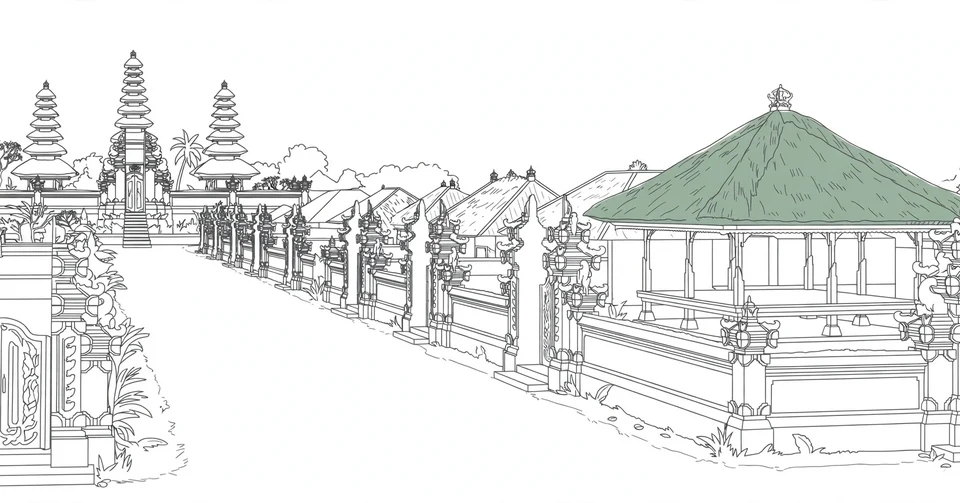
The village is older than its names
Long before any regulation named it, the Balinese village already governed itself. About a thousand years ago, the holy teacher Mpu Kuturan, adviser to King Udayana Warmadewa and Queen Gunapriya Dharmapatni, met religious and community leaders at Pura Samuhan Tiga. Those meetings produced the fundamental structures of Balinese society: the customary village itself, the three village temples known as kahyangan tiga, and the family shrine called sanggah rong tiga. The village ran religious life, social life, and economic life for centuries without needing a law to tell it what it was.
The first time a provincial regulation tried to fix the village in law, it used the name people already used. Bali Province Regional Regulation No. 6 of 1986 spoke of desa adat, the customary village. That name lasted through the New Order and into the first years of regional autonomy. Then, in the 1990s, as Indonesia handed more power to the regions and customary law had to be fitted into the new autonomy framework, the name began to shift. A history of Denpasar's pakraman villages describes how the term desa adat gave way to desa pakraman during that adjustment, and how Regional Regulation No. 3 of 2001 made the change official, confirming the desa pakraman as a customary institution with a formal legal basis.
The shift was not a small edit. Under the old order, the village had been treated as an administrative unit that happened to have customs. Under the new regulation, the customs were the point. The law recognised the village as a community with its own territory, its own assets, and the right to manage its own household affairs. The name desa pakraman carried that recognition. It said, in legal language, that this village is not a branch of the state. It is a community of its own.
I find that history quietly moving. A village that had governed itself for a thousand years needed a new name before the law would admit what it already was. The name was the price of recognition, and Bali paid it.
What a desa pakraman actually is
Regulation No. 3 of 2001 defines a desa pakraman in its first article as a unit of customary law community in Bali which has a unity of tradition and social interaction of Hindu society from generation to generation, in the bond of kahyangan tiga, which has a certain area and owns assets and also the right to take care of its own domestic business. That is a lawyer's sentence, but every part of it points at something you can see. The tradition is the ceremonies. The social interaction is the gotong royong, the shared work. The bond of kahyangan tiga is the three temples. The territory is the land inside the village boundary. The assets are the temple land, the meeting pavilion, and the village treasury. The right to manage its own business is the paruman, the village meeting, deciding for itself.
The three temples are the anchor of every desa pakraman. Pura Puseh stands in the east and honours the founders and ancestral spirits of the village. Pura Desa stands in the centre and serves the life of the village community, including the worship of Dewi Sri, the goddess of welfare and prosperity. Pura Dalem stands in the west and is linked to the dead and to protection from harm. Together they map the whole of village life, from origin to daily bread to death, and every desa pakraman must have them. A settlement without kahyangan tiga is not a desa pakraman at all.
Below the village level sits the banjar pakraman, the customary hamlet, and below that the tempekan, its smaller divisions. The people who belong are the krama, and the krama are the village in the most literal sense. The main residents, the krama ngarep, hold and manage the village land known as karang ayahan and take responsibility for the temples and ceremonies. The philosophy that holds it all together is tri hita karana, the balance between humans and God, humans and each other, and humans and nature. A desa pakraman is, in that sense, a small theory of how to live, written into streets and temples rather than into books.
There are about 1,490 of these villages across Bali, spread over eight regencies and one city. Denpasar alone, according to 2021 data, has 35 traditional villages, each with its own awig-awig. That number of desa pakraman is worth pausing over. Bali is a small island, and nearly fifteen hundred separate customary governments operate on it, each with its own rules, its own temples, and its own meeting. No central office could run that. That is why the law, in the end, had to recognise it instead.
The law the village writes for itself
Every desa pakraman writes its own constitution, and it is called awig-awig. The rules are made by the krama themselves, or by the krama of the banjar, and they guide the life of the village according to tri hita karana, local custom, and religious duty. Awig-awig covers worship procedures, the management of resources, and the settlement of disputes inside the community. It is the document that turns a shared tradition into binding law.
What strikes me about awig-awig is the language it is written in. Researchers who studied awig-awig texts across Bali found that they are written in alus singgih, the highest honor variety of the Balinese language, and that a new awig-awig is often made sacred through a pasupati ceremony, a ritual that is understood as breathing life into it. The village does not write its rules in the plain language of an office memo. It writes them in the language of respect, and then it treats the text as something alive. The effect, the researchers found, is that people obey not because they fear punishment but because the words themselves carry honour. A rule that honours you is harder to break than a rule that threatens you.
The contents are practical to the point of bluntness. One awig-awig sets out the duties of the main residents, who must look after the village land and the ceremonies at Pura Puseh, the Bale Agung, and the shrine of Betara Manik Bingin. Another sets fines in rice, one kilogram for breaking a minor rule, ten kilograms when the village must pay for a mass cremation. One village fines anyone who skips communal work without wearing the customary uniform. Another requires a purification ritual and hands the offender to the authorities if a murder pollutes the village. The rules about animals are just as concrete: owners must tie up their pigs and cattle so they do not damage a neighbour's garden, let alone desecrate a shrine, and the fine for a stray animal is set by pararem, the agreements the krama make together.
That is the genius of a desa pakraman. Its law is not handed down from a distant capital. It is written by the people who will live under it, in words that honour them, and it deals with the things that actually happen in a village: a loose cow, a skipped ceremony, a disputed plot of land, a death in the family. I have read national laws that say less about real life in ten times the words.
Two governments in one village
To understand a desa pakraman you have to understand that Bali has two villages in every village. One is the desa dinas, the administrative village created by national law, which handles identity cards, development funds, and the business of the state. The other is the desa adat, the customary village, which handles temples, ceremonies, customary land, and disputes under awig-awig. They occupy the same territory and often the same people, but a desa pakraman and a desa dinas answer to different logics. A desa adat is a village that governs itself, and the bendesa adat is the person who speaks for it.
The distinction became sharper after Indonesia passed the Village Law of 2014, Law No. 6 of 2014, which rebuilt the administrative village across the country. Bali's customary villages did not fit that law, because they are not administrative units. They are religious and customary communities with their own territory, origin rights, traditional rights, original structure, and original autonomy to manage their own household. The 2019 regulation therefore deliberately avoided basing itself on the Village Law. It based itself instead on the Regional Government Law of 2014, Law No. 23 of 2014, whose Article 236 paragraph 4 allows a regional regulation to carry local content. That technical choice is the whole story in miniature: the village could only be protected by a law that admitted Bali is different.
Living with two governments is not always comfortable. The administrative village controls state money and state programs. The customary village controls the land, the temples, and the loyalty of the krama. When the two disagree, the village meeting has to find a way through, and usually it does, because the same people sit in both rooms. But the tension is real, and it is the reason the name on the door matters. Call the village a desa dinas and it is a branch of the state. Call it a desa pakraman and it is a community with rights of its own.
The name the law took back in 2019
On 28 May 2019, Bali Province Regional Regulation No. 4 of 2019 on Desa Adat in Bali was set and promulgated in Denpasar. A week later, on 4 June 2019, Governor Wayan Koster formally launched it at Wantilan Pura Samuhan Tiga in Bedulu, Gianyar, the same temple where Mpu Kuturan had met village leaders a thousand years before. The ceremony was deliberate in every detail. It was held on Anggara Kasih Kulantir, a holy day believed to be the moment of Shiva's meditation, and the governor noted that Mpu Kuturan himself was a fourth son. The launch was attended by priests, the deputy governor, the police chief, the provincial parliament speaker, regents and mayors, the customary village councils, and the bendesa of 1,493 desa pakraman across Bali. A report from the launch ceremony records that the regulation was celebrated as a historic moment, because for the first time the customary village was recognised as a legal subject with a clear position and clear authority.
The regulation is a large document, 18 chapters and 104 articles, and it restores the old name. From 2019 onward, the law calls the village desa adat again, and desa pakraman becomes a name from an earlier chapter. The change was not cosmetic. The regulation gives the desa adat its own territory, origin rights, traditional rights, original structure, and original autonomy to manage its own household. Article 4 states that a desa adat is located within the province of Bali. Article 8 divides the people of the village into three categories with their own duties and rights: krama desa adat, Balinese Hindus who are mipil, registered as full members, and recorded in the village; krama tamiu, Balinese Hindus who are not mipil but are recorded in the village; and tamiu, people other than those two groups who stay or live in the village area and are recorded there. Article 11 requires that any change in the status, rights, or function of village land be decided by agreement through the paruman of the village or banjar concerned. Articles 21 to 25 set out the duties and authority of the village, including its local authority on a village scale.
The regulation also keeps the structure the bendesa adat article describes in detail. The bendesa adat is the head of the village administration, the pucuk pengurus, chosen by consensus in a musyawarah mufakat and serving a term set by local awig-awig or pararem. The prajuru, the village officers, must include at minimum a bendesa, a patajuh, a panyarikan, and a patengen. And the paruman, the village meeting, remains the highest decision making body. The bendesa executes what the paruman decides. That order matters: the head does not rule the meeting, the meeting rules the head.
Governor Koster had drafted the regulation since 2014, when he was still a member of the national parliament, and he described it as carrying out the vision of Nangun Sat Kerthi Loka Bali, building a new Bali era on a foundation of local wisdom. The regulation was, in his words, made to preserve what Mpu Kuturan had designed, so that the desa adat would be stronger and able to meet the challenges and opportunities of the age. Whether you agree with the politics or not, the ambition is plain: the law would no longer treat the village as a problem to be administered. It would treat it as a partner to be strengthened.
And yet the old name of the desa pakraman did not vanish. People still say desa pakraman in daily speech, and the councils and institutions built under the 2001 regulation carried the name for years. That is how names work in Bali. The law can change the label in a single day, but the community keeps the words it grew up with, and the new name has to earn its place the slow way, one ceremony at a time.
Why the name still matters
I keep coming back to a simple question. If the village never changed, why did the name have to change twice? The answer, I think, is that a name is never just a name when a state is involved. The 2001 regulation called the village a desa pakraman because the law needed a term that sounded like a legal institution rather than a folk custom. The 2019 regulation called it a desa adat again because the people had never stopped using the old word, and the law finally caught up with them. In both cases, the name was a negotiation between a community that knew what it was and a state that needed a word for it.
That negotiation is still going on, and it is worth watching. A desa pakraman, by whatever name the current regulation uses, is a reminder that government does not only come from parliaments and ministries. It can also come from a meeting under a pavilion roof, where neighbours who have known each other all their lives decide, by talking until everyone agrees, how their village will live. The awig-awig, the paruman, the kahyangan tiga, the karang ayahan: these are not decorations on a modern village. They are the village.
The next time you hear the words desa pakraman, listen for the whole story inside them. An old village, a label from 2001, a correction from 2019, and a community that kept governing itself through all of it. The law gave the village a name, and then it gave it back. The village, meanwhile, just kept meeting, kept praying, and kept writing its own rules. That is the part no regulation can grant and no regulation can take away.
More in Culture & Society
- A Primbon Reads Your Life From the Day You Were Born
- Pasaran Is the Five-Day Week Java Never Gave Up
- A Ceper Folds a Coconut Leaf Into a Crescent Moon
- Your Neptu Is the Number Hidden Inside Your Birthday
- Tilem Is the Dark Moon Bali Counts Its Year By
- The Saka Calendar Sets Nyepi on a Different Date Every Year
Latest posts
- On Tumpek Kuningan Bali Feeds Its Ancestors
- Garuda Carried a Mountain to the Middle of the Ocean
- Vasuki Was the Rope That Churned the Ocean of Milk
- En No Gyoja, the Mystic Shugendo Calls Its Patriarch
- A Saito Goma Burns Its Prayers Outdoors
- Kongobuji Still Governs the Mountain Kukai Left Behind
- A Shukubo Lets You Sleep Inside a Working Temple
- Okunoin Is Japan's Largest Cemetery and Its Quietest Forest
- Suka Duka Means the Banjar Shows Up for Joy and Grief Alike
- Tabuh Rah Spills Blood So the Ground Stays Calm
- The Bendesa Adat Speaks for a Village That Has Two Governments
- Catur Brata Is Four Silences Kept at the Same Time
- On Koyasan the Founder Is Said to Be Still Meditating
- Your Weton Is the Day You Were Born, Counted Two Ways
- Rahu and Ketu Still Chase the Sun and Moon Across the Sky