Petruk's Nose Arrives Before He Does
· 10 min read
Petruk is the tall, long nosed clown servant of Javanese wayang, the middle son of Semar who turns midnight comedy into sharp social criticism. This is his story, from the lost fight that shaped his face to the famous night he became king.
In a Javanese wayang kulit performance, most characters announce themselves with grandeur. Gods descend in radiance, kings arrive with retinues, heroes take up shining weapons. Petruk announces himself with his nose. The tall, gangling clown servant is built around a single feature that slides into the lamplight a fraction of a second before the rest of him, a long, unmistakable nose that Indonesian audiences have been laughing at, and listening to, for centuries.
Petruk is the middle son of Semar, standing in the family line between the short Gareng and the round, irrepressible Bagong. Together with their father they form the punakawan, the clown servants who steal every wayang show, attached to whatever hero the night's story belongs to. For the first hours of the performance they serve quietly at the edge of the plot. Then, around midnight, they take the whole show over.
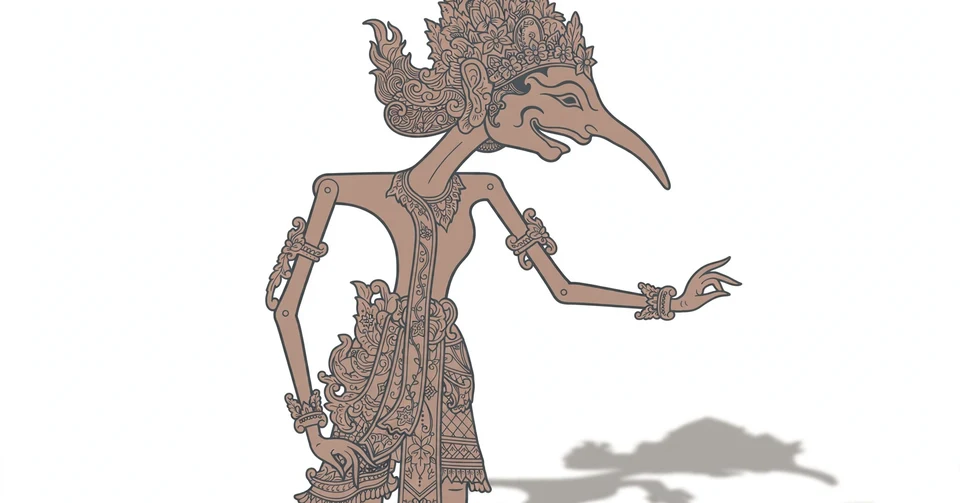
What the family does with that midnight hour explains why Petruk still matters. Under the slapstick, his is the voice in the epic that is allowed to talk about ordinary life: the price of things, the weight of debt, the foolishness of officials, and the distance between what rulers promise and what servants actually receive. The kings on the screen speak in the refined language of destiny. Petruk speaks in the language of the audience.
A face left over from a lost fight
The strangest thing about Petruk is that his famous body is not a costume. In his origin story, retold in the encyclopedia tradition of wayang purwa, he begins life as somebody else entirely: Bambang Pecruk Panyukilan, a noble giant, a raksasa of good birth who was funny, fond of jokes, and dangerously quick to pick a fight. One day he left home to test his strength, met another wandering strongman named Bambang Sukakadi, and challenged him on the spot.
The fight went on and on. Neither man would yield, and by the end both of them were covered in bruises and their once handsome faces were handsome no longer. The brawl was only stopped when Semar arrived and ordered the two battered fighters to become his students instead. Bambang Sukakadi became Gareng. Bambang Pecruk Panyukilan became Petruk, long limbed, long nosed, and grinning.
I have always liked that the tradition explains the clown this way. The long nose is not a random joke drawn by a puppet maker. Inside the story, it is what pride looks like after it has been beaten out of a man and he has survived the lesson. Petruk can afford to laugh at kings because he used to be the kind of creature who thought the world existed to test his strength against. He knows exactly how ridiculous that creature was. He is wearing the evidence.
Even his voice carries the trace of the old life. While his brothers are given comic, nasal voices by the dalang, the puppeteer, Petruk is usually given something closer to a warrior's voice, deeper and straighter than the clowning around him. The fighter is still in there. He has simply been reassigned.
Petruk owns the midnight hour
A full wayang kulit performance runs all night, and its turning point comes after midnight with a scene called gara-gara. The dalang shakes the kayon, the leaf shaped puppet that stands for the tree of life, while the gamelan quickens. On the screen the world falls into turmoil, a stretch of story time filled with disease, earthquakes, and eruptions. Then the chaos settles, and out of it come Semar and his sons.
Scholars who study the scene, such as the author of a study of the punakawan's untimely appearance, point out that gara-gara is less a plot event than an interruption of the plot itself. The clowns' doings barely affect the great war or quest that surrounds them. What they affect is the audience. For an hour or so the story stops, and in its place come slapstick, songs, rude jokes, and a running commentary on the world outside the screen.
This is where Petruk does his real work. The punakawan speak irreverently to everyone, heroes and gods included, exposing foolishness and hypocrisy wherever it sits. Because the words come out of a clown's mouth, in the middle of the night, inside an ancient story, they can be said at all. A dalang who wants to criticise a tax, a policy, or a pompous public figure does not make a speech. He waits for gara-gara and lets Petruk open his mouth.
The contrast is carved into the puppets themselves. The heroes of wayang are made slim and graceful, with fine features and controlled movements, while the clowns are deliberately grotesque, their bodies bulging, drooping, or stretched out of proportion. Petruk is the stretched kind. When the punakawan dance their way into the gara-gara scene, his long arms and legs turn every gesture into a gentle parody of the refinement happening elsewhere on the screen, a reminder that elegance is not the only way a body can tell the truth.
The scene is also cheerfully anachronistic. The punakawan talk about the present day in the middle of the Mahabharata, and Petruk has been known to claim possessions like a car or a mobile phone, objects that obviously never existed in the world of the epic. Nobody in the audience objects. That is the deal the midnight hour makes: the story lends the clowns its stage, and the clowns lend the story its connection to the street outside.
The night the servant became king
The boldest story Petruk ever carried is Petruk Dadi Ratu, Petruk Becomes King. It is not an old myth. According to the encyclopedia tradition, the tale arose during the Dutch colonial period, and it was understood at the time as a veiled criticism of the colonial power, the kind of criticism that had to wear a puppet's face to be performed in public.
In the story, Petruk takes the throne under the gloriously absurd royal name Prabu Welgeduwelbeh, overthrowing his own brother Gareng to become king of the land of Trancanggribig. The reign does not last. Bagong, the youngest brother, overthrows him in turn, and in the end the kingdom is handed back to the Pandawa heroes, where storybook order says it belongs.
Petruk carries other stories too, and even the straight adventures bend toward the same point. In Ambangun Candi Saptaharga, a sacred relic called Kalimasada is stolen by the sorceress Dewi Mustakaweni, and it is not a prince who recovers it. It is Petruk, slipping in to steal the treasure back. Again and again, the tradition hands its servant the jobs that matter and then pretends, politely, that nothing unusual has happened.
On paper the ending restores everything. In the theatre, though, something irreversible has happened: several thousand people have spent part of a night watching a gangling servant sit on a throne, issue decrees, and be obeyed. I find it hard to believe the audience went home thinking only about the restoration. Satire works by showing, and once you have seen a clown crowned, every real ceremony carries a faint echo of the joke. That the tale was born under colonial rule, when direct mockery of the powerful was genuinely risky, makes the long nose look less like a joke and more like protective equipment.
A husband, a father, and a man worried about school fees
For all his satirical duties, Petruk is also the most domestic of the punakawan. In the traditional stories he is married to Dewi Ambarawati, whose hand he won by defeating four rival suitors in battle, the old warrior showing through the clown once again. They have a son, Lengkungkusuma. He even has his own small-scale adventure story, Petruk Ilang Petele, in which the great crisis is that Petruk has lost his axe.
That ordinariness is deliberate, and performers keep renewing it. In one recorded performance discussed by scholars, a sleeping spell falls over an entire kingdom and hero after hero succumbs, even propping their eyes open with matchsticks. The one figure who stays awake a little longer is Petruk, and not because of any spiritual discipline. He cannot sleep for worrying about his children's school fees and the debts waiting for him at home.
It is a perfect Petruk joke, because it is barely a joke. The gods and kings of wayang worry about destiny. Petruk worries about tuition. Every person in the audience who has ever lain awake doing household arithmetic is, in that moment, sitting on the screen.
The same clown under other names
The punakawan are a Javanese invention, added to epics that came from India and found, in Java, to be missing something. Petruk and his family appear nowhere in the Indian Mahabharata. Scholars of wayang treat the clown servants as an original local creation, which means Javanese audiences of centuries ago listened to the great imported stories of gods and princes, enjoyed them, and then quietly inserted their own people into the cast: servants, jokers, and fathers, speaking the local language of common sense. Of all those insertions, Petruk is the one who walks in front, nose first. Other Indonesian traditions adopted the idea and renamed the family. In the Sundanese wayang golek of West Java, the clown servants appear under different names, and the tall, lanky son of the family is generally known there as Dawala. The silhouette survives the journey west; only the name changes.
Petruk also keeps escaping the screen into newer art. In Nano Riantiarno's celebrated 1995 play Semar Gugat, Semar Protests, Petruk appears as the son who walks away from his father after the old god loses his powers, a painful modern twist on the family's loyalty. His outline turns up in cartoons and everyday references, the long nose instantly readable even to people who have never sat through a full night of wayang.
His father has his own strange double life, being both servant and god, a story I told in full in my piece on Semar. Petruk inherited the earthier half of that inheritance. Where Semar carries divinity hidden inside a servant's body, Petruk carries the audience itself: its debts, its school fees, its suspicion that the people on the throne might not be any wiser than the people carrying their luggage.
The epics gave Java its kings, gods, and wars, but Java answered by inventing a servant with an impossible nose and giving him the best hour of the night. Petruk still earns that hour the same way he always has. The nose comes around the edge of the screen first, the audience starts laughing before he has said a word, and laughter, as every dalang knows, is exactly the state in which people are ready to hear something true.
More in Culture & Society
Latest posts
- Kombu Is the Quiet Half of Dashi
- Manza Onsen Bathes at 1,800 Metres
- Every Prefecture Argues About What Goes in Ozoni
- KRL Commuterline and the Trains That Move Jakarta
- Kecap Manis and the Sweet Soy Sauce of Indonesia
- In Mamoiada, Two Hundred Families Still Make Wine at Home
- Shochu and the Quiet Spirit of Japan
- A Dried Shiitake Is Louder Than a Fresh One
- Loma Linda's Long Lives Run on Saturdays
- Maruten Numazu and the Towering Kakiage Bowl of the Port
- The Three Sisters Grow Better Together
- Tatamiishi Terraces Filter a River Through Stone
- Wasabi-Zuke Puts the Whole Plant in Sake Lees
- Konyoku Is Still Out There, Past the Last Train Station
- Dry January Lasts a Month on Purpose