Punakawan, the Clown Servants Who Steal Every Wayang Show
· 8 min read
The punakawan are the clown servants of Javanese wayang: Semar, a god in the body of a fat old servant, and his sons Gareng, Petruk, and Bagong, who seize the stage at midnight for jokes, satire, and the wisest advice in the show.
Ask a Javanese audience which part of an all night wayang show they would never sleep through, and many will name the hours when the punakawan are on screen. The heroes may own the story, but the four clown servants own the night. They arrive late, they speak like ordinary people, and they say the things nobody else in the play is allowed to say.
The punakawan are Semar and his three sons, Gareng, Petruk, and Bagong, the attendants of whichever hero the night's story happens to follow. In a theatre of gods, kings, and demons, they look like nobody important: one round old man and three oddly shaped boys. Their job is to serve, to carry, to follow. What they actually do is advise, rescue, and mock, and by the end of the night the punakawan have usually understood the story better than the heroes living it.
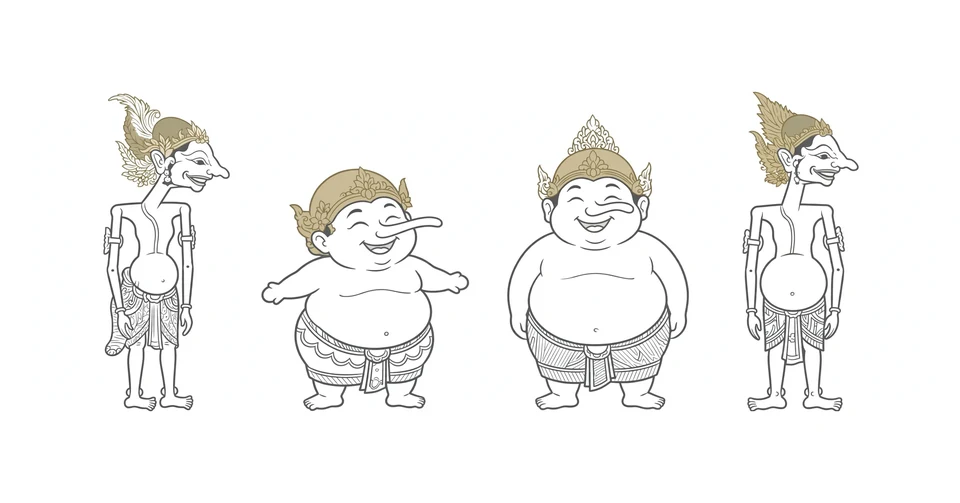
The stage they enter is an ancient and serious one. Wayang, Indonesia's shadow puppet theatre, performs the Ramayana and the Mahabharata, epics that travelled from India to Java more than a thousand years ago. Kings speak in archaic court language, gods descend, armies clash. Into that elevated world the punakawan walk in speaking everyday Javanese, and the whole theatre relaxes.
The punakawan are a Javanese invention
Here is the detail that makes the punakawan remarkable: India never sent them. Search the Mahabharata and the Ramayana in their Indian forms and you will find the gods, the Pandawa brothers, Rama and Sita, but no Semar, no Gareng, no Petruk, no Bagong. The punakawan are a Javanese creation, added by local storytellers to epics that were already ancient when they arrived on the island.
Scholars who have tried to trace Semar's origin suspect the clowns may descend from much older local deities, figures of the island itself who were demoted to servants when the imported heroes took over the stage. The evidence is thin and the origin stays honestly obscure, which feels right for characters built on mystery. What is certain is the effect. The punakawan are the point where a foreign epic becomes Javanese, the local soul of the show, proof that Java did not just receive these stories but answered them.
The family also changes as it travels. The punakawan belong to Java first, but related clown servants appear in the wayang traditions of Sunda and Bali under other names and other faces, and in Bali the counterpart of Semar is Twalen, another ancient servant who guides the heroes. Every region, it seems, insists on keeping its own ordinary people inside the epic. Java simply gave its version the deepest roots and the roundest god.
Semar, the god who works as a servant
Semar leads the punakawan, and Semar is the great paradox of wayang. By tradition he is not a clown who happens to be wise. He is Sang Hyang Ismaya, a god in human form, and the dhanyang, the guardian spirit of Java itself. Some regard him as the most sacred figure in the entire puppet set. His name is said to come from samar, a Javanese word meaning dim, obscure, and mysterious, and he is addressed with the honorific Kyai Lurah Semar, the venerable chief.
Javanese mythology holds that gods can only appear on earth as ugly, unprepossessing humans, and Semar follows the rule completely. He is short and round, with a flat nose, a protruding jaw, a bulging belly and chest, and a checkered hipcloth. Nothing about him suggests power. Yet inside the stories Semar is never wrong, and he is the only character who dares to argue with the gods themselves, even Batara Guru, and persuade them to change course. When a hero is in despair, Semar cheers him up. When a hero grows proud, Semar takes him down a size. He is god and clown at once, the most spiritually refined figure in the play and the roughest looking one.
I find this the most Javanese idea in the whole theatre: that the highest wisdom would choose the lowest seat in the room. A culture that hides its guardian god inside a fat old servant is making a quiet argument about where truth likes to live. Not on the throne. Beside it, carrying the bags.
Three sons, three silhouettes
The other punakawan are Semar's sons, adopted boys given to him as votaries by their parents, and each is built from a different piece of the human shape. Gareng, the eldest, is short, with a club foot, his body seemingly bent slightly out of true. Petruk, the middle son, went the other way entirely: tall and gangling, all limbs, with a long nose that enters the scene before he does. Bagong, the youngest, is round like his father, a small echo of Semar's outline.
Their temperaments differ as much as their bodies. Gareng is the cautious one, sly with words, fond of puns and hints rather than open statements. Petruk is the restless joker, the practical trickster, happiest when a scene descends into horseplay. Bagong is blunt and childlike, slow spoken, asking the naive questions that turn out to be the sharpest ones in the room. Between them, the sons of the punakawan household cover a fair range of ordinary humanity: the careful, the reckless, and the honest fool.
There is a practical stagecraft point here too. The heroes of wayang are carved with fine, elaborate openwork, all elegance and gold. The punakawan puppets are plainer and rougher, easier to read at a glance. In shadow, silhouette is identity, and nobody in the audience ever mistakes which of the punakawan is on screen.
Midnight belongs to the punakawan
A wayang performance runs all night, roughly from nine in the evening until dawn, in three great phases. The punakawan make their entrance in the second part of the play, known as pathet sanga, as the servants and counselors of whoever the hero happens to be. Their big scene is the goro-goro, the interlude that arrives around midnight, when the story pauses, the world of the play is thrown into comic disorder, and the clowns take the stage for themselves.
What happens next is unlike anything else in the performance. The archaic language falls away. The punakawan joke, sing, bicker, and talk about the world the audience actually lives in: current politics, daily prices, local scandals, the small absurdities of modern life. Petruk may claim to own a car or a mobile phone, centuries before either existed, and nobody minds. The anachronism is the point. For an hour or so, the epic steps aside and the village walks in.
All of this pours through one person. The dalang, the single performer behind the screen, voices the kings in courtly language and then, minutes later, voices four clowns arguing like neighbours. The goro-goro is where his improvisation lives, and listeners judge a dalang by what he dares to say through the punakawan. In recent years those scenes have travelled well beyond the village square: goro-goro performances by popular dalang such as Ki Seno Nugroho circulate widely on YouTube, where the clowns play as naturally on a phone screen as they ever did on a cotton one.
The safest voice on the screen
This is where the punakawan stop being decoration. The word at the root of their name simply means a follower or servant, but on stage the punakawan function as advisors, and the stories know it. When Bimasena faces the scheming Shakuni in the great war, it is Semar who slips in carrying the one fact that matters, the secret of Shakuni's weakness. The servants understand their masters' situations, sometimes better than the masters do, and they are permitted to say so.
The goro-goro extends that permission from the story to the real world. A clown can mock a greedy official or a foolish policy in a way that would be dangerous from anyone else, because the criticism arrives wrapped in laughter and spoken by a servant made of leather. Generations of dalang have used the punakawan as a channel for satire and for advice aimed upward at rulers, a pressure valve in societies where direct criticism carried a real cost. The anthropologist Clifford Geertz read Semar as a symbol of the peasantry, the ordinary people the palace hierarchy never includes, finally given a voice inside the palace's own story.
Wayang has survived for centuries by being two things at once: a sacred retelling of old epics, and a long night of entertainment for the people sitting in front of the screen. The punakawan are how it manages to be both. They keep the story human, keep the audience awake, and keep the powerful, on stage and off it, reminded that somebody is watching and laughing. The gods and kings may take the titles and the battles. The punakawan take the last word, and they have earned it.
More in Culture & Society
Latest posts
- Every Prefecture Argues About What Goes in Ozoni
- KRL Commuterline and the Trains That Move Jakarta
- Kecap Manis and the Sweet Soy Sauce of Indonesia
- In Mamoiada, Two Hundred Families Still Make Wine at Home
- Shochu and the Quiet Spirit of Japan
- A Dried Shiitake Is Louder Than a Fresh One
- Loma Linda's Long Lives Run on Saturdays
- Maruten Numazu and the Towering Kakiage Bowl of the Port
- The Three Sisters Grow Better Together
- Tatamiishi Terraces Filter a River Through Stone
- Wasabi-Zuke Puts the Whole Plant in Sake Lees
- Konyoku Is Still Out There, Past the Last Train Station
- Dry January Lasts a Month on Purpose
- Ikaria Runs on Island Time
- Why Nicoya Cooks Its Corn in Lime