Urashima's Dragon Palace Had a Name, Ryugu
· 9 min read
Ryugu is the Dragon Palace of Japanese legend, the undersea home of the dragon king Ryujin and his daughter Otohime, where the fisherman Urashima Taro lost three centuries. This is what the palace was said to be, how storytellers kept rebuilding it, and how its name ended up on an asteroid.
Ask someone in Japan about Urashima Taro and they will mention the turtle and the box. Fewer people mention that the place the fisherman was taken to had a name of its own. The palace where a dragon king's daughter received him, where he feasted while the years quietly slipped away, was called Ryugu.
Ryugu is the home of Ryujin, the dragon god who rules the sea, and of his daughter Otohime. Its fuller name, Ryūgū-jō, means Dragon Palace Castle. In a country surrounded by water on every side, Ryugu is close to a capital city for the ocean: older than the famous tale that made it familiar, and still collecting new meanings more than a thousand years later.
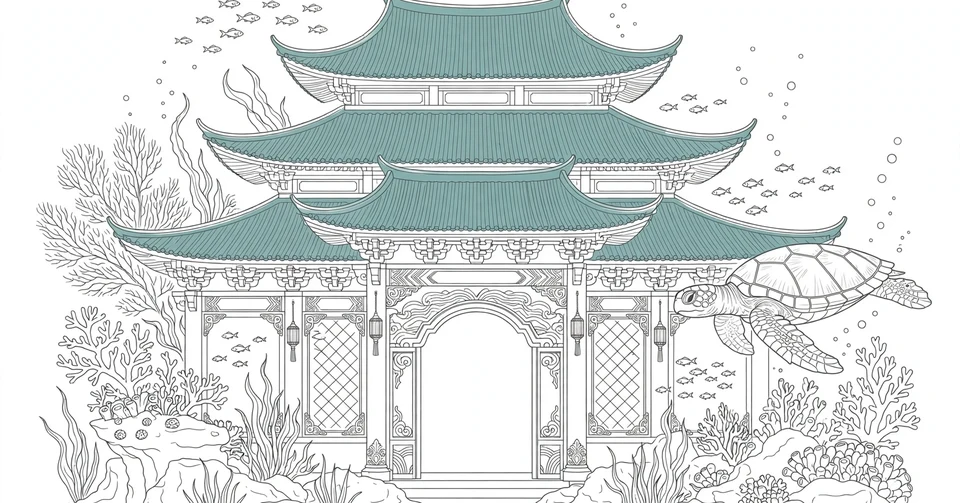
The honest starting point is that Ryugu was never one fixed place with one fixed description. Storytellers rebuilt the palace for centuries, changing its architecture and even arguing, in effect, about whether it stood under the sea at all. What stayed constant was the name, and the feeling attached to it: a beautiful home beneath the waves where a human guest is treated like royalty, and where the clock runs on different rules.
The palace before the fisherman
Ryugu is older than Urashima Taro. In the Kojiki, the chronicle of myths that Japan wrote down in the 8th century, the sea god Watatsumi keeps a palace described as built like the scales of a fish, and later tradition identifies that shining building with Ryugu. In the same old mythology, the prince Hoori travels down to the sea god's palace and returns to land triumphant, and the line of emperors is said to descend from that journey. Long before any fisherman visited, the palace under the sea was already the place where the human world and the ocean world met and negotiated.
Ryujin, its king, is the master of the tides, a dragon who can take human shape when he receives guests. His court is staffed by the creatures of the sea, and his palace is the seat of everything the ocean can give or withhold: storms, calm weather, safe voyages, fish. In the tradition of the Ryukyu islands far to the south, Ryugu has one more duty. It is said to be the source of the fire in every family and village hearth, which makes the dragon king, oddly, a god of the kitchen as well as the deep.
I like that detail. A palace that began as pure otherworld, the sort of place a mortal visits once and never recovers from, kept being given ordinary jobs by the people who told stories about it. Ryugu accumulated duties the way old houses accumulate furniture.
How Urashima Taro reached Ryugu
The tale that fixed Ryugu in the Japanese imagination is a simple one. Urashima Taro, a kind young fisherman, rescues a sea turtle that children are tormenting on the beach. Days later the turtle returns, now able to speak, and offers to carry him to Ryugu as thanks. He climbs onto its back and rides down through the water, breathing as easily as if he were still on land, until the palace appears.
At Ryugu he is received by Otohime herself, the dragon king's daughter, and entertained by attendants in the shape of fish. There are feasts, music and dancing. The palace is so absorbing that time loses its grip on him. In the oldest versions, Urashima believed he had spent three years at Ryugu. In the version most children learn now, he thinks only a few days have passed. The difference hardly matters, because the answer waiting for him on shore is the same either way: centuries have gone. Most tellings put the loss at more than 300 years, and some older ones stretch it to 700. Everyone he knew is long dead, and his village has forgotten his face.
Homesick before he understands the price, he begs to go home for one look. Otohime lets him leave, but she gives him a parting gift with a strict condition: the tamatebako, a beautiful lacquered box that he must never open. Alone in a world that no longer knows him, he opens it anyway. White smoke pours out, and the stolen centuries arrive all at once, turning the young fisherman into an old man in a moment.
It is worth noticing that the villain of this story, if it has one, is Ryugu itself. Nobody deceives Urashima. The palace simply runs at a different speed from the world above, and hospitality, not malice, is what costs him his life. That gentleness is what makes the tale ache a thousand years later.
Coral walls and four seasons at once
Because so many artists and storytellers described Ryugu, the palace has a rich paper architecture. One early English translation gave it walls of coral, trees with emeralds for leaves and rubies for berries. Another version lit its great hall with fish scales. Older Japanese picture books dressed its fish attendants in kimono and let them stroll about the grounds like courtiers.
The most famous detail comes from the medieval otogizoshi versions of the tale. The palace of Ryugu, they said, displayed the four seasons on its four sides at the same time. To the east, cherry blossoms were blooming in spring. To the south, cicadas were buzzing in summer. To the west, maple leaves were turning red in autumn. To the north, the ground lay white with winter snow. A guest only had to walk around the building to pass through a whole year, which is a beautiful idea and also, quietly, the whole story in miniature: inside Ryugu, time is scenery, not a rule.
There is a catch that honest retellings should admit. In the earliest versions, Urashima did not go under the sea at all. He travelled to Horai, the floating island of the immortals borrowed from Chinese legend. Pictures from the Edo period still often show Ryugu standing above the waves, even when the text sends him below them. Only in the modern period did the palace settle firmly on the sea floor, where school textbooks and picture books keep it today. Ryugu spent a long part of its life as a place that was somewhere over the water, not under it.
Ryugu on the modern map
The palace never left Japanese daily life. Travel to Fujisawa in Kanagawa and the station at Katase-Enoshima, the gateway to Enoshima island, is built as a model of Ryugu, with sweeping roofs meant to recall the dragon king's home above the shore it supposedly lies under. Down in Kagoshima, at the southern tip of Kyushu, a Ryugu Shrine stands on Cape Nagasakibana, which is also called Cape Ryugu. Local tradition says this is the point from which Urashima set out, and people there still honour Ryujin and turtles as protectors.
The name also swims. The great oarfish, a ribbon of silver that can grow several metres long and almost never appears near the surface, is called ryugu no tsukai in Japanese, which means the messenger from Ryugu. When one of these fish washes ashore or turns up in a net, it still makes the news as a creature on an errand from the palace. The princess has a modern namesake too. Otohime is the name of the small device fitted in many Japanese toilets, which plays the sound of flushing at the push of a button so nobody has to hear anything else. The dragon king's daughter now stands guard over privacy in public restrooms, which is either a demotion or a very Japanese form of continued employment.
Living in Japan, you run into Ryugu in these small ways constantly: a station roofline, a shrine at a cape, a fish in the news. The palace is not treated as a dead myth. It is treated as a local landmark that happens not to exist.
The asteroid that borrowed the name
In September 2015, the Minor Planet Center made the name official for a dark, spinning top shaped rock about 900 metres across: 162173 Ryugu. The space agency JAXA explained the choice through the tale. Urashima Taro came back from the palace carrying a mysterious box, and the spacecraft Hayabusa2 was being sent to do something very similar: travel to the asteroid named for Ryugu, scoop up material from a world no one had touched, and carry the box home.
Hayabusa2 was launched in December 2014 and reached Ryugu in June 2018. It landed rovers, touched down twice to collect samples, and in December 2020 its capsule parachuted into the Australian outback carrying about 5.4 grams of the asteroid. The story followed the mission onto the rock itself. The surface features of Ryugu are named under a theme of children's stories, and the tale took its share: a crater named Urashima, the ridge around the equator named Ryujin Dorsum after the dragon king, and the largest boulder on the asteroid, a rock well over 100 metres long, named Otohime. JAXA even nicknamed the first sampling site Tamatebako, after the forbidden box. Then the box was opened, in a laboratory, on purpose. In 2023 researchers announced that the samples contained uracil, one of the building blocks of RNA, along with vitamin B3: ingredients for life, delivered from a palace in the sky.
I find the naming unusually honest for a publicity exercise. The scientists were not borrowing glamour from the legend. They were admitting, in public, that the mission was the old story retold with better engineering: go somewhere no time passes the way it should, accept a sealed gift from it, and come home changed by what is inside.
Ryugu began as an address for wonder, a palace that a kind man could visit for three days and pay for with three centuries. It has been a sea god's court, a station roof, a shrine, a fish's business card and a princess's second job. Now it is also a real place, a rubble pile turning slowly in the dark, whose dust sits in Japanese laboratories. The old tale warned that the box should never be opened. The newest chapter suggests something the storytellers perhaps always suspected, which is that we were going to open it anyway, and that the name of the palace was the least of what came back with us.
More in Culture & Society
Latest posts
- Kombu Is the Quiet Half of Dashi
- Manza Onsen Bathes at 1,800 Metres
- Every Prefecture Argues About What Goes in Ozoni
- KRL Commuterline and the Trains That Move Jakarta
- Kecap Manis and the Sweet Soy Sauce of Indonesia
- In Mamoiada, Two Hundred Families Still Make Wine at Home
- Shochu and the Quiet Spirit of Japan
- A Dried Shiitake Is Louder Than a Fresh One
- Loma Linda's Long Lives Run on Saturdays
- Maruten Numazu and the Towering Kakiage Bowl of the Port
- The Three Sisters Grow Better Together
- Tatamiishi Terraces Filter a River Through Stone
- Wasabi-Zuke Puts the Whole Plant in Sake Lees
- Konyoku Is Still Out There, Past the Last Train Station
- Dry January Lasts a Month on Purpose