You Can Read a Pecalang From Across the Street
· 9 min read
A pecalang can be read by his checks: saput poleng cloth, an udeng headcloth, a black vest. Bali's customary village guards serve without pay, keep order at ceremonies and processions, and patrol the island's total silence on Nyepi.
In Bali, authority does not always arrive with a badge or a siren. Sometimes it walks toward you wearing a black and white checked sarong, a neatly folded headcloth, and a black vest, and you can read exactly who he is from across the street. He is a pecalang, the traditional security officer of a Balinese customary village, and inside his own village his word carries the combined weight of custom, community, and religion.
A pecalang is not a policeman, and he is not a private guard hired for the day. He is a villager, chosen by his own village from among its own members, and he serves without a salary. On an ordinary morning a pecalang might be standing in the middle of a junction, waving traffic around a temple ceremony. On the biggest days of the Balinese calendar, he becomes part of the quiet machinery that lets thousands of people parade, pray, and, once a year, fall completely silent.
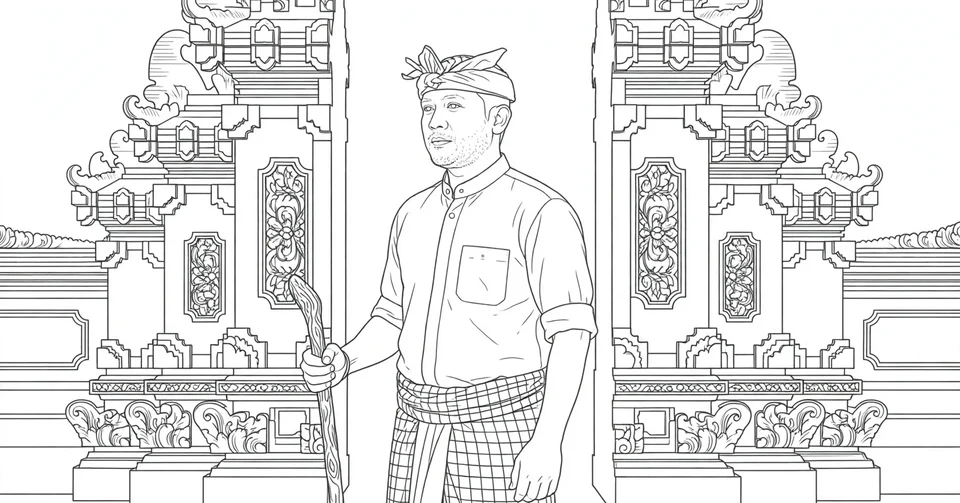
What makes the pecalang remarkable is not really the work. Every community on earth needs someone to hold the crowd back and keep the road open. It is where his authority comes from. A pecalang does not answer to a distant ministry or a police headquarters in the capital. He answers to his village, to the customary law his neighbours wrote for themselves, and the uniform announces all of that before he has said a single word.
A pecalang is the village guarding itself
Bali is organised, at its deepest level, into customary villages called desa adat. Each one governs its own ceremonies, its own temples, and much of its own daily order through written customary rules known as awig-awig. The pecalang are the enforcement arm of that world. A pecalang unit belongs to one village, is drawn from that village's registered members, known as krama, and works only within its home territory.
The name itself sets the job description. Pecalang comes from a Balinese word, celang, meaning sharpness, as in senses kept sharp: eyes, ears, and the intuition that notices a disturbance before it grows. The requirements listed by Indonesia's official tourism portal are concrete. A candidate should be Hindu, live in the area he will guard, be at least 25 years old, be of good character, and have no criminal record. He also needs the blessing of the community itself, given through a village meeting, the paruman, which is where a pecalang is appointed and where he can be dismissed.
And then there is the matter of pay, which is to say there is none. Serving as a pecalang is a form of ngayah, the Balinese practice of sincere voluntary devotion, work offered to the village and to God without expecting material reward. He keeps his ordinary job, his farm, or his shop. When the village calls, for a ceremony, a procession, a patrol, he puts on the checks and goes. I find there is something structurally honest in this. A guard who cannot be fired by an outside boss and is not chasing a wage has exactly one reputation to protect, and it is the one he has among the people he will eat dinner next to for the rest of his life.
The uniform is a summary of the job
Start with the cloth, because everyone in Bali does. The pecalang wears a saput poleng, the black and white checked cloth that is one of the most recognisable textiles on the island. The checks are not decoration. They stand for Rwa Bhineda, the Balinese philosophy of paired opposites: light and dark, joy and sorrow, good and evil held in balance rather than in permanent war. The same checked cloth wraps temple statues and sacred trees all over Bali, and on a pecalang it carries the same message. This man is not here to defeat one side. He is here to hold the balance while the sacred work goes on around him.
Above the cloth sits the udeng, the folded Balinese headcloth, worn by men across the island for ceremony and formal occasions, and the black vest that completes the silhouette. Many pecalang still tuck a keris, the traditional dagger, at the waist, an heirloom object as much as a weapon, and in modern traffic duty you are just as likely to see a handheld radio in the hand and the keris left at home. The details shift a little from village to village, which is fitting for an institution that belongs to each village separately. The overall effect never changes.
It is worth pausing on how deliberate this visibility is. A pecalang is not meant to blend in, undercover work is not in the job description, and the whole point of the outfit is that a stranger, a tourist, a child, or a drunk guest at a wedding can identify the authority in the crowd instantly, without reading a word of Indonesian. Authority you can recognise at fifty metres settles most arguments before they start. The checks do the first round of policing all by themselves.
Ordinary days, and the days that are not
Ask what a pecalang does all year and the honest answer begins with the mundane. Traffic control is the daily bread of the role: Bali's roads are narrow, its ceremonies are frequent, and a temple anniversary can pour hundreds of people, offerings, and gamelan players into a street that was designed for scooters. The pecalang stand at the junctions, hold the scooters back, wave the procession through, and absorb the impatience of everyone delayed. It is unglamorous work, and villages would seize up within a month without it.
Beyond traffic, the pecalang patrol their village, watch over its spaces, and help keep the awig-awig respected. Traditional teaching places them with a pleasing symmetry, guarding the village from posts toward the eight cardinal directions, as if the village were a small cosmos that needed watching from every side at once. In practice it means rounds, presence, and local knowledge: he knows whose son rides too fast, which gate sticks, and which guest house has a party planned.
The extraordinary days test the system at scale. Balinese ceremonies do not do small. A temple festival can run for days. A royal or village cremation can draw a crowd that fills the main road, which is why, when a community finally holds the mass cremation it may have spent years preparing, the pecalang are out in force, keeping the route open for the towering cremation structures and holding the crowd at a respectful distance. Weddings, temple anniversaries, elections, even large conferences held on the island have all borrowed that steady presence. The role that began with guarding ceremonies has quietly become Bali's general purpose answer to the question of who keeps order when the crowd is Balinese at heart.
Nyepi is the longest shift of the year
Once a year, the pecalang's job expands to cover the entire island at once. Nyepi, the Balinese Hindu new year, is a day of total silence. For 24 hours Bali closes down: no driving, no lights, no work, no entertainment, no noise. The airport shuts. The streets empty. An island famous for its energy simply stops, and the only people moving through the darkened villages are the pecalang, patrolling to make sure the silence holds.
The scale is difficult to grasp from outside. It was reported that some 22,000 pecalang were deployed across Bali for the Nyepi celebrations of 2017, one contingent for every customary village, each guarding its own stretch of the quiet. And the rule binds everyone, not just the Hindu majority. Visitors staying in Bali for Nyepi are expected to remain inside their hotels and villas, keep lights low and noise lower, and the pecalang patrols are how that expectation becomes real. A tourist who wanders out for a stroll will be met, politely and firmly, by a man in checks, and escorted back.
There is no real parallel elsewhere in the world: a whole island's stillness, enforced not by the state's police but by tens of thousands of unpaid neighbours in ceremonial dress. I think Nyepi is when the pecalang system explains itself most clearly. The silence is sacred, but sacred things still need guarding, and Bali decided long ago that the guarding should be done by the community itself, in the open, in an outfit nobody can mistake.
Written into law, answerable to the village
For an institution built on custom, the pecalang stand on surprisingly formal ground. Bali's provincial regulations on customary villages have recognised the pecalang for decades, and Bali's 2019 provincial regulation on desa adat kept them written into the structure of the customary village, with the task of maintaining security and order in its territory. The law does not create the pecalang; villages were forming their units through their own meetings long before any regulation caught up. What the law does is acknowledge them, the way a frame acknowledges a painting that was already hanging there.
Their relationship with the formal state is coordination, not subordination. On big days, a pecalang contingent works alongside the Satpol PP, the public order agency, and the Indonesian national police, sharing junctions, radios, and crowd lines. But the chain of command stays separate. Pecalang work in coordination with those agencies while reporting only to their own village leadership, a distinction every Balinese understands instinctively. The police enforce the law of the republic. The pecalang enforce the law of the village. On the days when both are needed, the two systems stand side by side in different uniforms and get on with it.
That dual structure could have produced friction, turf wars, and confusion about who is in charge. In practice it mostly produces something rarer: redundancy with respect. The state gets local knowledge it could never hire, and the village keeps its dignity, guarding its own ceremonies with its own people rather than borrowing authority from outside.
In the end, the reason you can read a pecalang from across the street is that he is meant to be read. The checks are a sentence in a visual language the whole island speaks: order is present, the village is watching over itself, and the balance is being held. Bali has louder symbols, dragons, dances, towers of offerings, but few more reassuring ones. A community that still produces its own guardians, unpaid and unmistakable, has not outsourced the care of itself. It has simply put that care on patrol, in black and white, where everyone can see it.
More in Culture & Society
- Edo's Hikeshi Wore Their Dragons Into the Fire
- Sodoran Treats an Heirloom Like an Honoured Guest
- When the Gara-Gara Starts, the Puppets Drop the Plot
- Forty Pounds of Cowbells, and the Mamuthones Say Nothing
- The Oarfish Still Answers to a Name From the Dragon Palace
- Irezumi Was an Art Before It Was a Warning
Latest posts
- Kagawa Puts the Sweet Part Inside the Mochi
- A Yubatake Cools a Spring With Nothing but Wood and Gravity
- Toji Meant Moving to a Hot Spring Until You Got Better
- Nyuto Onsen Hides Seven Inns at the End of a Snow Road
- A Donko Never Got the Chance to Open
- The Milpa Is a Garden That Thinks Like a Forest
- The Kitamaebune Came Home Loaded With Kelp
- Nobody Just Watches a Panigyria, Everybody Dances
- Ponzu Began With a Fruit Too Bitter to Eat
- Kombu Is the Quiet Half of Dashi
- Manza Onsen Bathes at 1,800 Metres
- The Oshi Kept Fuji's Pilgrims Fed, Housed, and Devout
- Every Prefecture Argues About What Goes in Ozoni
- Japan's Population Decline and the Villages It Leaves Behind
- KRL Commuterline and the Trains That Move Jakarta