Bali Wraps Its Statues in Saput Poleng
· 11 min read
Saput poleng is the black and white checkered cloth wrapped around Bali's guardian statues, sacred trees and temple gates, and its checks carry rwa bhineda, the Balinese teaching that opposites must be held in balance rather than defeated.
Spend a single day travelling around Bali and one pattern will keep finding you. It is tied around the waists of mossy stone guardians at temple gates, wound around the trunks of great banyan trees, and draped over small shrines at crossroads and in front of houses. The cloth is called saput poleng, a black and white checkerboard that might be the most quietly hardworking piece of fabric in Indonesia.
Saput poleng is not decoration, at least not in the places where it matters most. Wrapping a statue or a tree in saput poleng is a public statement that the place is guarded, inhabited and owed respect, and a reminder to everyone passing that some things are not theirs to touch. The name breaks down plainly enough: saput is the wrapping cloth, poleng the checkered pattern.
Yet the checks are also a philosophy you can hold in one hand. Saput poleng states, in wool and cotton, the idea Balinese Hindus call rwa bhineda, and once you understand what the black and white squares are arguing, you start seeing the whole island differently.
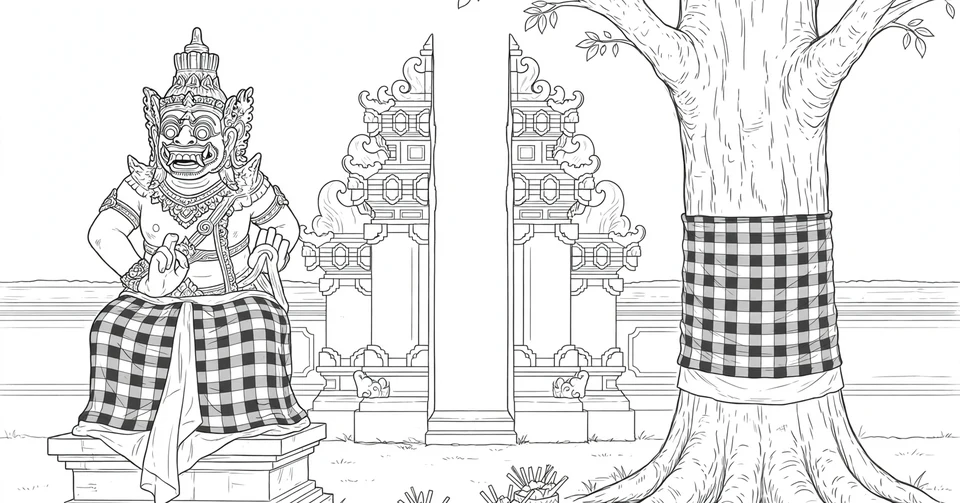
That double role is what makes saput poleng so durable. It is at once a warning sign, a uniform, a prayer and a piece of folk physics about how the world stays upright. Few objects manage to be all four, and fewer still manage it in two colours.
Two colours, and neither is allowed to win
Rwa bhineda is usually translated word by word: rwa means two, and bhineda means different. The teaching built on those two words is that existence comes in inseparable pairs. There is large and small, young and old, day and night, light and dark, good and bad, and neither half of any pair can be removed without breaking the whole. Saput poleng is that teaching woven into cloth, each black square given exactly as much room as each white one.
This is where saput poleng parts company with the way many visitors first read it. The checks are not a scoreboard in a war between good and evil, and the black squares are not losing. Balinese ceremonial life is largely about maintaining the balance between the two sides, and the darker powers are not enemies to be destroyed but forces to be acknowledged, fed with offerings and kept in their proper place. A philosophy that planned to defeat the dark would not bother weaving it into the island's most sacred cloth in equal measure.
Look closely at a length of saput poleng and the argument gets subtler still. The cloth is not purely black and white. Where the black and white threads cross in the weaving, grey appears, so a careful look finds several shades rather than two. Balinese writers make much of this, and it is the part of saput poleng I find most honest. Between the good square and the bad square sits the grey one, which is where nearly all of actual life gets lived. The cloth admits, in its own weave, that purity is rare and mixture is normal.
The pairs do not stop at the visible. Balinese thought divides reality into sekala, the tangible world you can touch, and niskala, the intangible one you cannot, and holds that the second is every bit as real as the first. A checkered wrap is one of the places where the two worlds are tied together, literally: a physical knot fastening physical cloth around a physical tree, addressed to an inhabitant no camera will ever record. That is why the cloth can look, to Balinese eyes, less like decoration than like an envelope, something sealed and delivered to an address in the unseen.
It is often through saput poleng that Balinese children first meet these ideas in concrete form, long before anyone explains rwa bhineda as a doctrine. Good and bad, bitter and sweet, day and night: the pairs are hanging on the tree at the end of the street. A teaching that a child can point at tends to outlast one that lives only in books, and saput poleng has been hanging in public view for a very long time.
What the checks of saput poleng are saying
When saput poleng is wrapped around an object, it is making a claim about that object. A tree or a statue dressed in saput poleng is understood to be a stana, a dwelling place, home to a guardian presence with real power. One widely read essay on the cloth calls poleng a kind of magic, a barrier around objects that hold a strong mystical charge. The wrap both honours what lives there and warns the rest of us to behave accordingly.
The same logic runs at household scale. In the Sawidji gallery's rembug discussion of the checkered cloth, Balinese contributors explain that the small altar at the front of a house wears the checks because it stands guard at the entrance, judging the positive and negative energy that tries to come in. The threshold of a family compound gets the same treatment as the gate of a great temple. Scale changes; the job description does not.
That is why the statues chosen for saput poleng are so often the ones already on duty. The dwarapala guardians who flank temple gates, the figures standing watch on bridges and at crossroads, the small shrines that guard the front of a house: these are the island's border staff, judging what may pass and what may not. Dressing them in saput poleng is like issuing a uniform to a guard who was already at his post. Even the kulkul, the wooden slit drum whose voice summons the village, may be wrapped in the checks.
Trees receive saput poleng for the same reason, and here the cloth does its most practical work. A great banyan or pule tree wound in saput poleng is considered tenget, charged and not to be trifled with, and in practice that belief protects it better than any fence. Nobody dares cut down a tree that wears the checks. Even tending such a tree properly calls for ceremony, with permission sought from the priest and the village elders first. The famous old pule tree of Pengosekan in Ubud stands under exactly this kind of protection.
There is a pleasing honesty in the arrangement. Saput poleng itself is fragile stuff, ordinary cloth that fades, mildews and tears in the tropical weather, and wrapped trees get fresh cloth as the old one rots away. The material is weak and the protection is absolute, because the strength was never in the fabric. Twice a year the island also pauses for Tumpek Uduh, the ceremony that thanks trees, fruiting trees especially, for everything they give. Saput poleng is the daily, visible half of that gratitude.
The people who wear the checks
Saput poleng is not only wrapped around things. It is also worn, and the people entitled to wear it tell you what the cloth is for. The most familiar wearers are the pecalang, the traditional security officers of the Balinese customary village. On duty at ceremonies and village events, a pecalang in his checked saput poleng is instantly readable: this is the man keeping order, guarding the proceedings, standing between the sacred and the crowd. The uniform works because the whole community has already learned the pattern's meaning from the statues and the trees.
You meet them most often standing in the middle of things: in temple anniversary crowds, beside cremation processions crossing main roads, at the edge of ceremonies where traffic, tourists and ritual all want the same few metres of street. The checks make a pecalang findable in a crowd and, just as usefully, make his authority legible without a word being exchanged. A raised hand from a man in that cloth settles arguments that a stranger's raised hand would only start.
Balinese tradition treats that uniform as an old obligation rather than a modern invention. The Lontar Purwadigama, an old palm leaf text on customary order, already sets the pecalang apart by his dress, checked cloth included. The reasoning woven into the outfit is neat: a man charged with keeping the peace should wear the balance he is meant to keep, and be reminded of it every time he ties the cloth on. Order, in this view, is not the victory of one side over another. It is the two sides held level, which is precisely what saput poleng pictures.
The other famous wearers of saput poleng work the puppet stage. The dalang, the puppeteer, may wear the checks, and so do the performers who play the punakawan, the clown servants of the wayang. Above all there is Twalen, the fat old servant of Balinese wayang kulit, who is never seen without his poleng cloth. As I wrote in the article on Twalen, Bali's own counterpart of Java's Semar, older Balinese scholarship treated the poleng girdle as a prerogative of exceptional persons, a sign of supernatural power in the wearer. The joke hidden in the costume is the same joke hidden in Twalen himself, and in Semar across the strait in Java: the servant dressed in the island's most sacred pattern turns out to be a god in disguise. Saput poleng gives the secret away to anyone who knows how to read cloth.
An old pattern on a changing island
Nobody can date saput poleng exactly, and honest accounts admit the uncertainty. The pattern is at least as old as the Majapahit era, the Javanese Hindu civilisation whose influence shaped Bali from the late thirteenth century onward, and it may be older still, an animist practice that the newer religion absorbed rather than replaced. What is certain is that saput poleng was never a souvenir. It was a working part of the island's religious machinery long before there were visitors to explain it to.
Making it properly was slow work. Woven by hand in the traditional way, a metre of the cloth could take a month, the checks built thread by thread so that the black, the white and the accidental greys all land where they should. Most saput poleng seen today is printed or machine woven, and the pattern has spread far beyond its sacred posts. You will find the checks on table runners, hotel staff uniforms, restaurant walls and scooter seats, an island identity you can buy by the metre.
Nor is the pattern confined to objects and officials. At temple ceremonies you will see the checks on the dress of worshippers too, sashes and wraps worn into the temple courts, so that on a festival day the crowd itself seems to flicker black and white between the offerings. The cloth moves through every register of Balinese life, from the god's statue to the guard's waist to the grandmother's sash, and it means something slightly different, and entirely consistent, at each stop.
That spread raises an obvious question: does saput poleng lose its meaning when it becomes a style? Sitting with the question for a while, I have come to think the answer is mostly no, because the cloth's meaning was never stored in the pattern alone. It lives in the placement. Saput poleng on a café cushion is a picture of an idea. Saput poleng tied around a statue by a priest, renewed as it weathers, in a place where grandmothers still lower their voices, is the idea itself at work. Context is the whole grammar of the thing, and Bali still supplies the context every few metres.
If anything, the decorative copies may serve the original. A visitor who has seen the checks on a menu already half recognises them on the tree, and half recognition is often enough to produce the pause the cloth was asking for.
Reading the cloth as you pass
Saput poleng asks very little of strangers. It does not demand belief, donations or participation. It asks only that you register the signal: this statue is on duty, this tree is somebody's responsibility and somebody's dwelling, this gate is a threshold and not a photo prop to climb on. In an island that receives millions of guests, a message that clear, delivered without a word of any language, is a small masterpiece of communication.
That, in the end, is why I admire saput poleng more the longer I live with it in photographs and stories from the island. It trusts a piece of cloth to do the work of fences, signboards and sermons, and the cloth does it, not because the fabric is strong but because a whole society agreed on what it means and kept the agreement. Black and white, given equal room, neither winning: there are worse constitutions to wrap around a community.
More in Culture & Society
- When the Gara-Gara Starts, the Puppets Drop the Plot
- Forty Pounds of Cowbells, and the Mamuthones Say Nothing
- The Oarfish Still Answers to a Name From the Dragon Palace
- Irezumi Was an Art Before It Was a Warning
- The Oshi Kept Fuji's Pilgrims Fed, Housed, and Devout
- Japan's Population Decline and the Villages It Leaves Behind
Latest posts
- Nyuto Onsen Hides Seven Inns at the End of a Snow Road
- A Donko Never Got the Chance to Open
- The Milpa Is a Garden That Thinks Like a Forest
- The Kitamaebune Came Home Loaded With Kelp
- Nobody Just Watches a Panigyria, Everybody Dances
- Ponzu Began With a Fruit Too Bitter to Eat
- Kombu Is the Quiet Half of Dashi
- Manza Onsen Bathes at 1,800 Metres
- Every Prefecture Argues About What Goes in Ozoni
- KRL Commuterline and the Trains That Move Jakarta
- Kecap Manis and the Sweet Soy Sauce of Indonesia
- In Mamoiada, Two Hundred Families Still Make Wine at Home
- Shochu and the Quiet Spirit of Japan
- A Dried Shiitake Is Louder Than a Fresh One
- Loma Linda's Long Lives Run on Saturdays